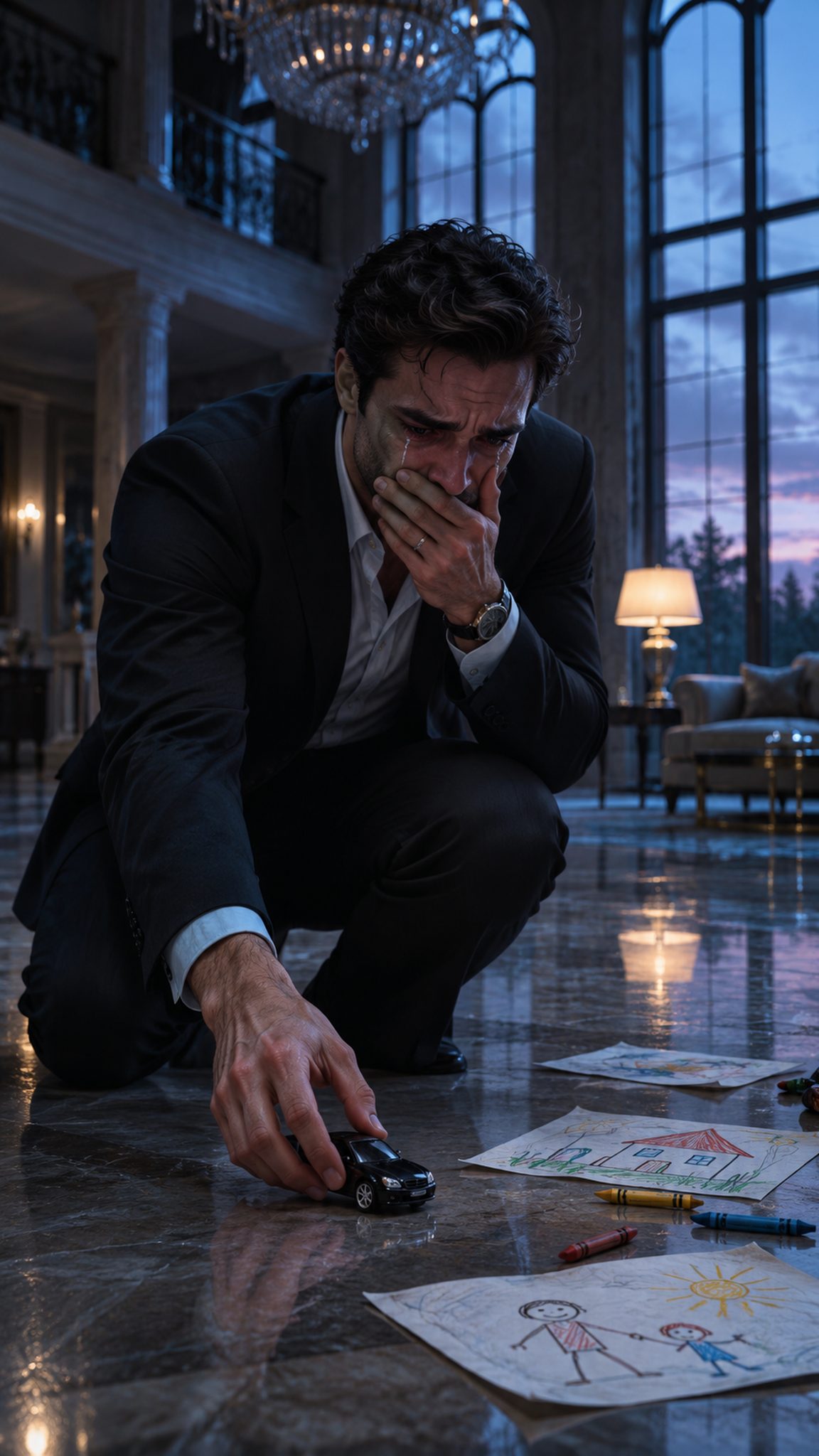
At 6:12 P.M., three days after surviving an ambush, I returned to my Chicago mansion and found a silence so complete it seemed to have swallowed the house.
I had expected Elena to be in the kitchen. I had expected Lucas to come running from the living room, his small shoes striking the marble floor, his voice announcing that I was late before he threw his arms around my waist. I had expected the ordinary sounds I had spent years treating as background noise: a television playing softly, a cabinet closing, Elena asking whether I had eaten.
Instead, the front door opened onto an empty hallway.
“Elena?”
My voice traveled through the mansion and came back unanswered.
I stood inside with one hand still on the door. My security men remained outside, waiting for instructions. The house was immaculate. The lamps were on. The flowers Elena liked stood in a crystal vase. Nothing looked damaged or disturbed.
But something was wrong.
I went upstairs first. Elena's closet was empty. The dresses she wore to dinners, the coat she kept by the door, the shoes she lined up with careful precision—all gone. Her drawers had been cleared. The bathroom shelf where she kept her perfume and small bottles was bare.
Lucas's room was worse.
His little jackets had disappeared from the hooks. His favorite books were gone. The blue blanket he dragged around when he was tired was missing from the bed. Even the framed drawing he had once insisted I display on his shelf had been taken.
I walked back into the living room. A black toy car sat alone on the pale floor.
I knew that car. Lucas carried it everywhere. He pushed it along the hallway while making engine noises, parked it beside his dinner plate, and sometimes fell asleep with it clutched in his fist.
I crouched.
Beneath it, in a child's uneven handwriting, were four words:
“So Daddy isn't alone.”
For several seconds, I did not move.
I read the sentence again, as though the words might rearrange themselves into something harmless. A joke. A game. A message from a child who expected me to find him hiding behind a curtain.
There was no hiding place. There was no laughter from upstairs. There was only the black car and the note beneath it.
I called Elena. The call went unanswered.
I called again.
Then I called my head of security and demanded to know how my wife and son had left the property without anyone informing me. He told me the cameras showed nothing useful. The relevant footage had been erased. The guards on duty claimed they had seen no departure, no suspicious vehicle, no confrontation.
I did not believe them. I did not believe the cameras. I did not believe the silence.
I went to Lucas's bedroom and searched it myself. Under his bed, pushed far back against the wall, I found a box. Inside were drawings, folded sheets of paper, and pictures made with colored pencils and blunt crayons.
I sat on the edge of his bed and began looking through them.
There was our house with three people standing in front of it. There was Elena holding my hand while Lucas stood between us. There was a birthday cake with six candles, a black car that looked like the one downstairs, and a picture of me wearing a crown that made my head look enormous.
In every drawing, Lucas had placed himself beside me.
The final picture was different.
Only Lucas and Elena stood beneath a yellow sun. Their hands were joined. The space beside them, where I had appeared in every earlier picture, was empty.
At the bottom, in careful letters, he had written two words.
“Dad's busy.”
I held the paper until its edges bent beneath my fingers.
I was Adrian Moretti. Men in Chicago lowered their voices when they said my name. I had built an empire by recognizing danger before it reached my door, by making decisions other men were too frightened to make, and by never allowing anyone to see uncertainty in my face.
Yet I had failed to notice my wife packing a life into boxes. I had failed to notice my son learning how to draw a family without me.
To understand how my house became empty, I have to go back to the years when I believed it could never happen.
My name is Adrian Moretti, and people called me the most feared mafia boss in Chicago. I controlled businesses that appeared legitimate, operations that were not, and men who understood that loyalty was not something I requested twice. I could buy information, punish betrayal, and make dangerous men disappear from the streets.
Power had made me confident. It had also made me careless.
Elena had known me before the tailored suits, before the private security, before men waited outside restaurants to see whether I would arrive. She had loved me when I was still building my position and had very little to offer except ambition and promises.
She never asked me to become a different man overnight. She asked me to come home. She asked me to sit at the table. She asked me to remember the small things that made a family feel like a family.
I mistook her patience for permanence.
Our son, Lucas, was six. He had my dark eyes and the same stubborn set to his jaw. When he frowned, I saw myself in miniature. It should have pleased me. Sometimes, instead, it irritated me to see how eagerly he waited by the window every evening for a father who rarely came home.
He never demanded expensive toys. He never asked for a bodyguard or a bigger bedroom. He wanted me to read the same story twice. He wanted me to watch him build a tower from wooden blocks. He wanted me to be there when he looked up and called, “Dad.”
Elena tried to make those moments happen. She kept dinner warm when I said I might come home. She left the hallway light on when meetings ran late. She told Lucas I was working, even when the truth was that I had chosen another room, another meeting, or another person over the people waiting for me.
Once, Lucas fell asleep on the living-room rug holding a drawing of the three of us. He had used bright colors and drawn our hands linked beneath a crooked blue sky. Across the top, in large letters, he had written, “My family.”
I came in after midnight. Elena was sitting nearby, exhausted, with a blanket over her knees. She showed me the drawing and told me Lucas had waited for me to see it.
I glanced at it for a few seconds.
“That's nice,” I said.
My phone rang before I could say anything else. Serena's name appeared on the screen.
I answered.
Serena was the mistress I kept simply because I could. She was beautiful, polished, and accustomed to getting what she wanted. She liked expensive restaurants, private rooms, and the attention that came from being seen beside a powerful man. I never promised her a future. I never asked her to understand my family. I kept her separate from the life Elena and Lucas were trying to build.
At least, that was what I told myself.
I walked away to take the call. When I returned, Elena had carried Lucas upstairs. The drawing remained on the table.
The next morning, Lucas found me in the kitchen.
“Did you like my picture, Dad?”
I looked at him.
“What picture?”
His smile faded. He glanced toward the table, then back at me.
“The one I made. The one with us.”
For a moment, I tried to remember. I could recall the phone call, Serena's voice, and the details of a business problem she had asked me about. I could not recall the drawing clearly enough to describe it.
“I saw it,” I said.
“You did?”
“Yes.”
“Did you like it?”
I should have put down my coffee. I should have crouched to his height and told him that I loved it, that I loved the three people in it, that I would keep it somewhere important.
Instead, I checked the time.
“Of course I liked it, Lucas.”
He nodded, but he did not look convinced. Elena stood at the counter, watching me. She said nothing. Her silence should have warned me. I treated it as another disagreement I could postpone.
Lucas's birthday should have changed me.
He had been talking about it for weeks. Elena planned a small celebration at home, with a cake Lucas chose himself and decorations he wanted to help hang. He asked me more than once whether I would be there when the candles were lit.
“I'll be home before you blow out the candles,” I promised.
He believed me.
That evening, a business associate invited me to a party. Serena was going, and there were people there whose attention I considered useful. I told myself I would stay for a short time. I told myself a six-year-old would understand if his father arrived late.
I did not go home.
Lucas sat in a tiny suit beside his cake. Elena later told me he refused to make his wish without me. The candles burned down while the guests waited. He kept looking toward the entrance.
I was with Serena.
A photograph from that night eventually reached my family. In it, I was fastening a diamond necklace around Serena's neck. The room behind us glittered with expensive light. Serena was smiling at the camera, and my hand rested near the clasp as though the gesture meant something.
Lucas saw the photograph.
He did not shout. He did not throw anything. He looked at Elena and quietly asked, “Why does Dad always choose her?”
Elena told me about that question later. At the time, I dismissed it as a child's confusion. I said Lucas did not understand adult relationships. I said Serena was not important. I said the photograph meant nothing.
I did not ask what it had meant to my son.
A few days later, I brought Serena into our home.
I had business on my mind and no patience for anyone questioning my decisions. Serena was with me when we entered. She looked around the foyer as if she were inspecting a property she might one day own. I did not consider what it would feel like for Elena to see her standing in the place where our family lived.
Elena came into the hallway. Her face changed when she saw Serena.
She did not raise her voice. She did not make a scene. She looked at me first, then at the woman beside me, and finally toward the staircase.
“Do whatever you want outside,” she whispered. “Just don't bring her here in front of our son.”
Her words were quiet, but they struck at the one thing I did not want challenged: my right to decide what happened under my roof.
I was already furious over business. A rival had interfered with one of my operations, two men had failed to deliver what they promised, and I had spent the afternoon dealing with consequences. Elena's request felt like one more person telling me what I could and could not do.
“Don't use the boy to control me,” I snapped.
The words came out harder than I intended. Serena went still beside me.
Then I noticed Lucas.
He was standing on the staircase, one hand wrapped around the railing. He had heard me. His small face was turned toward us, and his eyes moved from me to Elena.
No one spoke.
I could have taken back the words. I could have told him that his mother was not trying to control me, that he had done nothing wrong, that the argument was between adults and had nothing to do with him.
Instead, I stood there.
Elena looked at Lucas and then at me. Her expression was not anger. Anger would have been easier. It was the exhausted look of someone who had finally stopped expecting an apology.
She guided Lucas upstairs.
Serena asked whether she should leave. I told her it was fine. I said Elena was being dramatic. I said I would deal with it later.
Later had become my answer to everything.
That night, after Serena had gone and the house had settled, I passed Lucas's bedroom. The door was partly open. A small lamp cast a warm circle across his bed.
I heard him ask Elena a question.
“Mom?”
“I'm here, sweetheart.”
“Did I do something bad?”
My steps stopped.
“No, baby. You didn't do anything bad.”
“Then why is Dad mad?”
Elena's answer came after a pause. “Your father is dealing with grown-up problems.”
Lucas was quiet for a moment.
“If I was a better boy,” he asked, “would Dad come home more often?”
I stood in the hallway, one hand near the doorframe.
Elena did not answer immediately. I heard the mattress shift, then the soft sound of her drawing him close.
“You are already a wonderful boy,” she whispered. “You don't have to change anything to deserve love.”
I should have entered the room.
I should have told him that he was right to want me home, that no birthday or drawing or promise should have made him feel he had to earn his father's attention. I should have told Elena that I had heard every word and that I was sorry.
But I did not want to face what I had done. I told myself I would speak to him in the morning. I told myself there would be another chance.
I walked away.
I did not know that question was the moment Elena decided to leave me.
For weeks, she prepared quietly. I noticed small changes but never put them together. A folder disappeared from the study. Some papers were no longer in the drawer where I expected them. Elena made appointments for Lucas and took him herself. She closed accounts, moved documents, and began removing their belongings piece by piece.
When I asked why she needed to go out, she gave ordinary answers. When I asked about the boxes, she said she was organizing things. I accepted every explanation because I was too busy fighting rivals to examine my own home.
My men reported threats from the west side. A shipment had been delayed. Someone had been speaking to people who should have known better than to answer. I spent long hours in the office, took calls during dinner, and left before Lucas woke.
Sometimes I saw him at the top of the stairs. Sometimes he was waiting by the window. I began to recognize that he no longer ran toward me every time I entered, but I blamed his mood, his age, or Elena's influence.
I never asked him.
The house was still standing. My business was still moving. My guards were still at their posts. I believed those facts meant I was in control.
Then came the ambush.
It happened three days before I returned at 6:12 P.M. Men attacked the armored convoy on a road I had used dozens of times. The first impact threw me against the side of the vehicle. Glass burst. Shouts filled the cabin. My security team returned fire while the driver fought to keep the SUV moving.
I was bleeding in the back seat, pressing a hand against my side, and trying to understand how the attackers had known our route. My men were shouting into their radios. Someone told me to stay down.
I reached for my phone.
The first person I called was not Serena.
It was Elena.
The call rang. Once. Twice. Again.
She did not answer.
I tried a second time. Then a third.
I told myself she might be driving. I told myself she might have Lucas with her. I told myself she would call when she saw the missed calls.
The SUV carried me away from the ambush. My men got me medical attention and locked down the property. I survived. The people responsible would be dealt with. I had men searching for the leak and others tracing the attackers.
For three days, I focused on the threat to my life.
I did not ask why Elena had not called back.
I did not ask whether Lucas knew I had been hurt.
I assumed they were at home, waiting for me to recover, as they had waited through every other absence.
At 6:12 P.M. on the third day, I returned to the mansion.
And found the empty house.
Now, sitting on the edge of my son's bed with his drawings spread across my knees, I finally understood that the silence had not begun when I opened the front door. It had begun much earlier, in every unanswered question I had ignored, every promise I had broken, every time Lucas had waited for me and every time Elena had asked me to look at what was happening to our family.
The black toy car was downstairs. The note was beneath it. The final drawing was in my hands.
“Dad's busy.”
I read those words until they stopped looking like handwriting and became an accusation I could not escape.
I called Elena again. No answer.
I called every number I had for her. I ordered my security chief to find the erased footage and identify everyone who had been near the house. I told my men to search the city, then the roads beyond it. I wanted names, locations, records, anything that could tell me where my wife and son had gone.
My orders came out cold and precise. That was how I had survived for years. But when the calls ended and the men began moving, I remained in Lucas's room, holding a picture of a family that no longer existed in the way he had drawn it.
I had thought the most frightening thing in my world was an enemy who knew where I lived.
I had been wrong.
The worst thing was discovering that the two people I had expected to find waiting for me had spent weeks learning how to live without me—and that my little boy had found a way to say goodbye without asking me to listen.
I looked once more at the empty space beside Elena in the final drawing.
For the first time, I could not tell myself I would fix it tomorrow.