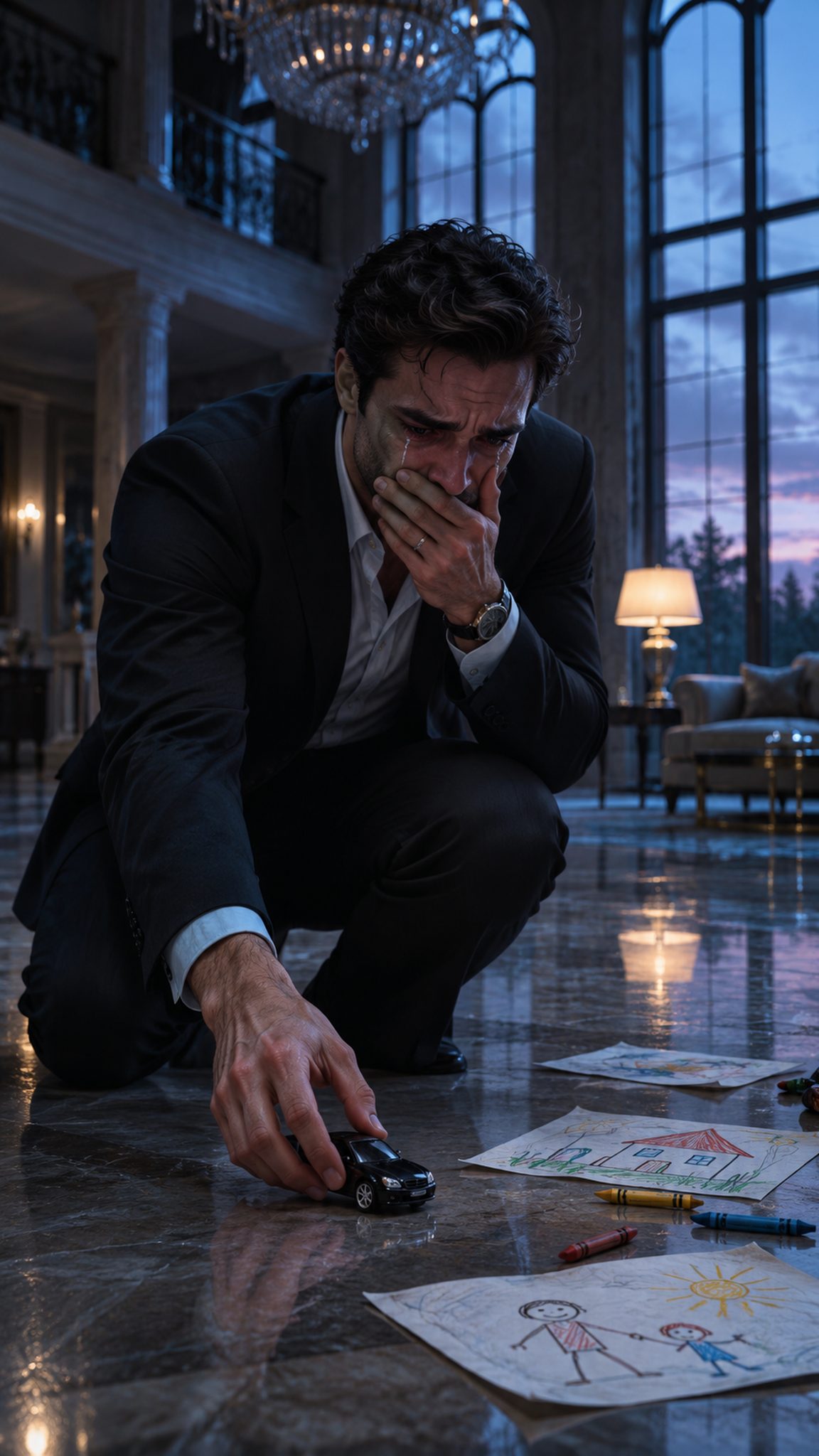
By midnight, the mansion had become a command center.
Men who usually waited for me to speak were moving through the halls with phones pressed to their ears. My security chief, Victor Hale, stood in the study while two technicians worked at the surveillance console. I had ordered every camera reviewed, every vehicle checked, every employee questioned. The search began inside the property because I could not accept that Elena and Lucas had simply walked out of my life.
“Start with the front gate,” I said.
Victor nodded. “We have.”
“Then start again.”
The footage from the front gate showed an ordinary afternoon, then an ordinary evening, then a gap. The same gap appeared on the service entrance cameras, the garage cameras, and the cameras covering the driveway. It was not a power failure. The systems had been accessed and their records erased.
“Who had the authority?” I asked.
“Your access. Mine. The systems administrator.”
“Bring him here.”
The administrator arrived twenty minutes later, pale and sweating. He insisted that he had not touched the recordings. He had been off-site during the period in question, and his credentials had not been used from his usual terminal. Someone had entered the system with knowledge of its architecture and removed the relevant files without leaving an obvious trace.
I stared at the blank timeline.
“Recover it.”
“We're trying.”
“Don't tell me what you're trying to do. Tell me what you can do.”
He swallowed. “The deletion was deliberate. We may be able to recover fragments, but I can't promise—”
“Then don't promise. Work.”
I sent him back to the console. Victor remained where he was.
“What about the guards?” I asked.
“They've all been interviewed. No one remembers Elena leaving with Lucas. No one saw a vehicle they couldn't identify. No one reports an argument or an unusual visitor.”
“Then they weren't watching.”
“They say they were.”
“People say many things when they want to keep their jobs.”
I had employed those guards because I trusted them to protect my home. They knew the entrances, the schedules, and the faces that belonged on the property. Yet Elena had apparently moved our son's life out of the mansion while they stood at their posts. Either they had been careless, or someone had made certain they saw nothing.
I ordered Victor to suspend the entire household security rotation and put a separate team on the search. Nobody was to leave without being questioned. Nobody was to contact Elena or her relatives without reporting it to me. I wanted the names of every driver, delivery worker, maintenance employee, and visitor who had entered the property during the previous month.
Then I called my network.
I began with the people who could find a person in Chicago before that person knew anyone was looking. I called men who owed me favors, men who feared me, and men who had spent years collecting information in places the police rarely entered. I gave them Elena's name, her description, Lucas's age, and every possible destination I could imagine.
I asked them to check airports, private terminals, hotels, rental properties, medical offices, and addresses connected to anyone Elena knew. I asked them to look for a car registered under another name, a payment made in cash, a new account, a familiar face captured on a camera.
By morning, I had dozens of people searching.
By the second day, I had nothing.
One contact found an old address belonging to a distant acquaintance of Elena's. Another checked a property outside the city. A third traced a vehicle that had once been used by one of our household drivers. None of the leads connected to her. Every trail ended in ordinary transactions, old information, or a person who had not seen Elena in months.
My network could find men who did not want to be found. It could trace shipments through false companies and identify a rival's informant from a single conversation. It could not tell me where my wife had taken our son.
That was the first time I understood that Elena had not left in a panic.
A frightened person made mistakes. A frightened person called someone, used a familiar account, or went somewhere predictable. Elena had done none of those things. She had prepared, and she had prepared carefully.
I returned to the study and began looking through the documents she had left behind. The drawers were not empty, but they were arranged differently. The folders I expected to find were missing. Some of the files had been replaced with copies that contained nothing useful. The safe held what I had always kept there, but the small envelope where Elena stored family documents was gone.
Victor brought me a list of accounts.
“Several joint accounts were closed,” he said. “Others were transferred or emptied before the departure. The dates go back weeks.”
“Weeks?”
“Yes.”
“Why didn't anyone tell me?”
“No one knew the changes were connected. The requests were legitimate. Your wife had authority on those accounts.”
I looked at the dates. One closure had happened while I was negotiating with a rival over a disputed business arrangement. Another had taken place on a day when two of my men were injured in an attack. A third had been completed during a week when I was moving between meetings and barely came home.
I had signed the household authorizations without reading every line. Elena had not needed to steal anything. She had used the rights I had given her and the space I had left unattended.
The documents were not the only evidence. Appointment reminders had been removed from the family calendar. Lucas's usual routines had changed. Elena had been taking him to appointments without telling me where they were, or perhaps she had told me and I had failed to remember.
I searched my messages. There were short notes from her about times, forms, and things she needed me to sign. Some I had answered with a single word. Others had no reply at all.
One message read: “Lucas has an appointment Thursday. Can you come if you're free?”
I had responded: “Can't. Send me the details.”
There were no details after that. I had not asked again.
Another message asked me to look over a document she had left in the study. I remembered seeing it beneath a stack of business reports. I had moved it aside because a call was coming in.
I began to understand how she had done it. She had not emptied the closets in one night. She had taken a coat, then a box of books, then a few toys. She had moved documents, closed accounts, and carried ordinary belongings out in stages. She had taken Lucas to appointments while I was occupied with rivals. She had built an exit so quietly that the people guarding my mansion had not recognized it as an escape.
And I had helped her by never looking.
The thought made me angrier than the erased footage. I wanted someone to blame, someone I could put in a room and force to explain how my wife had managed to disappear. But each new report pointed back to the same fact: Elena had not needed an accomplice inside my house. She had needed time, patience, and a husband who was rarely present.
I had given her all three.
My recovery from the ambush was slower than I allowed anyone to see. The injuries were serious enough to keep me under medical supervision, but I refused to let the doctors dictate my schedule. I wanted to return to the office, direct the search, and make the people responsible for the attack regret it.
My men told me to rest. I told them to find Elena.
The ambush investigation continued in parallel. We identified the route the attackers had used and the point where the convoy had been exposed. I ordered a review of the information available to anyone who knew my movements. I questioned the people responsible for schedules and transport. The possibility of a leak remained open, and I treated it as an immediate threat.
But every time a report came in, I asked the same question.
“Have you found my wife?”
The answer was always no.
I was still recovering when I went back to the mansion. I walked through rooms that seemed larger without Elena's things in them. The kitchen looked staged. Lucas's bedroom looked like a room prepared for a child who would never return. The house staff had begun to speak in whispers. They stopped when I entered, which made me suspect they knew more than they admitted.
I questioned them again. The housekeeper said Elena had been calm. The driver said he had not taken her anywhere unusual. The cook remembered Lucas asking for a particular breakfast but could not remember when. Each person offered fragments, and none offered the answer I needed.
I had the staff's phones reviewed and their schedules checked. I found no evidence that anyone had helped Elena. I found no evidence that anyone had betrayed me. I found only the quiet trail of ordinary days in which my family had been preparing to leave.
The weeks passed.
I kept the search active, but the urgency changed shape. At first, every hour had felt like a direct threat. Then days became weeks, and the leads grew colder. I stopped sleeping in the master bedroom. I spent nights in my study, surrounded by screens and reports. I had men check the same locations more than once because I could not accept that the first search had found nothing.
Sometimes I drove through neighborhoods where Elena had once liked to shop. I watched families crossing streets and children leaving school with their parents. I found myself looking at every dark-haired boy around Lucas's height.
I did not approach them. I only watched until they disappeared into a car or a doorway, then drove away.
I told myself Elena was keeping Lucas hidden because she feared my world. That explanation was convenient. It made her decision sound like a reaction to danger rather than a judgment of me. It allowed me to believe that if I removed the danger, she would come back.
But she had left before the ambush. The empty closets, the closed accounts, the missing documents, and the erased footage all proved it. The attack had not driven her away. It had merely happened after she had already decided she could no longer stay.
I could not make myself accept that distinction.
Serena called several times during those weeks. I answered some calls and ignored others. She asked when I would see her. She asked whether the search was affecting my business. Once, she suggested that Elena might return when she realized how difficult life would be without my protection.
I told her not to speak about Elena.
Serena fell silent, then changed the subject. She had never understood why I kept her separate from my family. She understood even less why I was suddenly spending every available hour looking for the woman I had treated as though she would always be waiting.
I did not explain it. I did not know how.
Months passed before the next message arrived.
It came through my office, delivered by courier in a plain envelope. The sender was an attorney whose name I did not recognize. The envelope was addressed to me personally, not to one of my companies. Victor brought it into the study and placed it on my desk.
“Do you know this firm?” he asked.
“No.”
He waited while I opened it.
The first pages were divorce papers.
For several seconds, I could not make sense of the words. I read Elena's name, then mine, then the formal language describing the dissolution of our marriage. I looked for a handwritten note, an explanation, anything that might tell me this was a threat or a mistake.
There was nothing.
The attorney's cover letter stated that Elena had retained counsel and that all further communication should be directed through the firm. It asked that I respect her privacy and refrain from attempting direct contact. The language was measured and professional. It was also final.
I read the letter twice.
“She filed?” Victor asked.
I placed the papers on the desk.
“Find out where the attorney is based.”
“I can do that.”
“And find out where Elena signed.”
Victor nodded, but I stopped him before he reached the door.
“No threats. No pressure. I want information.”
He left.
Beneath the divorce papers was a small storage device and a sealed packet of medical records. The attorney's letter identified them as documents concerning Lucas. I opened the packet first.
The first page carried my son's full name.
LUCAS MORETTI.
Below it were dates, clinical notes, test results, and specialist referrals. I recognized some of the dates from the messages Elena had sent me. Others were unfamiliar. There were appointment records stretching back months, each one connected to a medical office or specialist.
I turned the pages slowly.
Lucas had a congenital heart condition.
I read the sentence again. Then I read the medical explanation beneath it. The words were technical, but their meaning was clear enough: his heart had a condition he had been born with, and doctors had been monitoring it. Further evaluation was required. Depending on the findings and how his condition progressed, surgery might be necessary.
Possible surgery.
My hand tightened around the paper.
I had known Lucas sometimes became tired. I had seen him pause after running around the garden. Elena had once asked me to let him rest rather than encourage him to keep playing. I had thought she was being cautious. I had never imagined that those small moments might be connected to something serious.
The records contained the names of specialists and the dates of consultations. There were tests I had never heard about, follow-up appointments I had never attended, and notes describing discussions about treatment options. Some pages carried Elena's signature. Others showed the names of doctors who had examined our son.
There were dozens of entries.
I looked for my name.
It appeared on forms where a parent or guardian had been listed, but there were no signatures from me on the later records. The documents showed that Elena had been handling the appointments, receiving information, and making arrangements while I was elsewhere.
I opened the storage device.
A video file appeared on the screen. The filename contained Lucas's birthday date.
I pressed play.
The image showed our living room decorated for his birthday. The cake stood on the table. The candles were lit. Lucas sat in his tiny suit, his hands folded in front of him. Elena was beside him, trying to smile for the camera.
There was an empty chair.
My chair.
Lucas looked toward the entrance several times. Someone behind the camera asked him to make a wish. He shook his head.
“I'm waiting for Dad,” he said.
I stopped breathing for a moment.
The recording continued. Elena leaned closer and spoke gently to him. She told him we could take another picture later. Lucas looked at the candles.
“He said he'd come before,” he replied.
Elena's smile trembled. She looked toward the camera, then back at our son.
“Maybe we can call him.”
Lucas shook his head again. “He's busy.”
I had heard those words in his drawing. Seeing him say them was worse.
The video showed him sitting quietly while the candles burned lower. He did not cry. He did not throw a tantrum. He waited with the patience of a child who had already learned that asking too many times did not make someone arrive.
I paused the recording.
The study was silent except for the faint hum of the computer. I looked at the medical records beside the keyboard. My son had been waiting for me on his birthday while his mother was trying to manage a condition that might require surgery.
I had been with Serena.
I returned to the video and watched the rest.
There were ordinary moments: Elena adjusting Lucas's collar, Lucas looking toward the door, the cake being moved, the candles finally going out. At one point, he looked directly toward the camera.
“Can you tell Dad I saved him a piece?”
The recording ended shortly afterward.
I sat still, unable to move to the next page.
Then I found the call records.
The packet included a list of calls Elena had made to my number. Some were short. Some had lasted long enough to connect before going unanswered. Many had been placed during business hours. Others were made late at night.
There were dozens.
I checked the dates against my calendar. On one day, I had been in a meeting with two captains. On another, I had been reviewing the security arrangements for a shipment. There were calls from days when I had been with Serena, calls made while I was traveling, and calls placed during evenings when I had been sitting in the office telling myself I was too busy to go home.
I had ignored them.
Some had gone unanswered because I was occupied. Others had been silenced because I did not want an interruption. I remembered seeing Elena's name appear on my screen and deciding I would call her back when the meeting ended.
I had not called back.
The call log made no distinction between a call I had deliberately rejected and one I had simply allowed to ring out. It recorded the time, the number, and the absence of a conversation. The result was the same.
I found the voicemail file among the records.
Its timestamp matched a night I remembered too well.
I had been in a hotel room with Serena. The city lights had reflected in the windows. My jacket had been thrown over a chair, and my phone had been on the bedside table. Elena's call had come through while I was with Serena. I had seen her name and turned the phone facedown.
I remembered the small vibration against the table.
I remembered thinking that whatever she needed could wait until morning.
The voicemail had been left after I did not answer.
I pressed play.
For a second, there was only a faint rustle, then Elena's voice.
“Adrian, the doctor says Lucas may need surgery. I know you're busy. Please call me.”
The message ended.
I played it again.
Her voice was quiet. She sounded tired, but she was not crying. She did not accuse me. She did not demand that I come home immediately. She said the doctor believed our son might need surgery, then she asked me to call.
I had been in a hotel room with Serena.
I had listened to neither the message nor the silence that followed it. I had not known my son might need surgery because I had not bothered to hear his mother.
I searched the voicemail archive on my phone. The original message was still there, buried among missed calls and routine notifications. I had never opened it. I had never listened.
The date was months old.
I looked again at the medical records. The specialist appointments. The test results. The follow-up dates. The notes about possible surgery. The calls Elena had made while trying to reach me.
I had thought her silence meant she was determined to punish me. I had thought the divorce papers were the final act of a woman who had chosen to leave. I had treated the empty house as a challenge to my authority and the missing footage as an insult to my security.
But the papers in front of me told a different story.
Elena had been managing our son's health while preparing to protect him from a life in which his father was always absent. She had taken him to doctors. She had heard frightening explanations. She had waited for appointments and answers. She had called me again and again because I was his father, because I had a right to know, and perhaps because some part of her still believed I would finally answer.
And I had given her nothing.
I called the attorney's office. No one answered after hours. I left a message demanding a return call, then stopped myself from saying anything that could sound like a threat. The letter had been clear. All communication was to go through counsel.
I called Victor and told him to come back.
When he entered, I placed the medical records on the desk.
“Lucas has a heart condition.”
Victor's expression changed. “Sir?”
“Congenital. He's been seeing specialists. There may be surgery.”
“I didn't know.”
“Neither did I.”
I heard how the words sounded. They were not an excuse. They were an indictment.
Victor looked down at the pages but did not touch them.
“Find the specialists listed here,” I said. “Confirm the appointments. Find out what treatment was recommended and whether anything is scheduled.”
“I'll start now.”
“And the attorney?”
“I have the firm's address. I'll get the contact details.”
“Do not frighten Elena. Do not send anyone to her home. Do not approach Lucas without her permission.”
Victor nodded.
I looked at the voicemail transcript again.
“Adrian, the doctor says Lucas may need surgery. I know you're busy. Please call me.”
The words were simple. There was no hidden meaning to interpret and no complicated demand to misunderstand. My wife had told me our son might need surgery. She had asked me to call. I had been given the chance to be there before the situation became worse.
I had ignored it.
After Victor left, I remained in the study until dawn. I spread the records across the desk and arranged them by date. Each appointment revealed another day when Elena had been carrying a burden alone. Each call showed another opportunity I had discarded. The birthday video showed a little boy saving me a piece of cake. The voicemail showed a mother asking for help without knowing whether anyone would answer.
I had spent my life believing that power meant having choices. I could decide who entered my home, who worked for me, who stood beside me, and who was allowed to remain in my world.
But I had not chosen to hear my wife's warning. I had not chosen to attend my son's appointments. I had not chosen to learn what was happening inside the small body of the boy who shared my name.
Those choices had been made through neglect, one ordinary day at a time.
When the sun rose, I was still holding the same medical page. I had not slept. I had not eaten. The house remained empty around me, and the documents made it impossible to pretend I did not understand why.
Elena had not simply disappeared.
She had been trying to reach me while our son needed his father, and I had made myself unreachable.
I had ignored the calls, the appointments, the birthday, the drawings, and finally the warning that Lucas might need surgery. I had mistaken Elena's patience for an endless supply of forgiveness and Lucas's quietness for proof that he was fine.
Now I could see the scale of what I had ignored.
It was not one missed call. It was not one broken promise. It was months of a child's life, and a mother's fear, passing beyond my reach while I stood close enough to answer and chose not to.
For the first time, I understood that I might have lost far more than my family.
I might have lost the time when my son still needed me and believed I would come.