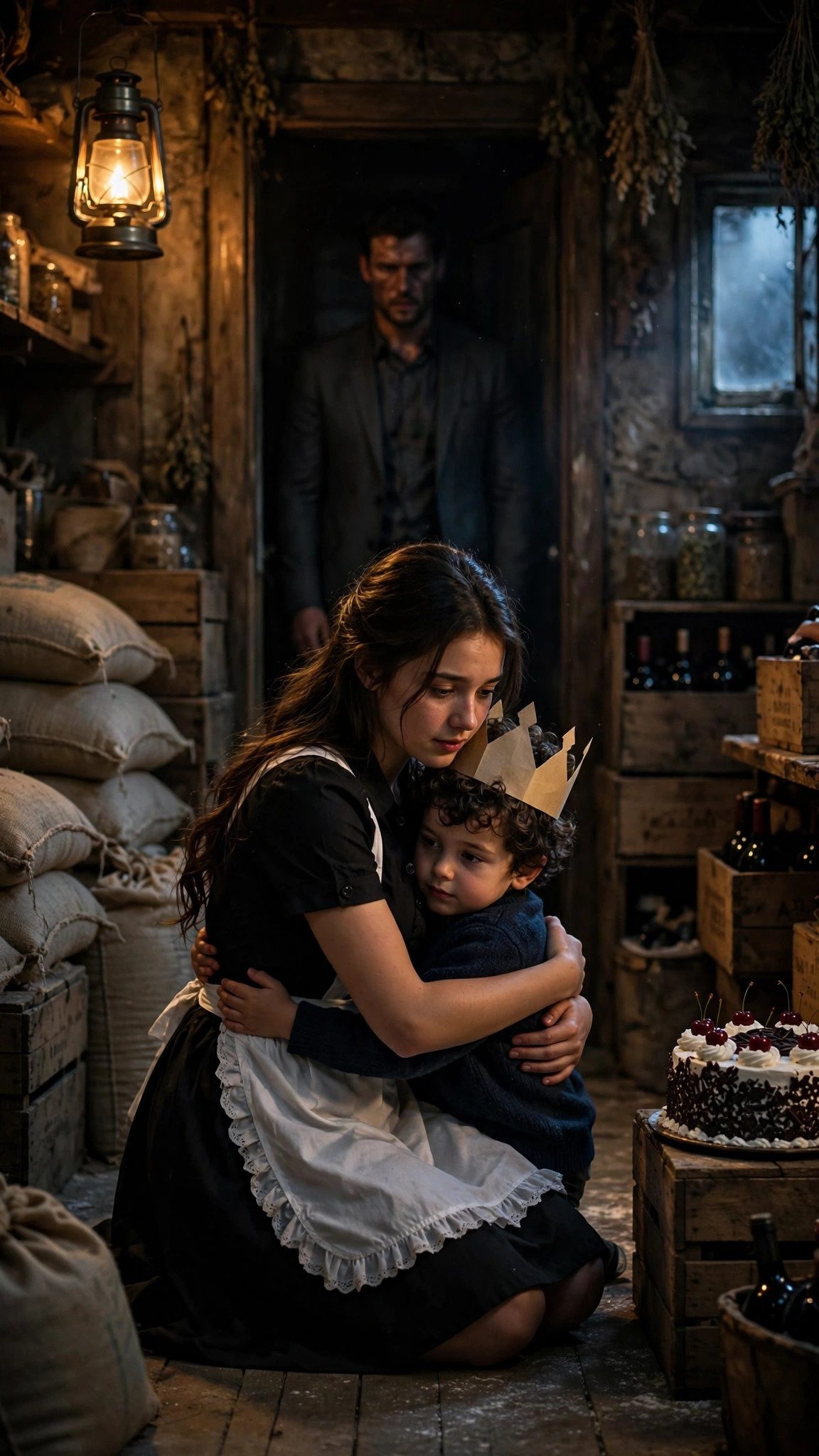
Regina had always been beautiful. That was the first thing everyone noticed about her, and it was the last thing anyone remembered, because beauty is a kind of armor, and Regina wore hers the way a soldier wears a shield: between herself and everything she had ever done.
She married my father when I was ten years old. She was twenty-nine, and she had red hair and green eyes and a laugh that made men turn their heads in restaurants. My father, who had not laughed since my mother died, laughed for her. I hated her for that, and then I hated myself for hating her, because my father deserved to laugh.
After he died — a heart attack in his office, at fifty-two, with a glass of whiskey in his hand and a photograph of my mother on his desk — Regina inherited the house on the quiet street in Brooklyn, and the money that was already gone, and me.
She did not want me. She wanted the house. But the house had a mortgage, and the money was gone, and Regina had expensive tastes and no patience, and so she began to play cards.
At first it was small games, in bright rooms, with women who wore too much jewelry. Then it was bigger games, in darker rooms, with men who did not smile. Then it was Tony Falco's rooms, where the lights were low and the debts were written down in a little black book, and the interest grew every week like a living thing.
Fifty thousand dollars. That was how much she owed by the time I was twenty-one. Fifty thousand dollars, and Tony Falco had run out of patience, and Vincent Castellano, the man Tony collected for, had told her there was only one way to clear a debt that size.
"Give me something worth fifty thousand," Castellano had said, through Tony, the way such men always speak — through someone else, so their hands stay clean.
And Regina, who had never loved me, who had looked at me for twelve years and seen only a mouth to feed and a problem to solve, said the words that would follow me into the storage room at Bellarosa.
"I have a stepdaughter," she said. "She is young. She is healthy. She is obedient. And she is Salvatore Bellini's daughter — her bloodline alone is worth more than fifty thousand to the right buyer."
That was the deal. I would be delivered to Tony's men. They would take me to Castellano, or to one of his buyers, or to a husband chosen from a list I would never see. And Regina's debt would be wiped clean, and she would go back to her card games, and nobody would ever ask what had happened to Aurora Bellini.
She found me the day after Kian dismissed me. I do not know how. Regina had always had a talent for finding things that wanted to stay hidden. She stood outside my little room above the laundromat, in a red dress, with a smile that did not reach her eyes, and she said, "There you are, darling. I have been so worried about you."
"I am not coming back," I said.
"Of course not," she said. "I have found you a husband. A good man. A rich man. You will thank me one day."
"I will not marry anyone you choose," I said.
"Then you will marry someone Tony chooses," she said, and her voice went cold, the way it always did when the smile came off. "You have no money, Aurora. You have no job. Kian Moretti threw you out like garbage. You have nowhere to go. I am your only family."
"You are not my family," I said. "My family is dead."
She slapped me then, across the face, hard enough to turn my head. It was the first time she had ever hit me, and the shock of it was worse than the pain.
"Ungrateful child," she said. "After everything I did for you."
I moved that night, to a room above a bakery on a different street, and I paid the rent with the last of my wages from Bellarosa, and I stayed inside for days, afraid to go out, afraid that every man in a dark suit was one of Tony's men.
Mrs. Alvarez, the baker's widow, found me crying in the stairwell on the third day and took me into her kitchen and made me tea and said, "Child, whatever you are running from, you cannot outrun it by hiding. You have to face it, or it will find you when you are tired."
"I have no one to face it with," I said.
"You have a little boy who loves you," she said. "That is more than most people have."
On the twentieth day of hiding, I heard about the party. Mrs. Alvarez's granddaughter worked at Bellarosa as a waitress, and she came home talking about the decorations and the cake order and the little boy who was turning four, and how his father had ordered a Black Forest cake from the bakery because it was the boy's favorite.
"He asked for Aurora's cake," the granddaughter said. "He told the chef: 'Only Aurora's cake. Nobody else's cake.' And the chef said he would try."
I stood in Mrs. Alvarez's kitchen with flour on my hands, and I understood something I had been trying not to understand for twenty days.
Zayn had not forgotten me. He had not moved on. He was still asking for me, still asking for my cake, still waiting for me to come back.
And Kian — Kian had ordered the cake. Kian, who had dismissed me, who had told me never to come back, had told the chef to make my cake for his son's birthday.
That was why I baked through the night. That was why I put on the black uniform. That was why I walked to Bellarosa on a Sunday morning with a cake in my hands and my heart in my throat.
I did not know that Regina had told Tony's men where I would be. I did not know that she had been watching the bakery, or that she had followed Mrs. Alvarez's granddaughter, or that she had sold the information along with me.
I only knew that a little boy was turning four, and that he wanted my cake, and that I would rather walk into a trap than let him spend his birthday wondering why the person he loved had disappeared.
That is what fifty thousand dollars bought: a stepmother's betrayal, a collector's patience running out, and a girl in a black maid's uniform walking straight into a storage room with a cake in her hands, because a four-year-old boy had asked for her.
I learned the full shape of Regina's debt only later, piece by piece, the way you learn about a fire after it has already burned the house down.
It started with my mother's jewelry. I discovered it was gone on a Tuesday, two years after my father's death, when I went to the drawer where my mother had kept her things — a thin gold chain, a pair of pearl earrings, a ring with a small blue stone — and found the drawer empty.
"Where is my mother's jewelry?" I asked Regina, standing in the kitchen with the empty drawer in my hands.
"I sold it," she said, without looking up from her cards. She was playing solitaire at the table, laying the cards out in neat rows, the way she always did when she was avoiding a conversation.
"You sold my mother's jewelry?" I said.
"We needed the money," she said. "The house has bills, Aurora. The roof leaks. The taxes are due. Your mother's jewelry was sitting in a drawer, doing nothing. I put it to work."
That was Regina's way of talking about everything she took: she put it to work. My mother's jewelry went to work. My father's watch went to work. The silver candlesticks from my grandmother went to work. And one by one, the things that had made our house a home disappeared, until there was nothing left but the furniture and the walls and me.
The second marriage attempt came that same year. The landlord's nephew, a man named Peter, who owned three buildings and smiled too much and asked me, on our first meeting, whether I knew how to cook.
"I know how to bake," I said.
"Good," he said. "A wife should know how to feed her husband."
Regina watched from the doorway, her arms crossed, her smile bright and false. "Peter is a good man," she said after he left. "He has property. He has money. He would take care of you."
"He would own me," I said.
"Do not be dramatic," she said. "Marriage is a business, Aurora. Your father understood that. I understood that. You will understand it too, when you grow up."
I was nineteen years old. I had grown up enough to know that Regina's idea of business always ended with someone else paying the price.
The third attempt was the worst. A man from her card games, forty-one years old, who smelled of cigars and looked at me the way you look at a house you are thinking of buying. He came to dinner, and he talked about his boat, and his house in Florida, and his first wife, who had left him, and Regina laughed at all his jokes, and after dinner he pressed a business card into my hand and said, "Call me when you are ready to be taken care of."
I threw the card away the moment he left. Regina found it in the trash the next morning, and she screamed at me for an hour, and that was the day I started looking for a job.
Bellarosa hired me a week later. I told the manager my name was Aurora Bell, and he did not ask questions, and I put on the black uniform, and I never went back to Regina's house except to collect my things — my mother's recipe card, a photograph of my parents on their wedding day, and the clothes I owned.
Regina let me go without a fight, because she thought I would come back. Girls like me always came back, in her experience. They ran out of money, or they got tired, or they got scared, and they came home, and then she could marry them off properly.
But I did not come back. I stayed at Bellarosa. I ate lunch with Zayn every day at one o'clock. I baked the Black Forest cake on Sundays. I built a life out of small, careful pieces, and I told myself that Regina was a problem I had already solved.
I was wrong. Regina had not forgotten me. She had simply been waiting for the right price.
The card games got bigger. The rooms got darker. The men got quieter. And one night, in Tony Falco's back room, with the lights low and the debts written down in a little black book, Regina borrowed fifty thousand dollars she could never repay, and when Tony asked her how she planned to pay it back, she said the words that would follow me into the storage room at Bellarosa.
"I have a stepdaughter," she said. "She is young. She is healthy. She is obedient. And she is Salvatore Bellini's daughter — her bloodline alone is worth more than fifty thousand to the right buyer."
Mrs. Alvarez told me later that Regina had come to the bakery twice, asking questions — where did I live now, where did I work, did I still go to Bellarosa on Sundays. Mrs. Alvarez had lied to her both times, because Mrs. Alvarez was a good woman who could smell a bad one from across the room.
"She asked about the boy's birthday," Mrs. Alvarez said, her hands shaking as she kneaded the dough. "She wanted to know when the party was. I told her I did not know. I am sorry, child. I should have warned you sooner."
"You did warn me," I said. "You told me I could not outrun it by hiding. You were right. I just did not know it would find me at a birthday party, with a cake in my hands."
Mrs. Alvarez's granddaughter, Lucia, came to the bakery the next day with more news, and her face was pale. "A man was asking about you at the corner," she said, in a low voice, glancing at the door. "A big man, in a dark jacket. He showed your photograph to the grocer. He said he was a friend of the family."
"He is not a friend," I said, and my hands went cold. "He is one of Tony's men."
"Then you must be careful," Lucia said. "Mrs. Alvarez says you should not go out after dark. And you should not go to Bellarosa. It is the first place they will look."
But Bellarosa was the only place I wanted to go. It was the only place where anyone had ever asked me to stay. And Zayn was turning four, and he had asked for my cake, and I had already decided — before Lucia finished speaking, before Mrs. Alvarez could argue, before fear could catch up with me — that I would go.
"I have to," I said. "He is four years old, Lucia. He does not understand debts, or collectors, or stepmothers. He understands only that someone he loves promised to stay, and then disappeared. I will not let his birthday pass without him knowing that I kept my promise."
Lucia looked at me for a long moment, and then she nodded, and she took my hand, and she said, "Then I will come with you. Not inside — I will wait outside, by the side door, and if anything happens, I will run for help. You will not be alone."
I hugged her then, hard, because kindness from a stranger is the most surprising thing in the world when you have lived without it for so long. And I understood, standing in that small bakery with flour on my hands, that Regina had been wrong about one thing: I was not alone. I had Mrs. Alvarez, and Lucia, and Maria, and Vince, and a little boy who had claimed me as his own.
Fifty thousand dollars could buy a great deal of fear. But it could not buy the people who loved me, and it could not make them stop.
What fifty thousand dollars could not buy was the thing Regina had never understood. You cannot sell a person who has already been claimed — not by money, not by debt, not by a deal made in a dark room.
Zayn had claimed me a long time ago, on a Tuesday afternoon in a flour-dusted kitchen, when he looked up at me with chocolate on his face and asked me to stay.
And Kian Moretti, whether he knew it or not, had claimed me too — in unsent apologies typed at two in the morning, in a cake ordered for a birthday, in the way he had once thanked me for a paper airplane.
Fifty thousand dollars was a great deal of money. But it was not enough to buy any of that.