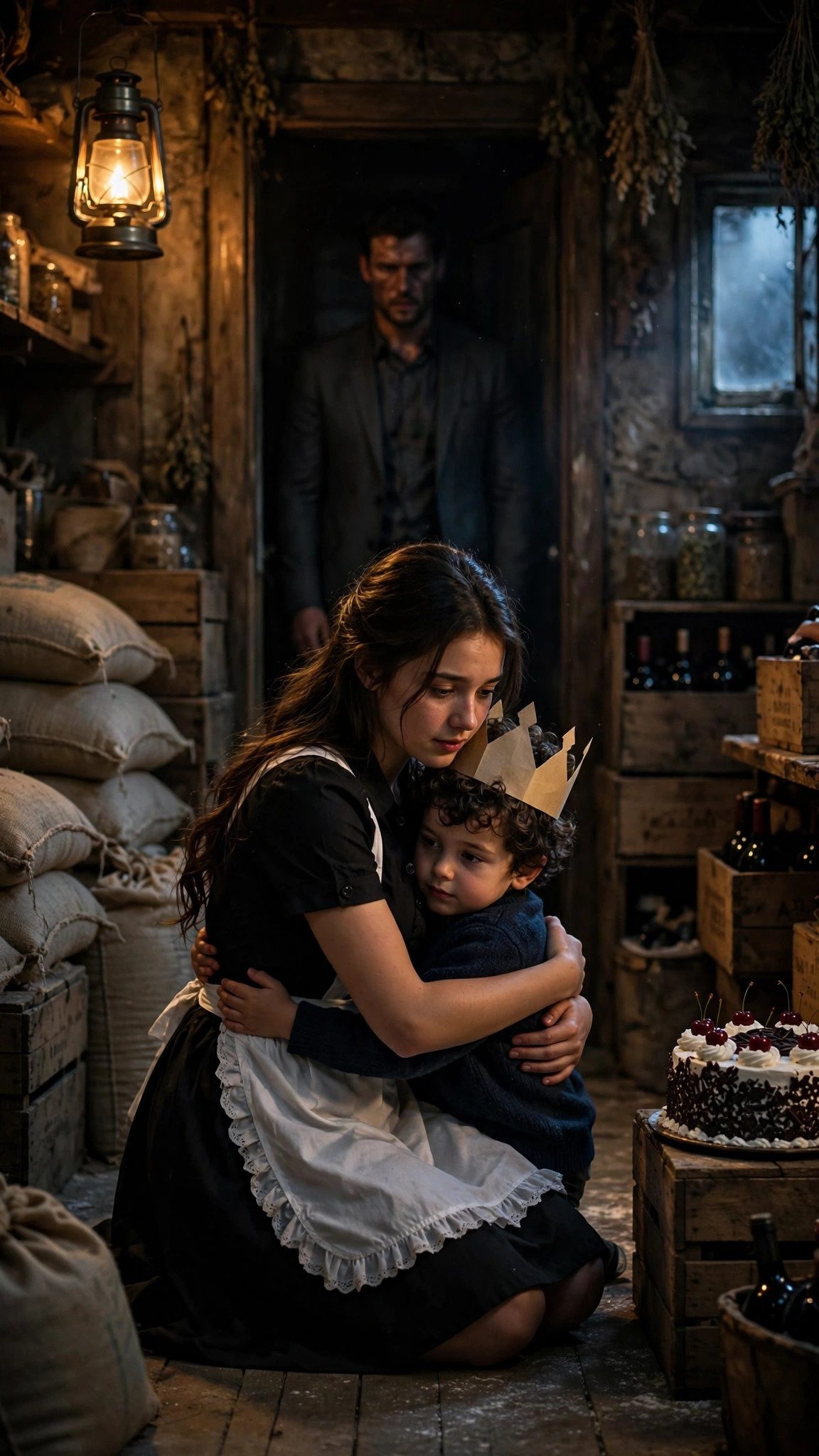
The party was beautiful. I saw it for only a moment, through the kitchen door, before Tony's men found me — blue and gold balloons, a table covered with presents, a small cake shaped like a race car, and Zayn in the middle of it all wearing a paper crown that kept slipping over one eye.
I had arrived early, before the guests, with my cake wrapped carefully in a white cloth. The kitchen was already full of noise and steam — old Vince shouting orders, Maria arranging flowers, the waiters carrying trays of food to the long table in the dining room. Nobody noticed me slip in through the side door. Nobody noticed the girl in the black maid's uniform with a cake in her hands, because in a restaurant on a party day, everyone is too busy to notice one more person carrying something.
Vince saw me first. He was standing at the stove, tasting a sauce, and he looked up, and his wooden spoon stopped halfway to his mouth.
"Aurora," he said quietly. "You came."
"He asked for my cake," I said. "I heard he asked for my cake."
"He did," Vince said. "He told his father: 'Only Aurora's cake. Nobody else's cake.' And his father said he would try." Vince looked at me for a long moment, and then he did something I did not expect: he put his hand on my shoulder, gently, the way a father would. "You are braver than I thought, girl. And braver than he is, if you want the truth."
"Where is Kian?" I asked.
"In the back room, with the men," Vince said. "He will come out for the cake. He always comes out for the cake."
I set my cake down on the counter, next to the race-car cake, and I unwrapped it slowly. The Black Forest cake — cherries, chocolate, cream, my mother's recipe. I had stayed up all night making it, in Mrs. Alvarez's kitchen, and my hands still smelled of cherries.
Maria found me there a moment later, and she threw her arms around me so hard I nearly dropped the cake.
"You came," she whispered. "I knew you would come. I told Vince you would come."
"I only came to leave the cake," I said, but we both knew it was a lie. I had come to see him. I had come to see Zayn, just once, on his birthday, to know that he was all right.
Through the kitchen door, I could see the dining room filling up. Children in party clothes. Parents with cameras. A table covered with presents, wrapped in blue and gold paper. And in the middle of it all, Zayn, wearing his paper crown, holding a toy car in one hand and a balloon in the other, looking around the room as if he were searching for someone.
He was searching for me. I knew it. He turned in a slow circle, his eyes scanning the faces, and when he did not find me, his shoulders dropped, just a little, the way a child's shoulders drop when the world disappoints them.
I could not bear it. I pushed the kitchen door open, just a crack, so I could see him better, and that was when I heard the voices behind me.
"There she is."
Tony's men had followed me in through the side door. I do not know how they knew I would be there — whether Regina had told them, or whether they had been watching the restaurant all morning, waiting. It did not matter. They were there, in the kitchen, in the middle of the noise and the steam, and one of them took my arm, and the other one nodded toward the storage room.
"Not here," he said. "Too many people. In there."
They pushed me toward the storage room, and I went without a fight, because the dining room was full of children, and I would not make a scene in front of them. Not on his birthday.
I slipped into the storage room to set down my cake and catch my breath. The room was cool and dim, full of flour sacks and wine crates and the smell of yeast and oak. I set the Black Forest cake on a crate and put my hands on my knees and tried to breathe.
That was when the door opened behind me.
Two men came in. Big men, in dark jackets, with the flat eyes of men who are paid not to think. One of them closed the door. The other one took my arm.
"Regina says hello," he said.
I tried to pull away. He tightened his grip. "Don't make a scene, sweetheart. The kid's party is right outside. You don't want to ruin the kid's birthday, do you?"
That was when Regina's voice came through the door, bright and reasonable, selling me the way she had sold everything else in her life.
"Fifty thousand, and she is yours. She is healthy. She is obedient. She will not cause trouble once she understands there is nowhere to run."
I could not breathe. My body was ready to return, ready to return to Tony's men's custody, the way a body learns to obey when it has been afraid for a very long time.
And then the door burst open, and Zayn was there.
He had followed me. Of course he had followed me. He was four years old, and he had seen me through the kitchen door, and nothing in the world could have kept him from running to me.
He stopped in the doorway, his paper crown crooked, his eyes wide, taking in the scene: me, in my black uniform, with a man's hand on my arm. The flour sacks. The wine crates. The two big men who did not belong.
And then he did the bravest thing I have ever seen anyone do.
He stepped between us.
"She is my mommy," he said, and his voice was steady, and it was certain, and it shut the whole room down. "No one will take my mommy."
The man holding my arm hesitated. He looked down at the boy, and then at his partner, and I could see the calculation in his eyes: a child was a complication. Children screamed. Children remembered faces. Children told their fathers.
"Move, kid," the man said, but his voice had lost its certainty.
"No," Zayn said.
"This is my future wife," he announced, louder now, to the whole room. "You can't take her away."
His little voice was strong enough to shut down the room, and the adults stared at me with shock. Regina, who had pushed the door open wider to see what was happening, stood frozen in the hallway with her mouth open.
I looked down at him, standing in the doorway of the storage room in his party clothes, his paper crown slipping over one eye, his small chest heaving from running, and I felt something break open inside me — not fear, not anymore, but a fierce, bright anger, the kind a mother feels when someone threatens her child.
Because he was my child. Not by blood, not by law, but by every morning I had wiped his face, and every night I had sung him to sleep, and every lunch at one o'clock at the small table by the kitchen door. He was mine, and these men were in my storage room, in my restaurant, on his birthday, putting their hands on me, and I was done being afraid.
The cake sat on the crate behind me, the Black Forest cake I had baked at three in the morning, wrapped in a white cloth, waiting for a birthday that was happening without me. I thought about my mother, and her recipe, and the promise she used to make — that if you followed the steps, the steps would keep you safe, and at the end there would be something sweet.
I had followed the steps. I had been careful. I had been obedient. I had hidden for twenty days. And still the men had come. Still Regina had sold me. Still the world had decided I was worth fifty thousand dollars and nothing more.
No more. I was done following steps that led me back to a storage room. I was done being a porcelain doll that could be bought. I was done being afraid.
Zayn reached up and took my hand, his small fingers wrapping around mine, and he looked up at me with complete trust, and I understood that he was not afraid either. He was four years old, and he had walked into a room full of dangerous men, and he was not afraid, because he believed — truly believed, with the whole of his small heart — that his mommy could not be taken away.
I squeezed his hand, and I stood taller, and I looked at Tony's men, and I said the first brave thing I had said in three years.
"No," I said. "You will not take me. Not today. Not ever."
And then the cold air swept in, and the doorway filled with a tall, broad-shouldered man, and every person in the room went suddenly quiet.
Kian Moretti.
He did not rush. He did not shout. He did not even look surprised. He looked at the man holding my arm, and he looked at Regina, and he looked at his son standing between me and the world, and something in his face changed — the way a winter changes when the sun finally comes out, slowly, and then all at once.
"Take your hand off her," he said.
His voice was quiet. It was the quietest voice I had ever heard, and it was the most frightening sound in the world, because it was the voice of a man who did not need to raise it.
The man let go of my arm.
"Now," Kian said, "someone is going to explain to me why there are strange men in my storage room, on my son's birthday, putting their hands on a woman who works in my building."
Regina found her voice first. "Kian, darling, this is a family matter. The girl owes—"
"The girl owes nothing," Kian said, without looking at her. "The girl works for me. The girl bakes my son's cake. The girl is under my protection. Did no one tell you that?"
"I knew that if I had delivered this girl to Tony, the Black Forest cake wouldn't poison any of you," Regina babbled, the words spilling out of her, desperate and strange, and I understood then that she was terrified — not of me, not of the men, but of Kian, and of what he would do when he understood what she had tried to sell.
"She is worth fifty thousand dollars," Regina said, and her voice cracked. "Tony will pay fifty thousand dollars. I have debts, Kian. You don't understand—"
"I understand perfectly," Kian said. "You sold your stepdaughter to a collector to pay your gambling debts. You brought his men into my building, on my son's birthday, to take a woman my son calls his mother."
He took one step forward, and Tony's men took one step back, and Regina pressed herself against the wall of the hallway, and the whole storage room seemed to hold its breath.
"Well, how many of them do you think are here for me?" one of Tony's men muttered, glancing at the doorway, where Kian's men were now standing, silent, in dark suits, waiting.
"Vince Moretti," Zayn said suddenly, pointing at old Vince, who had appeared in the hallway in his chef's whites, holding a wooden spoon like a weapon. "He is a chef."
It made no sense, and it made perfect sense, because Zayn was four and the world to him was divided into people who were safe and people who were not, and the chef was safe, and Tony's men were not.
And yet, Kian did not say a word more to the men. He did not threaten them. He did not touch them. He did something far more dangerous.
He reached into his suit pocket and took out his phone. He placed his phone into Zayn's hands and let the boy see a message.
"I'm sorry I hurt you already."
"I'm sorry, honey. I'm sorry. I'm sorry."
Zayn looked at the phone, and then he looked at his father, and then he looked at me, and he tightened his arms around my waist.
"See?" he said. "Daddy is sorry. So you have to stay."
Kian looked at me then, across a storage room full of his enemies and his son, and for the first time since I had met him, the mask was gone. There was no boss. There was no storm. There was only a man, tall and fierce and exhausted, who had made a terrible mistake and had typed his apologies into a phone at two in the morning because he did not know how to say them out loud.
"Aurora," he said, and my name in his mouth sounded like something he had been practicing. "I was wrong. I dismissed you because I was afraid — afraid of your father's name, afraid of what it would mean, afraid of what I felt when my son laughed for you. I was a coward. And I am sorry. I hurt you already, and I am sorry."
The room was so quiet I could hear the balloons in the next room, bumping softly against the ceiling.
"Stay," he said. "Please. Stay for my son. Stay for the cake. Stay because this is your home, and I was a fool to ever tell you otherwise."
Zayn tugged at my sleeve. "Stay, Mommy," he whispered. "Please stay."
I looked down at the little boy with the crooked paper crown, and I looked at the man who had finally said the words he had typed a hundred times and never sent, and I felt something inside me, something that had been holding its breath for twenty days, finally let go.
"I'll stay," I said.
And Tony's men, who had come to collect a girl worth fifty thousand dollars, walked out of the storage room empty-handed, because some things cannot be bought, and some rooms cannot be entered, and some little boys cannot be moved.
Not by money. Not by threats. Not by anyone.