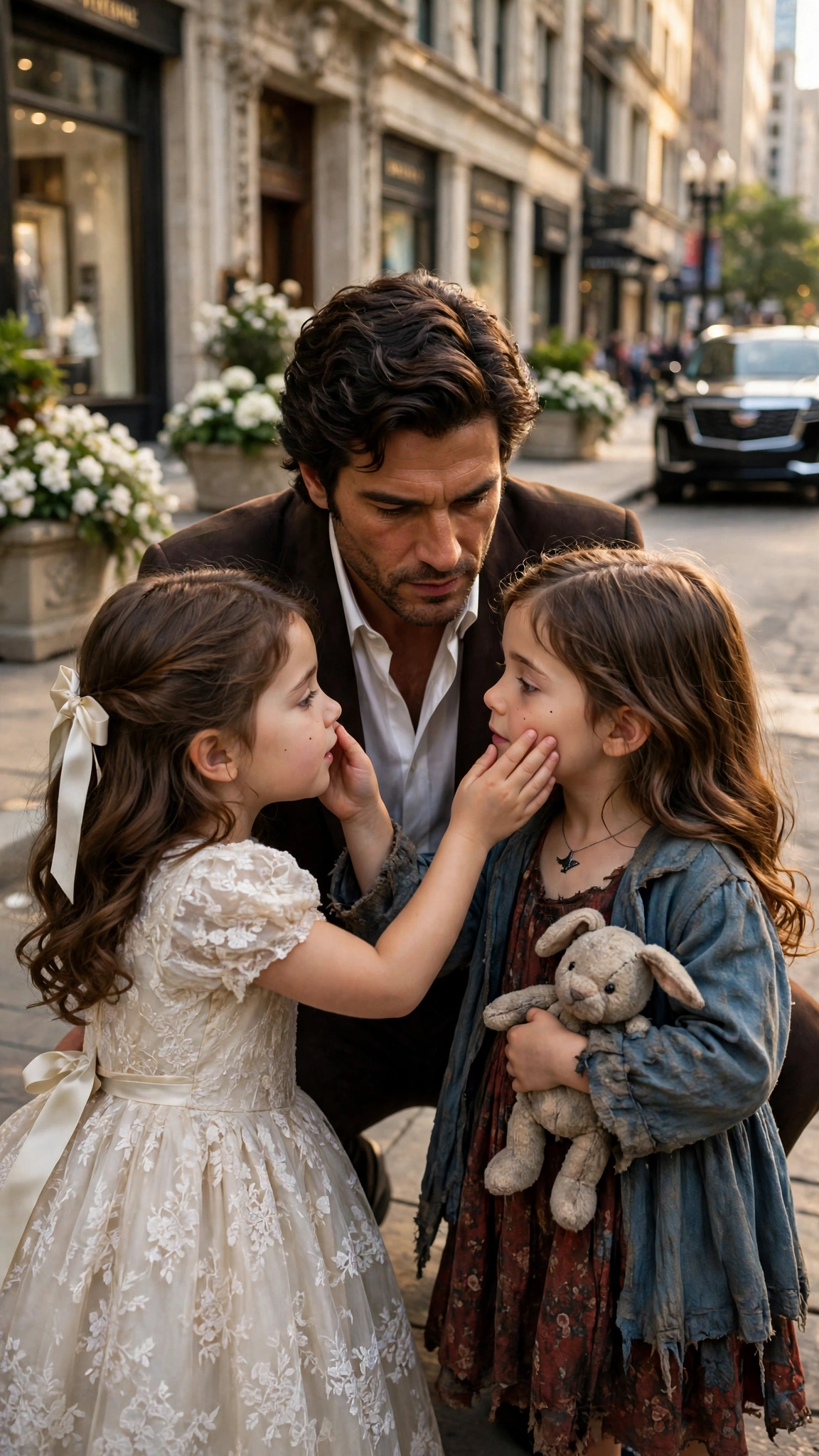
The little girl on the sidewalk had my daughter's face.
It was a sunny afternoon on Michigan Avenue, the kind of afternoon Chicago gives you in late September when the light turns to honey and the whole city seems to be walking somewhere happy. Sophie's hand was in mine. She was skipping, the way she does when she is trying not to run, her ivory dress catching the sun, the big satin ribbon in her chestnut hair bouncing with every step. Marco was three paces behind us with the shopping bags. Everything was ordinary. Everything was safe. And then Sophie stopped dead in the middle of the sidewalk and pulled my hand so hard I thought she had seen a dog, or a balloon, or something wonderful.
"Daddy," she said. "Daddy, look."
Across from us, sitting on the low stone edge of a flower planter filled with white blossoms, was a little girl. She could not have been more than five years old. Her hair was chestnut-brown, the same chestnut-brown as Sophie's, but messier, tied up in a loose bun with a faded burgundy ribbon. Her dress was dark red and worn thin at the elbows. A shabby blue coat hung from her shoulders like a blanket that had given up. She was holding a small, dirty beige rabbit against her chest with both arms, the way a child holds the only thing in the world that belongs to her.
And she had Sophie's face.
Not a similar face. Not a family resemblance. The same face. The same soft gray eyes. The same rosy cheeks. The same tiny freckle beside her nose. I stared at her, and she stared at Sophie, and Sophie stared at her, and for one long second the whole of Michigan Avenue — the pedestrians, the traffic, the storefront windows, the sun itself — seemed to stop and hold its breath.
Sophie whispered, "Daddy… why does she have my face?"
I had no answer. I am a man who always has an answer. I have sat across tables from men who would kill me for a wrong word and I have never once been lost for one. But on that sidewalk, with my daughter's hand in mine and her mirror image sitting ten feet away clutching a dirty rabbit, I had nothing.
I crouched down between the two of them. My knees complained — I am thirty-six and in good shape, but crouching in a tailored suit on a Chicago sidewalk is not a thing I do — and I looked at the strange little girl the way I have looked at a thousand faces across a thousand tables, looking for the lie in it. There was no lie in it. Her eyes were gray. Sophie's eyes are gray. Her freckle was in the exact same place, a tiny brown dot beside the left side of her nose, the one I kiss every night before bed.
"Sweetheart," I said, and my voice came out quiet and controlled, the way it does when I am most dangerous. "What's your name?"
She lowered her gaze. Her fingers tightened on the rabbit. "Ruby," she said, so softly I had to lean in. "Ruby Carter."
Carter.
The word went through me like a blade between the ribs. Carter was Elena's name. Elena Carter, before she was Elena Moretti. Before the fire. Before the night I lost her. I had not heard that name spoken aloud in five years, not by anyone, because there was no one left alive who knew it mattered. My jaw tightened. My hand stopped halfway toward her shoulder and hung there in the air, useless.
"Carter?" I whispered.
Sophie, braver than I have ever been, stepped forward and put her small hand gently against Ruby's cheek, the way she touches my face when she is trying to make me smile. Ruby went very still. She did not pull away. Their identical gray eyes met, and Sophie gave her a tentative, curious smile, and Ruby — this guarded, hungry, frightened little girl in her shabby coat — looked completely overwhelmed by the simple fact that someone was being kind to her.
And then Ruby shifted the rabbit in her arms, and the sunlight caught something at her throat.
A delicate silver necklace. A tiny blackbird pendant with spread wings.
My fingers froze. My lips parted. The blood left my face so fast I felt dizzy, and for a moment the sidewalk tilted under my shoes. I knew that necklace. I had given it to Elena on our wedding day, a blackbird because she used to sing in the kitchen in the mornings, off-key and happy, and I told her she was the only bird in Chicago that sang before the sun came up. She wore it every day of our marriage. She was wearing it the night the house burned.
"That necklace," I said, and my voice was a stranger's voice, shaken and raw.
Behind me, over my shoulder, a woman's voice cut through the crowd, anxious and breathless. "Ruby! Come here, sweetheart!"
A woman in a simple beige coat was pushing through the pedestrians near the flower stand, searching, her shoulder-length dark-blonde hair coming loose around her face. Ruby turned toward her voice and clutched the rabbit closer to her chest. I rose slowly to my feet, my legs unsteady beneath me, and the woman stepped into a narrow beam of sunlight and turned toward me.
And my whole world stopped.
Because I knew her. I knew the shape of her face and the color of her hair and the way she held her mouth when she was afraid. I had held her hand while she gave birth. I had buried her — or thought I had buried her — five years ago.
She saw me, and her expression shifted from worry to panic, pure and instant, like a woman who has seen a ghost.
"You…" I whispered, and my voice broke clean in half. "You're alive?"
That was where it began. That was the moment my life split in two: everything before that afternoon on Michigan Avenue, and everything after.
Three hours earlier, it had been an ordinary Tuesday.
Sophie had woken me at six in the morning by climbing onto my chest and putting her face three inches from mine. "Daddy," she had announced, "today is a yellow day." Sophie divides days by colors. Yellow days are good days. Gray days are sad days. She had decided, at the age of five, that she could manage the weather of her own heart this way, and I had never once argued with her. Her hair was a wild tangle of chestnut curls, the side braids I had attempted the night before half undone, the ivory ribbon hanging by a thread. I fixed the braids while she ate her toast, my big fingers clumsy with the small strands, and she sat very still and patient with me, the way she always does, because she knows I am trying.
"Tell me about Mama again," she said, as she does most mornings.
And I told her the story I have told her for five years, the story I believed with all my heart: that her mama loved her more than anything in the world, that her mama was beautiful and brave and sang in the kitchen, and that her mama had gone to heaven before Sophie could remember her, and that she watches over us from there. Sophie listened with her chin in her hands, and then she asked the question she always asks.
"Did Mama have a freckle like mine?"
"Yes, baby," I said. "Right here." And I touched the tiny freckle beside her nose, the way I always do.
What I did not tell her — what I have never told anyone, not even Marco, who has driven for me for twelve years — is that I have never believed the story myself. Not completely. They told me Elena died in the fire. They showed me a grave. But I was pulled out of that house unconscious, and when I woke up in the hospital, there was a baby in my arms — Sophie — and a hole in my life where my wife and my other daughter had been. They told me the second baby died too. They told me Elena's body was found in the nursery. I believed them because I had no reason not to, and because grief does not ask for proof. Grief only asks for somewhere to put its weight.
But there was always a small, cold voice in the back of my mind that said: you never saw her. You never saw either of them.
That morning, Sophie chose her ivory dress, the one with the puffed sleeves and the layered tulle skirt, and her cream-colored shoes, and she asked if we could go downtown to see the flower planters on Michigan Avenue, because her teacher had told her the white blossoms would be gone soon. I said yes, because I say yes to almost everything Sophie asks, and because the work could wait. The work always waits for Sophie. That is the first rule of my life, and the only one I have never broken.
We drove downtown in the black SUV with Marco at the wheel, and Sophie pressed her face to the window and narrated the whole city to me — the buses, the dogs, the man selling pretzels, the lady with the purple coat — and I listened to every word, because her voice is the only music I have left.
I did not know, as we walked down that sunny sidewalk with the shopping bags and the flower planters and the whole ordinary afternoon spread out in front of us, that I was walking toward the answer to the only question that has mattered to me for five years.
I did not know that my wife was alive. I did not know that I had two daughters, not one. I did not know that the man I trusted most in the world had built my grief with his own hands and then stood beside my grave and my wife's grave and wept like a friend.
On the drive home that evening, Sophie was quiet for the first time all day, which worried me more than any question she could have asked. She sat in the back seat with her bear, her forehead pressed to the window, watching Michigan Avenue slide past, and every few minutes she would glance at me in the rearview mirror, as if she were checking that I was still there, still the same father she had woken up with that morning.
"Daddy," she said at last, very softly, "was that girl really… did she really have my face?"
"Yes, baby," I said.
"How?" she asked. "How can somebody have my face?"
"I don't know yet," I told her, and it was the most honest thing I had said all day. "But I am going to find out. I promise you that."
"Is she sad?" Sophie asked. "She looked sad, Daddy. Her dress was old. Her shoes were old. Why was she sitting all alone?"
I did not have an answer for that either, and the not knowing sat in my chest like a stone. Marco, driving, caught my eye in the mirror, and I saw something in his face I had never seen there before: not just loyalty, not just obedience, but worry. Real worry. Marco had been with me the day the twins were born. He had carried flowers into Elena's hospital room. He knew what I knew, even before I said it out loud.
"Boss," he said quietly, so Sophie would not hear, "if that was who I think it was—"
"I know," I said. "I know, Marco."
Sophie leaned forward between the seats and put her small hand on my shoulder. "Daddy, if she is sad, we should help her. Mama always said that when you see somebody sad, you help them. You told me Mama said that."
I looked at my daughter's hand on my shoulder, and I thought about Elena, who had said exactly that, a hundred times, in our kitchen, with flour on her hands and a song on her lips. And I thought about the little girl on the sidewalk with the dirty rabbit, and the woman in the beige coat, and the blackbird necklace catching the sun. And I knew, with a certainty that settled over me like cold water, that whatever came next — whatever the truth was, and whoever had hidden it from me — I would not rest until I had it. Not for revenge. Not for the business. For Sophie. For the sad little girl on the sidewalk. For all of us.
I know it all now. And this is the story of how I found out — from the beginning, the way it really happened, before the fire and before the lies, when Elena was still singing in my kitchen and I still believed that the worst thing in the world was losing a business deal.
It begins five years before that afternoon. It begins with a wedding, and a blackbird, and a house by the lake.