I met Elena Carter on a Tuesday in April, in a flower shop on State Street, and I was there because my mother had died three weeks earlier and someone had told me that lilies were appropriate. I did not know anything about flowers. I knew about shipping routes and warehouse ledgers and which men in this city could be trusted with a loaded truck and which ones could not. I stood in that little shop in my dark suit, feeling like a wolf that had wandered into a garden, and this woman with shoulder-length dark-blonde hair looked up from a bucket of white blossoms and said, "You look like a man who has never bought flowers in his life."
"I haven't," I said.
"Then you need the lilies," she said, "but not too many, or it looks like you're trying to impress the dead, and the dead are never impressed."
She sold me twelve lilies and a small bunch of something purple she refused to name, and when I tried to pay too much she pushed my hand away and said the lilies were on the house because I had honest eyes. I did not have honest eyes. I had the eyes of a man who had been running his family's business since he was twenty-two and had learned to keep his thoughts behind his teeth. But something about the way she said it made me want to be the man she thought she saw.
I came back the next day for no reason at all. And the day after that. By the end of the week I had bought enough flowers to fill a warehouse, and Elena Carter was laughing at me over a bucket of roses, telling me I was the worst customer she had ever had and the only one she looked forward to.
Elena was not like the women I knew. The women in my world were careful. They spoke softly, they dressed beautifully, they understood the rules — which tables to sit at, which names never to say aloud, which smiles meant danger. Elena did not know the rules and did not care to learn them. She sang while she worked, off-key and completely unbothered. She argued with her suppliers. She gave flowers to a homeless man every morning and told him the day would be better because he had something beautiful in his hands. She was twenty-eight years old, she owned a flower shop the size of a closet, and she was the bravest person I had ever met.
I courted her the only way I knew how: honestly, and badly. I told her who I was on our third meeting. Not the cleaned-up version. The real one. I told her my family moved freight through the Port of Chicago, and that some of that freight was the kind the law did not like, and that my father had built the business with his hands and his reputation and that men in this city feared my name. I told her because I would not build a marriage on a lie, and I expected her to walk away. Instead she looked at me for a long moment, wiped her hands on her apron, and said, "Are you a good man, Adrian Moretti?"
"I try to be," I said.
"Then try harder," she said. "And don't ever lie to me. I can live with a lot of things. I cannot live with a lie."
We married a year later, in a small church with white lilies everywhere, and I gave her a silver necklace with a tiny blackbird pendant with spread wings, because she sang in the kitchen every morning and I told her she was the only bird in Chicago that sang before the sun came up. She wore it every day after that. She wore it when she was pregnant. She wore it the day our daughters were born.
The twins came in the spring, two tiny girls with chestnut hair and gray eyes, and the doctor laid them side by side in the hospital bassinet and said he had never seen two babies so alike. We named them Sophie and Ruby, after Elena's grandmother and my own. Sophie was born first, by four minutes, and she came out furious at the world, red-faced and wailing. Ruby came out quiet, blinking up at the lights with her tiny fists curled, as if she were already thinking something over. Elena laughed through her tears and said, "One of them is you and one of them is me, and God help us both."
For five months, we were happy in a way I had not known happiness could exist. The house by the lake was full of sunlight and the smell of Elena's cooking and the sound of two babies crying in imperfect harmony. I would come home from the docks and Elena would put a baby in each of my arms, and I would stand there in the kitchen in my suit, a man other men feared, holding two tiny girls and feeling like the luckiest man alive.
Dominic Rizzo was there for all of it. He was my father's oldest friend, my consigliere, the man who had taught me the business when my father died. He was fifty-two then, silver-haired, always in a perfect gray suit, always with a hand on my shoulder. He held the twins at their christening. He brought them silver rattles. He called himself Uncle Dom, and Elena trusted him, and I trusted him, and that is the part that still cuts me, even now, because trust is the only thing in my world that cannot be bought back once it is spent.
The night of the fire, the twins had just turned one year old. Elena had made a small cake with a single candle, and the girls had smashed their hands into it, and we had laughed until our sides hurt. After the girls were asleep, Elena and I sat on the porch with two glasses of wine, and she told me she wanted to expand the flower shop, and I told her I would buy her the whole street if she wanted it, and she laughed and said one shop was enough. The lake was black and calm. The air smelled like rain that had not yet come.
I woke to smoke. That is what I remember first — not the heat, not the sound, but the smell, thick and chemical, wrong in a way that told me even half asleep that this was not an accident. The hallway was full of black smoke. The nursery was at the end of it, and I could hear Sophie crying, and I went for her on my hands and knees with my shirt over my mouth, and the heat was like a wall. I found the crib. Sophie was there, screaming, her little face red. Ruby's crib was empty.
I remember shouting Elena's name until my throat tore. I remember the stairs giving way under me. I remember a beam coming down and the world going white, and then nothing at all.
I woke in the hospital two days later with burns on my back and my arm and a baby in the room next door — Sophie, alive, with a bandage on her tiny hand. Dominic was sitting beside my bed, his gray suit ruined, his face gray with grief, holding my hand like a father.
"Adrian," he said, and his voice was broken. "I'm so sorry. The fire took the nursery. Elena… Elena didn't make it out. And the little one, Ruby… I'm sorry, son. I'm so sorry."
I did not believe him. Not at first. I demanded to see them. He told me there was nothing to see, that the fire had been too hot, that the bodies were — he used that word, bodies — and I screamed at him until the nurses sedated me. When I woke again, he told me the funeral was already done, that he had buried them both in the family plot, that he had done what a father would do because I could not. He showed me photographs of two small white coffins. He wept with me. He held me while I wept.
And I believed him. God forgive me, I believed him, because he was Dominic Rizzo, my father's best friend, the man who had held my daughters at their christening, and because grief is not a detective. Grief does not investigate. Grief takes the first story it is given and builds a house out of it and moves in.
For five years, I lived in that house. I raised Sophie alone. I told her that her mother had gone to heaven, and I went to the family plot every Sunday and stood in front of two stones with two names on them — ELENA MORETTI, BELOVED WIFE AND MOTHER, and RUBY MORETTI, BELOVED DAUGHTER — and I talked to them as if they could hear me. I built my business back. I became harder, colder, more feared, because fear was easier to carry than grief. And every year, on the twins' birthday, I bought two small cakes and put one candle in each, and Sophie and I ate them in the kitchen, and I never once told her that she had a sister. What would have been the point? Her sister was dead. Her mother was dead. That was the truth, and the truth was a stone I had learned to carry.
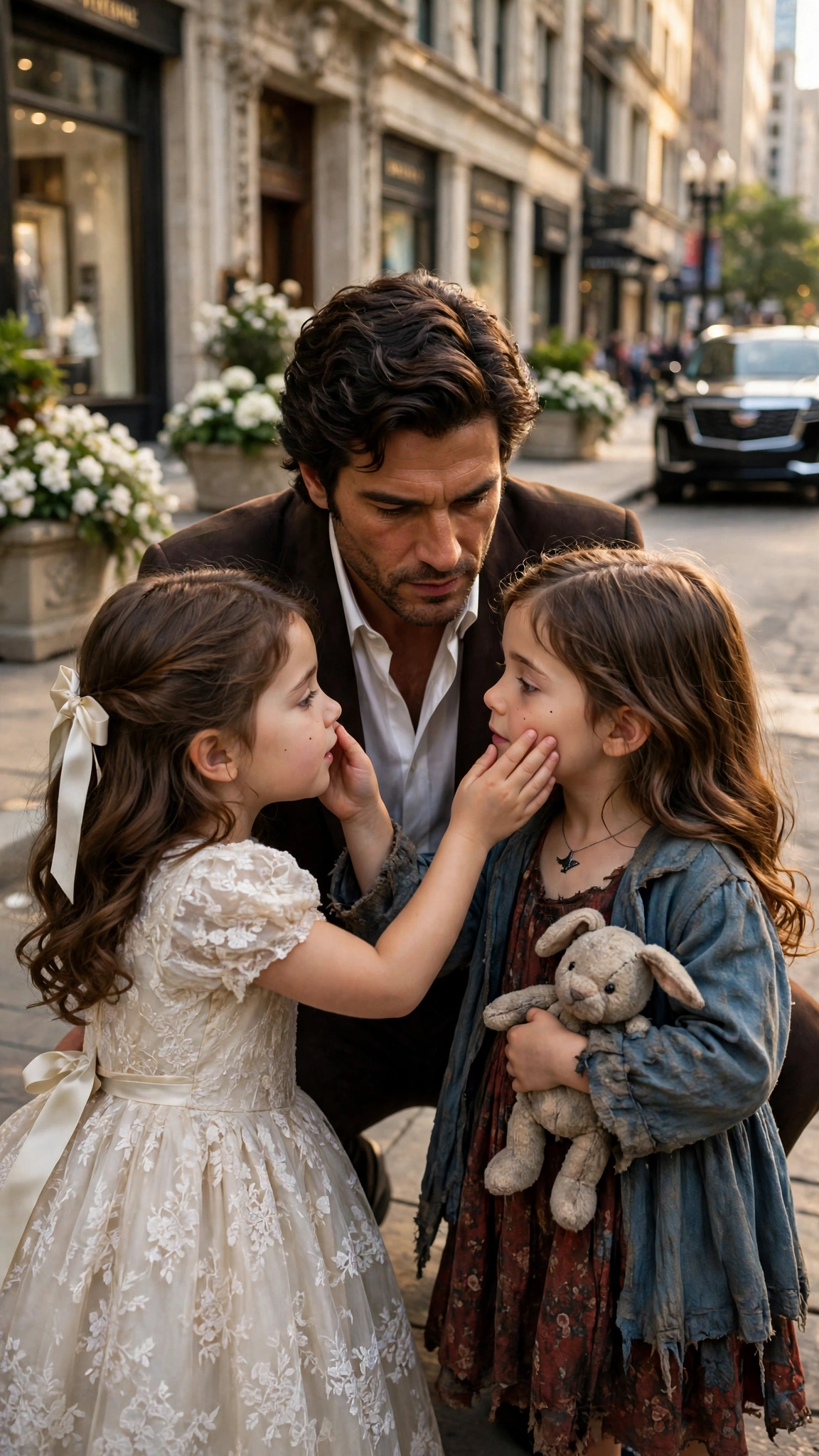
But it was not the truth. It was a story Dominic Rizzo had written for me, the way a man writes a contract — carefully, with every clause in his favor. And on a sunny afternoon on Michigan Avenue, five years later, a little girl in a shabby blue coat sat down on a flower planter with a dirty rabbit in her arms, and the whole story fell apart in front of my eyes.
The first year after the fire was the hardest year of my life, and I have lived a hard life. I came home from the hospital with a baby who cried all night and burns on my back that made it hurt to hold her, and I held her anyway, because there was no one else to hold her. Marco moved into the guest room for three months and slept on the floor beside the crib so I could sleep for two hours at a time. The house was too big and too quiet, and every room in it had Elena in it — her coat on the hook by the door, her books on the nightstand, her handwriting on the shopping list on the refrigerator — and I could not bring myself to move any of it. For months, I expected to hear her singing in the kitchen every morning. For months, I woke up reaching for her side of the bed.
Sophie's first birthday without her mother nearly broke me. I bought a small cake with one candle, the way Elena would have done, and I put Sophie in her high chair, and she looked at the cake, and then she looked at me, and she said her first real sentence — not "dada" or "mama" but "Where Mama?" — and I sat down on the kitchen floor with the cake in my hands and I cried for an hour while my daughter patted my head with her sticky hands, the way I had patted hers a hundred times.
I learned to braid hair from a video on the internet, pausing it every ten seconds, my fingers fumbling with the small strands while Sophie sat patient and still, the way she still does. I learned to cook pasta and to fold tiny dresses and to sing lullabies off-key, the way Elena had sung, because Sophie asked me to sing the songs Mama used to sing, and I was the only one left who remembered any of them. I learned that a man can be feared by a whole city and still be helpless in front of a one-year-old with a fever, and that the second thing matters more than the first.
By the second year, we had found our rhythm. Sophie and I against the world. I took her to the docks with me sometimes, and the men who worked for me — hard men, men with tattoos and prison records — would go soft around her, offering her candy and letting her sit in the big chair in my office. She called the office "the ship place," and she drew pictures of boats and taped them to my desk, and I kept every single one. Dominic came to dinner every Sunday, and he played the devoted uncle, and he asked about Sophie's school and her health, and he never once mentioned Elena or Ruby, and I never once noticed that he never mentioned them. Grief had made me blind to the one thing that mattered: that the man who had been closest to my family was the only man who never spoke of the two people I had lost.
On Sophie's fifth birthday, the day before Michigan Avenue, I had stood in her doorway and watched her sleep, and I had thought: she is all I have left. She is the whole world. And I had believed it, completely, with all my heart. I had no idea that the world was about to get twice as big.