That night, after Sophie was asleep, I sat in my study with the lights off and a glass of whiskey I did not drink, and I thought about the word Carter until it stopped sounding like a word at all.
Carter. Elena Carter. She had told me once, laughing, that Carter was a boring name for a woman who sold flowers, and I had told her it was the most beautiful name I had ever heard, and she had thrown a rose at my head. I had kept that rose. It was pressed in a book somewhere in this house, brown and flat and older than my daughter. I had not opened that book in five years.
There were four facts, and I laid them out on the desk in front of me like cards in a game I did not know how to play.
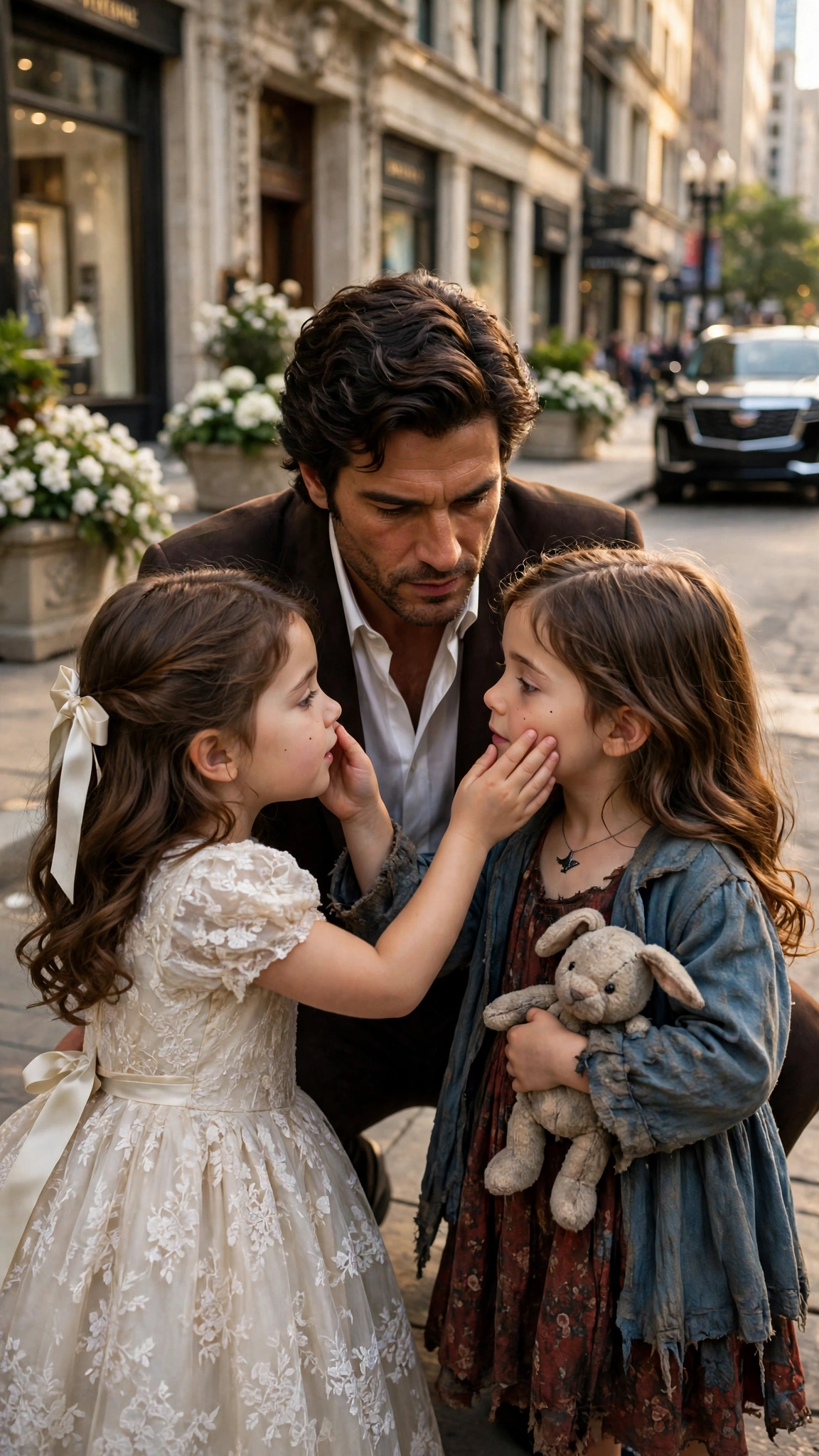
One: a five-year-old girl with my daughter's face, my daughter's eyes, my daughter's freckle, was sitting on Michigan Avenue in a shabby coat, holding a dirty rabbit.
Two: her name was Ruby Carter.
Three: she wore my wife's necklace. The blackbird. The one I had given Elena on our wedding day, the one she never took off, the one she was wearing the night the house burned.
Four: the woman who came for her — the woman in the beige coat with the dark-blonde hair — was Elena. I knew it the way you know your own heartbeat. I had seen her face in the sunlight for less than three seconds, and I would have sworn on my daughter's life that it was her.
Four facts. Any one of them alone could be explained away. A lookalike child. A common name. A necklace that could have been sold, or stolen, or copied. A woman who merely resembled my dead wife. But four facts together were not a coincidence. Four facts together were a door, and I had spent five years standing in front of a wall that I had been told was a door, and now the real door was standing open in front of me, and I was afraid to walk through it.
Because if Elena was alive, then everything Dominic had told me was a lie. And if Dominic had lied about that, he had lied about everything. And if he had lied about everything, then the fire was not an accident, and my wife had not died in it, and my daughter Ruby had not died in it, and the five years I had spent grieving were five years someone had stolen from me, the way you steal money or land or a life.
I picked up the phone and called Marco. It was nearly midnight. Marco answered on the second ring, the way he always does, as if he never sleeps.
"Boss," he said.
"I need you to find someone," I said. "A woman. Early thirties. Dark-blonde hair. She was on Michigan Avenue this afternoon, near the flower stand, with a little girl. The girl's name is Ruby Carter. The woman may be going by Elena Carter."
There was a silence on the other end of the line. Marco has worked for me for twelve years. He drove Elena to the hospital the day the twins were born. He carried Sophie out of the fire with me — no, that is not right. I carried Sophie out. Marco pulled me out after the beam came down. He was there. He saw what I saw. He believed what I believed.
"Boss," he said slowly. "Elena… Mrs. Moretti…"
"I know what I saw, Marco."
Another silence. Then: "I'll start tonight."
I sat in the dark for a long time after that. The house was quiet. Sophie was asleep upstairs with her rabbit — no, Sophie does not have a rabbit. Sophie has a bear, a brown bear with one ear chewed flat, and she sleeps with it every night. Ruby had a rabbit. A dirty beige rabbit with one ear flopping down. Two little girls, two different stuffed animals, the same face. I thought about that for a long time, about the small differences that proved they were two different children, and the impossible sameness that proved they were the same blood.
Around three in the morning I went up to Sophie's room and stood in the doorway and watched her sleep. She was sprawled across the bed the way she always is, one arm thrown over her bear, her chestnut hair spread across the pillow, her mouth open just a little. The ivory ribbon was on her nightstand, neatly folded, because Sophie folds her ribbon every night before bed, the way Elena used to fold her apron. I stood there until my legs ached, and I thought about how I was going to tell my daughter that her mother was alive, and that she had a sister, and that the last five years of her life had been built on a lie told by a man we both loved like family.
I did not have an answer. I went back downstairs and sat in the dark until the sun came up.
Marco called at seven. "I found her," he said. "Or I found someone. A woman named Elena Carter, thirty-three years old, works cleaning jobs, lives in a one-room apartment above a bakery on the west side. She has a daughter named Ruby. Five years old. No father listed anywhere. No records before five years ago — no school, no job, no address. It is as if she appeared out of nowhere five years ago, boss. With a baby."
"An address," I said.
He gave it to me. I wrote it down on the back of an envelope with a shaking hand.
"Boss," Marco said, "what do you want me to do?"
"Nothing," I said. "Not yet. I need to see her first. Alone."
"Boss, if this is a trap—"
"It might be," I said. "But if it is Elena, and I send men instead of going myself, I will regret it for the rest of my life. Stay with Sophie. If I don't call by noon, come and find me."
I drove myself, which I never do. I took the old car, not the SUV, because the SUV draws eyes and I did not want eyes. The address was in a part of the city I had not been to in years, a street of low brick buildings and tired storefronts, and the bakery on the corner smelled like fresh bread, and for one stupid second I thought: she lives above a bakery. Elena always said she wanted to live above a bakery. She said the smell of bread in the morning was the closest thing to heaven on earth.
I parked across the street and sat in the car and watched the building. I watched a woman come out with a mop bucket. I watched an old man walk a small dog. I watched the sun climb higher and the street fill with people going about their ordinary lives, and I thought about how strange it was that the whole world could keep turning while my whole life was about to change.
And then the door opened, and she came out.
She was thinner than I remembered. Her hair was shorter, and there were lines around her eyes that had not been there five years ago. She wore a plain gray dress and an apron, and she carried a bag of cleaning supplies, and she walked like a woman who has learned to hurry without seeming to hurry. She stopped on the sidewalk and looked up at the sky, the way she used to do every morning, and for one moment she was exactly the woman I had married, and my chest hurt so badly I had to grip the steering wheel to stay upright.
Then a little girl came out behind her — Ruby, in her dark-red dress and her shabby blue coat, holding her rabbit — and Elena took her hand, and they walked down the street together, and I followed them at a distance, the way I have followed men I meant to hurt, except this time my hands were shaking and my eyes were wet and I had never felt less dangerous in my life.
They stopped at a bus stop. Ruby said something, and Elena laughed — I could see her laugh from across the street, her head thrown back a little, the way she always laughed — and Ruby laughed too, and the sound of it reached me faintly, a small bright bell of a sound, and I thought: my daughter. That is my daughter. I have two daughters. I have a wife. They are alive. They have been alive all this time, ten miles from my house, eating bread and soup and riding the bus, while I stood in front of two stones in a cemetery and talked to the ground.
I got out of the car. I crossed the street. My legs felt like they belonged to someone else. Elena saw me coming, and her face went white, and she pulled Ruby behind her with one arm, the way a mother does, and her other hand went to the necklace at her throat, and she said, in a voice I had not heard in five years, "Adrian."
And I said, "Elena. Don't run. Please. Just… don't run."
She did not run. She stood there with Ruby behind her and looked at me as if I were a ghost, and in a way I was — I was the ghost she had been told was dead, standing on a street corner in the morning sun, wearing a suit that cost more than her month's rent.
"You told me he was dead," she said. It took me a second to understand that she was not talking to me. She was talking to the memory of the man in the van. "They told me you were dead. They told me the house was gone and you were dead and if I ever came back they would kill Ruby."
"Who told you that?" I asked, and my voice was very calm, the way it gets when I am about to do something I cannot take back.
"A man in a van. The night of the fire. He had a gun. He said — he said you were dead, Adrian. He said if I ever went back to Chicago, they would kill the baby. So I never went back. I stayed away. I stayed away for five years, and I worked, and I raised her, and I told her that her father was dead because that was what I believed."
"And I was told you were dead," I said. "Dominic told me. He told me you died in the nursery. He told me Ruby died with you. He buried two coffins, Elena. He showed me photographs. I stood in front of your stone every Sunday for five years."
Her hand went to her mouth. "Dominic," she whispered. "Uncle Dom. He held the girls at their christening."
"He held them," I said, "and then he burned our house down."
Ruby peeked out from behind her mother, her gray eyes wide, her rabbit clutched to her chest. "Mama," she said, "is that the man from the sidewalk?"
"Yes, baby," Elena said, and her voice shook. "This is… this is Sophie's daddy."
Ruby studied me for a long moment with that grave, watchful look of hers. Then she said, "You have Sophie's eyes too."
I crouched down, slowly, the way I had crouched on Michigan Avenue, and I looked at my daughter — my second daughter, my lost daughter, the child I had mourned for five years — and I said, "Ruby, my name is Adrian. I am your father. And I am so sorry it took me five years to find you."
She did not run to me. She did not cry. She looked at her mother, and Elena nodded, just once, and Ruby stepped out from behind her and put her small hand in mine, and her hand was cold and thin and her fingers were dirty from the bus stop railing, and it was the most precious thing anyone had ever given me.
"Mama says brave is the most important thing," Ruby said.
"Your mama is right," I said. "And you are the bravest little girl I have ever met."
Elena was crying by then, silently, the tears running down her face while she stood very still, as if she were afraid that moving would break the moment. I stood up and I looked at my wife — my wife, alive, standing on a street corner in a gray dress with an apron in her bag — and I said the only thing that mattered.
"Come home, Elena. Both of you. Come home. And then we are going to find out who did this to us, and we are going to make it right."
She looked at me for a long moment. And then she nodded. And we walked to the car together, the four of us — no, the three of us, because Sophie was at home with Marco, waiting for me to come back and tell her that her whole world was about to change — and as we drove across the city toward Lake Forest, Ruby pressed her face to the window and narrated everything she saw, the buses and the dogs and the man selling pretzels, exactly the way Sophie does, and Elena sat beside me with her hands folded in her lap, and neither of us said a word, because there are some moments too large for talking, and this was one of them.