Elena Moretti did not die in the fire. She woke up in the back of a van with a baby in her arms and a man she had never seen before holding a gun on her, and the first thing she said was, "Where is my husband? Where is my other baby?"
The man — young, nervous, with a tattoo on his neck — said, "Your husband is dead. The house is gone. If you ever go back to Chicago, the other baby dies too."
She did not believe him. She screamed until he put the gun to Ruby's blanket, and then she went silent, the way a mother goes silent when the only thing that matters in the world is the weight of her child in her arms. The van drove for hours. When it stopped, she was in a town she did not know, with a bag of cash on the seat beside her and a voice on the phone telling her the rules: new name, no contact, no police, no going back. She was Elena Carter now. Carter, her maiden name, the name she had been born with. She was to be a widow who had never been married, a mother of one child, a woman with no past.
She kept the necklace. That was the one thing they did not take, or the one thing she refused to give up — she never knew which. It stayed around her neck through everything that came after, and when Ruby was old enough to notice it, Elena told her it was a blackbird, and blackbirds were brave, and brave was the most important thing a person could be.
The first year was the hardest. She cleaned offices at night, mopped floors in a hospital, folded laundry in a laundromat where the owner paid her in cash and asked no questions. She lived in a one-room apartment above a bakery, and the smell of bread came up through the floorboards in the morning, and Ruby learned to walk in that little room, holding onto the edge of the bed. Elena sang to her while she worked — off-key, the way she had always sung — because a child should grow up with music, even if the music is bad.
She thought about Adrian every day. She thought about him in the mornings when she made Ruby's breakfast. She thought about him at night when Ruby was asleep and the apartment was quiet and the city hummed outside the window. She thought about the way he held the twins, one in each arm, standing in the kitchen in his suit, looking terrified and delighted all at once. She thought about the way he fixed Sophie's braids with his big clumsy fingers. She thought about his laugh, which was rare and sudden and always surprised him as much as anyone else.
And she told herself, every day, that he was dead. The man in the van had said so. The money had said so. The rules had said so. If Adrian were alive, he would have come for her. He would have torn the world apart to find her. He had not come. So he was dead. That was the story, and she built a house out of it and moved in, the same way Adrian had built his house out of Dominic's story, and neither of them knew the other was living in a house made of the same lie.
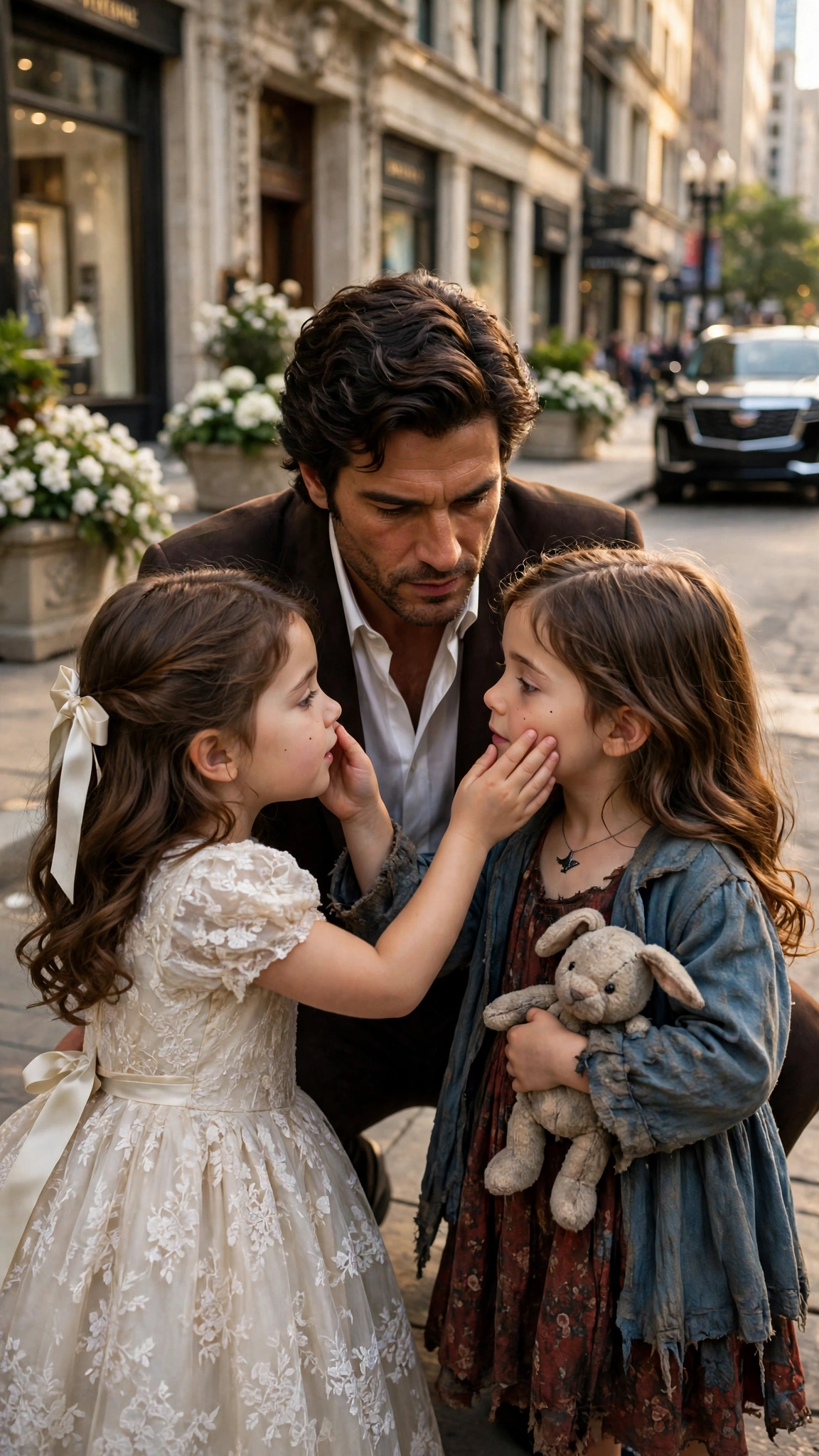
Ruby grew. She was a quiet child, watchful, with her father's gray eyes and her mother's dark-blonde hair turned chestnut by the sun. She learned to read from the backs of cereal boxes. She learned to be polite to strangers and invisible to trouble. She had one toy — a beige stuffed rabbit Elena had bought at a thrift store for fifty cents, with one ear flopping down — and she carried it everywhere, the way some children carry a shield.
When Ruby was four, she asked the question Elena had been dreading for four years.
"Mama," she said, "where is my daddy?"
Elena was washing dishes. She put the plate down very carefully, dried her hands on a towel, and sat down on the floor beside her daughter, because this was a conversation for eye level, not for standing up.
"Your daddy died before you were born, sweetheart," she said. "He was a good man. He would have loved you so much."
"Did he look like me?" Ruby asked.
"Yes," Elena said, and her voice caught, because it was true and it hurt in a way she had not expected. "He had your eyes. And your freckle." She touched the tiny freckle beside Ruby's nose. "Right here."
"Do I have a sister?" Ruby asked then, out of nowhere, the way children ask impossible questions as if they are asking about the weather.
Elena went very still. "Why do you ask that, baby?"
"I dream about her," Ruby said simply. "A girl with my face. She wears a white dress. She is happy."
Elena held her daughter until Ruby fell asleep in her arms, and then she sat awake for a long time in the dark, staring at the ceiling, wondering if grief could be inherited, wondering if her daughter was dreaming of a sister who was alive somewhere, wondering if she was going mad.
The fifth year was the worst of all, because the money ran out. The cleaning jobs dried up. The laundromat closed. Elena took a job scrubbing the floors of a restaurant downtown, and the pay was so small that some weeks there was only bread and soup, and Ruby never once complained, and that was somehow worse than if she had. Ruby was five years old and already too good at being brave, and Elena lay awake at night and thought: I am failing her. I am keeping her alive and I am failing her, and there is no way out of this that does not risk everything.
She had seen Adrian's face twice in five years. Once, on a television in a shop window, a news report about a shipping company, and there he was — older, harder, his hair touched with gray at the temples — standing beside a black car. She had frozen in the middle of the sidewalk, her heart hammering, and the voice on the television said his name, Adrian Moretti, and called him a businessman, and she had turned and walked away so fast she nearly ran, because if he was alive, then the man in the van had lied, and if the man in the van had lied, then everything was a lie, and she did not know what to do with that.
The second time was in a newspaper someone had left on a bus. A photograph. Adrian Moretti at a charity event, holding a little girl's hand. A little girl with chestnut hair and a white dress. Elena had stared at that photograph for a long time, her hands shaking, and she had thought: that is my daughter. That is Sophie. She is alive. She is beautiful. And he kept her, and he is raising her, and he never came for us.
She folded the newspaper and put it in her coat pocket, and she carried it for weeks, taking it out at night to look at it, until the paper went soft at the creases.
She made a decision then. She would not go to him. She would not risk Ruby. The men who had burned her house were still out there, whoever they were, and if they had lied about Adrian being dead, they would lie about anything, and the only safe thing was to stay small and stay hidden and keep her daughter alive. It was a mother's decision. It was the wrong decision, but it was made of love, and love is the reason for most of the wrong decisions in this world.
On the last day of September, Elena took a cleaning job at a flower stand on Michigan Avenue. The owner needed someone to sweep the sidewalk and water the white blossoms in the planters, and Elena needed the money, and Ruby needed new shoes, and so she brought Ruby with her, because there was no one to leave her with, and she told her to stay close and not to wander.
Ruby stayed close for an hour. And then she saw the flower planters, and the sun, and the crowds, and she was five years old, and she wandered — just a little, just to the edge of the next planter, where the white blossoms were thickest — and she sat down to rest her feet, because her shoes were too small and her feet hurt, and she held her rabbit against her chest.
The week before, Ruby had asked Elena about the necklace. They were sitting on the floor of the little apartment, sharing a bowl of soup, and Ruby had taken the blackbird pendant between her fingers and held it up to the light.
"Mama," she said, "why do I wear this? The other girls at the park don't have necklaces like this."
Elena had looked at the pendant for a long moment, and she had thought about the wedding day, and the church, and the lilies, and the man who had put it around her neck and told her she was the only bird in Chicago that sang before the sun came up. And she had said, very carefully, "Because it belonged to someone who loved us very much. Someone brave. And when you wear it, you carry a little bit of that love with you, wherever you go."
"Will I meet them one day?" Ruby asked. "The person who loved us?"
Elena had not known what to say. She had held her daughter's hand and said, "I hope so, baby. I hope so more than anything in the world."
Ruby had also started school that year — a free program at a community center, two mornings a week — and she had come home one day and told Elena that the teacher had asked all the children to draw their families, and she had drawn two stick figures, herself and Mama, and the teacher had said, "Where is your daddy, Ruby?" and Ruby had said, "My daddy died before I was born," the way Elena had taught her, and the teacher had patted her head and moved on. But Ruby had been quiet all evening after that, and when Elena asked her what was wrong, she said, "Mama, if my daddy died, why do I dream about him?"
"What do you dream, baby?" Elena asked, her heart beating too fast.
"I dream he is tall," Ruby said. "And he has gray eyes like mine. And he is looking for someone. He is walking down a long street, looking and looking, and he can't find who he's looking for."
Elena had held her daughter that night until they both fell asleep, and she had dreamed, too — dreamed of Adrian walking down a long street, looking for someone — and she had woken up crying, and she had told herself it was only a dream, and that dreams were not real, and that the only real things were the rent and the soup and the bus fare and keeping her daughter alive.
Elena kept a notebook. It was a cheap thing, bought at a dollar store, with a faded flower on the cover, and she kept it hidden in the back of the drawer where she kept Ruby's socks. Every Sunday night, after Ruby was asleep, she wrote a letter in it. She wrote to Adrian. She wrote about Ruby — her first tooth, her first word, the way she hummed in her sleep, the way she had asked about her father. She wrote about the apartment, and the bakery, and the bus, and the soup. She wrote about how much she missed him, and how angry she was at the men who had taken him from her, and how she was keeping their daughter safe, and how she would keep her safe for as long as it took. She never sent the letters. There was nowhere to send them. But writing them was the only way she knew to keep him alive in her own heart, and by the fifth year the notebook was nearly full, and she had started a second one, and she kept them both hidden, because they were the only proof in the world that the life she had lived before the fire had been real, and that she had not imagined it.
But dreams, as it turned out, were real. And the long street was Michigan Avenue. And the man who had been looking for someone for five years was about to find her, sitting on the edge of a flower planter with a dirty rabbit in her arms, on a sunny afternoon in late September.
And a little girl in an ivory dress, with her face, stopped on the sidewalk and pulled her father's hand and said, "Daddy, look."