The lunch rush at Sunrise Diner was in full swing when the stranger walked in.
Emma noticed him first because he did not look like a regular. The regulars came in hungry and a little rumpled, with newspapers or work boots or grandchildren in tow. This man came in neat and unhurried, in a grey suit that was expensive without being showy, his hair combed back, his smile polite in a way that never reached his eyes. He did not look at the menu. He looked at Emma.
"Miss Carter," he said, sliding into a stool at the counter while the diner buzzed around them. "My name is Nathan Reyes. I work with Damian Voss."
Emma kept her hands busy with the coffee pot. She had heard the name Voss only once, in passing, from Luca — a rival freight operator who wanted Romano freight contracts and did not like being told no. She had not paid much attention at the time. She was paying attention now.
"I'm in the middle of a rush, Mr. Reyes," she said. "If you want lunch, I can take your order. If you want something else, you'll have to be quick."
"Oh, I won't take much of your time," Reyes said, still smiling. "Mr. Voss admires people who work hard. He admires loyalty, too. He asked me to tell you that Mr. Romano's protection — well, protection has a price. And sometimes the people standing closest to a powerful man end up paying it."
The words were soft, almost friendly. That was what made them frightening. He had not raised his voice. He had not touched her. He had simply spoken, in a busy public diner, where everyone could hear the shape of a threat even if they could not quite prove it was one.
Mrs. Patel looked up from her crossword. Mr. Alvarez, at his usual table by the window, stopped mid-sentence, his coffee cup halfway to his mouth. A young mother with a toddler in a high chair pulled the child a little closer. Emma felt the whole room tilt toward listening, and she understood, with a sick clarity, that this was the point. Reyes wanted witnesses. He wanted Emma to feel watched in her own workplace.
"I'm not a messenger," Emma said, keeping her voice steady. "If Mr. Voss has something to say to Luca Romano, he can say it to him himself. I'm a waitress. I serve coffee and pie. I don't carry messages about freight contracts."
Reyes reached into his jacket — slowly, so everyone could see — and set a folded note and a plain business card on the counter. He did not slide them toward her. He left them there, like an offering, or a trap.
"Just read it when you have a moment," he said. "And think about it. Mr. Voss would hate for anything unpleasant to happen to such a hardworking young woman. Or to her mother, who I understand is not well."
Emma's blood went cold. Diane. He had brought her mother into this, casually, as if it were small talk. Her hands tightened around the coffee pot, and for a second she wanted to throw it, to shout, to do something loud and furious. But her father's voice was in her head again — steady hands fix things faster than shaking ones — and Mr. Alvarez was watching her with frightened eyes, his old hands trembling on the table.
She set the coffee pot down carefully. She walked around the counter, not toward Reyes, but toward Mr. Alvarez, and she put a hand lightly on his shoulder.
"It's all right, Mr. Alvarez," she said, loud enough for the room to hear, warm and ordinary. "Just a customer who got a little confused about what we serve here. Your toast is coming right up, and I'll bring you an extra cup, on the house."
Mr. Alvarez nodded, his breathing easing a little. The young mother relaxed, just slightly. Emma turned back to Reyes, and her voice was no longer warm.
"Pick up your card," she said. "And leave my diner."
Reyes studied her for a moment, as if he were reassessing her. "You have spirit, Miss Carter. Mr. Voss likes spirit. He also knows that spirit doesn't pay hospital bills."
"Get out," Emma said. "Now. This is my workplace, and you are not welcome in it."
Rick Dawson appeared from the kitchen doorway, his face flushed, a dish towel over his shoulder. "Is there a problem out here, Emma?"
"Mr. Reyes was just leaving, Rick," Emma said, without taking her eyes off Reyes.
Reyes picked up the folded note and the card with unhurried fingers and tucked them back into his jacket. "As you wish," he said. "But do think about the message, Miss Carter. For your own sake. And for Mr. Romano's."
He was still standing by the counter when the bell over the diner door rang again, and the whole room seemed to hold its breath.
Luca Romano walked in.
He was not with four SUVs this time, at least not visibly. He was alone in the doorway, in his tailored black suit, tall and broad-shouldered, his dark hair neat, his face calm in a way that was more alarming than anger would have been. His eyes found Emma first — checking, quickly, that she was unharmed — and then they moved to Reyes, and the temperature in the room seemed to drop.
"Mr. Reyes," Luca said, his voice level and quiet. "I don't believe you have business in this diner."
"Mr. Romano," Reyes said, turning with that same polite smile. "What a pleasant surprise. I was just having a friendly chat with Miss Carter about the freight business. Mr. Voss feels there is room for a better arrangement. One that would benefit everyone, including the people you care about."
"There is no arrangement," Luca said. He did not step closer. He did not raise his voice. He stood where he was, between Reyes and the counter, his posture straight, his hands at his sides. "And there will be no conversation about my contracts through Miss Carter. She is not part of that world. She does not carry messages for you, or for Voss, or for anyone."
"Everyone is part of it, once you care about them," Reyes said softly. "That's the price of having something to lose, isn't it? Mr. Voss simply wanted her to understand that."
Luca's jaw tightened, but his voice stayed controlled. "Then let me make something clear, so there is no misunderstanding for you to carry back. If Voss wants to talk about freight, he talks to me, directly, in a room where we can speak plainly. He does not send men to frighten waitresses during lunch. He does not mention mothers who are ill. And he does not come back to this diner. If he does, the next conversation will not be a friendly one."
It was a threat, but it was a verbal one, delivered without a raised fist, without a weapon, without anyone being touched. The diner watched, silent except for the hiss of the coffee machine and the clink of a spoon someone had dropped. Mrs. Patel had stopped pretending to do her crossword. The toddler in the high chair banged a plastic cup, oblivious, and the sound made everyone jump a little.
Reyes held Luca's gaze for a long moment, then nodded, as if a point had been made and filed away. "I'll pass along your message, Mr. Romano. Word for word." He turned to Emma, inclining his head with false courtesy. "Miss Carter. A pleasure."
And then he walked out, the bell ringing behind him, leaving the folded note and the business card behind on the counter — no, Emma realised, he had taken them with him. The counter was empty except for a faint ring where his coffee cup had never been filled. The diner exhaled.
For a few minutes, everything was noise and kindness at once. Rick clapped Emma on the shoulder and told her she had handled it well. Mrs. Patel squeezed her hand. Mr. Alvarez asked, shakily, if his toast was still coming, and Emma laughed — a real, shaky laugh — and said yes, of course, right away. She moved through the rest of the rush on autopilot, refilling cups, clearing plates, smiling at people who smiled back a little too hard, as if they were all pretending the last ten minutes had been normal.
Only when the rush thinned, and Luca was still there, waiting in booth six with a cup of coffee he had not touched, did the shaking catch up with her. She slid into the booth across from him, and for a moment she could not speak.
"Are you all right?" Luca asked quietly.
"No," Emma said honestly. "I'm not. A man just walked into my diner, in front of my regulars, and told me my kindness toward you has a price. He mentioned my mother, Luca. My mother, who is sitting at home doing a crossword and trying not to be a burden. Do you understand what that feels like?"
"I do," Luca said, and his face was grim. "And I am going to fix it. From now on, you will not be alone in this. I'll have Marco with you — at the diner, on your evening shifts, everywhere. Guards who know what to look for. No one will get near you again."
Emma shook her head, hard. "No."
"Emma —"
"No, Luca. Listen to me. I just told a man to leave my diner because I will not be used. I will not trade that for being watched at work by a bodyguard. I won't have my regulars whispering about why the waitress needs a guard, and I won't have Rick wondering whether his diner is safe. I won't quit my shifts, and I won't hide at home while you decide what's safe for me."
Luca stared at her. "Then what do you propose? Because I cannot sit by and wait for Voss to send someone else."
"A middle path," Emma said. "Marco checks in discreetly. Not standing over my tables, not following me into the kitchen. He can be nearby, he can call me, he can walk me to my car after a late shift if I'm worried. But he is not my shadow, and he is not my keeper. I keep my shifts. I keep my life. And you do not make decisions about my safety without me. Not again. Not after the grant, not after this. We decide together, or we don't decide at all."
There was a long silence. Luca looked down at his untouched coffee, and Emma saw, for the first time, not the mafia boss who could fill a street with SUVs, but a man who was genuinely afraid and did not know how to turn that fear into something useful without turning it into control.
"Agreed," he said at last, quietly. "Marco, discreetly. You keep your shifts. And I will not decide for you. But Emma — please, if you feel unsafe, you call me. Day or night. Promise me that much."
"I promise," Emma said. "If you promise to keep yours."
He nodded. Outside, the afternoon light was fading over the Chicago street, and the diner was settling back into its ordinary rhythm — clinking cups, murmured orders, the smell of pie from the kitchen. It should have felt safe. It did not, quite.
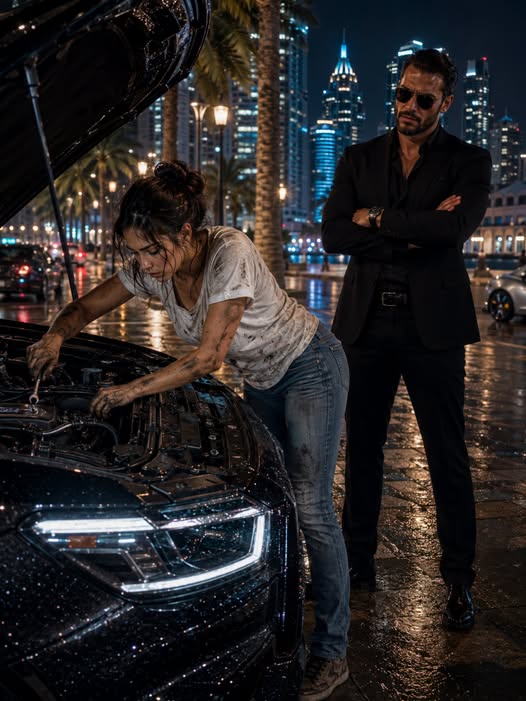
As Emma stood to clear the next table, a thought settled over her, cold and clear, and she could not shake it: she had fixed a stranger's car in the rain because it was the right thing to do, and she had refused his money because she wanted to stay free. But kindness, she realised now, had put her in the middle of Luca's world anyway — a world where a polite man in a grey suit could walk into her diner and mention her mother as if she were a bargaining chip.
And Luca, watching her move between the tables with steady hands and a brave face, realised something just as cold: he could buy buildings, command men, and fill a street with black cars, but he could not control his way out of this. He could not guard Emma into safety without losing her trust, and he could not leave her unguarded without losing sleep. For the first time in his life, power was not the answer, and the woman he cared about was standing in the very place where that truth hurt most.
That evening, after her office-cleaning shift, Emma found Marco Bellini waiting not inside the building, but across the street, beside an unremarkable car, exactly as they had agreed. He did not approach her or make a scene. He simply nodded once, walked her to the bus stop, and said, in his quiet, efficient way, that he would be nearby tomorrow, and that she only had to call if anything felt wrong. It was discreet, and it was respectful, and Emma was grateful for both — even though part of her hated that gratitude, because it meant the threat had already changed the shape of an ordinary day.
At home, Diane was asleep on the couch with her crossword unfinished and a blanket over her knees, and Emma stood in the doorway for a long moment, just watching her breathe. Her mother was stable, the doctors had said so, but stable was not the same as safe, and it was not the same as cured. Emma still had two jobs to work, bills to pay, and a mother to protect — and now, on top of all of that, a rival freight operator who knew her name, her workplace, and her mother's illness. She locked the door twice, made tea she did not drink, and sat by the window until the street outside grew quiet.
Neither of them said it aloud. They did not need to. The tension stayed in the room like the smell of coffee after closing — familiar, and not quite gone, and promising that the next visit would not be a friendly chat.