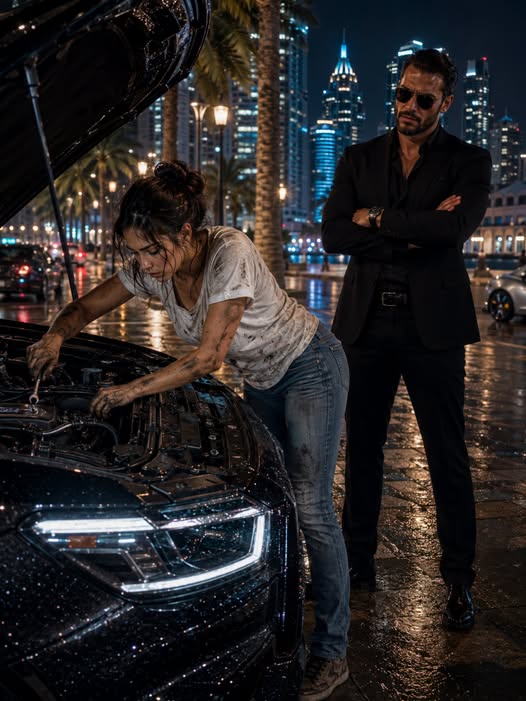
The morning after the lunch rush at Sunrise Diner, Emma Carter woke before her alarm, the way she always did when something was unresolved. Diane was already in the kitchen of their small apartment, moving slowly but steadily, a mug of tea in her hands and her pill organiser open on the counter. The morning light was thin and grey through the window, and the radiator clicked as it warmed up.
"You're up early," Diane said, looking at her daughter over her glasses.
"I'm up on time," Emma said, and kissed her mother's cheek. "Your appointment is Thursday. I put it on the fridge."
Diane smiled, a little tired, a little amused. "You put everything on the fridge."
"That's how nothing gets lost," Emma said.
It was an ordinary exchange, and Emma held on to it on purpose. The last few days had not been ordinary at all. A man she had met in the rain had turned out to be Luca Romano, and his world had arrived at her diner with four SUVs and an invitation to dinner. A charitable grant had appeared, quietly, for Diane's specialist consultation, and Emma had confronted Luca about it outside the diner and made him promise no more secret help. A stranger named Nathan Reyes had come into the diner during a lunch rush and tried to use her as a messenger, and Luca had faced him down in public with words, not fists. Emma had refused a bodyguard. She had told Luca he could not decide her safety without her.
Now she had to decide what came next, and she was determined to decide it herself.
At the diner, Rick Dawson was already counting the till and checking the specials board when Emma tied on her apron. He looked at her the way a manager looks at an employee he is fond of and slightly worried about.
"You're all right?" he asked.
"I'm all right," Emma said. "Busy, but all right."
"Good. Because we're short on the lunch shift Thursday, and I was going to ask if you could cover, but only if you want it. No pressure."
Emma almost laughed. That was the difference, right there. Rick asked. He did not arrange her life behind her back.
"I'll cover Thursday if my mum's appointment finishes in time," she said. "I'll let you know Wednesday night."
"Deal," Rick said.
The morning passed in the familiar rhythm Emma trusted: coffee refills, orders called back to the kitchen, plates cleared, a regular who wanted extra toast, a child who spilled orange juice and looked up at her, terrified, until Emma winked and said accidents happened to the best of us. Her hands knew this work. Her feet knew the floor. Nobody here needed her to be protected from her own life. They just needed her to show up and do her job well, and she did.
Luca came in the late afternoon, after the rush, when the diner was quiet enough for conversation. He did not bring SUVs this time. He came alone, in his perfectly tailored black suit, and he took the booth by the window the way a man takes a seat he is not sure he is welcome in. Marco Bellini waited outside, visible through the glass but not hovering, and Emma appreciated that small distance more than she could say.
"Hi," Luca said when she came over with coffee she had not been asked to pour but poured anyway, because that was her job.
"Hi," Emma said. She sat down opposite him, because this was not a conversation to have standing up with a tray in her hands. "We need to talk about what you offered yesterday. Or what you were about to offer."
Luca looked at her carefully. "I was going to offer you something comfortable," he said honestly. "A place where you wouldn't have to work two jobs. Security, quiet, people to help with your mother. Protection. You could leave the diner and the cleaning shifts and just… breathe."
Emma felt the offer land, heavy and tempting, and she recognised the temptation for what it was. She was tired. She had been tired for years, in the way people who work two jobs and care for a sick parent are tired. A comfortable life, handed to her, would be easy to say yes to. And that was exactly why she had to think about it clearly.
"Luca," she said, "I know you mean that kindly. But if I quit my jobs and move under your protection, then my life stops being mine. My work is not just money to me. It's how I know who I am. The diner is where people know my name and I know theirs. The cleaning shifts are mine, too, even when my feet ache at the end of them. And my mother…" She paused, glancing toward the window as if Diane might hear her from across the city. "My mother is not a problem for you to solve. She's my family. I take care of her, and she takes care of me in her own way. That's ours."
Luca did not interrupt her. He listened the way he had listened in the rain, when she had told him she did not want his money. That, Emma thought, was a good sign. The old Luca, the one Sofia would later describe to her, might have solved the problem before she finished the sentence.
"I understand," he said at last. "I don't like it, because I want you safe, but I understand it."
"It's not about liking it," Emma said gently. "It's about terms. If we're going to try this, whatever this is, I need terms. Honesty first. No secret decisions, no quiet arrangements, no help I find out about from someone else. If you want to help, you ask me, out loud, and I get to say yes or no, and no has to be a complete answer. My work stays mine. My mother stays mine. And you don't decide my safety without me in the room."
Luca nodded slowly. "Honesty. No secret decisions. Your work and your mother stay yours. And I ask before I help."
"And you accept the answer," Emma added.
"And I accept the answer," he repeated, as if he were learning a language. "Even when it's hard."
"Especially when it's hard," Emma said, and for the first time that day, she smiled at him properly.
He smiled back, a little ruefully. "My mother says I treat love like a locked door. I want to keep everyone I love on the safe side of it. I'm trying to learn that a locked door can also be a cage."
"Then we'll learn together," Emma said. "But I stay at the diner."
"You stay at the diner," Luca agreed.
Later that week, Sofia Romano invited Emma for tea at the lake estate. It was not a grand formal dinner this time. It was a quiet afternoon, just the two of them in a sunlit room with a view of the water, a teapot between them, and no staff hovering. Sofia poured with steady hands and looked at Emma with the frank warmth Emma had come to trust.
"Luca told me about your terms," Sofia said. "Good. Hold him to them."
Emma laughed, a little surprised. "You don't think I'm being difficult?"
"I think you're being wise," Sofia said. "My son loves deeply, Emma. That is his best quality, and it is also the one that can hurt people if no one holds him to honesty. Let me tell you why, so you understand the man you're dealing with, not just the suit."
Sofia set her cup down and folded her hands.
"Luca's father, Antonio, died of a heart attack when Luca was twenty-two," she said. "One morning he was there, and by the evening he was gone. There was no warning, no time to prepare, no goodbye that felt finished. Luca inherited the businesses overnight. He was barely more than a boy, and suddenly everyone was looking at him to be steady, to be strong, to make decisions that kept a whole family, and many other families, safe. He did it. He learned fast. But he learned the wrong lesson along with the right one."
"What lesson?" Emma asked softly.
"That if he controlled everything tightly enough, no one else would be lost," Sofia said. "He equated control with safety. If he could see every risk, arrange every detail, keep everyone close, then maybe the next loss would not happen. It is an understandable mistake, and it is still a mistake."
Emma thought of Luca in the diner, offering her a protected life as if protection were a gift with no cost. She understood him a little better now, and understanding did not mean surrendering.
"There was more," Sofia went on, her voice quieter. "Years later, a trusted friend of Luca's, Matteo, died in a car crash linked to rival intimidation. I will not give you details, because the details are not the point. The point is that Luca lost someone he trusted to the same world that had already taken his father, and after that, his fear hardened. He began to believe that loving someone meant guarding them, even from their own choices, if that was what it took to keep them alive."
Sofia looked directly at Emma.
"So when Luca loves you, and he does, Emma, I can see it plainly, it may look like control. He will want to decide for you. He will want to move you somewhere safer, quieter, further from risk. He will call it protection. Sometimes it will be protection. Sometimes it will be fear wearing protection's clothes. Your job, if you choose him, is to tell the difference out loud, and to hold him to honesty even when he is afraid. That is not unkind. It is the kindest thing you can do for him, because a man who is never told no will never learn that love can be safe without being a cage."
Emma felt tears prick at her eyes, and she did not hide them. "Thank you for telling me," she said. "I needed to hear that from you, not guess it."
"You are welcome here, Emma," Sofia said, reaching across the table and squeezing her hand. "Not as a guest to be guarded. As a person to be listened to. Come for dinner when you wish. Leave when you wish. That is my invitation, and it will not change."
On Thursday, Diane's appointment arrived, and Emma's ordinary life pressed in with its ordinary demands. The diner shift and the appointment overlapped awkwardly, and for a few hours Emma was caught between two responsibilities she refused to drop. She did not call Luca. She made her own plan: she asked a neighbour to sit with Diane in the waiting room, she told Rick she would be late but would still cover the end of the lunch shift, and she carried it all with the practical calm she had practised for years.
It was Luca who called her, that morning, and this time he asked.
"Emma," he said, "I know today is difficult. Would it help if I drove your mother to her appointment? Only if you want me to. You can say no, and I will understand. I am not arranging it. I am asking."
Emma stood in her kitchen, phone in her hand, Diane putting on her coat by the door, and she felt the difference between this offer and the last one like a door opening. He had asked. He had left room for no. He had not already sent a car.
"Yes," she said, surprised at how easy the yes felt when it was truly hers to give. "Yes, that would help. Thank you. But you drive her, you wait, you bring her home, and you tell me how it went. No extra doctors, no extra arrangements unless I ask."
"Agreed," Luca said. "Just the drive. Just what you asked for."
And that was what happened. Luca drove Diane to the appointment in a quiet, ordinary car, not a convoy. He waited. He brought her home. He told Emma, plainly, that the specialist had said Diane's condition was stable, managed, and needed continued care, not miracles. Diane came home tired but cheerful, and told Emma that Luca had been polite, had not fussed over her, and had let her choose the radio station. Emma laughed at that detail more than anything else, because it told her Luca had listened.
That evening, Adrian Cole stopped by the estate office briefly while Luca was finishing some paperwork. Adrian was Luca's logistics manager, a man Emma had met once at the dinner, polite and efficient, with a stack of freight schedules under his arm. He greeted Emma warmly when they crossed paths in the hallway, asked after Diane with ordinary kindness, and carried on with his work, helpful and unremarkable. Emma thought nothing more of it. There was no reason to. He was simply a colleague doing his job, and Emma had other things on her mind.
Later, Emma and Luca walked together by the lake as the evening light turned the water gold. The estate was quiet. The city felt far away, and the diner felt like another life, though Emma knew she would be back there in the morning, apron on, coffee in hand, and she was glad of it.
"So," Luca said, "do we try? On your terms?"
Emma looked at him, at the tall man in the tailored suit who had learned, slowly, to ask instead of arrange. "We try," she said. "On equal terms. Honesty, no secret decisions, my work and my mother stay mine. You offer openly. I say yes or no. And I still work at the diner."
"I can live with that," Luca said. "I can more than live with that. Emma, I would rather have you beside me, free and choosing this, than kept safe somewhere and unhappy."
"Then we're agreed," Emma said, and she took his hand. It was not a surrender. It was a choice, made in the open, by two people standing side by side, neither one locked behind a door the other had built. She would go back to Sunrise Diner in the morning, and she would come back here when she chose to, and that balance, fragile and honest, was the beginning she was willing to trust.