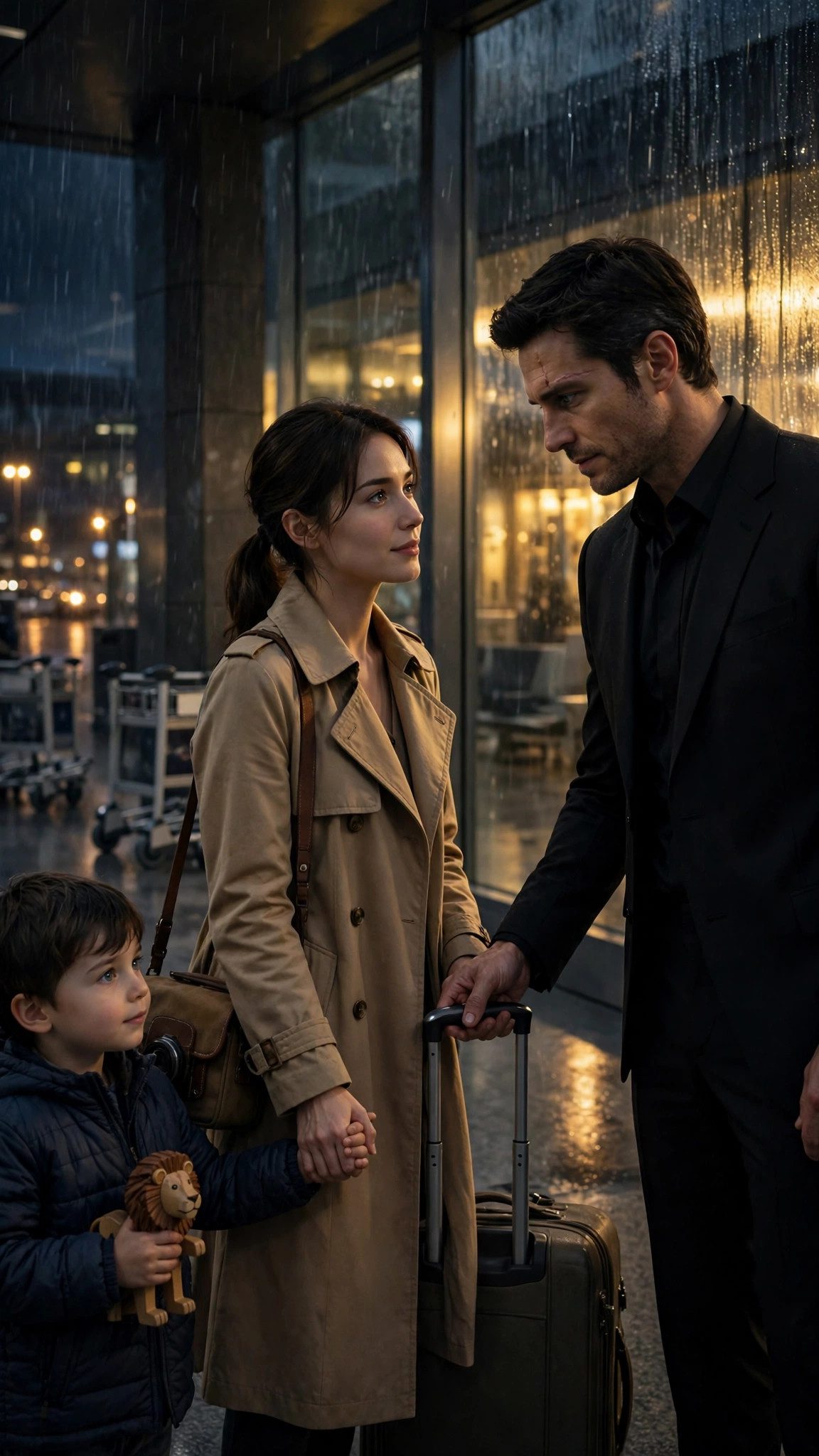
The attempt came on the third night, at the hotel, and it came the way these things always come: quietly, and from inside.
I had put Leo to bed at eight, in the little room off the suite, with his lion tucked under his arm and his red truck on the nightstand, and I had sat with him until his breathing went slow and even, and then I had gone into the sitting room, where Dante was waiting with two cups of coffee, black with one sugar, scalding hot, in plain white mugs, because he remembered, after three years, exactly how I took it, and I remembered, after three years, exactly how he took his.
Victoria had gone home to the house on Astor Street, the house she had shared with Dante for three years, to pack her things, because she had decided that she would not spend one more night under the same roof as a marriage that was already over. Dante had posted two of his men in the hallway, big quiet men named Tony and Sal, and Marco was downstairs with the car, and I had felt safe, for the first time since the text message at Sofia's, because Dante Moretti's men were outside my door, and Dante himself was sitting across from me with coffee, and Leo was asleep in the next room.
I was wrong to feel safe. Safety, in Dante's world, is always temporary.
At half past eleven, there was a knock on the door. Three sharp raps. I froze, because for one terrible second I thought it was Victoria, back again, and then I remembered that Victoria knocked three times, and so did the man in the hallway, and my blood went cold.
Dante was on his feet before the second knock, his hand inside his jacket, and he put a finger to his lips, and he moved to the door without a sound, and I understood, in that moment, why men were afraid of him, because the man standing in my hotel room was not the man who had cried at Sofia's. This was the boss. This was the man who had built an empire from a pushcart and a butcher's shop, and who had buried his father, and his driver, and a hundred other men, and who would bury a hundred more before he let anyone touch his son.
"Who is it?" he said, very quietly.
"Room service," said a voice in the hallway. "Compliments of the hotel."
"We didn't order room service," Dante said.
A pause. Then the door handle turned, slowly, and Dante stepped back, and the door opened, and a man came through it with a gun in his hand, and behind him another man, and behind him a third, and I screamed, and Leo woke up crying in the next room, and everything happened at once.
Dante moved faster than I had ever seen a man move. He caught the first man's wrist and twisted, and the gun went off, and the shot went into the ceiling, and plaster rained down on the carpet, and the second man lunged for the bedroom door, and I threw myself in front of it, because Leo was in there, my baby was in there, and I would die before I let them reach him.
"Get back!" Dante shouted, and he threw the first man into the wall, and Tony and Sal came through the door from the hallway, and there was shouting, and the sound of fists, and the crash of the coffee table going over, and one of the men grabbed my arm, hard, and I bit his hand, I actually bit his hand, and he let go with a yell, and Dante hit him, once, in the face, and the man went down and did not get up.
It was over in less than a minute. Three men on the floor. Tony with a bloody nose. Sal holding the gun. Dante standing in the middle of the room with his jacket torn and his knuckles bleeding, breathing hard, looking down at the men the way a wolf looks at traps.
"Who sent you?" he said.
The first man, the one with the gun, spat blood onto the carpet and said nothing.
"Who sent you?" Dante said again, quieter, and there was something in his voice that made the hair on my arms stand up, because it was the voice of a man who had stopped asking.
"Castellano," the man said finally. "Vincent Castellano. He wants the boy."
Dante nodded, slowly, as if he had expected it, and he looked at me, and I saw the fury in his eyes, and underneath the fury, the fear, because Castellano had sent men into a hotel in the middle of Chicago to take his three-year-old son, and that meant Castellano was no longer afraid of him, and that meant war.
"Take them downstairs," Dante said to Tony and Sal. "Find out everything. Who told them the room number. Who told them the boy was here. I want names."
They dragged the men out, and the room went quiet, and I stood in the doorway of the bedroom with my arms around Leo, who was crying into my neck, and Dante came to us, and he put his arms around both of us, and he held us, and his hands were shaking, and I understood that the most feared Mafia boss in Chicago was shaking, not from anger, but from the knowledge of how close he had come to losing us.
"I'm sorry," he whispered into my hair. "I'm so sorry. I should have had more men. I should have moved you to the house. I should have—"
"Stop," I said. "We're alive. Leo is alive. That's what matters."
He pulled back and looked at me, and his grey eyes were wet, and he said, "Elena, I need to tell you something. About your father."
"My father?" I said. "What about my father?"
Dante reached into his jacket and took out an envelope, old and creased, with my father's handwriting on the front, and he held it out to me, and my hands shook when I took it, because my father had been dead for six years, and I had not seen his handwriting in six years, and here it was, in Dante Moretti's hands, in a hotel room in Chicago, at midnight, with my son crying in my arms.
"Your father wrote this to me," Dante said, "two weeks before he died. He knew about us, Elena. He had known for a year. He had seen us together, at a banquet, and he had watched the way I looked at you, and he had watched the way you looked at me, and he wrote to me to tell me that he knew, and that he forgave me, and that he forgave you, and that the only thing he asked was that I take care of you when he was gone."
I opened the envelope with shaking hands, and I read my father's letter, and the words swam in front of my eyes.
My dear Dante, it began. I am not a young man, and I do not have much time left, and there are things I must say while I still can. I know about you and Elena. I have known for a long time. A father knows these things. I want you to know that I do not blame you, and I do not blame her. Love is not a crime, even when it is inconvenient. I only ask one thing of you. When I am gone, take care of my daughter. Not with money. With honesty. Tell her the truth, even when the truth is hard. She is stronger than you think. And Dante, if you ever have a child with her, love that child the way I loved my daughters, with everything you have, and do not let your empire come before your family, because an empire can be rebuilt, but a family cannot.
I read it twice, and then I folded it carefully and put it back in the envelope, and I looked at Dante, and I said, "He knew. All this time, he knew."
"He knew," Dante said. "And he never told you, because he wanted you to find your own way. But he told me to take care of you, and I failed, Elena. I failed for eight years, and I failed for three more, and I will not fail again."
He told me then that Castellano would be dealt with. Not that night. But soon. And when it was done, it would be done properly, and it would be the last time anyone ever threatened his family.
I looked at him, standing in the wreckage of my hotel room with blood on his knuckles and my father's letter in my hand, and I thought about the man I had met at twenty-two, the man who had crossed a room for me at the Drake Hotel, and I understood that he had never stopped being that man. He had just been buried under the empire, under the marriage, under the promises, and now, finally, he was digging himself out.
"What about my father's ashes?" I asked. "I came here to move them. I came here for five days. I didn't come here for a war."
"You came here for your father," Dante said, "and your father is still waiting. So tomorrow, at dawn, we will take him to the lake, you and me and Leo, and we will do what you came here to do. And after that, whatever happens, we will face it together. Not behind closed doors. In the daylight. As a family."
In the morning, Tony called from downstairs, and Dante took the call in the hallway, and when he came back his face was grim, and he said, "They found Adrian's car. In the parking garage. A second phone, and on it, messages to a Castellano number, and photographs of Leo, and the hotel name, and the room number. Fifty thousand dollars, transferred the day before we arrived. He sold us, Elena. His closest advisor. The man who sat at his right hand. For fifty thousand dollars, and the promise of a place in Castellano's organization."
"Where is he now?" I asked.
"Gone," Dante said. "He ran in the night. But he won't get far. Tony has men at the airport, and at the train station, and at every road out of the city. He'll be found. And Castellano will be dealt with. Not today. But soon."
Leo woke up then, and he came into the sitting room rubbing his eyes, and he looked at the broken coffee table, and the plaster on the carpet, and Dante's torn jacket, and he said, "Mama, what happened?"
"Nothing, sweetheart," I said. "Some men came to the wrong room, and Papa's friends sent them away."
Leo looked at Dante, and he said, "Are you my papa?"
Dante knelt down, so that his face was level with Leo's, and he said, "Yes. I am your papa. And I am sorry it took me so long to come and find you."
Leo thought about this for a moment, the way he thought about everything, with his grey eyes watchful, and then he said, "Do you have a big house?"
Dante laughed, a real laugh, deep and surprised, and he said, "Yes. A very big house. With a garden. And a dog. Do you like dogs?"
"I like lions," Leo said. "But dogs are okay too."
"Then we'll get a dog," Dante said. "And a lion, if we can find one."
At dawn the next morning, we drove to the lake, Dante and Leo and I, with my father's ashes in the small wooden box on my lap, and the sun was coming up over the water, turning it gold, and Leo was asleep in his car seat, and Dante drove with one hand on the wheel and the other holding mine, and for the first time in eight years, I did not feel like a secret.
We stood on the shore at Montrose Beach, where my father had taken Victoria and me when we were girls, to fly kites and eat ice cream, and I opened the box, and I scattered his ashes on the wind, and they caught the light as they fell, and Leo woke up and watched them, and said, "Mama, where is Grandpa going?"
"He's going home, sweetheart," I said. "He's going where the water meets the sky."
Leo looked up at Dante, and he said, "Can Grandpa see us, Papa?"
Dante knelt down in the sand, so that his face was level with Leo's, and he said, "Yes, Leo. I think he can. I think he can see all of us. And I think he is very proud of your mama."
"Why?" Leo asked.
"Because your mama is the bravest person I know," Dante said. "She crossed an ocean to keep you safe. And she came home to bring her father home. And that takes more courage than anything I have ever done."
Leo thought about this for a moment, and then he picked up a smooth stone from the sand, and he threw it into the lake, and it skipped twice before it sank, and he laughed, and Dante laughed, and I laughed, and for a moment the three of us stood on the shore at Montrose Beach with the sun coming up over the water, and it felt like the beginning of something, not the end.
Dante put his arm around me, and Leo took his hand, small fingers curling around one big one, and we stood there together, the three of us, watching the sun come up over Lake Michigan, and I thought about my father's letter, and I thought about the promise I had made in that little Swiss clinic, and I understood that some promises are meant to be broken, because the people who asked for them would have wanted you to break them, if they had known what was coming.
"Thank you," I whispered, to my father, to the lake, to the morning. "Thank you for knowing. Thank you for forgiving us. We are home now."