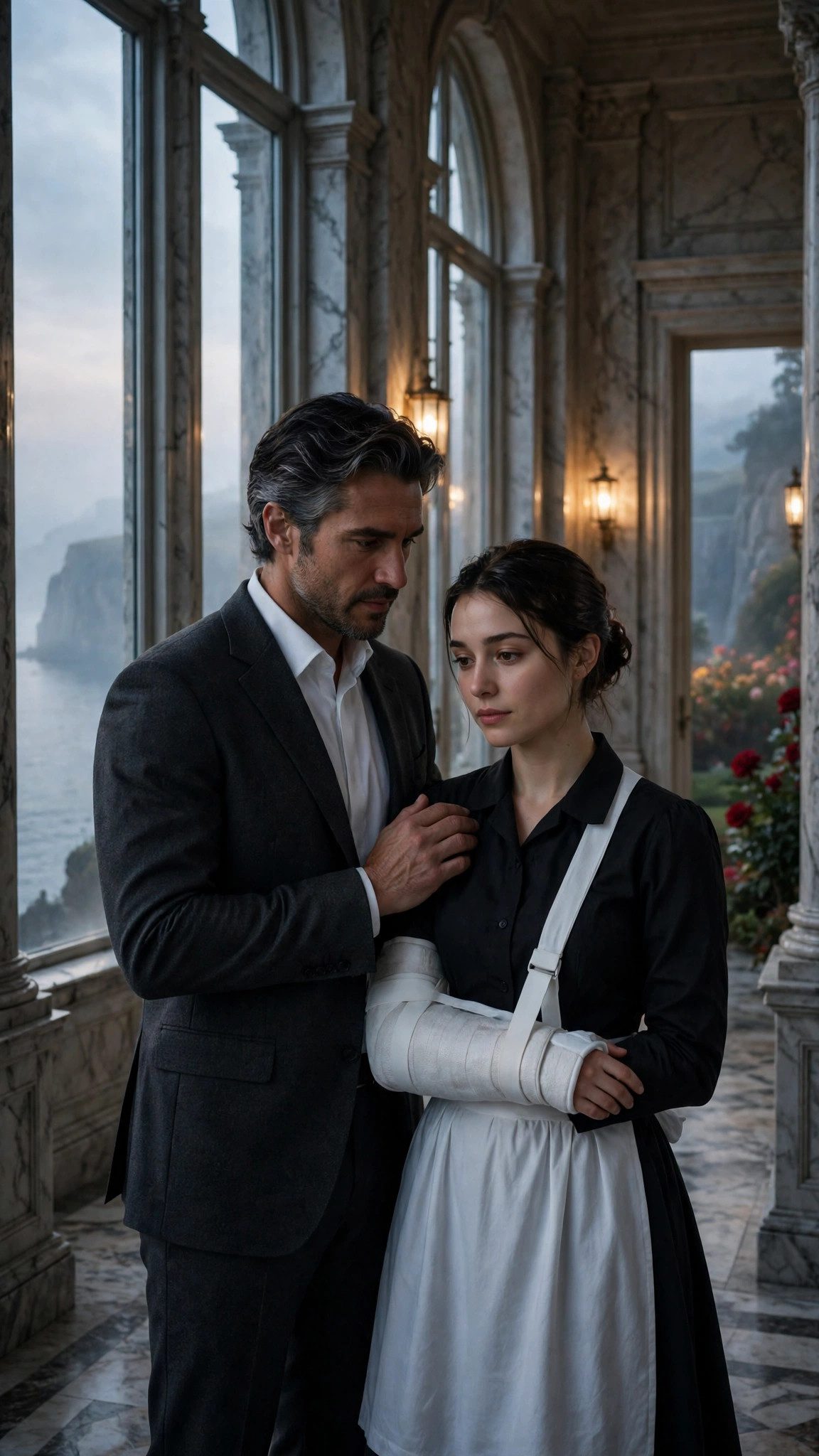
It happened on a Thursday, three weeks after I started working at the estate, and I remember the day because it was the first day of November, and the rain had been falling since dawn, and the light in the library was the color of weak tea.
That morning had started like every other morning. I woke at five, in the dark, and I dressed in my uniform, and I went down to the kitchen, where the cook was already making bread, and Mrs. Calloway was already checking the day's list, and the house was already awake, even though the sun had not yet come up. I ate a piece of toast standing at the counter, because maids did not sit down to breakfast in the dining room, and I drank a cup of tea, and I went to get my bucket and my mop, and I started with the ground-floor hallway, the way I always did.
The rain made the house feel smaller that day, and closer, and the sound of it on the roof was steady and soft, and the corridors smelled of damp stone and lemon polish. I worked my way through the rooms, one by one, dusting and sweeping and polishing, and I thought about my uncle Ray, who had called me the night before to ask how I was doing, and about the twenty-one dollars in my bag, and about the fact that I had been at the estate for three weeks and no one had asked me my name except Mrs. Calloway, and only when no one else was listening.
By mid-morning, I had finished the hallway and the dining room, and I came to the library, and I pushed the door open, and the room was empty, and the rain was drumming against the tall windows, and the books stood in their rows, thousands of them, and for a little while I could pretend that I was not a maid in a mafia boss's house, but a girl in a library, surrounded by stories.
I was dusting the library shelves, the way I did every Thursday, working my way along the tall rows of books with a feather duster in one hand and a cloth in the other. The library was the quietest room in the house. It smelled of old paper and leather and wood polish, and the rain drummed softly against the tall windows, and for a little while I could pretend that I was not a maid in a mafia boss's house, but a girl in a library, surrounded by stories.
The folder was on the desk. It was a plain black folder, the kind lawyers use, and it was lying open, as if someone had been reading it and had been called away in a hurry. I would not have looked at it. I had been trained since I was seven years old not to look at other people's papers. But the top page had slid halfway out, and I could see a diagram on it, a drawing of something round and metal with wires coming out of it, and underneath the diagram there were words in a language I did not recognize, and a list of numbers.
I should have looked away. Mrs. Calloway had warned me. My mother had taught me. But I was twenty-six years old, and I had spent my whole life looking away, and for one moment, I did not.
I picked up the folder. Inside it there was a black envelope, thick with money, and a second page with a list of names, and a third page with a map of the harbor, and the boathouse at the bottom of the cliff circled in red ink. And underneath it all, there was a photograph of a man I did not know, standing next to a crate, and on the back of the photograph someone had written a word in Russian.
I put the folder down. My hands were shaking. I did not know what an explosive device looked like, but I knew what a diagram of one looked like when I saw it, and I knew that the black envelope full of money was not the kind of money that paid for groceries, and I knew that the boathouse circled in red ink was the same boathouse I had seen men carrying heavy boxes into after midnight.
I turned to leave. And Daniel Blackwell was standing in the doorway behind me.
He was thirty-four years old, and he was handsome in the way that dangerous men are handsome, with dark hair and dark eyes and a smile that never reached his eyes. He wore a charcoal suit, and his shoes were polished, and he stood in the doorway with his arms crossed, blocking the only way out of the room.
"You found something that does not belong to you," he said. His voice was quiet, almost gentle, and that made it worse.
"I was only dusting, sir," I said. "I did not read anything. I put it back."
"You read enough," he said. "I can see it in your face."
He came toward me, and I backed away, and my back hit the desk, and there was nowhere else to go. He took my right wrist in his hand, and his grip was like iron, and he looked down at me, and his eyes were cold.
"Listen to me, Kate Bennett," he said, and the fact that he knew my name frightened me more than anything else, because no one in this house knew my name, and the fact that he did meant that he had been watching me. "You saw nothing. You read nothing. You will tell no one, not Mrs. Calloway, not your uncle, not anyone. If you speak about what you saw, you will disappear, and so will your family. Do you understand me?"
"Yes," I whispered. "I understand."
"Good," he said. And then he twisted my wrist.
The pain was sudden and white and total, like lightning going up my arm. I heard a sound, a small, dry crack, like a twig snapping, and I cried out, and he let go of me, and I fell against the desk, clutching my arm to my chest.
"That is a reminder," he said calmly, straightening his jacket, as if he had just done something ordinary, like signing a letter. "A reminder that some things in this house are not for you. Now go back to work."
He walked out of the library, and I stood there for a long time, holding my broken arm, listening to the rain on the windows, and trying not to cry, because crying would make noise, and noise would bring someone, and someone would ask what had happened, and I had been told what would happen if I told.
I went to the bathroom and ran cold water over my wrist, and I wrapped it in a towel, and I found a tube of menthol ointment in the staff medicine cabinet, and I rubbed it into the bruise, and I pulled my sleeve down low over my wrist, and I went back to work.
That afternoon, I dusted the guest wing with one hand, and every time I reached up to a high shelf, the pain shot through my arm like a white-hot wire, and I had to stop, and press my forehead against the cool wall, and wait for the pain to pass. The guest wing had six bedrooms, and each one had tall windows looking out over the bay, and the rain was still falling, and the light was grey, and I thought about the folder, and the diagram, and the black envelope, and I wondered how many other people in this house had seen things they were not supposed to see, and how many of them had been hurt for it, and how many of them had disappeared, like Ana, without anyone asking where they had gone.
At dinner, in the staff kitchen, I sat in the corner with my plate, and I ate with my left hand, and I kept my right arm under the table, and no one asked me why, because no one in this house asked questions about things like that. Mrs. Calloway looked at me once, and her eyes went to my wrist, and I saw her mouth tighten, and then she looked away, and she said nothing, and I understood that she knew, or that she guessed, and that she was afraid, too.
That night, I lay in my bed and I listened to the rain, and I thought about what Daniel had said, about disappearing, and about my family disappearing, and I thought about my uncle Ray, alone in his small house by the docks, and I thought about my mother, and I thought about Tommy, and I thought about the fact that I had no one to protect me, and no money to run, and no place to go, and that the only thing standing between me and disappearing was my own silence.
I took the wooden box out of my bag, and I opened it in the dark, and I touched the twenty-one folded dollar bills, one by one, with my good hand, and I whispered to myself, "You are Kate Bennett. You are still here. You are still alive." And then I put the box away, and I closed my eyes, and I slept, because there was nothing else I could do.
For three days, I worked with a broken arm. I carried buckets with my left hand. I wrung out mops with one hand. I dusted shelves and folded sheets and polished silver, and every time I moved my right arm, the pain shot up to my shoulder, and I bit my lip and kept working, because I could not afford to stop.
I could not afford to stop because I had twenty-one dollars in a wooden box, and a two-bedroom apartment, and an uncle who was sixty years old and tired, and no one else in the world. I could not afford to stop because if I lost this job, I would have nothing, and Daniel Blackwell knew that, and that was why he had done it. He had not broken my arm because he was angry. He had broken it because he knew I could not afford to tell anyone.
The next morning, I woke before dawn, as I always did, and my arm was worse. The swelling had spread, and the bruise had darkened, and when I tried to make a fist, I could not, and the pain made me gasp. I sat on the edge of my bed, in the dark, and I thought about calling in sick, and then I thought about what would happen if I did — Mrs. Calloway would ask questions, and Daniel would hear about it, and he would know that I had not obeyed him, and I did not know what he would do next.
So I got up, and I dressed, slowly, with one hand, and I went down to the kitchen, and I ate my toast standing at the counter, the way I always did, and I took my bucket and my mop, and I went to work, and I told myself that if I could survive one more day, I could survive another, and if I could survive another, I could survive a week, and if I could survive a week, perhaps the bone would heal on its own, and perhaps Daniel would forget about me, and perhaps the house would forget about me, too.
It was a foolish hope, and I knew it was foolish, but it was the only hope I had, and I held onto it the way a drowning person holds onto a piece of wood.
On the third day, Mrs. Calloway brought me tea in the kitchen, and she looked at my wrist, and her eyes narrowed.
"Your wrist is swollen, Kate," she said.
"I fell," I said. "On the stairs at home."
She looked at me for a long moment, and I could see that she did not believe me, and I could also see that she was afraid, and that she did not want to know the truth, because knowing the truth in this house was dangerous.
"Be careful," she said at last, and she went away.
That night, I lay in my small room in the staff wing, and I held my broken arm against my chest, and I thought about my mother, and about Tommy, and about the wooden box with twenty-one dollars in it, and I thought about the folder in the library, and the diagram, and the black envelope, and the boathouse circled in red ink, and I understood, for the first time, what kind of house I was living in.
It was not a house. It was a warehouse. It was a place where men brought things in the dark and took them away in the dark, and where a maid who saw something she should not see got her arm broken for it, and where nobody asked questions, because questions got people killed.
I thought about leaving. I thought about packing my bag and walking out of the estate and never coming back. But where would I go? I had no money. I had no other job. I had an uncle who needed me, and an apartment I could barely afford, and twenty-one dollars in a wooden box.
And so I stayed. I stayed, and I worked, and I hid my broken arm, and I told myself that if I was quiet enough, and invisible enough, the house would forget about me, and Daniel Blackwell would forget about me, and I would survive.
I was wrong. The house did not forget about me. The house was about to learn my name. And somewhere, in the dark corridors below my room, the men who had broken my arm were already beginning to understand that the girl they had tried to silence was not going to stay silent forever.