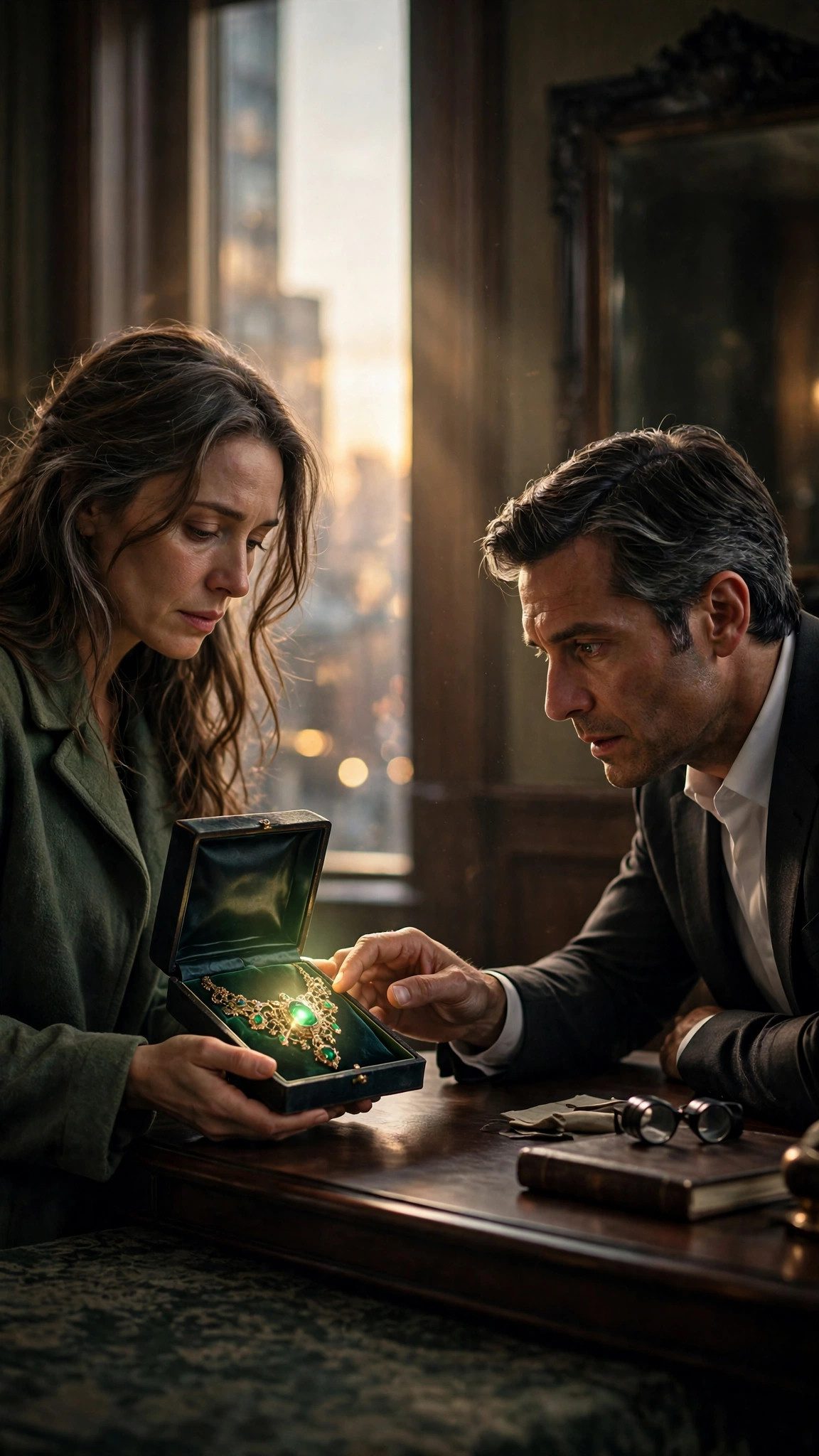
The document on the desk was old. The paper had yellowed at the edges, and the ink had faded to a soft brown, and the handwriting was careful and slanting, the handwriting of a man who had been taught to write with a fountain pen and had never forgotten the lessons.
Marcus laid his hand flat on it, the way a man lays his hand on a Bible when he swears an oath.
"Before anyone touches that necklace again," Marcus said, his voice calm and cold in a way Valerie had not heard from him before, "we will look at this."
Vincent Castellano laughed. "Another letter? Your widow's letters will not stand up in court, old man. My wife's claim is documented. I have the family records. I have the lawyers. I have —"
"You have nothing," Marcus said. "Sit down, Mr. Castellano. You are going to want to sit down for this."
Something in Marcus's voice — the quiet authority of a man who had spent forty years watching powerful men destroy themselves — made Castellano pause. He did not sit down, but he stopped reaching for the necklace, and he folded his arms, and he waited with the impatience of a man who is certain he is about to be proven right.
Marcus turned the document toward Valerie first. "Mrs. Bennett," he said gently, "this is your grandmother's will. It was filed with the county court in 1998, and it has been a matter of public record for twenty-eight years. It leaves the 1921 emerald and gold necklace to you, Valerie Bennett, by name, as her only living granddaughter in the direct female line. It also leaves a letter, which I have here, in a sealed envelope, addressed to whoever holds the necklace when it is next appraised."
Valerie's hands were shaking so hard now that she had to press them together to hold them still. "My grandmother never told me about a will."
"She told me," Marcus said. "Twenty-eight years ago, Rose Bennett came to this building — to the law offices on the ninth floor — and she asked for a man she could trust with a secret. I was that man. She told me the history of the necklace, and she told me that one day, someone would come for it, and that when that day arrived, I was to produce this will and this letter, and let the truth speak for itself."
Castellano's face had gone dark. Beneath the cold smile, Valerie could see the truth Marcus had already seen: this was a man who had married for money and for position, and who had spent his marriage spending his wife's inheritance faster than she could protect it. Bianca Castellano, she would learn later, was a quiet woman who had grown up in a house where her husband made every decision, and who had signed papers she did not understand because she had been taught that wives do not ask questions. She had not known the papers were forgeries. She had not known her husband planned to steal from her own cousin. She had known only that he had come home one evening and told her that the Bennett necklace was hers by right, and that she should be grateful he was fighting for her family. "A will filed in 1998 proves nothing about who the necklace belonged to before that. The necklace was Cain property — everyone in this city knows the story. Elias Cain gave it to a woman who was not his wife, and his family has wanted it back for a hundred years."
"That is correct," Marcus said. "Elias Cain gave the necklace to Rose Bennett in 1921, as a gift, freely given, with a letter of his own — which is also here." He lifted a second document from his briefcase, older still, the paper thin as tissue. "Elias Cain wrote that the necklace was a gift of love, and that it belonged to Rose and to her daughters after her, in the direct female line, forever. He wrote that no man of the Cain family had any claim on it, then or ever, and that any man who tried to take it back would be acting against his written wishes."
Valerie stared at the two documents, and the room seemed to tilt beneath her. Her grandmother had loved a man named Elias Cain. The necklace was a gift of love. And the man she herself had loved, twelve years ago, had been Elias Cain's grandson — and she had never known.
"Who are you?" she whispered to Marcus. "How do you know all of this?"
Marcus looked toward the one-way glass, and for the first time, Valerie followed his gaze. She saw only her own reflection in the mirror — a tired woman in a faded green coat, holding a velvet box like a shield. She did not see the man standing behind the glass, watching her with eyes that had not changed in twelve years.
"I am the man your grandmother trusted," Marcus said. "And I am the man who has waited twenty-eight years to keep a promise. But there is someone else you should ask, Mrs. Bennett. Someone who has waited even longer than I have."
At that moment, the door behind Valerie opened — not the door Castellano had entered through, but a second door, one she had not noticed, set into the wall beside the mirror. And Nathaniel Cain walked into the room.
Valerie Bennett had imagined this moment a thousand times in twelve years. In her imagination, she was always younger, and he was always younger, and the room was always the small kitchen where he had kissed her forehead and promised to come back tomorrow. In her imagination, she always knew what to say.
In reality, she said nothing at all. She simply stared at him, the velvet box clutched to her chest, her mouth open, her eyes filling with tears she had not cried in twelve years.
He was older now. His dark hair was threaded with grey at the temples. There were lines at the corners of his eyes, and a hardness in his face that had not been there when he was thirty-three. But his eyes were the same — the same dark, quiet eyes that had looked at her across a free clinic waiting room and decided, without a word, that she was worth sitting down for.
"Hello, Valerie," Nathaniel Cain said, and his voice was low and rough, like a man speaking after a long silence. "I am sorry it took me twelve years to say that."
Castellano recovered first. "Cain," he said, his voice dripping with contempt. "Of course. The ghost in the walls. You own this building, you own this appraisal, you own this little performance — and you expect me to believe any of it? Your family has wanted that necklace back for a century. You staged this entire scene to steal it from my wife."
"I staged nothing," Nathaniel said. He did not look at Castellano. He looked only at Valerie. "Twelve years ago, my father ordered me to take that necklace from you. He told me it was Cain property, stolen by sentiment, and that I had to choose between my family and you. I chose my family, and I walked away, and I have regretted it every day since. I never took the necklace. I never told my father I had refused. I simply left, and I let you believe I did not love you, because the truth was worse: I loved you, and I was too much of a coward to fight for you."
Valerie's tears spilled over then, running down her cheeks, and she did not wipe them away. "You left without a goodbye," she whispered. "I waited for a month. I went to the clinic. I walked every street we walked. You were just gone."
"I know," Nathaniel said. "And I am not here to ask you to forgive me. I am here because that man" — he finally turned to Castellano — "is lying to you, and because the documents on this desk prove it."
Castellano's hand moved toward his jacket, and Marcus's voice cut through the room like a whip. "Do not," Marcus said. "There are six of Mr. Cain's men in the hallway, Mr. Castellano, and they have all seen your two men waiting outside. You will not reach for anything in this room."
Nathaniel stepped to the desk and picked up the second document — Elias Cain's letter — and held it out to Valerie. "Read it," he said softly. "Your grandmother kept his letter with the necklace for ninety years. She loved him, Valerie. And he loved her. My father spent his life trying to erase that, because a Cain does not love a laundry worker's granddaughter — a Cain marries for advantage and takes what he wants. My grandfather was the only honest man in my family, and he paid for it with a lifetime of silence."
Valerie took the letter with trembling hands. The handwriting was old and careful. The words were simple, and they broke her heart open in a way nothing had in twelve years: "My dearest Rose, this necklace is yours, and your daughters' after you, forever. No man of my family has any claim on it. I loved you, and I am sorry the world was too small for us. — Elias."
She looked up at Nathaniel, and the twelve years between them collapsed into nothing. "Your grandfather," she whispered. "My grandmother. They —"
"They loved each other," Nathaniel said. "And the world was too small for them. My father made sure the world stayed small for me, too. He is dead now, Valerie. And I am done living in the cage he built."
Castellano slammed his hand on the desk. "This is a fraud! A will from 1998, a letter from a dead man — my wife has the real documents, and my lawyers will —"
"Your wife has forgeries," Marcus said calmly. He opened a folder and slid a third set of papers across the desk. "I had your wife's documents examined this morning, Mr. Castellano, by the same firm that examined your claim on the Harlow estate last year. The paper is wrong. The ink is wrong. The signatures were traced. Your wife's great-aunt was not Rose Bennett's sister — Rose Bennett had no sisters. Your claim is a fabrication, and you know it. You came here today because you heard a widow was selling a two-hundred-thousand-dollar necklace for one thousand dollars, and you thought you could frighten her into giving it to you."
The color drained from Castellano's face. For a moment, the cold smile was gone, and Valerie saw what was underneath it: a frightened man, caught, with nowhere left to go.
"You cannot prove that in court," Castellano said, but his voice had lost its certainty.
"I do not need to prove it in court," Nathaniel said quietly. "I need only to make one phone call, and the men who examined those documents will make one phone call, and by tomorrow morning, every family in this city will know that Vincent Castellano tried to steal a widow's inheritance with forged papers. Your wife will know. Your creditors will know. Your rivals will know. Or — you can walk out of this room now, and never come near Valerie Bennett or her family again, and I will let this be a story no one ever tells."
Castellano looked at Nathaniel for a long moment. Then he looked at Marcus, and at the documents on the desk, and at Valerie, who stood holding her grandmother's jewel with tears on her face and steel in her spine. He turned on his heel and walked out of the room without another word. His two men followed him, and the door closed behind them, and the quiet room was quiet again.
Valerie looked down at the necklace, and then up at Nathaniel, and she said the only thing she could think of to say.
"Why did you come back?"
Nathaniel Cain looked at the woman he had loved for twelve years, and he told her the truth.
Valerie read the letter twice, and then she read it a third time, slowly, the way you read something you are afraid you will never see again. The handwriting was old and careful, and the paper was thin as tissue, and the words were simple — but behind them, she could hear her grandmother's voice, and a young man's voice she had never heard, speaking across ninety years.
"My dearest Rose," the letter began, and Valerie's breath caught, because her grandmother had never once, in all the years Valerie had known her, spoken of a man who called her "my dearest Rose." "This necklace is yours, and your daughters' after you, forever. I give it freely, and I give it with all my heart. No man of my family has any claim on it — not my father, not my brother, not my son, not any man who comes after me. If they come for it, show them this letter, and tell them that Elias Cain loved you, and that love is the only law that matters. I am sorry the world was too small for us. I will carry you in my heart until the day I die, and beyond it. — Elias."
Valerie looked up, and her eyes were full of tears, and she said, "She never told me. All those years, she never told me his name. She said the necklace was a promise, and I thought she meant a promise to her husband. I never knew she meant a promise from a man she loved and could not marry."
"She protected you," Nathaniel said quietly. "She protected the necklace, and she protected you, by never telling you what it was worth — in money, or in history. If you had known, men would have come for you sooner. Your grandmother was a wise woman, Valerie. She kept the secret until the day it was needed, and she trusted Marcus to keep it with her."
Outside the door, in the hallway, Castellano's two men stood with their arms folded, and they did not know that inside the room, their employer's claim was coming apart. They did not know that six of Nathaniel's men were standing at the far end of the corridor, watching them, waiting for a signal that never came. The hallway was silent, the way hallways are silent before a storm breaks — or before it passes.
"Because I finally understood what my grandfather knew in 1921," he said. "That a jewel is only a jewel. And a promise is everything."