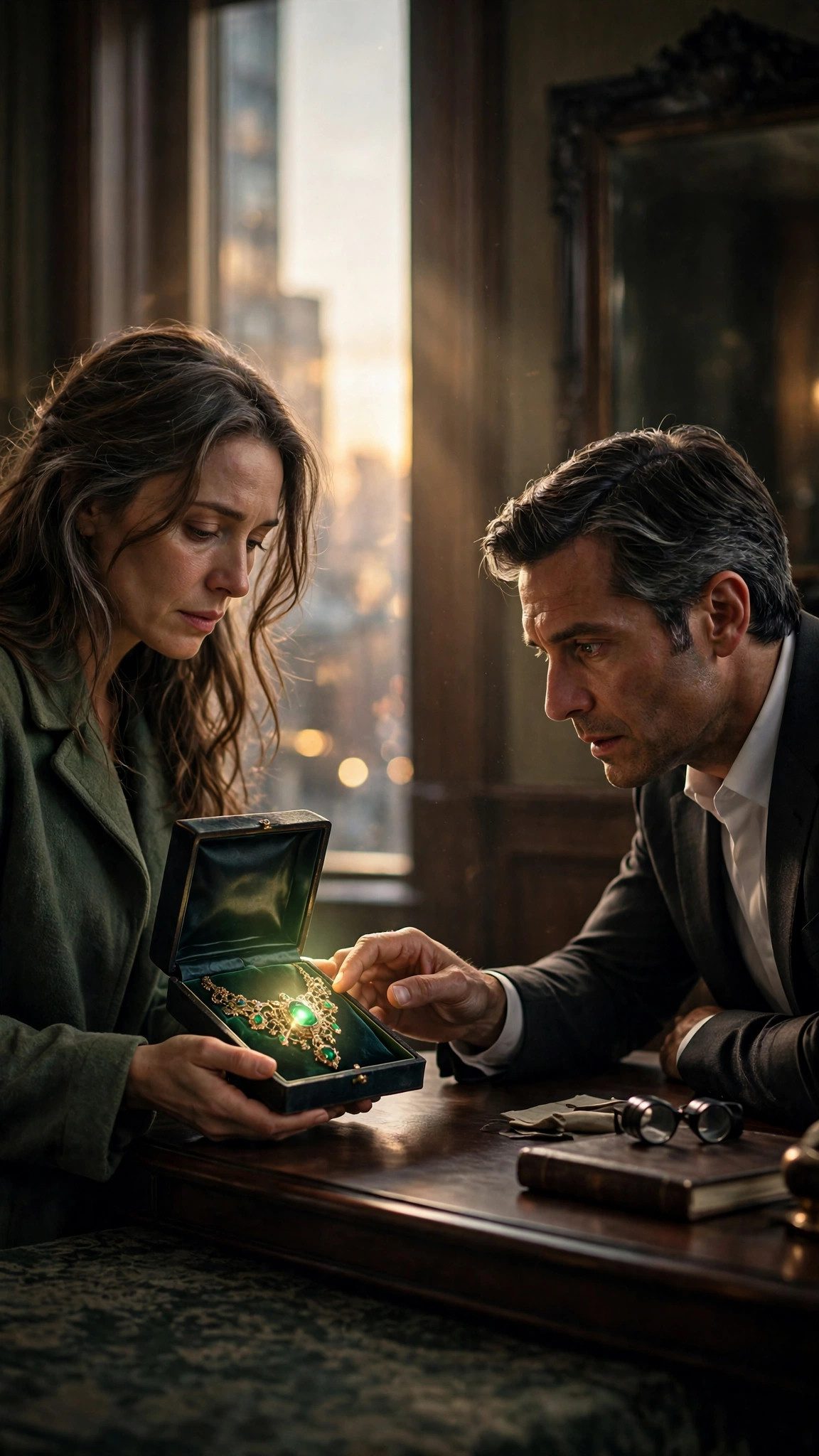
After Castellano left, the room was so quiet that Valerie could hear her own heartbeat.
Nathaniel stood on the other side of the desk, looking at her the way he had looked at her twelve years ago in the clinic waiting room — like she was the only real thing in a world full of performances. Marcus quietly gathered the documents and put them back in his briefcase, and then he did something Valerie would remember for the rest of her life: he bowed his head slightly to her, the way a man bows to a woman he respects, and he walked out of the room and closed the door behind him, leaving them alone.
"Valerie," Nathaniel said. "Your mother. Tell me about her."
Valerie sat down slowly, as if her legs had only just remembered they were tired. She set the velvet box on the table between them, and she told him. She told him about the laundry, and the forty years of hot water, and the knees, and the breathing, and the word the doctor had said last winter. She told him about the chemotherapy, and the one thousand dollars, and the electricity, and the bills on the kitchen table. She told him about Thomas, and the heart attack in the classroom, and the green coat, and the three years of eating one meal a day so her mother could eat three.
Nathaniel listened without interrupting, his hands flat on the desk, his eyes never leaving her face. When she finished, he was quiet for a long time.
"One thousand dollars," he said at last. "You came here to sell a two-hundred-thousand-dollar necklace for one thousand dollars, because that was all your mother needed, and you did not ask for a penny more."
"I didn't know it was worth two hundred thousand," Valerie said. "And even if I had known, I would have asked for one thousand. That is what Mama needs. The rest — the rest would have felt like stealing from my grandmother."
Nathaniel reached into his jacket and took out a checkbook. He wrote a check, tore it out, and slid it across the desk. Valerie looked down at it, and her breath caught.
It was a check for two hundred thousand dollars, made out to Valerie Bennett.
"No," she said immediately, pushing it back toward him. "No, I can't take that. I didn't come here for a fortune. I came here for my mother's medicine."
"You are not taking it," Nathaniel said. "You are being paid what your necklace is worth. That is the appraisal, Valerie. That is what Marcus told you it was worth. If you sell it to me, I will pay you its full value. That is business. That is fair. And it is the least I owe you."
Valerie stared at the check. Two hundred thousand dollars. Her mother's chemotherapy, ten times over. The electricity. The rent. The debts. A small house with a garden. A life without fear. It was everything she had dreamed of in the dark, in the kitchen, with the velvet box open in front of her — and it was the last thing in the world she wanted to take from this man.
"I don't want to sell it to you," she whispered. "If I sell it, then it's gone, and my grandmother's promise is gone with it, and I will have nothing left of her except a letter I can't bear to read. I don't want your money, Nathaniel. I want —" She stopped, because she did not know what she wanted. She wanted her mother to live. She wanted Thomas back. She wanted her grandmother's kitchen, and the tea too strong and too sweet, and the man she had loved at twenty-six to have been brave enough to stay.
Nathaniel took the check back, folded it once, and put it in his pocket. Then he took out his phone and made a call.
"Marcus," he said. "Pay St. Mary's Hospital in full for Margaret Ellis — every bill, every treatment, past and future, for as long as she needs it. Pay the electricity company. Pay the rent for a year. Do it now, and do it in Valerie Bennett's name, not mine." He listened for a moment, and then he said, "And Marcus — find out who Vincent Castellano's creditors are. I want to know everything about his debts by tomorrow morning."
He hung up, and he looked at Valerie, and his voice was quiet and steady. "Your mother is safe, Valerie. The hospital has been paid. The electricity will stay on. The rent is paid for a year. No one will ever call you about a bill again. I want you to hear me say that, and I want you to believe it, because I know that believing good news is harder than believing bad news, when bad news is all you have heard for three years."
Valerie stared at him, and she tried to believe it, and she could not — not all at once. Belief came slowly, the way dawn comes slowly, in small pieces of light. She thought about the kitchen table, and the bills piled on it like snow, and the hospital bracelet, and the one thousand dollars. She thought about her mother, sleeping in a hospital bed, breathing the shallow, careful breaths of a woman whose lungs were losing a war. And she thought about the man in front of her, who had left her twelve years ago without a goodbye, and who was sitting across from her now, telling her that her mother was safe.
"Keep the necklace," he said. "It was never mine to buy. It was your grandmother's gift, and it belongs to you, and to your daughters after you, forever. I will not take it from you. I will not let anyone take it from you. Your mother's bills are paid, Valerie — not as a price for the necklace, and not as a debt you owe me. As a gift. As the beginning of an apology that will take me the rest of my life to finish."
Valerie covered her face with her hands, and for the first time in twelve years, she cried — not the quiet tears of the appraisal room, but great, shaking sobs that came from somewhere deep and old, the grief of twelve years of waiting, and three years of widowhood, and a winter of watching her mother fade. Nathaniel came around the desk, and he knelt beside her chair, and he held her hand the way he had held it in the clinic all those years ago, and he did not say a word. He simply stayed, and let her cry, and waited for her to be ready.
When her tears finally slowed, Valerie wiped her face with the sleeve of her green coat, and she laughed — a small, broken sound, but a laugh.
"Thomas bought me this coat," she said. "He said green was my color. He said I looked like spring."
"He was right," Nathaniel said.
"He was a good man," Valerie said. "He loved me, and he knew — he always knew — that there was a part of me that belonged to someone else. He never held it against me. He used to say that a heart is big enough for more than one love, and that the second love doesn't erase the first."
Nathaniel was quiet for a long time. "I am sorry I was not there when he died," he said at last. "I am sorry for all of it. For the twelve years. For the lies. For the cowardice. My father is dead, Valerie, and I have spent the last three years dismantling everything he built — the fear, the threats, the men in hallways. I am not the man I was at thirty-three. I am not asking you to love me again. I am asking you to let me prove that I am finally the man your grandmother believed I could be when she looked at me that first Sunday and said I had my grandfather's eyes."
Valerie looked at him for a long moment, and then she said, "Take me to her. Please. Take me to my mother."
Nathaniel stood, and he held out his hand, and Valerie took it, and they walked out of the appraisal room together, past the mirror that was glass, past the corridor of thick carpet and closed doors, past the elevator that was silent and fast — and out into the evening, where the city glittered, and the hospital waited, and the rest of their lives were about to begin.
That night, Vincent Castellano made his move.
Valerie looked at him for a long moment. "Rose said that to you? That you had your grandfather's eyes?"
"She did," Nathaniel said. "And I spent twelve years wondering what she meant. Now I know. She meant that I had his heart, too — and that I was wasting it."
That night, Vincent Castellano made his move.
It was not subtle. Castellano was not a subtle man. At nine o'clock, two of his men went to St. Mary's Hospital and asked for Margaret Ellis's room, claiming to be family. The night nurse, a woman named Angela who had worked at St. Mary's for thirty years and had seen every kind of trouble a hospital can hold, took one look at them and called security. Security called Marcus. Marcus called Nathaniel.
Nathaniel arrived at the hospital at nine-thirty, with four of his own men, and he found Castellano's men in the parking lot, arguing with a security guard half their size who refused to move. Nathaniel walked up to them, and he did not raise his voice — he never raised his voice — and he said, "You have a choice. You can leave this hospital now, and never come back, or you can explain to the police why two men with no connection to Margaret Ellis were trying to enter her room at nine o'clock at night."
The men left. Nathaniel stood in the parking lot for a long time, looking up at the hospital windows, at the small square of light that was Margaret Ellis's room. Then he went inside, and he sat with Valerie beside her mother's bed, and he held her hand while her mother slept, and he told her about the call Marcus had made, and the debts Castellano owed, and the fact that by tomorrow morning, Castellano would have larger problems than a widow's necklace.
"He will come back," Valerie whispered. "Men like that always come back."
"Not this time," Nathaniel said. "I have spent twelve years building an empire out of fear. Tomorrow, I will spend it protecting the people I love. There is a difference, Valerie. I am finally learning what it is."
Margaret Ellis opened her eyes then, and looked at the tall man in the dark suit sitting beside her daughter's bed, and she smiled — a tired, knowing smile, the smile of a woman who has seen enough of life to recognize love when it sits down next to her.
"You must be Nathaniel," she said, her voice thin but clear. "Rose told me about you. She said you had kind eyes, and that you were a fool, and that fools sometimes learn. Are you learning, Nathaniel?"
"Yes, ma'am," Nathaniel said. "I am learning."
"Good," Margaret said, and closed her eyes again. "Then take care of my daughter. She has taken care of everyone else for long enough."
Nathaniel looked at Valerie, and Valerie looked at him, and in the quiet hospital room, with her mother's hand in hers and his hand over hers, twelve years of silence finally ended — not with a grand gesture, and not with a promise, but with a simple truth, spoken in a whisper, in the dark.
Marcus spent that night the way he had spent a hundred nights before it: at his desk, in the dark, with a telephone and a list of names. He called Castellano's creditors one by one, in the calm, precise voice of a man who has never once raised his voice and never once needed to. He did not threaten anyone. He did not have to. He simply told each creditor, in turn, that Vincent Castellano had attempted to defraud a widow with forged documents that afternoon, that the documents had been examined by a reputable firm, and that the report would be public by morning. He asked each creditor, politely, whether they wished to be associated with a man who stole from widows.
By eight o'clock, three loans had been called in. By nine, the firm had sent its report to two newspapers and one federal investigator, and Marcus had made a second round of calls — this time to the men Castellano owed money to in rooms without windows, men who did not read newspapers but who understood, perfectly, what it meant when a man's name appeared in a report about fraud.
"Mr. Castellano will be leaving the city," Marcus told one of them, in the same calm voice. "I suggest you collect what you are owed before he does."
By midnight, Castellano's world was a house with its supports kicked out, waiting for a wind. Marcus put down the telephone, poured himself a glass of water, and sat for a long time in the dark, thinking about Rose Bennett, and the rainy afternoon in 1998, and the promise he had kept for twenty-eight years. He had kept it. It was done. And for the first time in twenty-eight years, he felt the weight of the briefcase on his desk grow lighter.
At the hospital, Margaret slept and woke and slept again, and each time she woke, Nathaniel was there, sitting in the chair beside her bed, and Valerie was there too, holding her mother's hand. At two in the morning, Margaret woke and asked for water, and Nathaniel held the cup while she drank, and she looked up at him with eyes that were tired but clear.
"Rose told me about Elias," Margaret said softly. "She told me on the night before she died. She said he was the love of her life, and that she had married my father because my father was a good man, and that a woman can love two men in a lifetime, and neither love makes the other smaller. She said Nathaniel would come back one day, and that when he did, I should tell him that."
"Tell me what, Mrs. Ellis?" Nathaniel asked.
"That Rose forgave him," Margaret said. "She forgave your grandfather, for not being brave enough. And she forgave you, before she ever met you, for the same thing. She said you would learn, the way Elias never learned, and that learning was enough. Are you learning, Nathaniel?"
Nathaniel held the old woman's hand, and his voice was rough when he answered. "I am learning, ma'am. Slowly. But I am learning."
"Good," Margaret whispered, and closed her eyes again. "Then take care of my daughter. She has taken care of everyone else for long enough."
"I am here," Nathaniel said. "And I am not leaving."