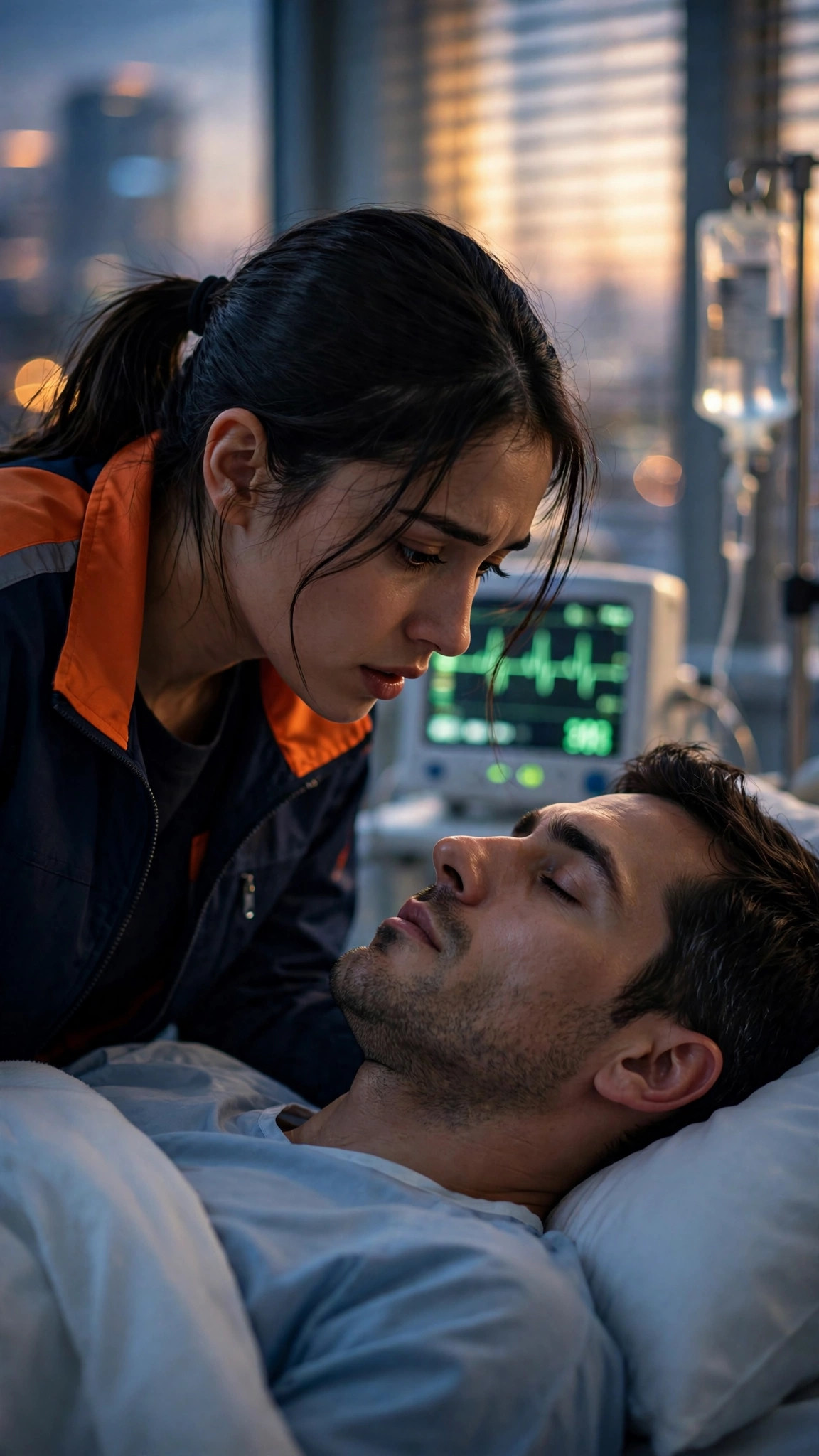
The monitors erupted the instant my mouth touched his.
I had not meant to kiss him. I had not meant to fall at all. One second I was carrying a tray down a hallway that smelled of beeswax and old money, and the next a maid brushed past my elbow, a glass of red wine slid across my tray, coffee splashed down my legs, and the floor went out from under me. I twisted as I fell, threw my hand out to catch the bed instead of the floor, and misjudged the distance by the width of a heartbeat.
My lips landed on his.
He was the man in the bed. The unconscious man. The man everyone in that house had declared unreachable for two years.
His eyes opened.
They were dark, startled, almost human in a way that made my chest seize, and they looked straight past me — straight at the tall man who had just stepped into the doorway.
"Victor!" someone shouted. "Get in here!"
Feet raced toward the bed. A vase of flowers tottered off its table and spilled petals across the floor by the door. The monitor at the bedside flickered, then began to shrill, a thin, furious sound that cut through the shouting.
I stared at the bed, my mouth open, my heart pounding so hard I could feel it in my throat. I had just kissed a stranger. A stranger in a coma. A stranger whose family owned this mountain and probably half the state.
"Tell me what happened. What did you do?" a man snapped, slapping a folder into his palm. His voice was like a flare going off in a dark room. "Wait a minute. You are not staff."
"He's awake?"
"He's AWAKE!" someone shouted from the hallway.
"Mia Bennett, you're fired!"
"I'm sorry. I'm so sorry. I was just bringing the trays—"
"Not from him."
"Did you fall on him?"
"No," said a voice from the bed. Quiet. Hoarse. Almost a whisper, like a man speaking through two years of dust. "She didn't fall on me. She was doing her job."
The room seemed to narrow to a single point. Every face turned toward the bed.
The man in the bed — the man who had not moved in two years, the man whose name I did not even know yet — was looking at the doorway. At his brother. And in his eyes there was no confusion at all. There was recognition. Cold, clear, and utterly certain.
He said, softly, "For two years, I have dreamed. And in those dreams, I never saw my little brother…"
Then the tall man stepped forward, carrying a glass of water and a yellow note, and held the water to my lips as if I were the one who had nearly died.
"No," he said. "You are the reason…"
I did not understand him then. I would understand him later, when I learned what had really been done to the man in that bed, and who had done it, and why the brother standing in the doorway had gone pale as paper the moment those dark eyes opened.
But I am getting ahead of myself. Twenty minutes earlier, I had been worrying about a catering invoice.
—
My little brother had three days of medication left.
That was the number I carried in my head all that week, the way other people carry a grocery list. Three days. Tommy was fourteen and his heart had a defect the doctors described with words I had learned to spell but never learned to stop fearing. The medication cost more than my rent. The state program covered part of it, and the rest came out of whatever I could earn carrying trays through other people's celebrations.
The landlord had already taped a notice above the broken buzzer. The buzzer had been broken since October. The notice was new. It said, in the landlord's careful block letters, that the rent was due on the first and that patience was not a payment plan.
My mother had taught me that other people's houses had rules, and that working in them did not make those rules less real. She had taught me that, and then she had died when I was twenty-two, and I had carried that lesson through diners and wedding halls and private parties where nobody remembered my name. I survived by staying useful and unnoticed. I was good at it. I had been good at it for years.
So when the dispatcher called that afternoon and promised triple overtime for delivering dinner to a private research team in the Catskills, I said yes before she finished the sentence.
"A storm stranded the regular staff," she said. "The estate kitchen needs someone willing to drive through freezing rain. It's a private house, Mia. Big money. The client pays in cash."
Triple overtime sounded less like an opportunity than a rope thrown down a well. I took it with both hands.
That morning, before the dispatcher ever called, Tommy had woken me up coughing. Not the ordinary cough — the other one, the deep one that came from his chest and made his ribs stand out like the rungs of a ladder. I had sat on the edge of his bed in the dark and counted his breaths the way the cardiologist taught me, one hand flat against his back, feeling the flutter under his skin like a bird trapped in a paper bag.
"I'm fine," he had said, which was what he always said, and which had never once been true.
"You're not fine," I had said. "You're three pills away from not fine."
He had grinned at me then, because he was fourteen and invincible in the way only fourteen-year-olds can be, and he had held up the sketchbook he kept under his pillow. He drew constantly — cars, mostly, and once a perfect replica of our mother's face from a photograph so old the colors had gone soft. "When I get better," he said, "I'm going to draw you a whole house. With a kitchen you don't have to share with the landlord's pipes."
"When you get better," I said, "I'm going to make you do the dishes in it."
I made him oatmeal with the last of the brown sugar and watched him take his morning pill with a glass of water he was too proud to admit he needed. The pill bottle rattled when I shook it. Three days. I did the math again, the way I did it every morning: three days of pills, two days of rent grace, one broken buzzer, and zero dollars in the account my mother had opened for us before she died. The math never changed. It just got louder.
At the diner, my shift manager, a woman named Denise who had worked the same counter for twenty years and had the varicose veins to prove it, took one look at my face and slid a cup of coffee across the counter without asking.
"You look like a girl who needs triple overtime," she said.
"Triple overtime doesn't exist," I said.
"It does if you know the right dispatcher," she said, and wrote a number on a napkin in purple pen. "Catskills. Private estate. Rich people who pay cash and don't ask for receipts. The regular girl got snowed in. They need someone tonight."
I stared at the napkin. Denise had never steered me wrong. She had gotten me the wedding hall job that paid for Tommy's first cardiology visit, and the christening job that paid for his second. "Is it safe?" I asked.
"Honey," Denise said, "nothing that pays triple is safe. But the dispatcher is legit, the estate is real, and the worst thing that happens to you is you come home smelling like somebody else's roast beef."
I called the number from the pay phone by the diner bathrooms, because my own phone had been cut off the month before and the dispatcher needed to reach me. The woman on the other end had a voice like a metronome — fast, even, no wasted motion.
"Catskills estate," she said. "Private research team. Dinner service, eight o'clock. You drive yourself. Triple overtime, cash at the end of the night. Storm stranded the regular staff. Can you be there by seven?"
"Yes," I said. "What kind of research team?"
There was a pause. The metronome skipped one beat. "Medical," she said. "A private patient. You won't see him. You deliver, you clean up, you leave. That's the whole job."
"A patient," I said. "In a private house."
"Rich people keep their sick at home, sweetheart. Don't make it strange."
I should have asked more questions. I know that now. But the pill bottle was rattling in my head, three days, three days, and the landlord's notice was taped above a buzzer that hadn't worked since October, and triple overtime was a rope thrown down a well. I said yes before she finished the sentence.
I packed my black catering uniform, the one with the frayed cuff I had mended twice. I counted Tommy's pills into the plastic organizer and left a note on the refrigerator in case he woke up before I got home: Soup in the fridge. Take the blue pill at nine. Do not answer the door for the landlord. I love you. Then I drove north into the rain.
The Catskills in freezing rain are beautiful in the way a knife is beautiful. The road wound up through dark pines, and the rain turned to sleet on the windshield, and twice I had to pull over to scrape ice off the wipers with a gas station receipt. By the time I reached the gates, my hands were shaking from the cold and from the heater that only worked when the car was going downhill.
The gates were black iron, twelve feet high, with a camera that swiveled to look at me like an eye. A guard came out of the gatehouse in a black coat. He did not smile. He took my phone and put it in a numbered pouch.
"Deliver. Clean up. Leave," he said.
I intended to obey.
I drove through the gates and up a long drive lined with bare trees, and the house rose out of the dark like something from a dream I had not agreed to have. It was not a house. It was an estate — stone and glass and warm light, three stories high, with a circular drive and a fountain that had been turned off for the winter. A senator's car was parked by the eastern wing. A man in a loose jacket was opening gates at the far end of the property. A tall silhouette stood by the eastern windows, watching the rain.
Inside, the air smelled of beeswax and lilies and roast meat. A long table in the dining room was set for people who had not arrived — twenty places, silver gleaming, candles unlit. The kitchen was a cathedral of stainless steel, and the estate's own staff moved through it with the tight, silent efficiency of people who knew better than to ask questions.
The head of the kitchen staff, a woman named Mrs. Alvarez with iron-gray hair and a voice like a closing door, looked me up and down and pointed at a stack of trays.
"Dinner service is upstairs," she said. "Second floor, rear room. The family eats at eight. You carry, you serve, you do not speak unless spoken to, and you do not look at the man in the bed."
"The man in the bed?" I asked.
Her face did not change. "There is a sick man in this house. You will see his room. You will not enter it. You will not touch anything in it. Do you understand?"
"Yes, ma'am."
She held my gaze for one second longer than was comfortable. "Good. The last girl who asked questions is not working here anymore."
I picked up the first tray and carried it up the stairs.
Years later, I would remember how certain I had been that this night would be another shift I could survive by staying useful and unnoticed. I would remember the weight of the tray in my hands, and the smell of the roast, and the way the hallway carpet swallowed the sound of my shoes. I would remember thinking about Tommy's pills, and the landlord's notice, and the triple overtime, and nothing else at all.
I did not know that the man in the bed had been asleep for two years. I did not know that his brother had put him there. I did not know that the house I had walked into was not a house at all, but a crime scene with the lights still on.
I only knew that I had a tray to carry, and a brother to keep alive, and a shift to survive.
I carried the tray down the long hall toward the second-floor rear room, carefully watching my shoes, and I did not see the maid coming the other way until her elbow caught mine and the whole night tipped sideways.
The hallway was lined with portraits I had not really looked at until that moment — stern men in dark suits, generation after generation of them, their eyes following me down the carpet like a jury. A tabby cat with a torn ear sat at the far end of the hall, watching me with the unblinking patience of an animal that had seen everything in this house and judged all of it. Somewhere below, a clock struck the quarter hour, and a door I could not see opened and closed, and a man's voice — low, familiar in a way I could not place — said, "No. You can't be serious."
I told myself it was nothing. Rich houses were full of voices and cats and portraits. I had a tray to carry and a brother to keep alive and a shift to survive, and I was good at surviving shifts. I shifted the tray to my other hand, apologized to no one in particular, and kept walking toward the rear room where a sick man lay behind a closed door and a long table waited for people who had not arrived.