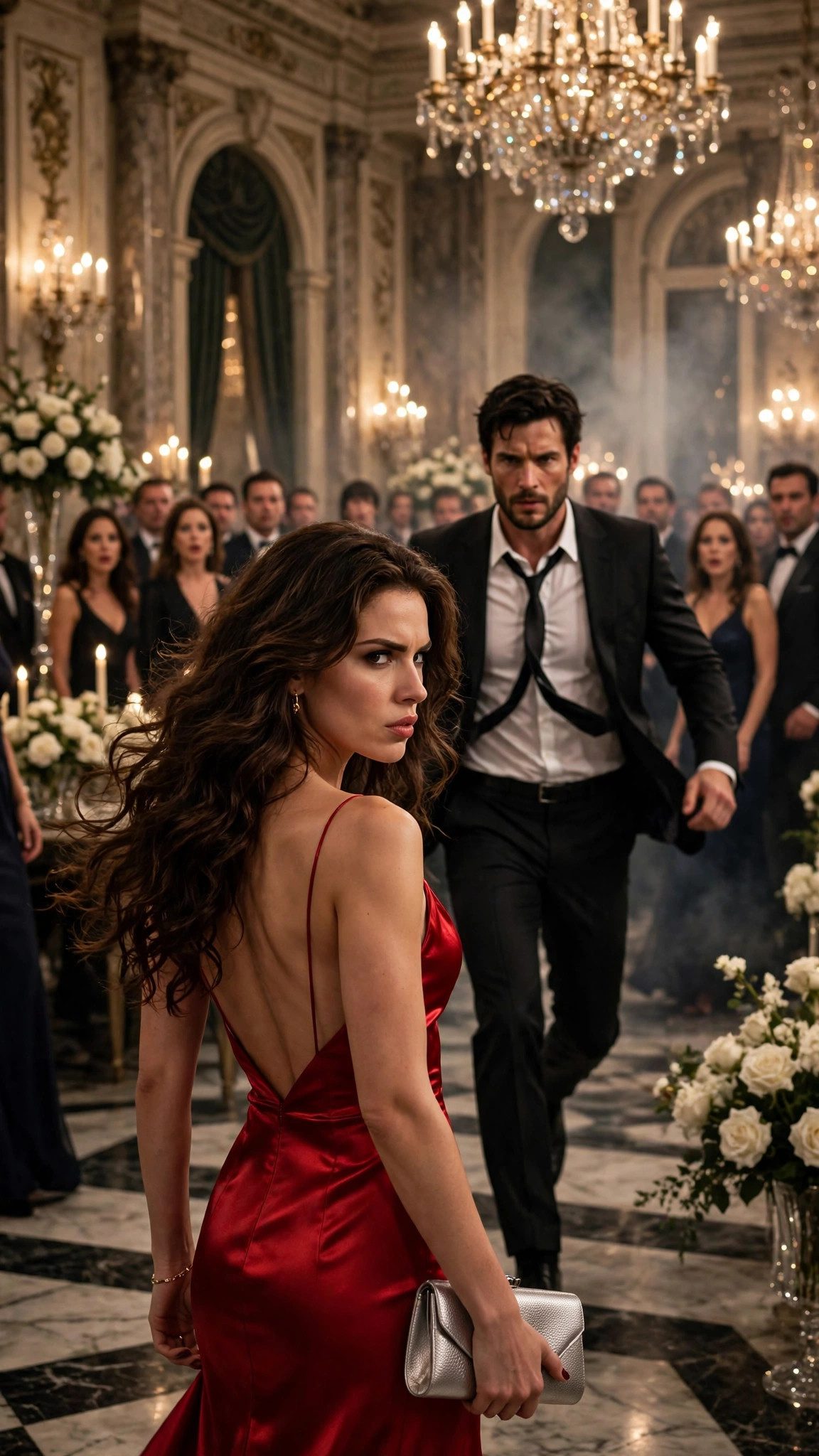
He ate the risotto.
It was cold, and the rice had gone stiff, and the wine was too warm, and it was the best meal I had ever eaten in that house — because for the first time in eight months, my husband sat across from me at a table I had set for two, and he stayed.
We ate in the lamplight, low and golden, the way he liked it. We didn't talk much at first. There was too much to say, and neither of us knew where to begin. So we ate, and we listened to the rain that had started outside, soft against the tall windows, and when our plates were empty, Dominic reached across the table and took my hand.
"I don't know how to do this," he said. "I don't know how to be a husband. My father never taught me. He taught me how to run a family, how to negotiate, how to win. He never taught me how to sit at a table with a woman and ask her about her day."
"Then we'll learn together," I said. "You're a fast learner. I've seen you negotiate with men who wanted to kill you. You can handle dinner conversation."
He almost smiled. It was the closest thing to a smile I had ever seen on his face — a small, careful thing, like a man testing ice with one foot.
"I want to court you," he said. "Properly. The way a man is supposed to court a woman. Dinners. Flowers. Walks by the lake. I want to earn the right to call you my wife, instead of just owning the title."
"Flowers?" I said. "You hate flowers."
"I hate roses," he said. "They remind me of funerals. But I'll buy you any other flower you want. Tulips. Lilies. Whatever you like. Just tell me."
"Tulips," I said. "Red ones."
He nodded, serious as a man signing a treaty. "Red tulips. Every week."
That was how it began. Not with a grand gesture, not with a declaration, but with a cold plate of risotto and a promise of red tulips every week.
The next morning, Noah came home.
Dominic's men brought him to the mansion in the morning, and he stood in the front hall with a duffel bag over his shoulder, looking older than seventeen and younger than seventeen all at once — a boy who had carried packages for a dangerous man and had come out the other side with his hands shaking and his pride intact.
I ran to him. I threw my arms around him, and he hugged me back so hard it hurt, and he said, "I'm sorry, Claire. I'm so sorry. I thought I was helping. I thought if I earned enough money, I could buy back Dad's debt, and then you'd be free. I didn't know — I didn't know Adrian was using me to get to you."
"I know," I said. "I know, Noah. It's all right. You're safe now. That's all that matters."
Dominic stood in the doorway, watching us, and when Noah looked up at him — nervous, unsure, waiting to be judged — Dominic did something I had never seen him do with anyone outside his family.
He held out his hand.
"Noah," he said. "You're my brother-in-law. That makes you family. And in my family, we protect each other. From now on, if you need money, you come to me. If you need a job, you come to me. If anyone — anyone — ever threatens you again, you come to me. Understood?"
Noah stared at his hand for a moment, and then he shook it, hard, the way a young man shakes a man's hand when he's trying to prove he's a man too.
"Understood," he said.
"Good," Dominic said. "Now go upstairs and take a shower. You smell like a warehouse. And then come down for breakfast. Mrs. Alvarez made pancakes."
Noah grinned — the first real grin I'd seen on his face in months — and ran upstairs, two steps at a time.
I turned to Dominic. "Thank you," I said.
"Don't thank me," he said. "He's family. That's what family does."
In the weeks that followed, the house changed. Slowly, the way a house changes when someone finally opens the windows after a long winter.
Dominic started coming home for dinner. Not every night — he was still a man with a business to run, and a war to keep from starting — but most nights. He sat at the table I set, and he told me about his day, and he asked me about mine, and he listened. Really listened. He learned that I liked my coffee with cream, that I hated the gray dresses as much as he had once thought I loved them, that I had always wanted to learn to paint but had never had the time or the money.
He bought me paints. He cleared out a room on the second floor with tall windows facing the lake, and he called it my studio, and he said, "Paint whatever you want. The room is yours."
I painted the lake. I painted the garden. I painted Noah asleep on the couch with a book on his chest. And one afternoon, I painted Dominic — sitting in the library with his tie loosened, reading, the lamplight low on his face — and when he saw it, he stood in front of it for a long time without saying anything.
"Is that how I look?" he asked at last.
"That's how I see you," I said.
He was quiet for a moment. Then he said, "Keep it. Hang it in the library. Where I can see it."
Adrian Cross did not disappear. Men like Adrian never disappear. But the war he had promised never quite started, either. The recording — the one Dominic had played in the ballroom, of Adrian's man threatening a seventeen-year-old boy — found its way to the wrong ears, or rather the right ones. Two of Adrian's business partners quietly ended their arrangements with him. A third called Dominic's lawyer and asked, very politely, if the Russo family might be interested in a partnership instead. And the detective who had received a copy of the recording paid Adrian a visit, and after that visit, Adrian's men stopped coming around Noah's school, and stopped calling my father's house, and stopped leaving envelopes full of money on kitchen tables.
It wasn't peace. It was a truce. But in Dominic's world, a truce was as close to peace as anyone ever got, and it was enough.
My father came to dinner one Sunday. He sat at the table in the Lake Forest mansion, wearing the only suit he owned, and he looked around at the food and the lamplight and his daughter and his son, and his eyes filled with tears.
"I'm sorry, Claire," he said. "For all of it. For the debts. For your mother. For selling you. I know that's what I did. I know it, and I'll carry it for the rest of my life."
I took his hand. "You gave me to a man who turned out to be a good one," I said. "That's more than I expected. We're all right, Dad. We're all right now."
He nodded, and he wiped his eyes with his napkin, and Mrs. Alvarez brought out dessert, and Noah told a story about a chemistry experiment that had gone wrong and set off the fire alarm, and for one evening, we were just a family. A strange family, a broken family, a family held together by a debt and a marriage and a red dress — but a family.
Three months after the night of the party, Dominic took me to the lake.
It was early evening, the sky the color of bruised peaches, the water calm and dark. He had set up a small table on the shore — two chairs, a bottle of wine, a box of chocolates, and a bouquet of red tulips, fresh and bright against the gray of the lake.
"I've been practicing this," he said, and he sounded nervous, which was strange, because Dominic Russo was never nervous. "I've been practicing for three weeks, and I'm still not sure I'm going to get it right."
"Get what right?" I asked.
He got down on one knee. Right there on the shore, in his black suit, with the lake behind him and the tulips in my arms, Dominic Russo — the coldest man I had ever known, the man who had once told me he never wanted me — got down on one knee and opened a small velvet box.
Inside was a ring. Not the ring from our wedding — the plain band he had slipped onto my finger in a chapel with no guests and no music. This one was different. A diamond, small and bright, set in gold, with a tiny ruby on either side. Red. Like the dress.
"Claire Hale," he said, and his voice was steady, but his hands were shaking. "Eight months ago, I married you to settle a debt. I didn't ask you. I didn't give you a choice. I treated you like an arrangement, and you deserved better. So I'm asking you now. I'm asking you properly, the way I should have asked you then. Will you marry me? Not because of a debt. Not because of an arrangement. Because I love you. Because I have loved you since the night you walked into that gala in a red dress and I realized that the most dangerous thing in my world wasn't my enemies — it was the possibility of losing you."
I looked down at him — this tall, dark, beautiful man on his knee in front of me, holding out a ring with red stones, asking me the question he had never asked — and I thought about my mother, and my father, and Noah, and the gray dresses, and the table for two, and the night the doors slammed open in Adrian Cross's ballroom.
"Yes," I said. "Yes, Dominic. I will marry you."
He slipped the ring onto my finger, next to the plain band from our wedding, and then he stood up, and he kissed me — really kissed me, for the first time in eight months, not on the cheek like a stranger, but on the mouth, like a husband. Like a man who had finally stopped pretending.
We were married again three weeks later, in the garden of the Lake Forest mansion, under a white arbor covered in red tulips. It was a small ceremony — Tessa as my maid of honor, Noah as Dominic's best man, Mrs. Alvarez crying in the front row, my father walking me down the aisle in the only suit he owned. Dominic wore a black suit, and his tie was loosened, and when I walked toward him in a white dress — a white dress I had chosen, because I wanted it, because it was mine — he looked at me the way he had looked at me in the ballroom that night. Like I was the only person in the world.
"I do," I said.
"I do," he said.
And this time, when he kissed me, the whole garden cheered.
After the ceremony, in the master suite, I opened the closet. Behind the gray dresses and the respectable coats — the ones I never wore anymore, because Dominic had filled my closet with colors, reds and blues and greens, dresses I chose for myself — I found the red dress. The red satin dress. The dress he had once told me to burn.
I took it out. I held it up. The satin caught the lamplight, low and golden, and it shimmered like something alive.
"Keep it," Dominic said from the doorway. "Don't ever burn it. That dress is the reason I found you. It's the reason I finally told you the truth. It's the reason we're standing here."
I hung it back in the closet — not hidden behind the gray dresses this time, but in front, where I could see it every morning. A reminder. Of the night I stopped begging. Of the night I walked into my husband's worst enemy's party in red. Of the night Dominic Russo discovered exactly what rejection looked like when it stopped begging — and discovered, too, that the woman in the red dress was the one thing in his world he could not afford to lose.
My name is Claire Russo. I was twenty-six years old when my father sold me to settle a debt. I am twenty-seven now, and I am married to a man who once told me he never wanted me — a man who now tells me, every single morning, that I am the best thing that ever happened to him.
And every Sunday at four o'clock, my little brother calls me. He tells me about school, about his teachers, about a girl named Mia who sits next to him in chemistry. He is safe. He is happy. He is free.
And the red dress hangs in my closet, where I can see it every day.
I kept it. I will always keep it. Because it is not just a dress.
It is the dress that broke the mafia king.
Noah started at a new school that autumn — a good school, the kind with small classes and teachers who knew every student's name. He joined the chemistry club, and he made friends with a girl named Mia who was smarter than everyone in the class, and on the first day he came home and told me, very seriously, that he intended to become a doctor. "A real one," he said. "Not the kind on television. The kind that actually helps people." I believed him. I had always believed in him. And when he said it, I thought about my mother, and the promise I had made her, and I knew — I knew in my bones — that she would have been proud of the boy he was becoming. Dominic paid his tuition without a word, and when Noah tried to thank him, Dominic just said, "Family doesn't keep score, Noah. Remember that." Noah remembered. He still remembers.
The End.
THE END