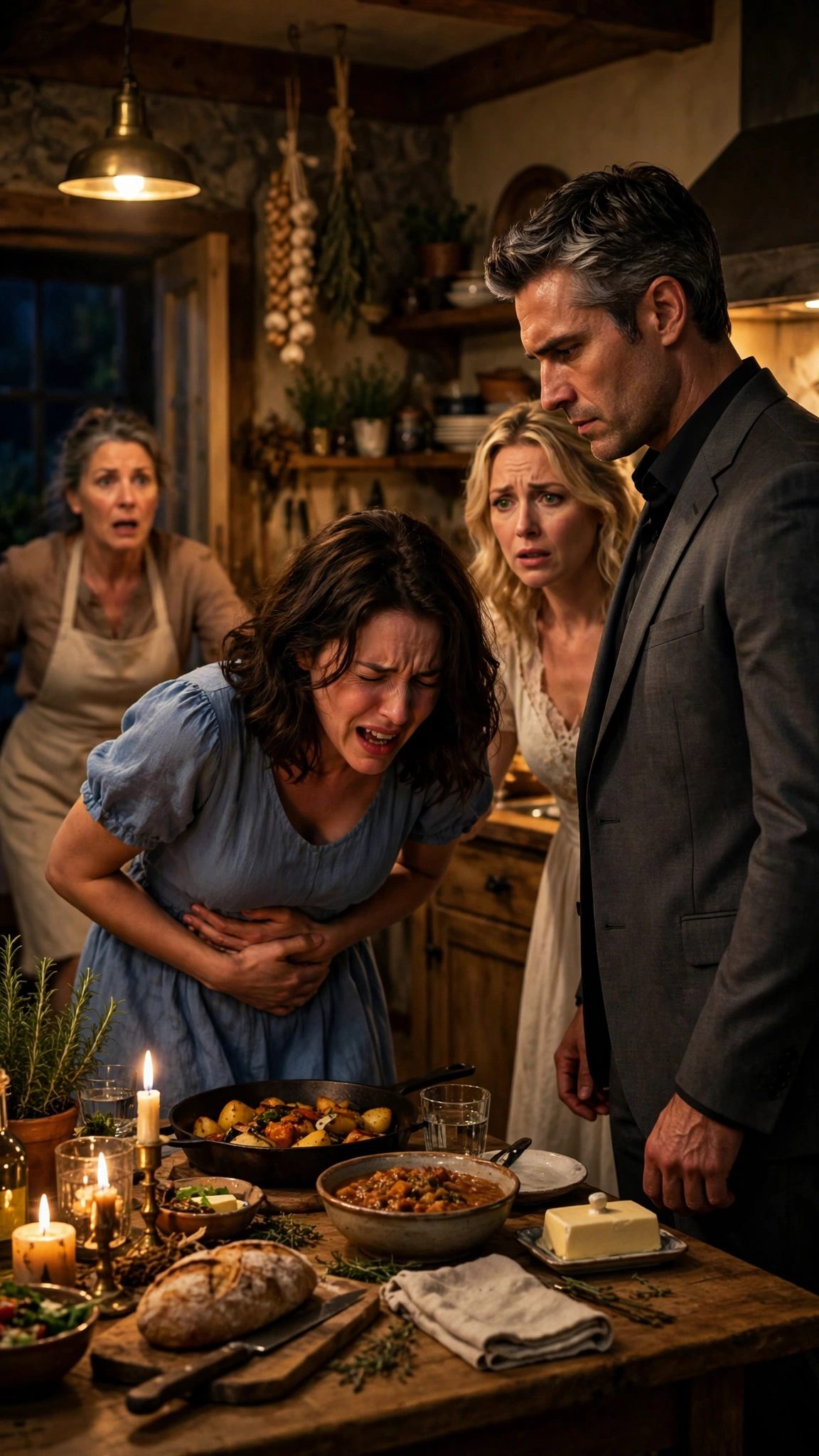
The night my husband let his childhood sweetheart shove me into a table, I was pregnant with our first child.
I did not know it yet, standing there in my mother's small kitchen with my hands wrapped around my stomach and pain exploding through me like something had torn loose inside my body. I knew only that the edge of the table had caught me low and hard, that my knees had gone weak, and that the man I had married five years earlier was looking at another woman first.
"Are you okay?" Alexander asked her.
Not me. Her.
Sophia Reynolds was crying, her blonde hair falling across her face in the careful way it always did when she wanted to look helpless, and my husband had stepped in front of her like a shield, like she was the one who had been hurt, like I was the danger in the room.
"I didn't mean to push her that hard," Sophia sobbed, and the words came out practiced, almost pretty, the way everything about Sophia came out practiced and pretty.
I folded over the table, both hands gripping my abdomen, and the only sound I could make was my mother's name.
"Mom," I whispered. "Mom, the baby."
My mother rushed toward me. Rose Bennett was fifty-eight years old and had spent nearly the whole day cooking for a dinner that was supposed to change everything, and now she was catching her daughter as she slid toward the floor, shouting at the most feared man in Chicago in a kitchen that smelled of rosemary and burned cilantro.
"Your wife is hurt!" she screamed at him. "Alexander, your wife is hurt!"
He looked at me then. Really looked at me, for the first time all evening, and I saw something move behind his eyes, something uncertain, something that might have been the beginning of understanding. But Sophia tugged at his sleeve and whispered something I could not hear, and whatever it was, it was enough. He turned away from me. He walked out of my mother's house with Sophia Reynolds, and the front door closed behind them with a sound so ordinary it seemed impossible that my whole life had just ended inside it.
My mother took me to the hospital alone.
That is the sentence I have carried with me ever since, the one I repeat to myself on the nights when I cannot sleep. My mother took me to the hospital alone. Not my husband. Not the man who had once paid my college tuition and bought my textbooks and told my mother she would never have to worry about money again. My mother, in her good coat with the frayed cuffs, driving with one hand and holding mine with the other, telling me to breathe, telling me to stay with her, telling me that everything was going to be all right even though neither of us believed it.
The doctors said the impact had caused serious pregnancy complications. They used words I did not understand at first, words like abruption and monitoring and bed rest, and then they used words I understood perfectly. The baby might not survive. I might lose the baby. I had to stay still. I had to stay calm. I had to stay in the hospital while they watched the small heartbeat on the monitor and waited to see whether it would keep going.
I was eight weeks pregnant. I had found out four days earlier, standing in the bathroom of our apartment with a little white stick in my hand and my heart beating so hard I thought it would wake the whole building. I had not told Alexander yet. I had wanted to tell him properly, the way a moment like that deserves to be told, with a table full of food and my mother's cooking and both of us sitting down together like a family. I had planned a dinner at my mother's house so I could surprise him. I had imagined his face. I had imagined him laughing, picking me up, spinning me around in that kitchen, telling me he loved me, telling me we were going to be parents.
Instead, his first love had come to dinner with us, and my husband had thrown my mother's cooking into the trash, and a woman who had never carried a child in her life had shoved me into a table and put our baby's life at risk, and my husband had asked her if she was okay.
Two days later, Alexander called. Not to ask whether I was alive. Not to ask why I had been doubled over in pain. He only said, "There's an important Moretti family gathering. Be there on time, and don't embarrass me."
I said nothing. I let the silence sit between us on the phone line, and then I ended the call, and I lay in that hospital bed staring at the ceiling and thinking about the five years I had spent loving a man who had just shown me exactly who he was.
When I didn't appear at the gathering, Alexander sent his men to my mother's house. They found it empty. The lights were off. The table was still set from the dinner that had ended in disaster, the plates still sitting where we had left them, my mother's good tablecloth still stained with the food Alexander had thrown away. Then they discovered I had been hospitalized because of pregnancy complications.
"Pregnancy?" Alexander demanded, and his man hesitated before he answered, the way men hesitate before they tell a powerful man something he does not want to hear.
"Mrs. Moretti is pregnant, boss."
That was when everything came back to him. The shove. My hands over my stomach. My mother screaming. The dinner I had arranged. He finally understood why I had invited him there. I had been trying to tell him we were having our first child.
His men searched the empty house again. This time, they found a small recorder on the table. A note was attached to it, written in my handwriting, in the careful script I had learned from my mother when I was a little girl and she was teaching me that words mattered, that you should never write something down unless you mean it.
For Alexander Moretti.
When he pressed play, my voice filled the room. And for the first time in five years, the man who believed he could control everything realized he might never hear me speak to him in person again.
But that is the end of the story, and a story should never begin at its end. Let me go back to the beginning, to the girl I was before I ever met Alexander Moretti, to the day my father walked out of our lives and my mother taught me the first and most important lesson of my life: that a woman who depends on no one can survive anything.
My name is Claire Bennett Moretti, and I was ten years old when my father abandoned my mother and me.
I remember the morning with a clarity that has never faded, the way some memories stay sharp while others blur. It was a Tuesday in October. The leaves in Chicago had turned the color of rust and gold, and my mother was standing at the kitchen window with a cup of coffee gone cold in her hands, watching my father's car pull away from the curb. He did not look back. He did not wave. He did not even slow down at the stop sign at the end of our street. He just drove, and the sound of his engine faded, and then there was only the sound of the wind in the trees and my mother breathing very carefully beside me, like a woman who had decided she would not cry in front of her child.
"Where is Daddy going?" I asked her.
She put her coffee down. She knelt in front of me and took my face in both her hands, and her hands were warm and smelled faintly of dish soap, and she looked into my eyes the way she always did when she was about to tell me something true.
"Your father has made a choice, Claire," she said. "And his choice is not us. That is going to hurt for a long time. But I want you to remember something. We are going to be all right. Not because someone comes to save us, but because we are going to save ourselves."
She was right. We saved ourselves, slowly, the way people do when they have no other choice. My mother took a second job cleaning offices at night. I learned to cook dinner at eleven and do laundry at twelve and fix a leaking faucet at thirteen by watching videos on the library computer. We were poor in the way that makes you count every dollar and feel every winter, but we were never broken. My mother made sure of that. She made sure I did my homework. She made sure I believed I was going somewhere. She told me every single night, without fail, "You are going to college, Claire Bennett. You are going to build a life no man can take away from you."
I believed her. I worked for it. I got the grades. I got the scholarship forms. I got into a good university in Chicago, and I walked onto that campus at eighteen years old with a suitcase full of clothes my mother had mended and a heart full of plans, and I told myself that the girl whose father had abandoned her was going to become a woman no one could abandon.
That was when I met Alexander Moretti.
He was not yet the most feared man in Chicago. He was twenty-four years old, a senior, tall and dark and quiet, with hair that fell across his forehead and eyes that seemed to notice everything and say nothing. He sat two rows behind me in an economics lecture, and I did not know his name for three weeks, and I did not know who his family was for three months, and by the time I knew both, it was already too late, because I had already fallen in love with the way he carried my textbooks when my arms were full and the way he showed up at the library at midnight with coffee when I was studying for finals and the way he looked at my mother the first time he met her, like she was someone worth respecting.
He paid my tuition when my scholarship fell through in my junior year. He did not make a speech about it. He did not ask for anything in return. He simply walked into the bursar's office with me and paid the balance, and when I tried to argue, he said, "Claire, let someone carry something for you for once. You have carried everything alone since you were ten years old."
He bought my textbooks. He fixed my mother's leaking roof. He sat at our kitchen table on Sunday afternoons and ate my mother's cooking like it was the best food he had ever tasted, and my mother, who had trusted no man since my father left, looked at him across that table and saw something in him that made her believe he was different.
I believed it too. I believed he loved me. I believed the man who had saved my future would never become the man who could stand in my mother's kitchen and throw her cooking into the trash while another woman shoved his pregnant wife into a table.
I was wrong about many things in those five years. But I was not wrong about this: the night my husband let Sophia Reynolds shove me into a table, I was pregnant with our first child, and something inside me broke that could never be put back together the way it was before.
What came after that night is the rest of this story. It is a story about a recorder left on a table, and a man who finally learned to listen, and a woman who learned that the bravest thing she ever did was not surviving what her father did to her, but walking away from what her husband did.
And it begins, as all the important things in my life have begun, at my mother's table.
The nurse who came to check on me that second night was a woman named Grace, with kind eyes and gray hair pulled back in a braid, and she sat beside my bed for a while after she had finished her rounds, just talking to me the way one woman talks to another when there is nothing left to do but wait.
"My daughter lost a baby once," she told me, very quietly, so my mother would not wake up in the chair beside me. "Not the same way as you. An illness, a fever that would not break. She carried that grief for years, and I thought it would break her. But you know what she told me, years later? She said the worst part was not the loss. The worst part was that the man she loved looked away when she needed him most. She said she could have survived anything except that."
I looked at her, and I thought about Alexander walking out of my mother's house with Sophia, and I said, "He looked at her first. He asked her if she was okay. I was bleeding, and he asked her if she was okay."
Grace nodded, and she took my hand, and her hand was warm and dry and steady. "Then you already know what you need to know," she said. "A man can love you and still fail you. The question is never whether he loves you. The question is whether he will choose you when it costs him something. Remember that, when you decide what to do next."
The doctor came in the morning with the ultrasound machine, and he showed me the small, flickering heartbeat on the screen, a tiny light pulsing in the dark, and he said, "There. Do you see that? Your baby is fighting. Your baby is strong, just like her mother."
Her mother. He said her, and I did not correct him, because in that moment I knew, the way mothers know things before anyone tells them, that the baby inside me was a girl, a daughter, a little girl who would grow up strong and brave, a little girl who would never have to watch her father walk away, because I was going to make sure of it.
I put my hand on my stomach, and I felt the smallest flutter, so faint I thought I might have imagined it, and I whispered, "Hold on, little one. Hold on. Your grandmother and I are going to take care of you. We are going to keep you safe. I promise."
My mother woke up then, and she saw me crying, and she came to the bed, and she held me, and she said, "We are going to be all right, Claire. Not because someone comes to save us, but because we are going to save ourselves."
She was right. She had always been right. And as I lay in that hospital bed, listening to my baby's heartbeat on the monitor, I began to understand what saving ourselves was going to mean this time. It was going to mean leaving. It was going to mean walking away from the man I loved, from the life I had built, from everything I thought I wanted. And it was going to mean finding a way to tell him the truth, even if he never heard it from my own lips.
That was when I thought of the recorder.