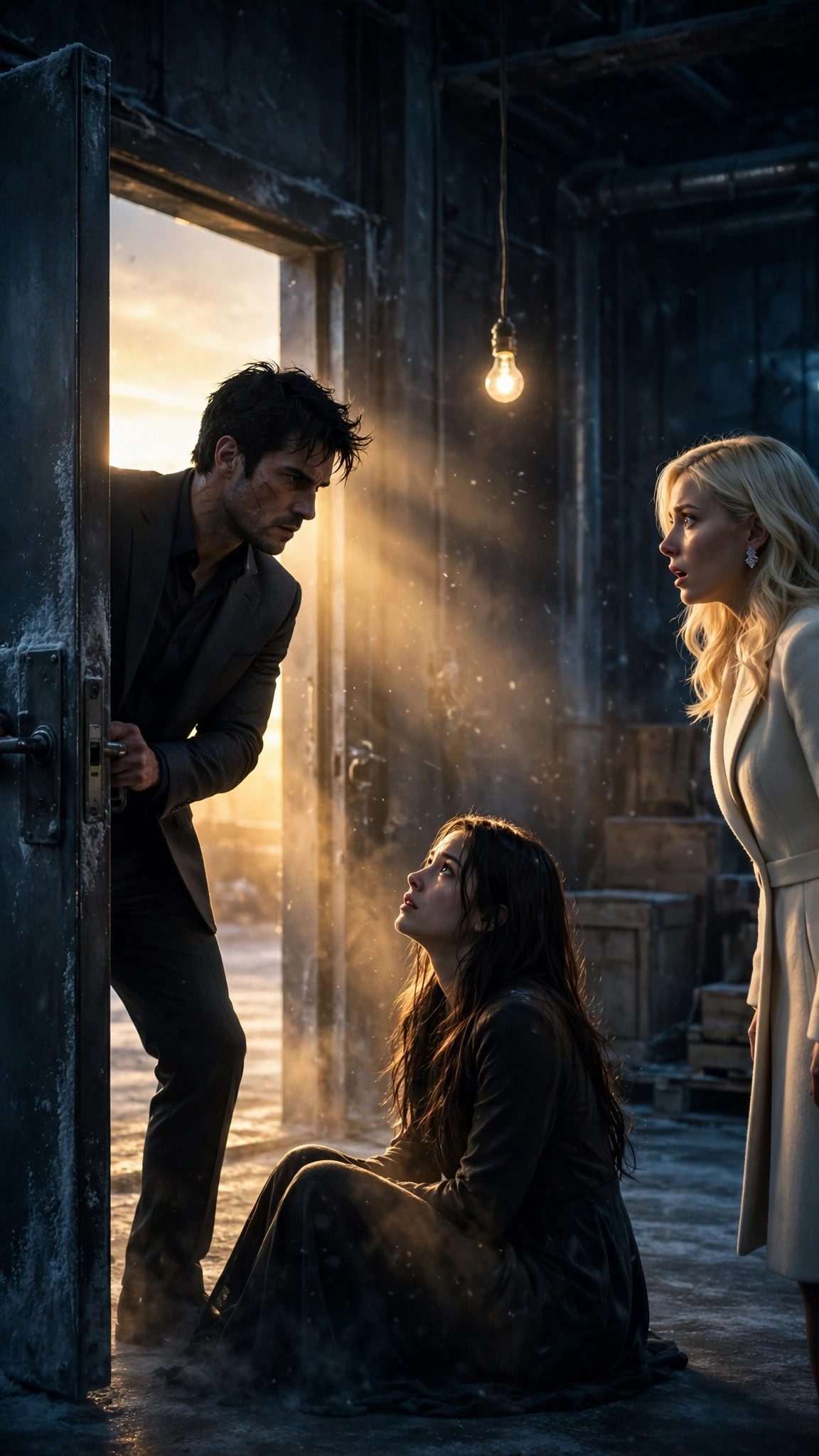
The door did not open. It exploded.
I had spent six days in the dark, and I had forgotten what light looked like, and when the steel door came off its hinges and the evening light came flooding into the warehouse, it hurt. It hurt my eyes so badly that I squeezed them shut, and I heard Evelyn scream, and I heard the man with the scar through his eyebrow shout something, and I heard footsteps, fast and heavy, crossing the concrete floor toward me, and then I heard a voice I knew better than my own heartbeat, even though I had barely ever heard it speak to me at all.
"Maya."
Roman Calder knelt beside me on the freezing warehouse floor, and his hands were on the ropes around my wrists, and his hands were shaking. I had never seen Roman Calder's hands shake. I had seen those hands sign contracts and hold a whiskey glass and rest flat on a table while men in dark suits told him things that would have made other men flinch, and those hands had never once shaken. Now they shook, and he could not get the knot undone, and he cursed, quietly, under his breath, and he pulled a knife from his pocket and cut the rope, and the rope fell away, and the blood came rushing back into my hands, and it hurt so much that I cried out.
"I'm here," he said. "You're safe. I've got you."
He cut the rope around my ankles, and he picked me up, and I weighed almost nothing after six days of bread and water, and he carried me like I was something breakable, like I was made of glass, and I put my face against his shoulder, and his suit smelled like rain and cold air and something else, something I recognized after a moment as the smell of the library, of old leather and wood smoke, and I started to cry.
I had not cried in six days. I had been too thirsty to cry, and too cold, and too afraid. But in his arms, with the light coming through the broken doorway and the warehouse suddenly full of men I did not know, I cried, and I could not stop, and Roman held me tighter, and he said, "It's all right. It's over. You're safe now."
Evelyn was standing ten feet away, still crouched where she had been, her cream coat arranged around her, her diamond earrings catching the light, and her face was white. Not pale. White, the way paper is white, the way a person looks when the blood has left their face all at once and has not come back.
"Roman," she said. "Roman, darling, I can explain."
He looked at her. He did not put me down. He looked at her over my head, and his eyes were the eyes I had seen in the library that morning, the eyes of a man who had once been a ten-year-old boy watching his mother die, and there was nothing in them at all. No anger. No hatred. Nothing. Just a flat, cold emptiness that was more terrifying than any shouting I had ever heard.
"You asked her for her last wish," he said. His voice was quiet. It was the quietest voice I had ever heard from him, and it filled the whole warehouse. "You stood over a woman you had starved for six days, and you asked her for her last wish, and you told her that by tomorrow, everyone would believe she had abandoned her little brother. Do you know what I heard, Evelyn? I heard my mother. I heard a woman begging for someone she loved, and I heard another woman deciding whether she deserved to live. And I have spent twenty-eight years becoming the kind of man who can stop that from happening."
"Roman, please." Evelyn's voice cracked. The polish was gone. The cut-glass coolness was gone. She was just a frightened woman in an expensive coat, standing on a concrete floor. "You don't understand. I did this for us. For you. She was a threat, Roman. She was getting close to you. I saw it. I saw the way you looked at her that morning in the library. I saw the blanket. I saw the tea. I have given you two years of my life, Roman. Two years of dinners and galas and being perfect, and you looked at a cook the way you have never once looked at me. I did this because I love you."
"You did this," Roman said, "because you wanted to be Mrs. Roman Calder, and you were willing to kill a woman and destroy a nine-year-old boy to get there. That is not love, Evelyn. That is ambition wearing love's clothes. And I have seen enough of that to last me a lifetime."
He turned away from her, and he carried me toward the door, and behind us, I heard his men moving, and I heard Marcus Hale's voice, calm and professional, saying, "Miss Sterling, you need to come with us," and I heard Evelyn say, "Don't touch me. Do you know who my father is?" and I heard Marcus say, "Yes, ma'am. That's why the FBI is on its way."
The FBI. Not Roman's men. Not a quiet conversation in a locked room. The FBI.
I lifted my head from Roman's shoulder. "What did you do?"
"I called Agent Reyes," he said. "Daniel Reyes. He has been building a case against the Sterling family's real estate fraud for two years. Your kidnapping gave him what he needed. Evelyn's father signed the warehouse lease. Evelyn's money paid for it. Danny Cole has already given a statement. The man with the scar — his name is Eddie Marcone, and he has a daughter in Ohio, and he has already told the FBI everything."
He carried me out of the warehouse and into the cold evening air, and the sky was the color of bruised plums, the same color it had been on the night they took me, and I breathed it in, and it was the sweetest air I had ever breathed in my life.
An ambulance was waiting. Roman set me down on the stretcher, gently, like I was made of glass, and the paramedics put a blanket over me, and one of them put an oxygen mask on my face, and I pushed it away.
"Caleb," I said. "I need to see Caleb."
"He's at the hospital," Roman said. "Mrs. Alvarez brought him. He's been waiting for you for six days. He's sitting in the waiting room with his tin box in his lap, and he has not left that chair except to use the bathroom, and he told the nurse that his sister promised she'd be home before dark, and he intends to hold her to it."
I started to cry again, and this time I did not try to stop, because crying meant I was alive, and being alive meant I was going home.
The ride to the hospital was a blur of lights and sirens and the paramedic's voice asking me questions I could barely answer. What is your name? Maya Hart. How old are you? Twenty-six. Do you know what day it is? No. Do you know where you are? A warehouse. Do you know who did this to you? Evelyn Sterling.
When we arrived, they wheeled me into a bright room that smelled like antiseptic, and a doctor with kind eyes told me I was dehydrated and malnourished and that my wrists would heal and that I was very lucky, and I told her I didn't feel lucky, I felt like I had been asleep for six days and woken up in a different world, and she said, "That's normal. Rest. Your brother is here."
And then the door opened, and Caleb came in, and Mrs. Alvarez was behind him, and Barnaby the one-eyed dog was tucked under his arm, and his tin box was in his other hand, and he stopped in the doorway and looked at me, and his face did something I had never seen it do before. It crumpled, all at once, like a piece of paper, and then he was running across the room, and he was on the bed beside me, and his arms were around my neck, and he was crying, and I was crying, and he kept saying the same thing over and over again.
"You came back. You came back. You came back."
"I never left you," I whispered into his hair. "Not for one second. Not in my heart. I never left you, Caleb."
"I know," he said, and he pulled back just enough to look at me, and his eyes were red, and his nose was running, and he was the most beautiful thing I had ever seen in my life. "I knew. Mrs. Alvarez said maybe you left, and the police said maybe you left, but I knew. You left me a note. You always leave me a note. And there was no note. So I knew."
He held up the tin box. "I saved it," he said. "I counted it. Forty-seven dollars and thirty-five cents. I was saving it for your birthday. It's in three weeks. I wanted to buy you something beautiful."
I took the box from him, and I held it in my hands, and it was dented and covered in faded baseball stickers, and it rattled when I shook it, and it was the most valuable thing in the entire world.
Roman was standing in the doorway. I had not noticed him come in. He was standing very still, watching us, and his hand was on the scar along his jaw, and his eyes were wet.
I had never seen Roman Calder cry. I did not see him cry then, either. But his eyes were wet, and he looked at my little brother holding his tin box, and he looked at me holding my little brother, and something in his face changed, the way a door changes when it opens after being locked for a very long time.
"Mr. Calder," Caleb said, and he turned to look at Roman, and he did not look afraid at all. "Did you find her?"
"I did," Roman said.
"Thank you," Caleb said, very seriously, like a man thanking another man for a debt paid in full. "She makes the best oatmeal. And she always leaves me a note. And she loves me more than all the stars."
Roman nodded. He did not speak for a moment. Then he said, "She told me." And he looked at me, and for the first time in five years, he looked at me like I was a person, and not a function, and not a cook, and not a problem to be solved.
"I know your name now," he said. "Maya Hart. And I know your brother's name. And I know about the notes, and the shoebox, and the tin box. And I am sorry, Maya. I am sorry that it took me six days to notice you were gone. I am sorry that I never once, in five years, said thank you. And I am sorry that the woman I was going to marry tried to kill you in my name."
I did not know what to say. I had spent five years being invisible to this man, and now he was standing in my hospital room, apologizing to me, and my little brother was asleep on my chest with his tin box in his lap, and the world had turned upside down, and I was too tired to understand any of it.
So I said the only thing I could think of. "Thank you," I said. "For finding me. For bringing me home."
He shook his head. "Don't thank me," he said. "Not yet. There's more to do. Evelyn is in custody. Her father is going to try to make this disappear. And I am going to make sure he can't. But first, you rest. And Caleb stays with you. And no one — no one — is going to take you away from him again. Not while I'm alive."
He turned to leave, and then he stopped in the doorway, and he looked back at me, and he said, very quietly, "The tea helped, by the way. The chamomile. My mother used to make it. I hadn't slept through the night in twenty-eight years. That morning, in the library, I slept."
And then he was gone, and the room was quiet, and Caleb was breathing softly against my chest, and I closed my eyes, and for the first time in six days, I slept without dreaming of the dark.
In the ambulance, on the way to the hospital, I had asked the paramedic if Evelyn was going to be all right, and the paramedic, a young woman with kind eyes, had looked at me like I was delirious, and said, "Miss, she tied you up in a warehouse for six days," and I had said, "I know. But I don't want anyone else to die because of me. Not even her." The paramedic had not answered. She had just checked my pulse again, and written something on her chart, and I had understood, in a hazy way, that forgiveness is not the same as forgetting, and that I could want Evelyn to face the law without wanting her to suffer the way I had suffered. Roman rode in the ambulance with me, sitting on the small bench beside the stretcher, holding my hand, and he did not let go until the doctors took me into the bright room that smelled like antiseptic. His hand was warm, and steady, and it did not shake anymore, and I held on to it the way a drowning person holds on to a rope, because for six days, the dark had been the only thing holding me, and now there was a hand, and a voice, and a promise, and I was not alone anymore.