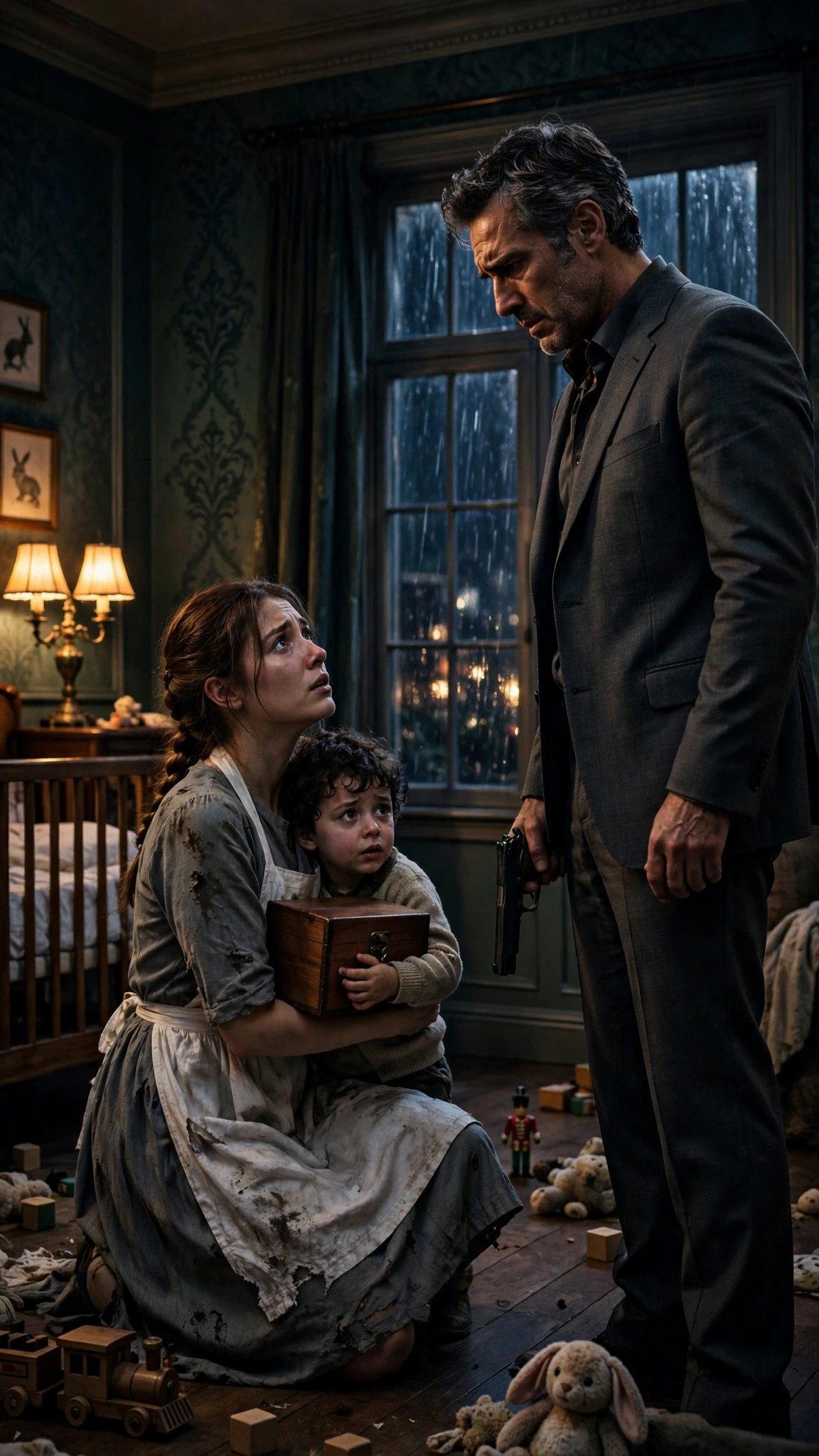
The morning after the night the gatehouse fell, the Rossi house was full of people who did not belong there. Police officers in the hall. Detectives in the library. A doctor in the nursery. And in Adrian's office, sitting in a chair that was too big for her, with a blanket around her shoulders and a bandage on her arm, was Hannah Collins, telling the truth for the first time to a man who was finally ready to hear it.
Adrian sat across from her. He had not slept. His shirt was still dark with Rosa's blood. His hands were still shaking — not from fear, but from something he had never felt before in his life. Shame. He had pointed a gun at this girl. He had believed his mother over her. He had believed Tony over her. And she had sat in his office, with a bandaged arm and a blanket around her shoulders, and she had not cried, and she had not shouted, and she had not asked him for anything. She had simply told him the truth, in that quiet, steady voice of hers, the way she read books to his son.
"Start from the beginning," Adrian said. "Tell me everything. Do not leave anything out. Not one thing."
So Hannah told him. She told him about the blood on his sleeve, that evening in September, when she was reading to Leo and she saw the smear of dark red on his white cuff. She told him about the pool house, and Tony's voice through the open window, and the words she had heard — "the pool plan," "Tuesday," "the docks," "make sure the boy is asleep." She told him about the garden, and the car, and the lie about Adrian calling Tony. She told him about the library, and Tony on the phone again, saying, "He talked. The boy talked. We have to know what he said." She told him about the new guards at the gate, men she did not know, men who answered to Tony and not to Adrian. She told him about Rosa, and what Rosa had told her that last night in the kitchen — to take Leo to the nursery and lock the door and not open it for anyone but Rosa or Adrian. She told him everything, in order, without exaggerating, without guessing, the way a nurse's daughter tells a doctor about a patient's symptoms: carefully, and completely, and without fear.
When she finished, Adrian sat in silence for a long time. Then he stood up, and he went to the window, and he looked out at the garden, where his son had climbed the oak tree and called himself a bird, and he said, very quietly, "The pool house. I never used the pool house. It has been empty for three years, since Isabella died. She used to swim there in the mornings. After she died, I locked it. I told everyone it was closed." He turned around. "Tony used it as a drop point. He used my dead wife's pool house to pass money and information to the Castellanos. And my son heard him. And my son told him about his mother's lullaby. And Tony tied a four-year-old boy to a tree in the dark because he was afraid of what a child might have heard."
Hannah nodded. She did not speak. There was nothing to say.
Adrian went to his desk, and he opened a drawer, and he took out his phone, and he called a number he had not called in two years. "Daniel," he said, when a man answered. "It is Adrian Rossi. I need you to come to my house. Now. Bring your men. Bring a warrant. I have something for you, and it is bigger than anything you have been building for two years."
Daniel Reyes was an FBI agent, forty years old, with a calm face and a patient voice, and he had been building a case against the Rossi family for two years, and against the Castellanos for longer than that. He arrived within the hour, with four agents and a warrant and a face that said he had been waiting for this phone call for a very long time. Adrian met him in the hall, and he said, "I am not asking for a deal, Agent Reyes. I am not asking for protection. I am giving you a man. His name is Tony Falco. He has been working for Vincent Castellano for at least a year. He killed my guards. He beat my housekeeper to death. He tied my four-year-old son to a tree. He used my house to pass information to the Castellanos. I have his phone records, his bank records, and two men in my basement who will tell you everything, if you ask them the right way. Take him. Take all of it. I only ask one thing: that you do it by the law. Because my son is watching. And I want him to see that the law is stronger than a gun."
Reyes looked at him for a long moment. Then he nodded. "Show me," he said.
Adrian showed him. He showed him the pool house, with the lock broken and the floorboards loose, and the hollow space underneath where Tony had hidden a metal box full of cash and a burner phone and a list of names. He showed him Tony's phone records — forty-seven calls to a number that belonged to a Castellano lieutenant, all in the last three months, all late at night. He showed him the bank records — money moving from Rossi accounts into a shell company, and from the shell company into Castellano accounts, a little at a time, for over a year. He showed him the two men in the basement, Tony's men, who had killed the guards, and who were now sitting in chairs with their hands tied, looking at the floor, waiting to see what would happen to them. And he showed him Hannah.
"This is Hannah Collins," Adrian said. "She is the woman who saved my son. Twice. Once in the woods, and once last night. If you need a witness, she is your witness. If you need the truth, she is the truth. Do not frighten her. Do not threaten her. She has been frightened enough."
Reyes talked to Hannah for an hour. He was gentle with her, the way good agents are gentle when they know they are talking to someone who has done nothing wrong. She told him everything she had told Adrian. She told him about the pool house, and the garden, and the woods, and the nursery, and the night the gatehouse fell. When she finished, Reyes closed his notebook, and he said, "Miss Collins. You are a very brave young woman. Your mother would be proud of you." And Hannah cried, then, for the first time since the night began, because no one had said that to her since her mother died, and she had not known how much she needed to hear it.
But Tony was not finished. Men like Tony Falco do not go quietly. That afternoon, while Leo was in the hospital — Dr. Marsh had taken him in for observation, for the concussion, for the bruise on his forehead, for the night in the woods that had left him shaking — Tony escaped. He was being held in the basement, waiting for the FBI to take him, and one of the guards — one of Tony's men, a man Adrian had not yet identified — slipped him a key, and Tony walked out of the basement, and out of the house, and he drove to the hospital, because he knew that the only witness who could destroy him was a twenty-four-year-old maid from Ohio, and he knew that if he could silence her, the case would fall apart, and the Castellanos would protect him, and he would live.
Hannah was sitting beside Leo's hospital bed, reading to him, when the door opened. She looked up, and she saw Tony standing in the doorway, with a gun in his hand, and a smile on his face, and he said, "Hannah. We need to talk."
Leo woke up. He saw Tony, and he screamed. It was a small scream, a child's scream, but it was enough. The nurse in the hallway heard it. The orderly heard it. And Adrian, who had been sitting in the waiting room down the hall, drinking coffee he did not want, heard it, and he ran.
He ran down the hallway, and he burst into the room, and he saw Tony with a gun pointed at Hannah, and Hannah with her body between Tony and Leo, again, always between them, and Adrian did not think. He did not reach for his own gun. He did not shout. He simply moved. He crossed the room in three steps, and he took Tony's gun hand in both of his, and he twisted, and the gun fell to the floor, and Adrian drove his fist into Tony's face, once, twice, and Tony went down, and Adrian stood over him, breathing hard, with blood on his knuckles, and he said, very quietly, "You touched my son. You tied my son to a tree. You killed Rosa. You pointed a gun at the woman who saved him. And you thought you could walk into a hospital and finish it. You are finished, Tony. You are finished."
The FBI agents came running. They took Tony away in handcuffs, and Reyes looked at Adrian, and he said, "You know, Mr. Rossi, most men in your position would have shot him. In that room. In front of your son."
Adrian looked at Leo, sitting up in his hospital bed, holding Hannah's hand, watching him with wide eyes, and he said, "My son is watching. I want him to see that the law is stronger than a gun. I want him to see that his father can be angry, and still choose the law. That is the only way he will ever believe that this family can be something other than what it was."
Reyes nodded. "Then you have my respect, Mr. Rossi. And you have my word: Tony Falco will never see the outside of a prison again. And Vincent Castellano — we will get him, too. With what you gave us today, we will get him."
The next morning, while Leo slept in the hospital under Dr. Marsh's watch, Adrian stood in the pool house with Agent Reyes, looking at the place where his wife used to swim. The lock was broken. The floorboards were loose. Reyes lifted one of them with a crowbar, and underneath, in the hollow space, there was not only the metal box of cash and the burner phone. There was a second phone, smaller, older, wrapped in a plastic bag, and a notebook, full of names and dates in Tony's handwriting — deliveries, drop-offs, payments, all in code, all going back more than a year. Reyes bagged them both, and he said, "Mr. Rossi, this notebook is worth more than the cash. This notebook puts Castellano's whole network on paper. Tony was not just skimming. He was the bridge. Without him, Castellano cannot move anything through your docks."
Adrian looked at the empty pool, at the pale blue tiles, at the place where Isabella used to do her laps in the early morning, before Leo woke up, before the house woke up, and he thought about how Tony had turned his dead wife's sanctuary into a hiding place for stolen money. He thought about how many times he had walked past the pool house in the last year, and never once opened the door, because it hurt too much to look inside. And he understood, with a clarity that felt like a wound opening, that grief had made him blind. He had locked the pool house because he could not bear to remember Isabella there. And Tony had used that locked door — his grief — as a cover.
Later that day, Reyes asked Hannah to walk him through the pool house, step by step. She showed him where she had stood when she heard Tony's voice through the open window. She showed him the path she had taken with the tray. She told him the exact words she had heard — "the pool plan," "Tuesday," "the docks," "make sure the boy is asleep" — and she told him the date, and the time, and the weather, because she remembered all of it, the way she remembered everything about the house, carefully and completely. Reyes wrote it all down, and when she finished, he said, "Miss Collins, do you know how rare it is for a witness to remember this much? Most people remember feelings. You remember facts. That is going to put a very bad man in prison for a very long time."
In the afternoon, Adrian arranged Rosa's funeral. He did it himself, in his office, on the phone, with a voice that did not shake, because Rosa would have wanted it done properly, and done quickly, and without fuss. He chose the family plot. He chose the stone. He called the priest. He called the florist, and he ordered white lilies, because Rosa had always said that white lilies were the only flowers fit for a church. And when it was done, he sat in his office alone, and he looked at the photograph of Isabella on his desk, and he said, out loud, to no one, "I am sorry, Rosa. I am sorry I did not see it. I am sorry I let him into our house. I am sorry you died for my blindness." And then he went to the hospital, and he sat beside his son's bed, and he held Leo's small hand, and he did not let go, not once, all night.
That night, in the hospital room, with Leo asleep in his bed and Hannah asleep in the chair beside him, Adrian sat in the corner, and he watched them, and he thought about what the blood had said. The blood on his sleeve. The blood on Hannah's dress. The blood on the hallway carpet, where Rosa had died. The blood had told him everything, if he had only known how to read it. It had told him that his house was rotten from the inside. It had told him that the man he trusted most was the man who was destroying him. It had told him that the woman he had almost shot was the only person in his house who had been telling the truth.
And it had told him one more thing, the most important thing of all: that his son had chosen. Leo had chosen Hannah. Not because she was rich, or powerful, or born into the family. Because she had stayed. Because she had read to him. Because she had held him in the dark. Because she had stood between him and a gun, twice, and never once stepped aside. And Adrian Rossi, who had spent twenty years earning men's loyalty with fear, finally understood what his son had known all along: that loyalty is not earned with fear. It is earned with love. And love, unlike fear, does not need a gun to protect it. It needs only someone willing to stand in front of it, and say, "No. Not him. Not while I am here."