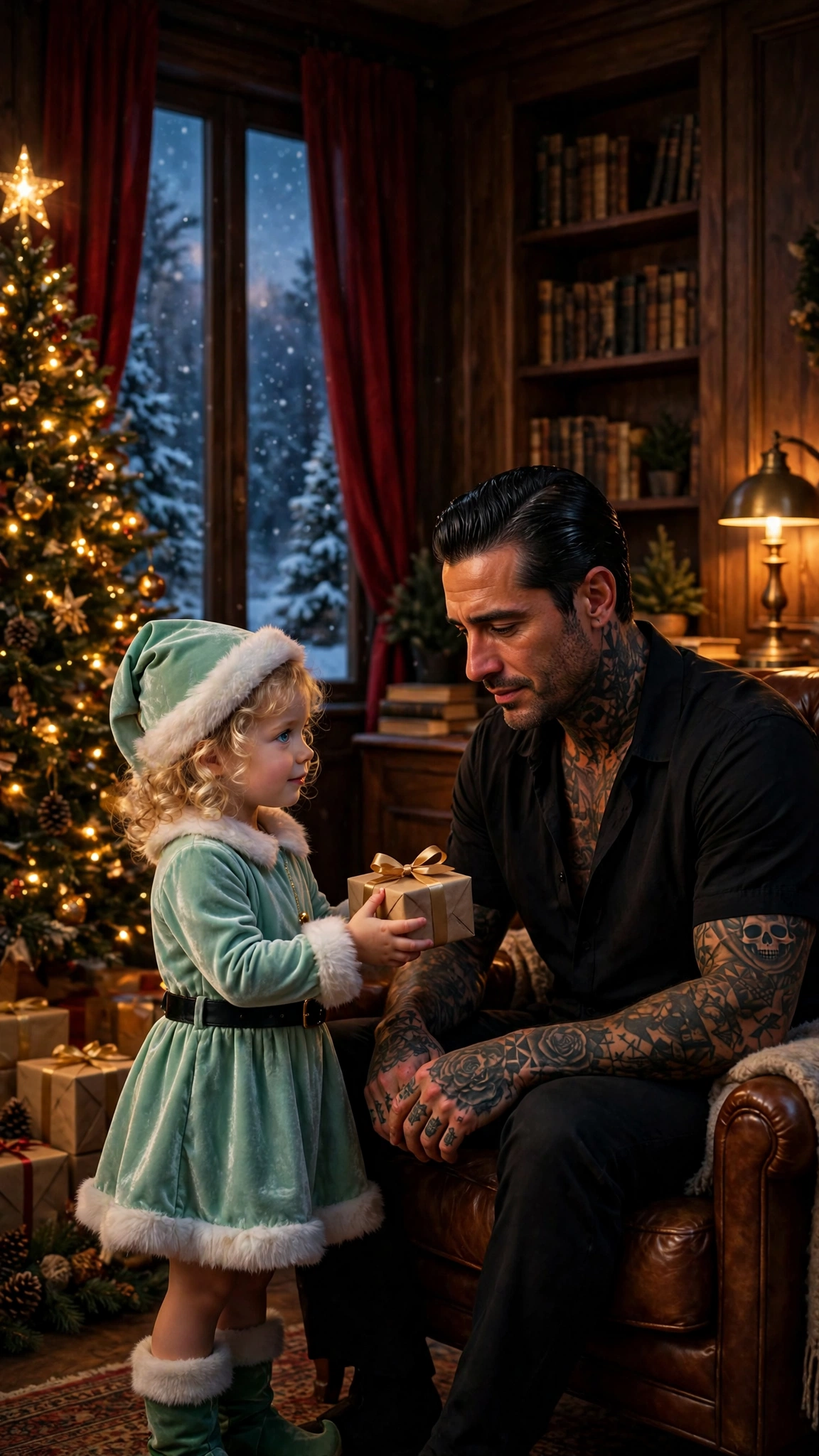
Sophia woke to the sound of music.
It was not a loud sound. It was soft, and slow, and sweet, and it came from downstairs, from the back of the house, from the room that had been closed for two years, and for a moment Sophia lay in her bed with her eyes closed, listening, because she thought she must be dreaming.
But she was not dreaming. The music was real. It was the tune from the music box, the slow, sweet melody that sounded like rain on a window, only bigger now, and warmer, and played on a real piano by real hands, and Sophia knew that tune, and she knew who had played it, and she knew that something wonderful had happened while she was asleep.
She threw back her blankets and ran to the door in her bare feet, and down the hallway, and down the stairs, two at a time, her blonde curls flying behind her, and she followed the music through the house, past the portraits and past the tall clock, and she stopped in the doorway of the music room, and she stared.
Her father was sitting at the grand piano.
He was wearing a clean black shirt, and his hair was combed back, and his tattoos showed dark against his skin in the morning light, and his hands — his big, tattooed hands, the hands that had held a gun and signed papers and frightened grown men — were moving over the piano keys like birds over water, gently, carefully, as if the keys were made of glass. And the music that came out of the piano was "Silent Night," slow and sweet and perfect, and the whole house seemed to be holding its breath to listen.
Sophia stood in the doorway for a long time, watching him, and then she went to him, very quietly, and she climbed up onto the piano bench beside him, and she leaned against his arm, and she began to sing.
She did not sing well. She was five years old, and her voice was small, and she forgot half the words, and she made up the other half. But she sang, and her father played, and the music filled the room, and the sun came up over Chicago, pale and gold through the tall windows, and the snow glittered on the garden outside, and for the first time in two years, the music room was alive.
When the song ended, Lorenzo lifted his hands from the keys, and he looked down at his daughter, and he smiled — really smiled, the way he used to smile in the photograph, before everything went quiet — and Sophia smiled back, and she threw her arms around his neck, and he held her, and they sat there together on the piano bench, in the morning light, while the whole house woke up around them.
"Did you hear it, Daddy?" Sophia asked. "Did you hear Mummy singing?"
"I heard her," Lorenzo said, and his voice was rough, but it was steady, and it was true. "I heard her, little one. She was singing to us both."
After that, the whole day was Christmas.
Rosa had been up since dawn, and the kitchen smelled of cinnamon and oranges and fresh bread, and the table in the dining room — the long mahogany table that had not been used for a celebration in two years — was laid with the best cloth and the best plates and the best silver, and there were candles in the middle, and holly, and a bowl of oranges, and a great golden turkey waiting in the oven.
But first there was the tree.
Lorenzo took Sophia by the hand, and they went into the study, where the Christmas tree stood in the corner, burning with small golden lights, and Sophia looked up at it, and her blue eyes went wide, because there, on the highest branch, right beside the glowing star at the top, hung her own gold star — the star she had cut from her mother's song and painted gold and written "For Daddy" on the back in green crayon — and it caught the morning light and shone like a small piece of the sun.
"That's my star!" Sophia cried, and she clapped her hands, and she danced in a circle on the rug, her blonde curls bouncing. "Daddy! That's my star! You put it on the tree!"
"I did," Lorenzo said, and he lifted her up so she could see it properly, high on the branch, shining in the light. "It is the finest star this tree has ever had. And it is going to stay there, little one, for every Christmas, for as long as we live in this house."
Sophia looked at the star for a long time, and then she looked at her father, and she said, in a very serious voice, "Mummy would like that, Daddy. Mummy would like her star to be on the tree."
"Yes," Lorenzo said. "I think she would."
And then he took the star down, very carefully, just for a moment, and he carried it upstairs to Sophia's room, and he put it in a small silver frame, and he set the frame on the table beside her bed, next to the photograph of her mother, where the morning light would fall on it every day, and Sophia looked at the two of them together — the photograph and the star, her mother and her present — and she smiled, and she said, "Now Mummy can see it every morning, when I say good morning to her."
After that came breakfast, and breakfast was the best part of all.
Lorenzo sat at the head of the long mahogany table, in his clean black shirt, with Sophia beside him in her best dress — not the elf costume, which was hung carefully in the wardrobe for next year, but a soft blue dress with a white collar, the one Rosa had laid out for her that morning — and around the table sat the whole family of the house: Rosa, in her best uniform, with her silver cross shining at her throat; Macy, in a new dress Lorenzo had sent out for that morning, her dark hair braided neatly, her eyes shining, because she had a job, and a home, and a family, and she was never going to lose any of them; and John Barone, in his best coat, with his red scarf around his neck, sitting up very straight in his chair and trying very hard not to look as proud as he felt.
They ate, and they laughed, and they told stories, and Macy told a story about the time she had dropped an entire tray of Christmas puddings in her first week, and Rosa told a story about the time Elena had tried to cook Christmas dinner herself and set fire to the turkey, and John told a story about the time he had planted a rosebush in the wrong place and it had grown into the most beautiful rosebush in the whole garden, and Lorenzo, who had not laughed in two years, laughed until his sides ached, and Sophia laughed loudest of all, because she was five years old and it was Christmas morning and her father was happy.
After breakfast, they went into the music room again, all of them, and Lorenzo played the piano, and Rosa sang, in a voice that was not very good but was very loud, and Macy sang too, and John hummed along, and Sophia danced in the middle of the room in her blue dress, spinning in circles until she was dizzy, and the music filled the house, and the snow fell past the windows, soft and steady, and the whole big house, which had been silent for so long, was full of sound and light and life again.
And then, because it was Christmas, and because Lorenzo Moretti had decided that this year would be different from every year before it, there were presents — not just the ones under the tree, but presents he had chosen himself, in secret, in the small hours of the morning while the house slept.
For Macy, there was a warm wool coat, deep green, with brass buttons, and a letter, written in his own hand, confirming her position in the house and doubling her wages, and a small silver locket, plain and simple, with nothing inside it yet, because Lorenzo had said, when he gave it to her, "For the photographs you will take in the years to come, in this house, with us." Macy held the coat to her chest, and she held the letter in her hands, and she cried, and she laughed, and she hugged him, right there in front of everyone, and Lorenzo, who had never been hugged by a kitchen maid in his life, stood very still for a moment, and then he hugged her back.
For John, there was a leather-bound book about roses, thick and heavy, with colored pictures on every page, and a new set of garden tools with handles of polished wood, and a bottle of the best wine from the cellar, and John, who had worked in the garden of this house for forty years and had never once been given a Christmas present by the boss himself, turned the book over in his weathered hands, and he looked at the pictures of the roses, and he said, in a voice that shook a little, "I will plant the red ones by the south wall, sir. The ones in the picture. They will be beautiful come June."
For Rosa, there was a shawl of soft blue wool, and a new silver chain for her cross, because the old one had worn thin after twenty-two years, and Rosa, who had seen everything in this house and was surprised by nothing, put her hand over her mouth, and her eyes filled with tears, and she said, "You remembered. After all these years, you remembered."
"I remember everything that matters," Lorenzo said. "I just forgot it for a while. I will not forget it again."
That afternoon, when the sun began to go down and the snow turned blue in the evening light, Lorenzo took Sophia out into the garden, to the old oak tree, where John had been working that first morning of December, and they stood together in the snow, father and daughter, looking up at the great dark house with its windows lit gold, and Lorenzo picked Sophia up and set her on his shoulders, the way he had done when she was very small, and she laughed, and she put her small hands on his head to hold on, and he said, "Look, little one. Look at our house."
Sophia looked. The house was beautiful in the snow, with its windows burning gold and its chimneys smoking and its garden white and still, and it did not look like a sad house anymore. It looked like a home.
"Is Mummy watching us, Daddy?" Sophia asked.
"Yes," Lorenzo said. "I think she is. I think she is watching us right now, and I think she is smiling."
Sophia nodded, and she leaned down and kissed the top of his head, and she said, in a very small, very certain voice, "I told you, Daddy. I told you my present would make you smile."
Lorenzo laughed, and he lifted her down from his shoulders, and he held her in his arms, and he looked at her — at her blonde curls, and her blue eyes, and her rosy cheeks, and the small gold star in its silver frame waiting for her upstairs beside her mother's photograph — and he said, "You were right, little one. You were right about everything."
That night, when Sophia was in bed, and the house was quiet, and the Christmas tree burned gold in the study, Lorenzo went to the music room one last time, and he sat at the piano, and he played "Silent Night" once more, slowly, softly, for the woman he had lost and the child he had kept and the life he had chosen to live again.
And when the last note died away, he closed the piano lid, very gently, and he went upstairs to his daughter's room, and he stood in the doorway for a moment, looking at her asleep in her bed, with the photograph and the star on the table beside her, and the snow falling past the window, and he whispered, to the empty room, to the snow, to the woman he had loved and lost and found again in the music:
"Thank you, Elena. Thank you for the star. Thank you for the song. Thank you for our daughter. I am not sad anymore. I promise you. I am not sad anymore."
And he went to bed, and he slept, and the house slept, and the snow fell, soft and steady, over the whole white world, and Christmas morning came, bright and gold, and the most feared man in Chicago woke up smiling, because a five-year-old girl in an elf costume had come into his study on Christmas Eve with a small box tied with a gold ribbon, and told him not to be sad anymore, and he had listened.
THE END