The sitting room had been a beautiful room once, and grief, whatever else it does, is an excellent preservative.
Morning light came through the tall windows in dusty shafts and found everything exactly as Isabella Falcone had left it on a Thursday eighteen months ago: the books spine-out on the low shelves, the blue sofa, the coffee tray on the side table with two cups on it — two, because the staff who dusted nothing in that room had nonetheless never had the heart to take one away. A fine gray film lay over all of it, soft as ash. The air smelled of paper and lavender and time.
Dante stood in the doorway with his hand still on the handle he had finally turned, and for a moment Rosa thought he would not be able to do it. His shoulders had gone rigid. His breath had gone somewhere high and tight. She stood behind him with Sophia in her arms — Sophia awake now, solemn, taking in the dusty golden room with the gravity of a small ambassador — and Rosa did the bravest thing she had ever done in that house, braver than serving the Castellanos, braver than any corridor at midnight.
She stepped up beside him, close enough that her shoulder nearly touched his arm, and she said, very quietly:
"We're right here, Mr. Falcone. Take your time."
Sophia, who had no patience for adult weather, pointed imperiously at the sofa. "It's dusty," she announced. "It needs a clean. Mommy cleans. Then it's a room again."
And Dante Falcone laughed — in the doorway of the room he had sealed like a tomb, dust in the light, a maid at his shoulder and her daughter conducting operations — laughed until he had to put one huge tattooed hand flat against the doorframe to hold himself up, while Rosa, helpless, laughed with him, and Sophia nodded with deep satisfaction, like a doctor whose diagnosis has been confirmed.
"Then it's a room again," Dante repeated, wiping his eyes. "Out of the mouths of management." He straightened, and looked at the portrait they had carried in from the hallway — he had carried it himself, that morning, the first time it had moved in eighteen months, and set it not in its old place of mourning beside the door but here, in the sitting room, in the light, where Isabella's summer laugh belonged to a living room again. "She would have liked you," he told Rosa, simply. "Both of you. She had a policy about people who walk with sad men. She married one."
Cleaning the sitting room took four days, and it was the worst-kept secret in three counties. Sophia supervised from the blue sofa, enthroned on cushions like a building inspector, pointing out dust with a wooden spoon and a merciless eye. The guards moved the heavy furniture with the reverent clumsiness of pallbearers at a christening. Giulia wept once, happily, into a dust sheet, and denied it. On the second day, Dante himself appeared in the doorway with his sleeves rolled and a stack of Isabella's books in his arms that he had carried down from the attic — books she had meant to shelve in that room "when there was time," in the way of all beloved, postponed things — and he set them on the low shelves one by one, in her order, which he remembered perfectly, while the whole staff found reasons to pass the open door very slowly.
On the third day, at four o'clock, the walk came down the hallway as it always had — and turned, for the first time in eighteen months, into the sitting room. Dante stood in the cleaned and sunlit room with two cups of coffee on the tray by the sofa, because he had made them himself, badly, and set them out himself, carefully, and waited with the expression of a man defusing something of his own manufacture until Rosa arrived, breathless, wiping her hands on her apron, summoned by a message carried by three separate members of staff in case the first two fainted.
"You take yours with sugar," he said, with enormous dignity, "which I have provided. Sit down, Rosa. The room is open. Apparently it seats two."
She sat. The coffee was dreadful. It was the best coffee she had ever had in her life, and she told him so, and he said — looking out at the garden, at the light, at anything but her, with the ghost of the rumor of almost a smile — that she was a terrible liar and a credit to the house, and they drank every drop. The staff did it like people defusing something precious — Addie directing operations with a duster like a baton, Marco on a ladder with the chandelier crystals, the maids beating cushions on the terrace and gossiping in voices so full of joy you'd have thought there'd been a wedding. There had not been a wedding. But there had been, on the second day, a set of announcements that moved through the house's servant telegraph faster than light.
Rosa Bennett was to be housekeeper — Addie's own chosen successor, with Addie retiring in the spring to the gatehouse cottage, at full pension, in scandalous comfort, telling everyone who would listen that she had planned it all along. The housekeeper's salary was three times a maid's. And folded inside the envelope with the appointment letter — Rosa found it that night, alone, and sat down hard on her bed — was a receipt, stamped and final, from a hospital billing department: an account, eleven days of intensive care, two years of forty-dollar Fridays, closed. PAID IN FULL. No note. There was no need of a note. There was only one hand in that house that paid debts without leaving fingerprints of kindness on them, and she had seen it adjust a ribbon in a child's hair.
She tried to thank him. It went badly, in the best way.
"You can't— Mr. Falcone, I can't accept— that's charity, and I—"
"It's back pay," Dante said, not looking up from the freight ledgers, with the air of a man discussing weather. "The house underpaid its most valuable employee. Marco did the arithmetic." From the doorway, Marco — who had done no arithmetic — examined the ceiling with profound interest. "Take it up with accounting, Mrs. Bennett."
"Dante—" It was the first time she had ever used his name. It stopped both of them. The ledger. The room. "Thank you," she said, at last, simply, because she understood suddenly that some debts are only insults if you refuse to let them be gifts. "For all of it. Thank you."
He looked up then. "You walked into my kitchen at midnight and told me ghosts shouldn't shake," he said. "Nobody has told me the truth in eighteen months, Rosa. It appears I was starving for it. Sit down. The coffee in this house is terrible when I make it, but I'm told the company improves it."
Sophia turned four in that room, at a party whose guest list would have terrified three police departments: two dons, one retired consigliere, an underboss on probation in Baltimore (present by video call, hugely offended to have been seated, screen-wise, next to the cake), forty-one members of staff, one orange cat, and Carla Castellano, who arrived in yellow, kissed Rosa on both cheeks like a sister, and presented the birthday girl with a hat of such magnificence that Addie had to sit down.
Dante's gift was the smallest box on the table. Inside, on a ribbon of lavender silk, was a smooth white stone — polished now, and drilled, and shining like a pearl that had taken the long way round. Sophia held it up, open-mouthed, and looked at him with the dawning recognition of a fellow practitioner.
"I found it at the door of this room," he told her, gravely, in front of everyone, "a long time ago. Somebody left it there for a lady who was lonely in a picture. I've carried it every day since, to remind the stone to be brave." He fastened the ribbon around her neck himself, his huge hands absurdly careful. "Now it can retire. The lady has company. The stone's work is done — but you keep it, piccola, in case there's ever another sad man. You're the expert now."
Sophia closed her fist around the stone and nodded like a don accepting a territory. "I will check all the men," she promised. "Every day. At four o'clock."
Spring came to the Falcone house the way it comes everywhere, which is to say all at once and entirely without permission. The sitting room filled with books being actually read, and the white flowers — still arriving every Monday, Isabella's standing order — began appearing in other rooms too, as if the house were slowly remembering it had more than one room in it. The joint company with the Castellanos produced its first joint profit and a dinner at which Carla, magnificent and completely recovered, informed Rosa that she had had the red dress burned and considered it the best money she'd ever spent, and then demanded to be introduced to "the small general in the lavender dress," to whom she presented, with great ceremony, a box of chocolates the size of a suitcase.
The suitcase came down from the wardrobe one last time in March — because Rosa, unpacking the winter linens, found it still under the bed where she had packed it on the worst night, and stood holding it by the handle in the middle of her room with the strangest expression. It was Addie who solved the matter, commandeering the case without being asked, emptying it onto the bed with the briskness of a woman defusing an embarrassment, and sending it up to the attic with the Christmas ornaments. "A household keeps a suitcase for visits," the old woman declared, "not for exits. If you're ever fool enough to want one for an exit again, you may climb up and fetch it down yourself, past all the ornaments, and by the time you've done that you'll have had time to think — which is all a suitcase is for, in a well-run house: thinking time." Rosa laughed until she cried a little, and helped carry it up.
Enzo wrote from Baltimore. The letters were stiff, then less stiff. One, in April, contained a crayon drawing of his own — a large stick man, a small stick girl, enormous smiles, executed in ballpoint pen with more enthusiasm than skill — and the words: Tell the artist the freight office is boring and the boss here is a tyrant about paperwork. It went up on the sitting-room wall, next to the original, which Dante had had framed. Marco claimed it was a security measure. Nobody believed him.
And every afternoon at four o'clock, the house still held its breath — but the way you hold it before music now, not before weather.
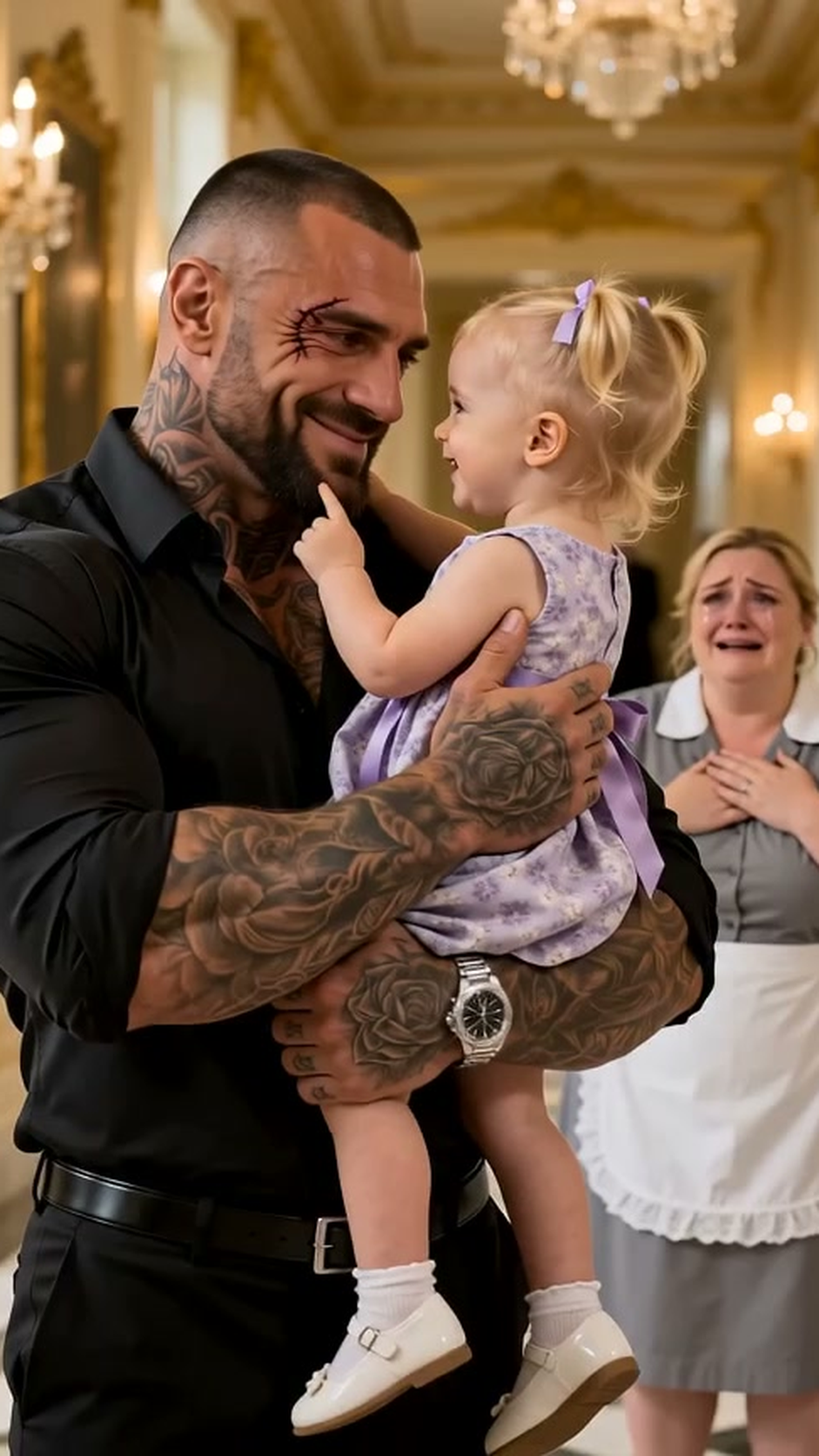
Dante comes through the tall doors at the far end of the marble hallway, slowly, hands clasped behind his back, the way he has always walked and always will; it is simply who he is, that walk, minus only the sorrow that used to ride on it like a second spine. Six feet behind him — sometimes six, sometimes three, sometimes riding piggyback with her white shoes kicking gently against a fortune in tailoring — comes Sophia Bennett, hands folded, chest puffed, face arranged into the sternest scowl a four-year-old has ever manufactured, taking her solemn enormous steps. And beside them, more often than not, walks Rosa with the afternoon coffee, laughing at something, saying something, answering something — because the walk has a conversation in it now, and music in the rooms it passes, and a stop at the sitting-room door that is no longer a stopping at all. Just a door. Open. With people in it.
On the first warm day of May, Dante stopped at the far end of the hall, where the light fell gold through the tall windows, and turned, and held out one enormous tattooed hand behind him without looking — the way you reach for something you are perfectly certain is there.
A small hand took it.
"Are we walking, bear?" Sophia asked. She had gotten the name from Addie, who had gotten it from heaven knows where, and it had stuck to the most feared man on the coast like a burr.
"We're walking, piccola."
"Good." She arranged her face into the scowl, folded her free hand behind her back, and nodded once, with immense professional satisfaction. "You don't look lonely anymore. That's because of my good walking."
"Is that so?"
"Yes," said Sophia, "and Mommy's."
Dante Falcone looked back at Rosa, coming up the hallway with the coffee and the smile she no longer bothered to hide from anyone, and his whole scarred, tattooed, resurrected face softened into the expression the guards had once crossed themselves at the sight of, and now merely pretended not to notice, because a house has its dignities.
"Then don't let me walk alone," he said.
"We won't," said Rosa.
And they didn't.
THE END