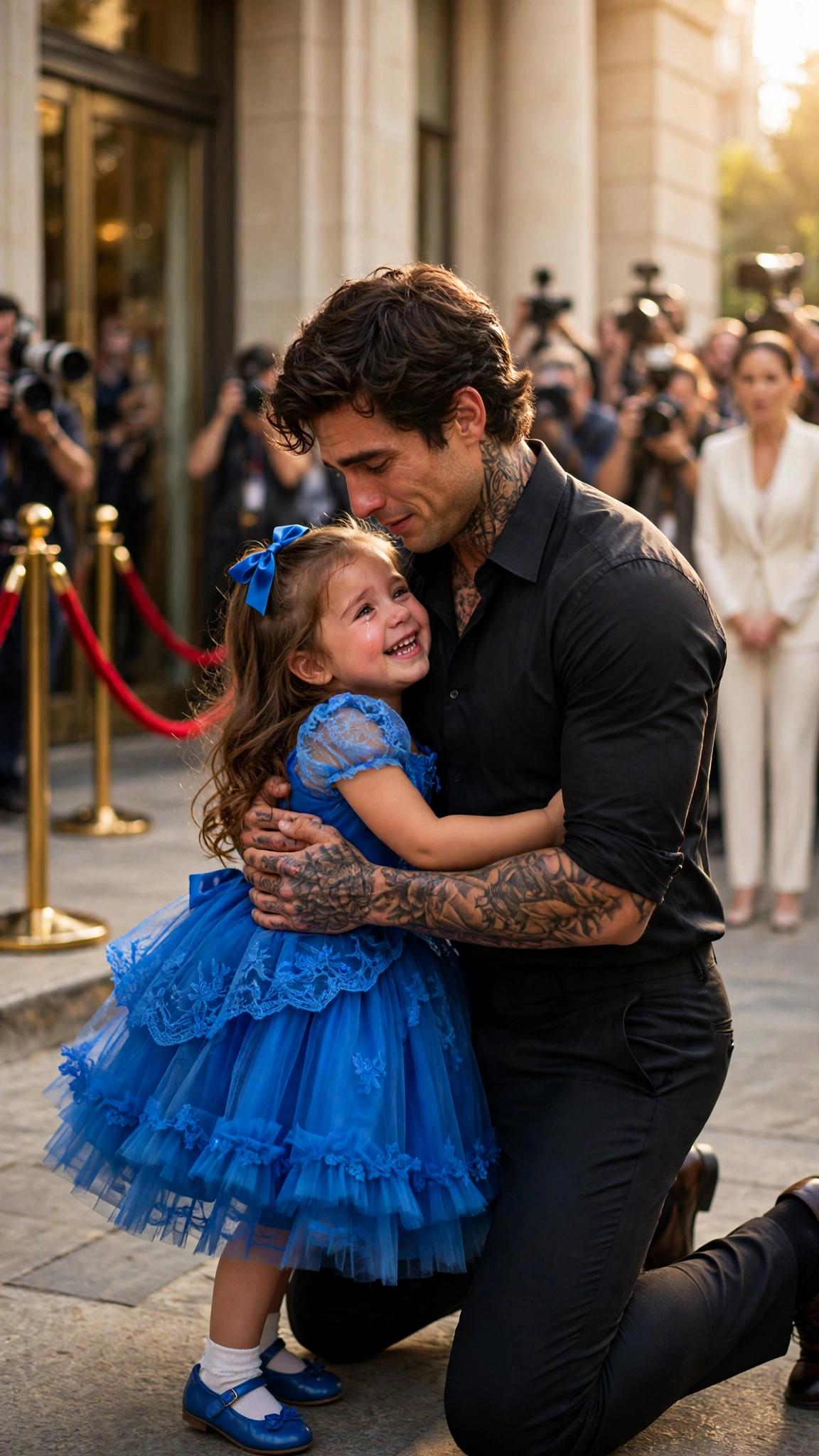
The cameras were already flashing when Michael Rivers stepped out of the black town car.
Afternoon sunlight poured down the front of Sunrise Children's Home, turning the cream limestone gold and throwing long shadows across the polished pavement. Golden stanchions with red velvet ropes marked the press area. Reporters called his name. Photographers lifted their cameras in a single rippling wave. It was the kind of entrance Michael had made a hundred times — chin up, shoulders back, a small practiced smile that said a generous man had arrived to do a generous thing. Three million dollars, this year. A new wing for the children. His assistant had written the speech. His publicist had approved the suit.
He had walked perhaps twenty feet toward the tall glass doors when a small blue shape broke through the crowd.
A little girl in a vivid royal-blue princess dress, her long wavy light-brown hair flying behind her, a bright blue bow pinned to the right side of her hair, ran straight at him across the pavement. Her white ankle socks flashed beneath the full layered tulle skirt. Her blue Mary Jane shoes slapped the stone. Her arms were already open before she reached him.
"Daddy!" she cried, her voice cutting through the noise of the press gathering like a bell. "Daddy! I knew you'd come!"
Michael stopped walking.
The cameras kept flashing. The reporters kept shouting questions. But the sound seemed to fall away from him, as if someone had turned the volume down on the whole world. The little girl threw herself against him and wrapped her tiny arms tightly around his waist, pressing her cheek against his black shirt. He could feel her shaking. He could feel her heart hammering through the thin fabric of her dress.
He looked down at the top of her head, at the blue bow, at the lace on her puffed sleeves, and for a moment his mind simply refused to work. He was thirty-two years old. He owned buildings in four cities. He had negotiated with men who could ruin him with a signature. And he had never in his life been so completely, helplessly unprepared for anything.
Slowly, carefully, as if she might break, he lowered himself onto one knee. His tattooed hands hovered uncertainly near her shoulders. The black-and-gray ink on his forearms stood out against her pale skin. He studied her face — the innocent round face, the soft rosy cheeks, the large brown eyes — and something cold moved through his chest, because those eyes were his own. He had seen them in the mirror every morning of his life.
"Sweetheart," he said quietly, and his voice sounded like a stranger's. "Who are you?"
The girl slowly raised her head. Her joyful expression began to fade, the way sunlight fades off a wall. Her lower lip trembled. Tears filled her eyes — not the tears of a child who had fallen down, but the tears of a child watching something precious break in front of her.
"You don't remember me?" she whispered.
A woman in an elegant ivory pantsuit hurried through the journalists and stopped beside the girl. She had shoulder-length chestnut-brown hair and worried eyes, and she carried a small black handbag clutched tight against her side. She looked at Michael, then at the little girl, and Michael saw the exact moment she understood what had happened. Her face went pale.
"Mr. Rivers," she said, her voice nervous and hushed, pitched for him alone though every microphone in the press area was straining toward them. "Her name is Emma."
Michael turned sharply toward her. The name hit him like a physical blow. Emma. He had not heard that name spoken aloud in five years — not since the night Claire had whispered it to him in the dark, her hand on her stomach, telling him what she wanted to call their daughter if it was a girl.
"Claire Bennett?" he whispered, almost breathless.
The woman's expression froze.
He was still kneeling. He gently took Emma's small hands in his large tattooed ones, and he looked from her face to the anxious woman and back again, trying to hold on to the world as it tilted under him.
"How did you know I was your daddy?" he asked softly, trembling.
Emma looked directly into his eyes, completely sincere, the way only a five-year-old can be. "Mommy showed me your picture."
Michael swallowed hard. Somewhere behind him a camera shutter clicked, and clicked again. He barely heard it. All he could think about was a photograph — Claire keeping his photograph, showing it to a little girl, telling her that her daddy would come. For five years.
The woman in the ivory pantsuit stepped closer, her eyes glistening with restrained sadness. "Her mother left something for you," she said quietly.
Michael's expression tightened. "Where is Claire?"
The woman looked down at Emma instead of answering. An uncomfortable silence followed, and in that silence Michael understood that something terrible had happened. He looked toward her, fear replacing the disbelief in his eyes.
"Please," he said, his voice breaking. "Tell me she's alive."
The woman lowered her eyes without speaking. Emma innocently tightened her grip on his hands.
And Michael Rivers, who had everything, understood in that moment that he had nothing at all.
—
Five years earlier, on a night when the rain came down over Manhattan in silver sheets, Claire Bennett had stood in the middle of his penthouse living room holding a small white stick in her hand, and she had said, "Michael, I'm pregnant."
He remembered the exact way the city lights had looked through the windows behind her. He remembered the way her hands had shaken. He remembered that she had smiled when she said it — not a big smile, a small brave one, the smile of a woman offering a man the best thing she had.
He remembered what he had said back. He had rehearsed a thousand better answers in the five years since, and none of them would ever be spoken, because the answer he had actually given was the one that had ended everything.
He had said, "You can't be serious."
Claire's smile had not fallen all at once. It had faded the way Emma's joy had faded that afternoon on the pavement — slowly, in pieces, as understanding arrived. "I am serious," she had said. "I took three tests. Michael, we're going to have a baby."
He had walked to the window. He had put his hands flat on the glass. Behind him, the penthouse was silent except for the rain. He had been twenty-seven years old, and Rivers Capital had just closed the biggest deal of its life, and his father was dying in a hospital uptown, and the whole weight of the company and the family name was sitting on his shoulders like a stone. He had told himself, later, that he was afraid. That was true. He had also been selfish, and that was true too.
"We're not ready," he had said, and even as the words left his mouth he had known they were a coward's words. "Claire, I'm not ready. The company — my father — everything is happening at once. We can't do this now."
"There is no now," Claire had said quietly. "There's just what is. I'm pregnant, Michael. That's not something we schedule."
He had turned around then, and he had seen her face, and he had seen that she was not angry. That was the worst part. She was not angry. She was just looking at him the way you look at someone you are saying goodbye to.
"I need you to think about this," he had said. "Really think. I can take care of you. I'll pay for everything. Whatever you need. But a child — Claire, a child changes everything, and I can't —"
"Don't," she had said.
"Don't what?"
"Don't offer me money for our baby." Her voice had stayed soft, but something in it had gone hard as glass. "I didn't come here to sell you something, Michael. I came here to tell the man I love that we're going to be parents."
He had stood there, twenty-seven years old, with the rain running down the windows behind her, and he had done nothing. He had not crossed the room. He had not taken her in his arms. He had not said the words that would have saved them both.
His phone had rung then. His father's nurse, from the hospital. His father was asking for him. And Michael had taken that ringing phone like a rope thrown to a drowning man, and he had said, "I have to go. We'll talk about this tomorrow."
Claire had nodded. She had set the little white stick down on the coffee table, neatly, like a woman leaving a note. She had picked up her coat. And at the door she had stopped and looked back at him one last time.
"I love you," she had said. "Whatever you decide tomorrow, I want you to know that. I love you."
Then she had gone, and the door had closed behind her with a soft click that he would hear in his sleep for the next five years.
He had gone to the hospital. His father, Richard Rivers, had been propped up on pillows, his face grey, his breathing thin. He had taken Michael's hand in his own papery one and said, "She's gone, son. The girl. She took the money and she's gone. It's for the best. You have a company to run and a name to protect."
Michael had believed him. He had believed him because it was easier than believing the truth — that he had driven Claire away himself, that she had left with nothing but a coat and a pregnancy and her pride. He had believed him because his father was dying and dying men, he thought, told the truth.
In the months that followed, he buried himself in work the way other men bury themselves in drink. He arrived at the office before dawn and left after midnight. He closed deals he barely remembered negotiating. He bought a building in Chicago and another in Miami, and he could not have told you a single thing about either of them. His assistant began leaving sandwiches on his desk because he forgot to eat. His friends stopped calling, because he never answered.
Once, in the first winter after Claire left, he drove past her building in Queens. He told himself he was only passing through the neighbourhood. He slowed the car and looked up at her windows, and the lights were off, and there was a moving van parked outside the building next door, and he told himself that settled it — she was gone, she had taken the money, she had moved on. He drove away and he did not come back.
Once, in the spring, he saw a little girl in a blue coat in Central Park, holding her mother's hand, and his heart stopped so hard he had to sit down on a bench. The girl was not Emma — Emma had not been born yet, or had just been born, somewhere, without him — but for a moment he had seen, with terrible clarity, everything he had thrown away.
Once, late at night, he picked up his phone and found Claire's number, and he held his thumb over the call button for a full minute, and then he put the phone down. What would he have said? I'm sorry? Come back? He had not earned the right to either sentence. He told himself she had made her choice. He told himself the money his father had mentioned — money he had never seen change hands — had settled everything.
It had settled nothing. It had only buried the truth under five years of noise and work and silence, where it waited, patiently, for a little girl in a blue dress to dig it up.
He never went to her apartment. He never called. He told himself she had made her choice. He told himself the money his father had mentioned — money he had never seen change hands — had settled everything. He buried himself in work. He closed the biggest deals of his life. He became the billionaire the newspapers loved to photograph.
And all the while, somewhere in Queens, Claire Bennett was raising his daughter alone, showing her a photograph of him, and telling her that her daddy would come one day.
Five years later, on a bright afternoon in front of Sunrise Children's Home, a little girl in a blue princess dress ran through a crowd of reporters and proved her mother right.
"Please," Michael whispered again to the woman in the ivory pantsuit, still kneeling on the pavement with Emma's small hands in his. "Tell me she's alive."
The woman finally lifted her eyes to his. "My name is Helen Marsh," she said. "I'm the director here. Mr. Rivers — Claire left you a letter. It's been waiting for you for three weeks. And yes." She paused, and her voice shook. "Yes, she's alive. But you need to come quickly. You need to come now."