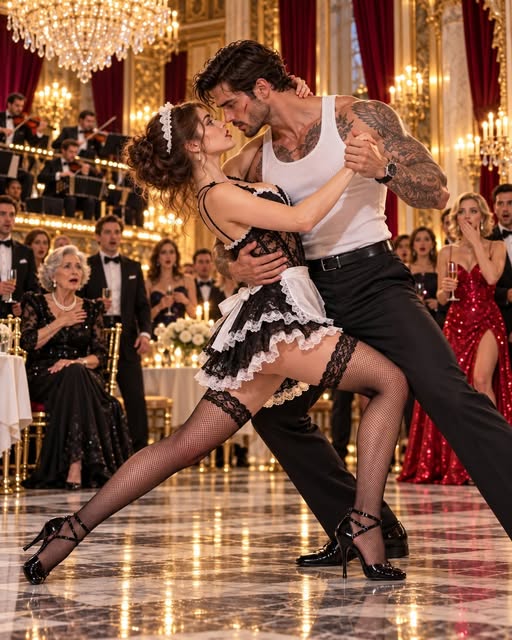
The next morning I stood in front of my closet for twenty minutes, which was nineteen minutes longer than my entire wardrobe justified, because Eleanor Whitmore had told me to wear something that wasn't gray and everything I owned was a variation on the theme of a woman trying not to be seen.
I chose the blue dress. It was eight years old, bought for a cousin's wedding, and it was the only thing I owned that my father had ever seen me in as a grown woman. He had told me I looked like my mother in it. I wore it like armor.
The study at nine o'clock smelled of leather and espresso. Grant was there, and Marcus, and — unexpectedly — Eleanor, enthroned by the window with a cup of tea she never drank, present, I understood immediately, as a witness. In their world, important things were said in front of witnesses.
Grant got up when I came in. Men in his world did not get up for housekeepers, and we both knew it, and the small courtesy landed between us like a coin on a table.
"Miss Brooks." He gestured to a chair — not across the desk. Beside it. "Thank you for coming."
What followed was the strangest negotiation of my life. Grant Whitmore did not apologize — I would learn that his apologies came in actions, never words — but he laid out the situation with a banker's precision. His word had been given publicly. The videos were at eleven million views. Two rival families had already made inquiries that Marcus described, with distaste, as "fishing." If he now announced it was a joke, every contract he'd ever signed by handshake would be worth the paper it wasn't written on. He intended to honor the offer.
"Intend," I said. "You intend to marry me the way you intend to acquire a shipping company."
"Yes," he said, without flinching. "At first. I won't insult either of us by pretending this is a love story today. But I keep my word, Miss Brooks, and I am told — " his eyes flicked, almost unwillingly, toward the window where the ballroom chandeliers caught the morning " — that your father taught my grandmother what a promise sounds like. So here are my terms. An engagement, announced properly. A period of — courtship, for the public. Your position in this house ends today; no fiancée of mine scrubs floors, and before you argue, understand that is not generosity, it is choreography, and your wages will be replaced with a settlement that clears your sister's debts and sets up a fund for the boys. You keep your own rooms, your own schedule, your own say. And when we marry — if we marry — it will be because both of us walk into it with our eyes open."
"And Vanessa?" I said.
Something in his face closed like a door. "Vanessa Hale's engagement was a business arrangement between my organization and her father's. It will be unwound like one." He folded his hands. "That's my word too."
I thought about Rachel's landlord. I thought about the electric bill with teeth. I thought about my father's hands, and about Eleanor's face when she said his name, and about the expression on Grant's face in the last bar of the tango — a man hearing a voice through a locked door in his own house.
"One condition," I said. "I am not a contract, and I am not choreography. If at any point I say this stops, it stops, and you shake my hand in front of witnesses and wish me well, and your word survives it — because I will tell anyone who asks that Grant Whitmore treated me honorably. Those are my terms."
He looked at me for a long moment. Then he stood, and came around the desk, and held out his hand — the same hand, the same ballroom gesture, but daylight now, and sober, and no one laughing.
"Done," he said.
I shook it. His grip was careful this time, the way you hold something you've decided not to break.
Eleanor set down her untouched tea. "Now," she said briskly, "someone feed this girl. She's marrying into this family on an empty stomach and a blue dress."
I told Rachel in person the next afternoon, in her kitchen, while the boys built a fort out of couch cushions in the next room and demolished it, repeatedly, at volumes that suggested demolition was the entire point.
She listened to all of it without interrupting — the study, the terms, the settlement, the fund for the boys, the word given and kept — with her hands wrapped around a mug she never drank from. When I finished, she said, "You shook his hand."
"I shook his hand."
"Emily. You shook the mafia's hand and dictated terms." A sound came out of her that was half laugh and half alarm. "Dad would be — God. Dad would be so proud he'd be unbearable. He'd tell the whole church hall." Then the laugh went out of her, the way it does, and she reached across the table and took my wrist, and her voice dropped under the boys' noise. "But listen to me. Really listen. A settlement and a fund — Em, that changes the boys' whole lives. And I am grateful, and I am also telling you: if this turns, if it gets strange or cold or frightening, you do not stay for our rent. We managed before. We were poor, we weren't dead. Promise me the money doesn't buy your exits."
"It doesn't," I said. "That's literally in the terms. I checked. Twice. With a witness and everything."
"Terms." She shook her head slowly, and then she smiled — the real one, the one from before the divorce and the bills and the years of both of us being so tired. "My sister. The housekeeper who negotiated with Chicago." She stood up and got the good biscuits, the ones she kept for company and emergencies, which is to say she classified my engagement to a mafia boss as both. "Eat. You look like a strong wind would take you. If you're going to marry an empire, you're not doing it on an empty stomach."
From the next room, Ethan shouted that the fort had fallen and Noah was king now, and Rachel called back, without looking, "Long live the king, somebody find his other sock," and I sat in my sister's kitchen with biscuit crumbs on my one blue dress and thought: whatever else this strange arrangement turned out to be, it had begun, at least, with the truth told in the right order, to the people who mattered most.
The week that followed was like living inside a snow globe someone kept shaking. A statement from Whitmore Reserve: Mr. Whitmore is delighted to announce his engagement to Miss Emily Brooks. The newspapers used the word housekeeper eleven thousand times. Strangers wrote to the estate. The staff didn't know whether to curtsy or gossip, and mostly chose both. I moved out of the servants' wing into a guest suite with a view of the lake, and cried in the enormous bathtub, and felt guilty for crying, and missed my tiny apartment with a ferocity that surprised me.
Vanessa, meanwhile, was unwound like a business arrangement — except that Vanessa Hale had never in her life been unwound from anything, and her father, Conrad Hale, controlled the harbor commission votes Grant needed for his new shipping terminal, and a woman scorned with a port authority for a father is not a business arrangement.
She is a weather system.
She came to the estate on the eighth day, officially to collect the last of her things from the east rooms she had been redecorating as the future Mrs. Whitmore. She brought her mother, and her friend Paige — a bridesmaid-in-waiting with a laugh like breaking glass — and a photographer she described as "for the family archive," and the whole household staff was turned out in the hall because Mrs. Hale wished to inspect the silver that would no longer be hers.
I stayed out of the way. I was in the library with Eleanor, being taught which fork my new life required, when Marta came to the door white-faced and said the words that rearranged the day:
"Miss Emily. Miss Vanessa's necklace is missing. The diamond one. And Mr. Doyle is asking everyone to come downstairs."
The necklace was famous even to the staff: a Hale family piece, diamonds like a string of frozen lightning, that Vanessa had worn to the anniversary ball and left — she announced, loudly, in the entrance hall, in front of her mother and the photographer and a dozen staff — in the east room safe. Only, it wasn't in the safe. And the east rooms were cleaned, she said, turning her head with terrible slowness until her eyes found me at the top of the stairs, by the housekeeping staff.
"By her, mostly."
What happened next happened the way drowning happens: fast, and in front of people, and with everyone watching your hands. Marcus, doing his job, asked — formally, miserably — for the household lockers to be opened. I walked down those stairs on legs made of water and said, "Of course," because innocence is supposed to say of course, and because a refusal would have been a confession in that hall.
The necklace was in my locker.
It was folded inside my spare apron, in the pocket, glittering up through the gray cloth like something alive. Someone gasped. The photographer's camera made its small, hungry sound. Vanessa made a noise that was almost a sob and almost a triumph and put her hand to her throat — to the place, I understood even then, where she was already imagining it back.
"Oh, Emily," she said, in a voice pitched for the back row. "The dancing wasn't enough? You had to steal from me too?"
I want to tell you that I was eloquent. I wasn't. My hands were shaking so hard I had to press them flat against my skirt. What I said was, "I didn't take it," and then again, to Marcus, to the room, to the stairs, "I didn't take it, I have never opened that safe, I don't even know the combination — "
"The combination," Vanessa said gently, "is kept in the housekeeper's office. Isn't it. For emergencies."
It is. It was. Taped inside the logbook, in case of fire. Every senior housekeeper knew it. I had never used it. There was no way to say that that didn't sound like the exact shape of a lie.
And then Grant came in.
He came through the front doors with his coat still on, straight from the city, and the hall rearranged itself around him the way iron filings rearrange around a magnet. He took it in — the open locker, the apron over Marcus's arm, Vanessa's tears, my face — in about two seconds, and I saw his jaw set, and I saw him do the math of his world: the Hales, the harbor votes, the videos, the promise, the port.
"Marcus," he said. "The security footage. All of it. Now."
"We're pulling it, boss. There's a gap — the locker corridor camera was down for eleven minutes this morning. Maintenance log says a scheduled test."
"A scheduled test," Grant repeated, and something in his voice made Paige, at the back, go very still.
But here is the moment I have carried with me since, the moment that mattered more than the necklace: Grant looked at me. Across that hall, with his fiancée of convenience accused and his fiancée of business weeping diamonds, he looked at me for one full second — and in that second I saw him hesitate.
Not accuse. Not defend. Hesitate. Weigh. One second of a man deciding what I was worth against the cost of believing me.
A second is a very long time, when you're the thing being weighed.
"Miss Brooks will stay in her rooms," he said at last, "until this is resolved. No one speaks to the press. Mrs. Hale, Miss Hale — Marcus will see you out."
They resolved nothing. I climbed the stairs with my gray apron over my arm, minus one pocket's glittering contents, past the staff who would not meet my eyes, and I sat on the bed in the beautiful guest suite with the lake view, and I did not cry. I called Rachel. I told her before the papers could.
And that night at nine o'clock, Marta slipped into my room with tea I hadn't asked for and a whisper: men had been seen that afternoon near Ethan's school. Not touching. Not approaching. Photographing.
The Hales were not weighing anything. The Hales had already decided what I was worth, and they were spending it.
At ten, I began, quietly and methodically, to pack my bag — the blue dress, my father's old metronome, the folded linen napkin — because whatever Grant Whitmore decided I was worth, my sister's boys were worth more, and a woman can run from a rich man's house but children cannot run from a rich man's war.
At ten-fifteen, there was a knock on my door.
Not a servant's knock. Three raps, hard, impatient, furious.
"Emily." Grant's voice, through the door, stripped of every trace of polish I had ever heard in it. "Open this door. The footage came back — all of it, including the eleven minutes they thought they'd erased. You need to see who put that necklace in your locker."