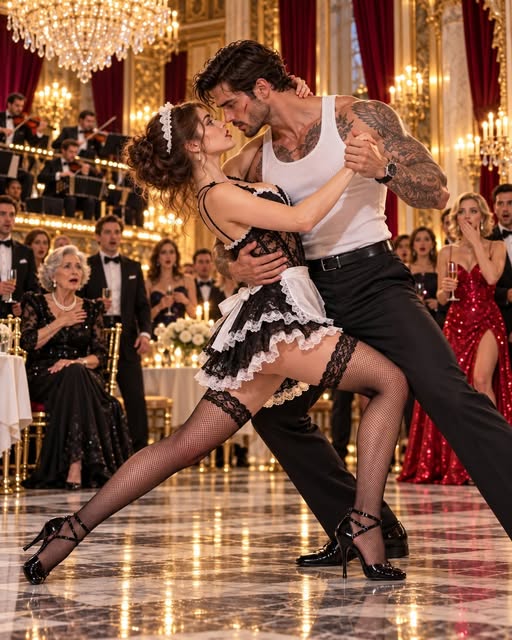
The applause started with one person — an old man near the windows, someone's grandfather, clapping slowly with tears in his own eyes — and then it took the whole room, the way fire takes a field. Two hundred people who had been laughing at me ninety seconds earlier were on their feet, and I was still folded over Grant Whitmore's arm in the middle of his ballroom, in a wine-stained uniform, with my heart trying to climb out of my throat.
He lifted me upright slowly, like I was made of something he hadn't budgeted for, and he didn't let go of my hand.
"Daniel Brooks," Eleanor said again. Her voice shook. She had crossed half the ballroom on her grandson's security chief's arm, and now she stood in front of me and took my other hand in both of hers, and her grip was astonishingly strong. "You're Daniel's girl. You're little Emily. You had a gap in your teeth and you used to hide behind the piano when the advanced class came in."
I could not speak. I nodded, and the tears I'd held back through wine and mockery and two hundred laughing faces came all at once, standing in the middle of a marble floor in my work shoes.
"How did you — " My voice broke. "Nobody here has ever — how did you know my father?"
"Know him?" Eleanor's laugh was wet and astounded. "Child, Daniel Brooks taught me to dance. Sixty years ago, at your grandfather-in-law's first club — may he rest — there was a room above the bar on Halsted Street, and Thomas hired the best young tango teacher in Chicago to give lessons on Friday nights, and that teacher was twenty-three years old and so poor his shoes were held together with hope, and so gifted that women crossed the city in the snow for one hour in his class. I was one of them." She pressed my hand. "Every Friday for a year. Until my father arranged my marriage, and I danced with Daniel Brooks at my last lesson, and he told me the same thing he told every student. Do you remember it, Emily?"
"A good tango isn't about controlling someone," I whispered. "It's about making sure they never lose their balance."
Eleanor closed her eyes. "Sixty years," she said, "and I can still hear him."
Around us, the room had reorganized itself into the shape of an emergency. Vanessa had arrived at her fiancé's elbow like a storm making landfall, smiling the smile she used for photographs, with her hand arranged on his sleeve like a claim check.
"Well!" she said brightly, to the room, to the phones. "Wasn't that — something. Grant, darling, the joke's gone far enough, don't you think? People are actually filming."
"People were filming when you poured wine down her back too," Eleanor said, without looking at her. "I do hope those videos come out as clearly."
Vanessa's smile thinned to a blade. "Grant."
And here is the thing you have to understand about Grant Whitmore's world, because I learned it that night and I have never forgotten it: in the world of ordinary people, a promise made as a joke is a joke. In Grant's world — the world of port contracts and whiskey routes and men who shook hands over millions in unmarked rooms — a man's word, spoken in public, in front of witnesses, was the only currency that never devalued. His own father had built an empire on it. He had said so himself, in his speech, not one hour earlier: the word of a Whitmore is a thing a man can build a grave or an empire on.
Marcus Doyle, his security chief and oldest friend, materialized at his other elbow, phone in hand, face carefully blank. "Boss," he said quietly. "Three of the clips are already past four million views. The Albano family account reposted one. So did a councilman." He paused. "Everyone's quoting the promise."
The room was very quiet now, under the applause that had died away — the quiet of two hundred people who have realized they are watching something real happen.
Grant looked at Vanessa. He looked at his grandmother, who was still holding my hand like a woman who had found something in the street she had lost in another century. He looked at me.
And I watched him understand, in real time, exactly what his joke had cost him — and I watched him decide, with the whole city watching, that Grant Whitmore would rather marry his housekeeper than be the man who broke his word in his own ballroom.
"My grandmother," he said, in a voice pitched to carry, "has just reminded this room of something. Daniel Brooks taught half of Chicago to dance, including — apparently — everyone in my family with any grace at all." A ripple of laughter, warmer now. He turned to me, and something complicated moved behind his eyes. "I made an offer in this room tonight. I don't make offers I don't keep. Emily Brooks — "
"Stop." The word came out of me before I'd decided to say it, and the whole ballroom heard that too. Grant stopped. Two hundred people held still. My heart was slamming. "Mr. Whitmore. I danced with you because your grandmother was watching my feet and I wasn't going to shame my father's music. I didn't dance for a proposal, and I am not going to stand here and be the punchline of the second half of the joke." I made myself breathe. "If your word means something, then it means something tomorrow, sober, in daylight, with no audience. If it doesn't, I'd rather know that too."
The silence after that was the loudest thing I have ever heard.
Eleanor laughed. That was the first sound — an eighty-three-year-old woman laughing with pure delight in the middle of her grandson's catastrophe. "Oh, Daniel," she said to the ceiling, "she is yours. Every inch."
Grant stared at me for one long moment. Then — slowly, in front of everyone — the most feared man in Chicago inclined his head. Not a bow. Something rarer: acknowledgment.
"Tomorrow," he said. "Nine o'clock. My study. Sober, in daylight, no audience." His mouth did something that wasn't quite a smile. "We'll discuss what my word means."
Vanessa's face, beside him, was a beautiful, frozen mask, and only her eyes were alive, and what was in them when they found me was not embarrassment.
It was a promise of her own.
The rest of the night moved like weather. Someone from the staff — kind, frightened Marta from the kitchens — materialized with my apron and my coat and the news that the head housekeeper had given me the rest of the night off, in tones suggesting the ground had shifted under the whole household. Guests who had laughed at me an hour before now touched my arm as I passed and said things like wonderful and my dear and I had no idea, as if the idea had been mine to give them. I smiled until my face ached and said almost nothing, because my whole body was shaking in waves, and all I wanted was the service stairs and the cold air and my phone.
I didn't go straight to the bus stop. I went down the back stairs to the kitchens, because my coat was in the staff room and because some animal part of me needed to be somewhere that smelled like onions and steam instead of orchids and money.
The kitchen was in the bright, exhausted quiet that follows a great event. Marta was wrapping trays. Two of the young waiters were slumped over a phone at the pass, and when I came in they straightened up so fast one of them nearly dropped it — and then, instead of the averted eyes I'd had for two years, I got a grin, wide and helpless, and the phone turned toward me.
"Miss Brooks. You have to see. It's you."
It was me. Forty feet of marble, a gray uniform, a wine stain like a handprint between my shoulders — and Grant Whitmore's hand outstretched, and my own voice, thin and steady through a phone speaker: Are you sure you want to make that promise, Mr. Whitmore? The clip had been posted forty minutes. It had three million views. It had comments in languages I didn't read, and one in English, pinned at the top, that said: forget the dance, look at HIS face at the end, that man just realized he meant it.
"Is it true?" the waiter said. "What he's saying online — that a Whitmore has to — "
"I don't know what's true yet," I said, honestly. "Ask me tomorrow after nine o'clock."
Marta put a plate in my hands — actual food, hot, the staff meal I was suddenly somehow above and below at the same time — and looked at me the way she'd looked at me for two years when she thought I wasn't watching: like a person. "Eat, Emily. Whatever they're deciding in there, it goes better fed." She lowered her voice. "And the head housekeeper has already told the agency girls to stop calling you 'the maid from the video.' She used your name. In two years I never heard her use any of our names." She shrugged, enormous meaning in it. "The ground is moving, querida. Stand somewhere soft."
I ate standing up in the kitchen where I had worked a hundred anonymous nights, and it was the best meal of my life.
I called Rachel from the bus stop at the end of the drive, standing under the bare trees in my coat, watching the windows of the great house burn gold behind me.
She answered on the second ring, thick with sleep. "Em? It's midnight. Are the boys — I'm fine — what happened, are you fired?"
"I'm not fired," I said, and heard my own voice wobble. "Rach. Something happened. I danced."
"You — what?"
"Dad's tango. The arrangement. They played it and I — " I started crying again, standing on the gravel in the cold, laughing and crying at the same time like a woman coming unstitched. "And the owner saw me, and he made a joke in front of everyone, he said if I could dance it he'd marry me, and Rachel, I danced it. I danced it like the studio. And his grandmother knew Dad. She knew him. She took lessons from him before I was born, before you were born, she said his name in front of two hundred people — "
"Em." Rachel's voice had gone wide awake and very gentle. "Breathe. Slow down. Are you safe?"
"I'm safe. I'm on the bus. I'll tell you everything tomorrow. I just — nobody has said Dad's name to me in eight years, Rach. Nobody outside us. And tonight a room full of strangers applauded his choreography and a woman who took lessons from him in 1964 held my hand and cried."
There was a silence, and then my sister said the thing she always says, the thing that has held our whole family up since the funeral:
"Well. It's about time the world remembered him."
I rode the bus home through the dark with my forehead against the cold window. My feet ached. My back itched where the wine had dried. In my coat pocket, folded small, was Eleanor Whitmore's linen napkin — she had pressed it into my hand at the door and closed my fingers over it, the way you close a child's hand over a coin.
"Come at nine," she had whispered. "And Emily — wear something that isn't gray."
I stood in my little kitchen at one in the morning, still in my uniform, eating toast over the sink because sitting down felt too momentous, and I looked at my reflection in the dark window — a tired woman with wine on her collar and her father's choreography in her bones and an appointment with a mafia boss at nine o'clock sharp.
"Well, Dad," I said to the empty room. "You always said the dance would take me somewhere."
I set my alarm for six. Whatever tomorrow was going to be, I intended to meet it fed, washed, and standing straight — the way he taught me to meet everything.