Penny Kendrick had not always been a waitress. She had been, once, the daughter of the Ashford house.
Not the family. Never the family. But the house. There was a difference, and Penny had learned it before she could read.
Her mother, Elena Kendrick, had been the cook in the Ashford family's Manhattan townhouse for twenty years. Elena had ruled the kitchen the way the Don ruled the boardroom: absolutely, and with love. She made the Sunday sauce from tomatoes she crushed by hand. She made the bread that made grown men close their eyes. She knew every man's favorite dish and every child's birthday, and the house ran on her cooking the way a body runs on a heartbeat.
Her father, Thomas Kendrick, had been Marcus Ashford's driver for twenty years. He had driven the old Don to meetings and to weddings and to funerals, and he had taught Penny to ride a bicycle in the alley behind the townhouse, and he had told her that a man's word was the only thing he truly owned.
Penny had grown up in the staff quarters on the third floor, in two small rooms with a window that looked out over the garden. She had done her homework at the kitchen table while her mother cooked. She had stolen warm bread when Elena wasn't looking. She had known the house the way other children knew their own bedrooms: every stair that creaked, every door that stuck, every hiding place.
And she had known the boy who would become Kendrick Ashford.
He had been fifteen when she was twelve, tall and serious and already carrying himself like a man twice his age. He had taught her to skip stones in the garden fountain. He had shown her the secret drawer in the library desk where his grandfather kept peppermints. He had been kind to her in the absent, unthinking way of a boy who has never had to think about kindness, and she had loved him the way a twelve-year-old girl loves the sun: completely, hopelessly, and from a very great distance.
She had not seen him in twelve years.
Twelve years ago, on a rainy night in October, everything had ended.
Penny was fifteen. Her father had driven Marcus Ashford to a meeting in Brooklyn, and the meeting had been a trap. Gunmen had waited in the dark. Marcus Ashford had been killed in the back seat of his own car, and Thomas Kendrick had been killed in the driver's seat, trying to drive them out.
Penny had been in the kitchen with her mother when the news came. She remembered the sound her mother made. She remembered the way the whole house seemed to tilt sideways. She remembered Elena holding her so tightly that Penny could not breathe, and whispering, "Your father died a good man. Remember that. He died a good man."
Two years later, Elena had died too. A stroke, sudden and quiet, in the same kitchen where she had cooked for twenty years. Penny had been seventeen, alone in the world, with two small rooms in the staff quarters and no one left to cook for.
The new Don — Kendrick, twenty-six years old then, cold and grieving and already turning to stone — had been kind in the only way he knew how. He had paid for Elena's funeral. He had given Penny a reference letter and a month's wages. And then the townhouse had been sold, the staff dismissed, and Penny Kendrick had walked out of the only home she had ever known with a suitcase, a reference letter, and her mother's recipe book wrapped in a dish towel.
She had not seen Kendrick Ashford since the day of her mother's funeral, when he had stood at the back of the little church in his black suit, said nothing, and left before the final prayer.
She had not expected to ever see him again.
She had gotten a job in a diner. Then a job in a hotel. Then a job with a catering agency, because the catering agency paid better and the hours were flexible, and flexibility mattered when you had a daughter.
Mia had arrived five years ago, small and furious and perfect, and Penny had loved her with a fierceness that surprised even herself. Mia's father, Daniel Marsh, had been a kind man, a delivery driver with a quick laugh, and he had died in a car accident on the highway when Mia was two years old, and Penny had buried him beside her mother in the little cemetery in Queens, and she had gone back to work the next Monday because the rent did not stop for grief.
That was Penny's life. She woke at four thirty. She took two trains and a bus. She carried silver trays in rooms full of people who did not see her. She came home, she made dinner, she read Mia a story, she fell asleep with her daughter's foot pressed against her ribs. She paid the rent. She paid the daycare. She saved five dollars a week in a jar on top of the refrigerator, for Mia's future, for the day when Mia would not have to carry trays in rooms full of people who did not see her.
She did not dream anymore. She had stopped dreaming the year her mother died. Dreams were for people who could afford them.
On the morning of the Ashford Tower job, she had stood in front of the cracked mirror in her bathroom and looked at herself for a long moment. Twenty-seven years old. Dark hair, soft brown eyes, the same face her mother had. The black uniform fit her well enough. The white apron was clean. She looked, she thought, like exactly what she was: a waitress.
She had not known that the job was at Ashford Tower. The agency had only said "a private event, Midtown, formal dress." She had not known until she walked through the service entrance and saw the gold letters on the wall — ASHFORD — and her heart had stopped dead in her chest.
For one wild moment, she had thought about turning around and leaving. She could have told Denise she was sick. She could have walked back out into the morning and taken the bus home and lost the forty dollars and been safe.
But Mia needed the field trip money by Wednesday. And the rent was due on Friday. And Penny Kendrick had never once in her life walked away from a job.
So she had gone up in the service elevator to the eighty-eighth floor, and she had taken her place against the wall with the other servers, and she had kept her eyes down, the way Denise had taught her, and she had tried very hard not to look at the man in the leather chair.
She had tried very hard not to remember the boy who had taught her to skip stones in the garden fountain.
She had failed at both.
Because the moment Kendrick Ashford had lifted his eyes and looked down the line of women, Penny had looked up — just for a second, just one second — and she had seen him. Thirty-eight years old now. The boy gone, the man in his place. Chiseled face. Dark slicked-back hair. The same gray eyes that had once shown her a secret drawer full of peppermints, now cold and unreadable and a thousand miles away.
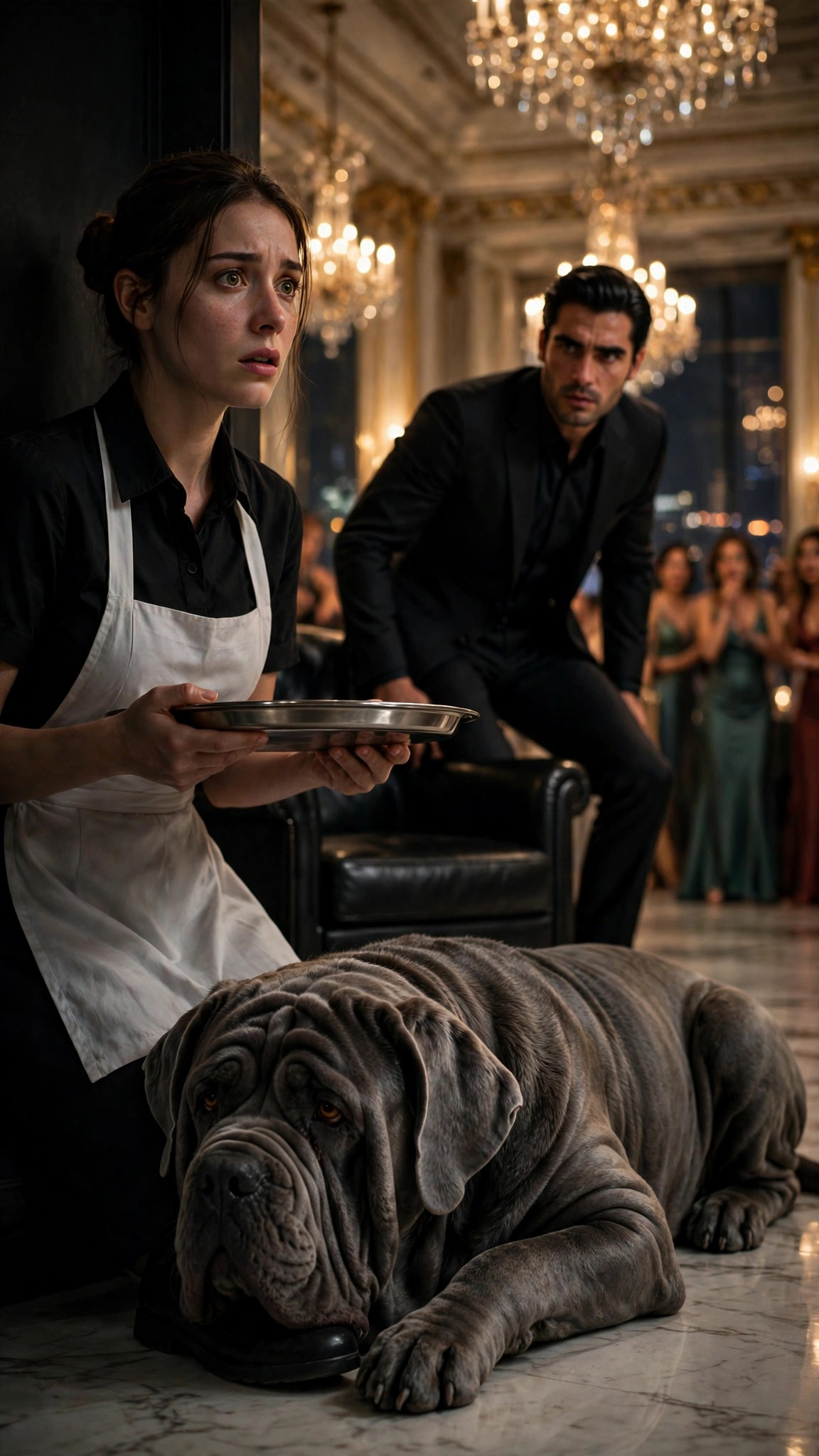
And beside his chair, lying on the marble like a mountain that had decided to rest, was the dog.
Titan.
Penny had not known his name then. She had not known he was Titan. But she had known his eyes. She had known the gray of him, and the size of him, and the way he lay with his great head on his paws, watching the room the way a soldier watches a battlefield.
She had seen those eyes twelve years ago, in a kitchen, in the dark.
She had been fifteen years old, and her father had been dead for three hours, and her mother had been holding her so tightly she could not breathe, and somewhere in the house, a puppy had been whining under the kitchen table. A great gray puppy, no bigger than a breadbox then, with amber eyes and soft ears, trembling so hard his teeth chattered. Titan. Marcus Ashford's new puppy, the one the old Don had brought home the week before, the one nobody had thought to take when the house went mad with grief and shouting and men running in every direction.
Penny had crawled under the table. She had pulled the puppy into her lap. She had fed him pieces of bread from her mother's apron pocket, and she had whispered to him, "Shh. Shh, it's all right. I'm here. Shh."
And the puppy had stopped trembling. He had pressed his small gray head against her chest, and he had fallen asleep in her lap while the house fell apart around them.
That was the last time Penny had seen him. The next morning, the puppy had been taken away with the rest of the old Don's things, and Penny had never asked where he went. She had had her own grief to carry.
Now, twelve years later, the puppy had grown into a mountain. And the mountain was walking toward her across a marble floor, step by heavy step, while fifteen heiresses and a room full of the most dangerous men on the East Coast watched in silence.
Penny tightened her grip on her silver tray.
She did not know it yet, but her life — the small, careful, dreamless life she had built out of early mornings and silver trays and five dollars a week in a jar — was about to end. And a new one, a life she had never dared to imagine, was about to begin.
All because a dog remembered her.
On ordinary evenings — the evenings before the ballroom, the evenings that made up Penny's real life — she came home at seven, and she made dinner, and the apartment smelled like her mother's kitchen for one hour, and that was enough.
She cooked from Elena's recipe book, the one wrapped in the faded blue dish towel with the strawberry embroidered in one corner. The book was old and stained, its pages soft from twenty years of use, and Penny knew every recipe in it by heart: the Sunday sauce, the bread, the soup her mother made when someone in the house was sick, the little almond cakes Elena baked on birthdays. She cooked them for Mia now, standing on a chair in the tiny kitchen in Queens, stirring with a wooden spoon almost as tall as she was, and Penny taught her the way Elena had taught her: a pinch of this, a handful of that, never measure, always taste.
"Mommy," Mia asked one evening, while the sauce simmered and the apartment filled with the smell of tomatoes and garlic, "was Grandma Elena a good cook?"
"The best," Penny said. "The best cook in the whole world. She cooked for a very big house, with a very big family, and everyone said her bread could make a grown man cry."
"Did she cook for a king?" Mia asked, wide-eyed.
"Not a king," Penny said, smiling. "A Don. Which is almost the same thing, except a Don doesn't wear a crown."
"Did you live in the big house?" Mia asked.
"I did," Penny said. "When I was a little girl, not much older than you. I lived in two small rooms on the third floor, and I did my homework at the kitchen table, and your grandma cooked, and your grandpa drove the Don's car, and it was the happiest time of my whole life."
"Why did we leave?" Mia asked.
Penny was quiet for a moment, stirring the sauce, watching the steam rise.
"Because sometimes," she said at last, "sad things happen, and people have to leave the places they love. But the recipes came with us. And the stories came with us. And that means the big house is still with us, in a way. Every time we cook Grandma's sauce, we're home again."
Mia considered this with the gravity of a five-year-old philosopher. Then she said, "When I grow up, I'm going to be a cook like Grandma. And I'm going to have a dog. A big dog. Bigger than me."
Penny laughed, and she kissed the top of her daughter's head, and she thought, as she did every night, that Mia was the best thing she had ever made, better than any recipe, better than any dream she had ever given up.
After dinner, after the dishes, after Mia's bath and her story — the one about the brave little mouse, always the same one, always requested by name — Penny sat at the kitchen table with the bills. The rent notice, still on the refrigerator, said Friday. The daycare envelope said Wednesday. The electric bill said the fifteenth. She added the numbers in her head, the way she did every night, and the numbers added up to just barely enough, the way they always did, if nothing went wrong.
Nothing had gone wrong in three months. Penny knocked on the wooden table twice for luck, the way her mother used to, and she put the bills away, and she counted the money in the jar on top of the refrigerator. Five dollars a week, every week, for two years. The jar was nearly full. Someday, she told herself, someday there would be enough in that jar for Mia's college, or for a little house with a garden, or for a life where Penny did not have to wake up at four thirty in the morning.
Someday. Not today. Today there was a catering job at a private event in Midtown, formal dress, forty dollars extra, and Denise had called that afternoon to say the client was the Ashford family, and Penny's hand had gone still on the telephone, and she had said, "Yes, I'll take it," before she could talk herself out of it.
She had not told Mia where the job was. She had only said "the fancy job," and Mia had asked about a dog, and Penny had said there would be no dogs at fancy jobs, and she had smiled, and she had gone to bed, and she had dreamed — for the first time in years, she had dreamed — of a kitchen, and a puppy under a table, and a boy showing her a drawer full of peppermints.
She had woken up at four thirty with tears on her face and no idea why.
She had wiped them away, and she had gotten up, and she had gone to work, because that was what Penny Kendrick did. She got up. She went to work. She carried the tray. She came home. She cooked the sauce. She read the story. She counted the money in the jar.
She had no idea that the day she had just woken up to would be the last ordinary day of her life.