"Don't move."
Kate stopped breathing. The tray stayed miraculously level in her good hand, and her broken arm — traitor, fool, the whole architecture of her silence — slipped in its hiding place behind her apron as she turned, too fast, toward the voice.
Damon Blackwell rose out of the chair by the fireplace the way deep water rises: without splash, without haste, and with the absolute certainty of drowning whatever it reaches. He was not supposed to be in the sitting room. The sitting room was for principals, for contracts, for the hour before the announcement; the boss was supposed to be in the ballroom being admired. Instead he was here, in the dark, in the one room she had run to — because of course he was. Of course that was how the evening ended. She had spent three days hiding from Preston Caldwell, and it was the other one who had been waiting in the dark all along.
"Kate." He came toward her. "What are you hiding?"
"Nothing, sir. I — the tray, I was just—"
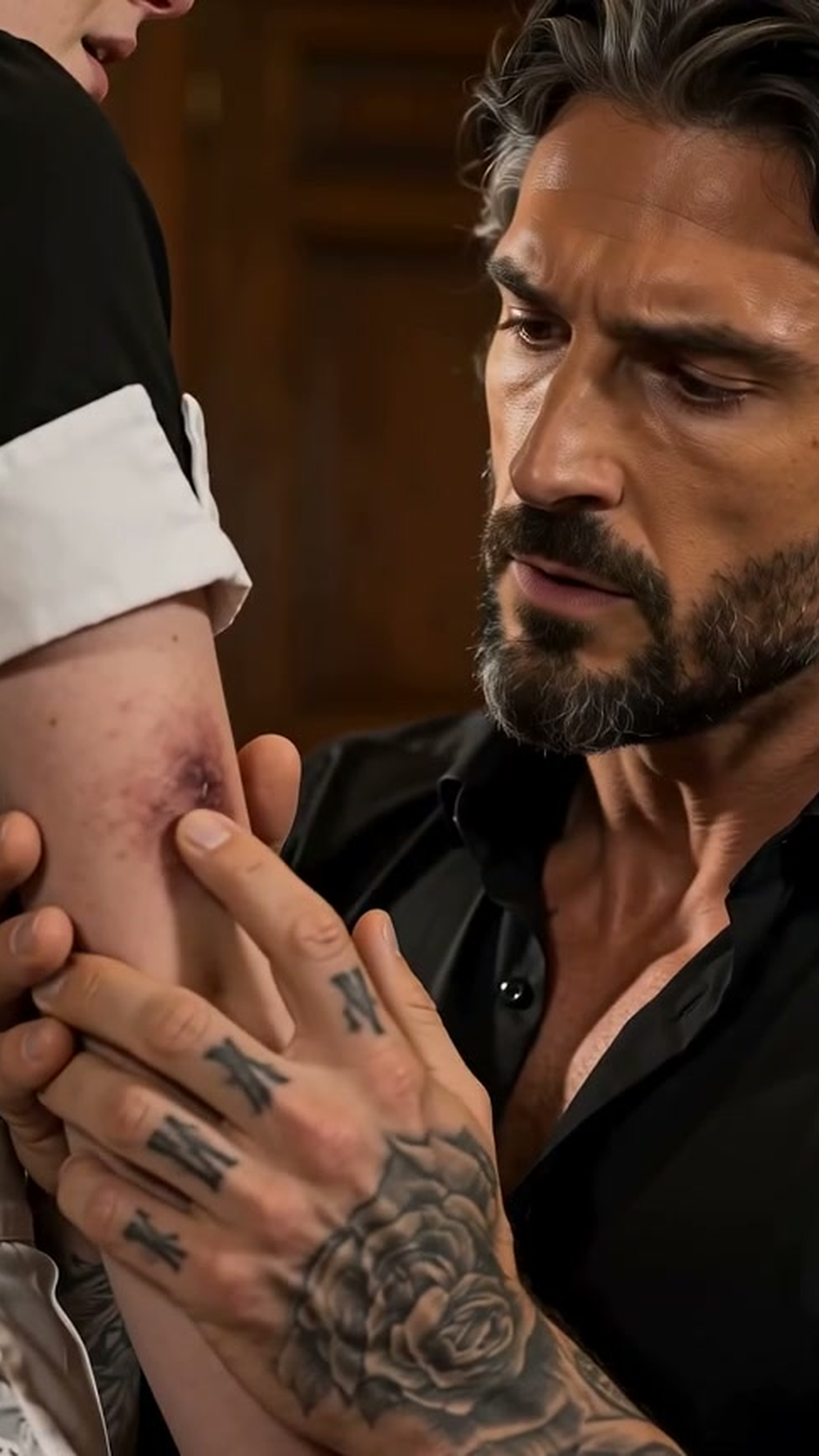
She stepped back, and her right arm swung, useless, behind the white lace, and his tattooed hand came up and stopped it — gently, terribly gently, the way you stop a thing you already suspect is broken and are afraid of finishing.
Three days collapsed into one held breath. She watched it happen in his face in sequence, like lights going on in a house: the resistance of the sleeve, the swelling under his fingers, the heat of it. The stillness. He rolled her cuff back with his thumb, over her small, hopeless sound of protest, and the lamplight found the bruises — wrist to elbow, plum and storm-black and old green, and above them the four fingers and the thumb, printed on her upper arm like a signature.
The music went on beyond the doors. Three hundred people. A senator. An empire, waiting to be announced.
"Who broke your arm?"
There are questions that are doors, and Kate stood in front of this one with her whole life on the other side of it — her mother's heart, the deposit due in eight days, the folly in the dark garden, the man in the ballroom with her name in his mouth like a sweet. She had sworn silence the way you swear on a grave. She had practiced the lie until it had calluses.
"Please," she whispered. "Please… I can't lose this job."
What she did not know — what she could not have known, standing there in her terror — was that she was not begging a stranger. She was begging the one man in the city who had spent the entire evening quietly setting fire to his own coronation on the strength of eleven minutes of static and a flinch. Damon Blackwell looked at her arm, and at her face, and at the closed doors where his partner waited with a contract and a smile, and a decision that had been assembling itself in him for two days closed like the bolt of a rifle.
He drew the chair close. He knelt. The king of the city's underworld went down on one knee on his own carpet and made himself smaller than his maid, and if the walls of that house could have spoken they would have gasped, because in twenty years those walls had seen everything except that.
"Look at me, Kate."
She looked.
"You're not losing your job." Each word set down like a stone in a road being built across a river. "Not tonight. Not for this. Not ever, while I own the roof over it. Do you understand me?"
She nodded, weeping now, silently, the way she did everything.
"Then give me the only thing I am asking for." Feather-light, his thumb beside the worst of the bruising. "A name."
Her eyes went to the ballroom doors. She could not help it. Three days of terror had trained them like dogs.
"Kate."
"Preston Caldwell."
She said it barely louder than breath, and the room changed temperature, and the most dangerous man in the city received the name of the second most dangerous man in it the way a priest receives a confession — without a flicker, without a sound, with the whole of his reaction poured into the one place she could feel it: his hands, which gentled. On her broken arm. As if the rage, arriving, had gone everywhere in him except there.
From the housekeeper's kit in the sideboard he took the black orthopedic brace, and he fitted it to her forearm strap by strap with the concentration of a jeweler. Tattooed fingers. Knuckles that had ended arguments in three counties. Each strap checked twice, eased, checked again, so that nothing pressed where it should not.
"He'll never touch you again," he said, not looking up. "That is not a threat, Kate. Threats are for men who negotiate. It is a schedule."
Then he rose. He took out his phone. He looked toward the ballroom doors — toward the gold light, the music, the partner, the empire — and what was in his face then was not fury. Fury is hot and brief and stupid. What was in his face was administration.
"Matteo," Damon said. "I want every name before sunrise."
He was gone through the doors before she could find a word, any word, and Kate sat on the edge of the antique sofa in the lamplit quiet with her arm cradled in new black strapping and her uniform damp with tears, listening to the music change — because it did change, in the way a whole ballroom changes when one man walks into it differently. She did not understand, then, that she had just watched a coronation become an execution in the space of one phone call. She understood only that everything was broken open now, and that the arithmetic would never work again, and that she had never in her life been so frightened —
— or so strangely, shamefully safe.
The door opened. Kate flinched so hard the brace knocked the sofa's wooden frame — but it was Rosa who slipped inside, closed the door with her hip, took in the scene in one comprehensive glance — the girl on the sofa edge, the medical kit open on the sideboard, the black brace new and correct on the ruined arm — and sat down, heavily, on the arm of the sofa like a woman whose own knees had filed a complaint.
"He knows," Rosa said. It was not a question.
"He knows a name," Kate whispered. "Rosa — he fitted this himself. On his knees. He said — he said it's a schedule."
Rosa looked at the brace for a long time. Then she reached out, with the care of long practice, and tidied the strap's end where it had been left a fraction too loose, and her hands — those laundry-roughened, nine-years-in-this-house hands — were not entirely steady.
"Nine years I have worked for that man," she said. "I have seen him fire a chef for a sauce. I have seen him buy a shipping line because its owner insulted Matteo at cards. I have never — not once, not for anyone — seen him frightened of hurting something." She looked up, and her eyes were wet and furious and wondering all at once. "Whatever you think you have done tonight, hermana, hear me: you did not start this fire. You were the fire's address. There's a difference, and someday, when you're done being terrified, you'll know it."
"He's going to destroy Preston," Kate said. "At his own gala. Because of a maid. Rosa, the merger—"
"The merger," Rosa said witheringly, "is a boat arrangement. Boats can be rearranged. I have buried three brothers and I know what a man looks like when something is finished in him — and whatever was between the boss and Mr. Caldwell finished on Thursday, in a corridor, before you ever said a word. You only told him where it happened." She stood, smoothing her apron, every inch the senior servant again. "Now. The quiet men are looking for you to stand somewhere safe, and I am looking for you to eat something before you faint onto a senator. Come. The night is not finished with any of us."
* * *
What happened in the ballroom over the next hour, the newspapers would later describe as "an unexpected postponement." The guests described it, in whispers, for years.
Damon Blackwell mounted the small stage at eleven beneath a chandelier the size of a carriage, with Preston Caldwell at his right hand — smiling, tanned, immaculate — and the merger contracts waiting in their leather folder on the lectern like a bride at an altar. The orchestra fell silent. Three hundred glasses stilled. A senator's wife raised her phone.
"My friends," Damon said, into the golden hush, "you came tonight to watch two houses become one." He let the pause live exactly as long as it needed. "You will have to forgive the house of Blackwell. We keep our promises in order — and tonight I find there is an older promise outstanding." His eyes moved, once, unhurriedly, across the room, and found his partner's face the way a sniper finds weather. "The announcement is postponed. The audit is not complete."
A sound went through the ballroom like wind through a wheat field.
Preston Caldwell's smile did not fall. That was his quality, and Kate — watching from the service door with a cloth twisted in her good hand, because she had been unable to obey the quiet man's instruction to stay away once she heard the music stop — watched the smile stay and the eyes change, and understood that she was seeing a man do arithmetic of his own, very fast, with her name in every column.
He laughed — lightly, generously, the laugh of a partner indulging a perfectionist — and raised his glass. "To audits," he said, and the room, grateful, laughed with him, and the orchestra hurried back in like water over a stone.
But in the hour that followed, the second clock ticked loud enough for Kate to hear it with her naked ears.
A steward Preston had cultivated for months was relieved of his tray by two quiet men and walked, smiling fixedly, toward the kitchens, and did not come back. The freight clerk vanished from the receiving door between one delivery and the next. Down in the mews, Preston's driver — who had driven him to this house on Thursday at three — was invited, with great courtesy, to step out of his own car. None of it was loud. None of it was visible from the ballroom, where the dancing had begun and the postponement was already being re-told as a power move, a mystery, a very Blackwell sort of theater. It was only that, if you stood where Kate stood, you could feel the house quietly closing its hand.
Matteo passed her once, at speed, with a phone at his ear and a folded list in his breast pocket that had not been there an hour before. "Eleven," he said, to the phone, not to her. "Keep counting."
At midnight the first firework went up over the garden — a white chrysanthemum that lit the terrace, the ballroom glass, and three hundred upturned faces — and in that white light Kate saw Preston Caldwell at the garden doors, not watching the sky at all.
Watching her.
He lifted one finger, very slightly, off the stem of his glass. Come here. The oldest gesture in the world. And around her the ballroom applauded the fireworks, and the quiet man assigned to her elbow was suddenly not there — drawn off by a spilling guest, a commotion at the stairs, some small arranged chaos — and the service corridor stood open behind her like a throat.
Kate looked at the man in the garden doors. She looked at the darkness at her back, where the linen, the tray, and the ruin of her life had all begun.
And Preston Caldwell smiled at her across the burning garden — the smile of a man who has already decided that if he is going down tonight, he is taking the evidence with him —
—and crooked his finger once more.