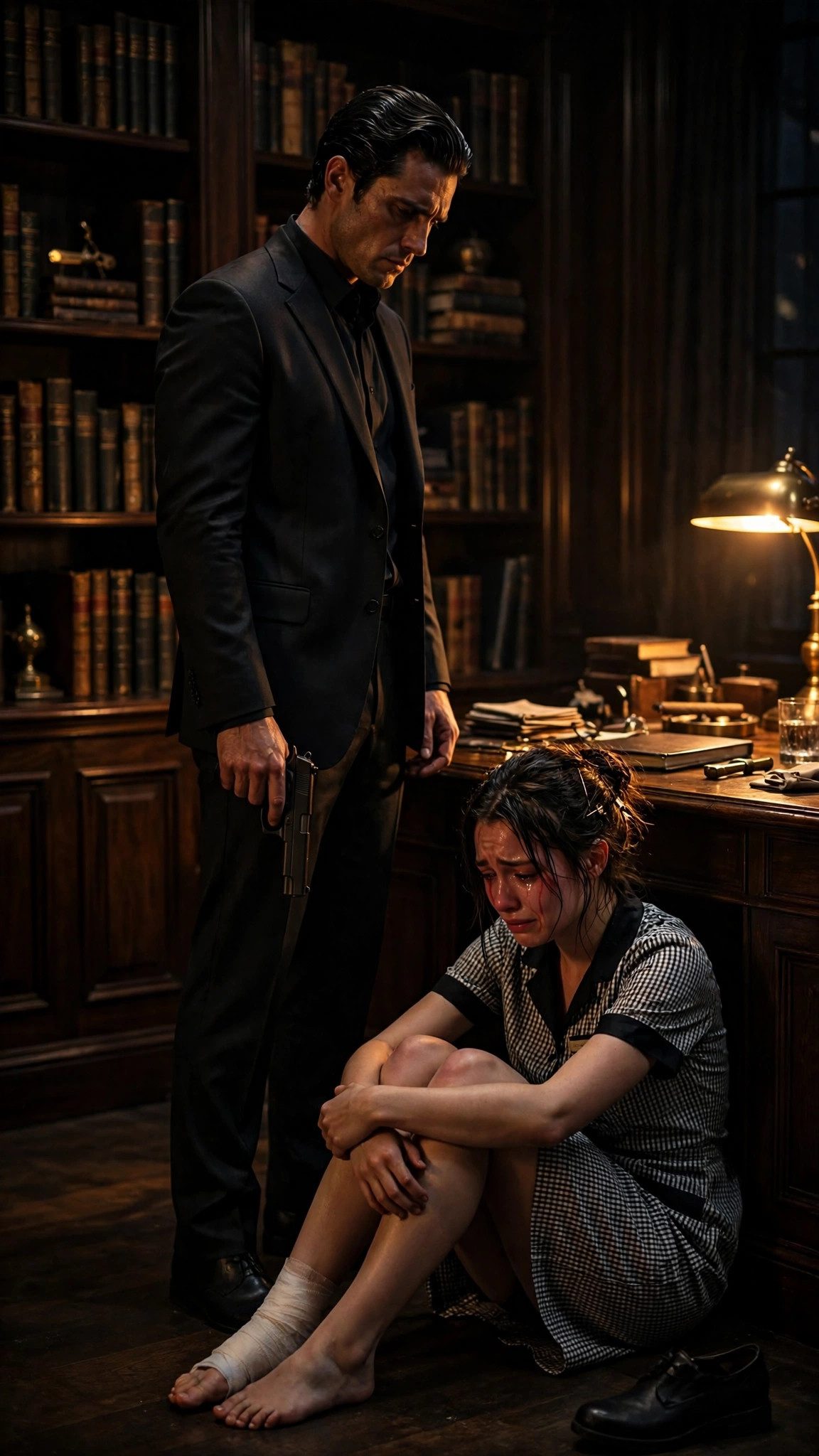
The man who had pointed a gun at her face on his thirty-sixth birthday looked down at Clare Dawson and said, "You are crying in my study."
It was not a question. It was not an accusation either, though it should have been. It was a statement of fact, delivered in a voice so cold and so calm that it sounded like a man reading a weather report. The gun did not waver. The amber light from the brass wall switch fell across the dark wood paneling and the leather-bound books and the heavy oak desk, and it fell across Clare's face, red and blotchy and wet, with mascara running down her cheeks in crooked black lines.
Clare did not scream. She did not beg. She looked at the barrel of the gun, and then she looked into the eyes of the man holding it, and for a long moment she felt nothing at all except a deep, bone-weary surrender. She had been running for so long, working three jobs and sleeping four hours a night, selling nearly everything she owned that was worth anything, and it had not been enough. It was never enough. So she sat on the floor of a stranger's house in the darkness and looked at a gun, and she thought, with a strange and terrible clarity, that at least this would be quick.
"Please," she whispered. Her voice came out cracked and raw from crying. "I didn't steal anything. I just needed somewhere quiet. I'll go. I'll leave right now."
The man did not lower the gun. He studied her the way a man studies a lock he has never seen before, trying to decide whether it is a trap or simply a door. He was tall, broad-shouldered, dressed in a black suit that fit him like it had been sewn onto him by someone who knew exactly how dangerous he was. His dark hair was combed back from a face that might have been handsome if it had ever learned how to soften. His eyes were grey, and they did not blink.
"Your shoes are bleeding," he said.
Clare looked down. Her left heel had blistered and split open sometime around nine o'clock that evening, and by eleven the cheap fabric of her slip-resistant shoes had felt wet and raw, scraping against exposed skin with every step. She had stopped feeling it properly an hour ago. Now there was a dark stain spreading through the fabric, and a thin red smear on the polished wood floor where her foot had rested.
"I'm sorry," she said. "I'll clean it. I swear I'll clean it."
"Stand up," he said.
Clare tried. Her legs shook so badly that she had to brace one hand against the wall, and the other against the doorframe, and even then she swayed. The gun followed her up. She pressed her back against the door and waited for him to decide what she was.
It had started, like everything in Clare's life lately, with a phone call she could not afford to miss and a bill she could not afford to pay.
Three weeks earlier, her sister Sophie had gone into St. Jude's Hospital with a fever that would not break. Sophie was nineteen years old, a nursing student with a laugh that could fill a whole apartment, and the doctors had found an infection deep in her abdomen after her appendix burst. They had operated. They had told Clare the surgery went well. And then the fever had come back, and the infection had spread, and the billing office had started calling.
Thirty thousand dollars. That was the debt. Clare had managed to scrape together enough money for the baseline treatments by working three jobs, sleeping four hours a night, and selling nearly everything she owned that was worth anything. She had sold her mother's piano. She had sold her car. She had sold the small gold locket her grandmother had left her, and she had cried in the pawnshop and then gone straight to her next shift because crying did not pay hospital bills.
It was not enough. It was never enough.
The catering company did not provide names for jobs like this. Employees received only an address and a time. The pay was triple her normal hourly rate, delivered in crisp, untaxed bills at the end of the night. That was the only reason Clare had accepted the shift at the sprawling estate on the edge of the city, a house so large it had wings, and a ballroom, and a private study on the second floor that the staff had been explicitly instructed to avoid.
She did not know whose house it was. She did not care. She needed the money desperately.
Her phone had vibrated inside her apron pocket at half past ten. A short, sharp buzz. Clare had ignored it. The floor manager, a perpetually sweating man named Higgins, had already warned her twice about looking at her phone. She had kept her eyes on the polished marble floor and continued toward the kitchen service doors with a massive silver tray loaded with crystal champagne flutes, its weight digging a dull ache into her forearm.
Her phone had buzzed again. Then a third time.
A cold spike of dread had struck her chest. Three texts in succession. That was the code she had arranged with the night nurse at St. Jude's.
Clare had pushed through the swinging kitchen doors and entered the chaotic heat beyond them. She had placed the tray down on a stainless steel counter and scrambled to a quiet corner behind the industrial-sized fridge. Her hands had shaken as she pulled the cracked phone from her apron.
The messages were from the hospital. Her sister's temperature had spiked again. The infection was spreading. Billing had flagged the account. If the next payment was not received by six o'clock in the morning, her sister would be moved to a lower-priority ward.
The nurse was sorry. She asked Clare to call.
Clare had stared at the glowing screen. The words blurred. Around her, pans clanged, chefs shouted, and steam hissed, but the noise gradually disappeared into a dull, distant hum. She could not breathe. The air felt as if it had thickened into wet cotton.
Now, because she did not possess a piece of plastic with a high enough limit, her sister was going to die.
Higgins had demanded to know whether she was deaf. He needed two trays of tartlets delivered to the west wing immediately. Clare had not moved. He had stepped toward her and told her to look at him when he was speaking. Clare had turned, shoved past him, and walked out through the back of the kitchen.
She did not know where she was going. She only needed air. She needed quiet.
She had followed a long, dimly illuminated hallway lined with dark wood paneling and antique portraits. She had entered the private wing, an area the staff had been explicitly instructed to avoid. At the end of the hallway, Clare had found a heavy oak door. She had turned the brass knob. It had opened with a smooth, heavy click.
Clare had slipped inside and closed the door behind her. The room was completely dark. It smelled of old paper, leather, and faint tobacco. She had leaned against the solid wood door and slowly slid to the floor, pulling her knees against her chest. Her left heel had throbbed in sharp, pulsing waves.
She did not want to cry. Crying was useless. Crying did not pay hospital bills. Crying did not cure infections.
But the dam broke anyway. It was not quiet or delicate. The sobs tore through her throat and left her gasping. Her chest heaved as if she were drowning. Her eyes burned. Everything was collapsing. The sheer weight of her life seemed to press down on her in the darkness.
Clare was twenty-four years old and entirely alone in the world except for a sister fading away in a sterile hospital bed. She had nothing left to give.
So she sat on the floor of a stranger's house in the darkness and fell completely apart.
Downstairs, Gabriel Hayes had been planning a murder.
He did not want to. It was his birthday, after all. He had turned thirty-six that day, a minor miracle in his line of work. But the capo from the South Side, an aging brute named Sullivan, had spent the previous forty minutes dropping veiled threats in the trophy room. It was a test. In Gabriel's world, a test left unanswered became an advertisement of weakness.
Gabriel stood beside the fireplace with a crystal glass of water in his hand. He did not drink alcohol. It dulled reflexes and loosened tongues. The ballroom surrounding him was crowded with the city's elite: politicians, judges, and men who owned things they were not supposed to own. Every one of them wanted something.
Sullivan clapped a heavy hand against Gabriel's shoulder and congratulated him on the party, calling it the event of the season. His breath smelled of expensive cigars and cheap intentions. Gabriel thanked him and told him to enjoy the Scotch. It was older than Sullivan's operation. Sullivan's smile tightened. His hand left Gabriel's shoulder.
Gabriel handed his water to a passing waiter and excused himself. He needed to get out. The ballroom felt suffocating, thick with perfume, cologne, and the invisible burden of constant vigilance. Across the room, Gabriel caught the eye of Thomas, his head of security, a massive man standing quietly near the grand staircase. Gabriel gave him a brief two-finger gesture toward the ceiling. He was going upstairs. Do not follow. Thomas gave an almost imperceptible nod.
Gabriel avoided the grand staircase and took the narrower private stairs concealed behind the library. The sounds of the party diminished with every step. The brass instruments became a low thrum. The laughter faded to a distant murmur. He reached the second floor. The private wing. His sanctuary. Nobody came up here. Everyone on his payroll understood the rule, from his highest lieutenant to the lowest cleaner. The consequences of violating it were immediate and severe. Gabriel valued privacy more than he valued most human lives.
He followed the carpeted hallway until he reached the heavy oak door to his study. At first, he did not hear anything. The house was old and filled with the natural groans of settling wood. Then his hand touched the brass knob.
Gabriel stopped. A faint, muffled sound came from inside.
He did not gasp or freeze. His body simply entered a state of relaxed readiness. His right hand moved beneath his suit jacket and closed around the textured grip of the nine-millimeter inside his shoulder holster. He drew it smoothly. Then he turned the knob.
The study was dark, its curtains closed. The familiar scents of tobacco and leather filled the room, but beneath them Gabriel detected something else. Fear. Sweat. A wet, ragged gasp came from the floor just left of the doorway.
Gabriel stepped inside and flicked the safety off his weapon. With his left hand, he reached for the brass switch. Amber light flooded the room.
Gabriel leveled the gun toward the corner. There was no assassin. No rival enforcer. There was a girl.
She sat on the floor with her knees drawn against her chest, dressed in the cheap standard uniform of the catering company. Her hair had probably been neatly pinned hours earlier, but damp strands now hung around her face. She looked up at him. Her skin was red and blotchy. Her eyes were bloodshot and wet with tears. Mascara had run down her cheeks in crooked black lines. She looked entirely destroyed.
Clare stared at the weapon pointed at her face. She did not scream. She did not beg. She looked at the barrel and then into Gabriel's eyes. For a long moment, Gabriel saw something in her expression he had not seen in years. It was more than fear.
It was exhaustion. A deep, bone-weary surrender.
And now she was standing, shaking, pressed against his study door, waiting for him to decide whether she lived or died, and Gabriel Hayes realized with a cold shock that he had no idea what to do with her.
He had planned for an assassin. He had planned for a thief. He had planned for a rival's spy. He had not planned for a crying girl in a catering uniform with a bleeding heel and mascara down her face, who looked at his gun the way a drowning woman looks at the surface of the water — not with fear, but with a terrible, quiet relief.
"Who are you crying for?" Gabriel asked.
The question surprised them both. Clare's breath caught. She stared at him, and for a moment the tears stopped, as if her whole body had forgotten how to cry.
"My sister," she whispered. "Sophie. She's nineteen. She's in the hospital. She's dying, and I can't pay, and by six in the morning they're going to move her, and I don't know what to do, and I don't know what to do."
The words came out in a rush, tumbling over each other, and then she was crying again, harder than before, her shoulders shaking, her hands pressed over her mouth as if she could hold the sobs inside her body by force.
Gabriel Hayes stood in the amber light of his study with a gun in his hand, and he listened to a stranger cry for her sister, and he thought about a girl named Anna who had died when she was fifteen years old because nobody in his family had been able to pay a hospital bill in time.
He lowered the gun.
"Tell me everything," he said. "From the beginning. And do not leave anything out."
As Clare began to speak, Gabriel's eyes dropped to the cracked phone lying on his desk, where she had set it down when Thomas helped her into the chair. The lock screen showed a photograph of two girls laughing on a fire escape, one with dark hair and a gap between her front teeth, the other younger, with Clare's eyes. Sophie, in a nursing student's uniform, holding up a stethoscope like a trophy. Gabriel picked the phone up carefully, as if it might break further in his hands, and turned it over. On the back, in faded marker, someone had written a phone number and three words: "Call if fever spikes."
"She wrote that herself," Clare said, following his gaze. "Sophie. The night before she went into the hospital. She said, 'Clare, if anything happens, you call this number, and you tell them I am your sister, and you do not take no for an answer.' She was nineteen years old, and she was already giving me instructions, like she was the older one."
Gabriel set the phone down gently. He looked at the name tag on Clare's uniform. Clare D. He thought about how little a name tag tells you about a person. It did not say that she worked three jobs. It did not say that she had sold her mother's piano. It did not say that she was the only thing standing between her sister and a crowded ward where nobody would notice if her fever spiked in the middle of the night.
"Go on," Gabriel said. "I am listening."