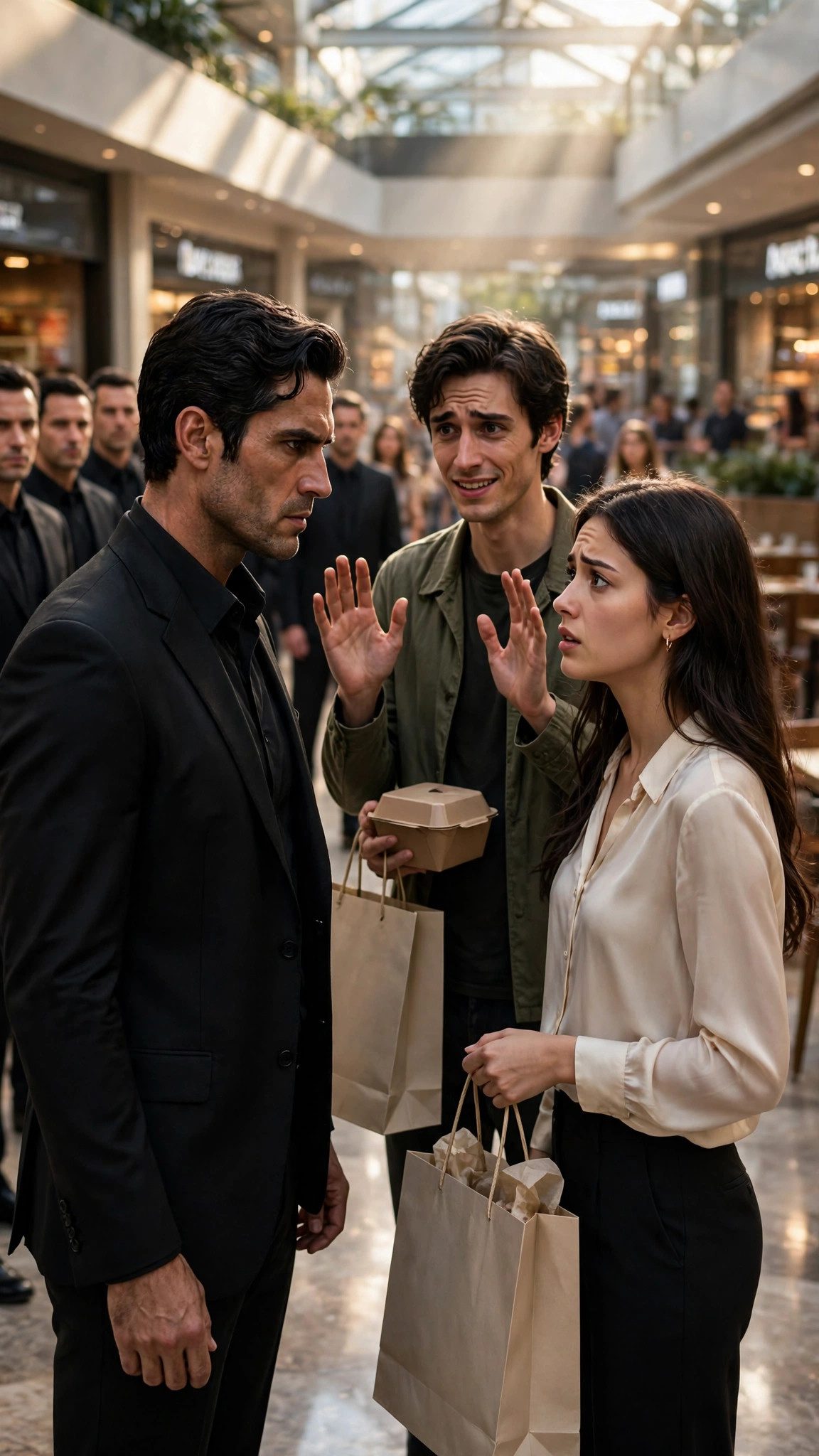
The rumor reached me the way rumors always reach the person they are about: from a stranger, in a place I did not expect, in words I did not understand at first.
It was Thursday, three days after the mall. Daniel and I had gone to the farmers' market on Division Street because he wanted to cook dinner — real dinner, he said, not the kind of dinner that arrives on a silver tray carried by a silent woman — and because I wanted, for one morning, to feel like a normal person doing a normal thing with her brother. We were standing at a stall full of late-season apples, Daniel holding up two of them and asking me, with great seriousness, which one looked more trustworthy, when a woman I had never seen before leaned toward her friend and said, in a voice just loud enough to carry, "That's her. That's Sterling's wife. The one with the other man at the mall."
Daniel's hand froze in mid-air, an apple in each fist. I felt my face go hot, then cold, then hot again. The woman's friend whispered something back, and the first woman laughed, a small, ugly laugh, and said, "Well, you know what they say about arranged marriages."
I put down the apple I was holding. I took Daniel's arm. I walked us out of the market and into the car without a word, and I did not speak until we were three blocks away, and then I said, "They think you are my lover."
Daniel was quiet for a moment. Then he said, "Audrey. They think I am your lover because your husband announced to a food court that he did not know who I was. Do you understand that? He did not say, 'This is my brother-in-law.' He said, 'I don't care who you are, you don't touch what's mine.' He introduced me to Chicago as a stranger."
"He did not know," I said, and even as I said it, I heard how thin it sounded.
"He did not know because he never asked," Daniel said. "That is not the same thing as an excuse. Audrey, I have been in London for two years, and I have read the newspapers, and I know what kind of man you married. But I did not know — I did not know that he had never once asked you about your family. I did not know that he had never once asked you about me. Do you know what that means? It means he married a name, not a woman. It means he married the Bennett shipping routes and the Bennett harbor contracts, and he got you thrown in as a signature on a page."
I wanted to argue. I wanted to defend my husband, which was a strange thing to want, because I had spent six months not defending him to anyone, including myself. But Daniel was right, and we both knew he was right, and so I said the only honest thing I could think of.
"He left me a note this morning," I said. "It said Priya may call whenever she wants."
Daniel looked at me. "A note," he said. "After six months, he left you a note."
"It is a start," I said.
"It is a note," Daniel said. "Audrey, I love you, and I am not leaving Chicago until I am sure you are safe. And right now, I am not sure."
That afternoon, Julian came home early, which he never did. He found Daniel and me in the library — the library I was not allowed to rearrange, where I had been showing Daniel the one shelf I had been permitted to fill with my own books — and he stood in the doorway for a moment, watching us, and then he said, "We need to talk. Both of you."
We went to his study, a room I had entered perhaps four times in six months, a room of dark wood and darker leather and a desk the size of a small car. Julian sat behind the desk. Daniel and I sat in the chairs across from him, like two people called into a principal's office. Julian opened a drawer, took out a phone — not his phone, a different phone, a cheap one with a cracked screen — and set it on the desk between us.
"Someone filmed the mall," he said. "The video is circulating. It has been edited. The part where Daniel says he is my brother-in-law has been cut out. What is left is a video of my wife laughing with a strange man, and then of me dragging her away. The caption says: 'Sterling's wife, caught with her lover at the mall.'"
The room went very quiet. I could hear the clock on the wall, ticking, and the lake wind against the window, and my own heart beating too fast.
"Who filmed it?" Daniel asked.
"One of my own men," Julian said. "Marcus Hale. He was standing six feet behind me in the food court. He raised his phone. I remember it now — I thought he was checking my expression for instructions. He was filming."
"Why would he do that?" I asked.
Julian looked at me, and for a moment, his face was the face of a man who had just realized that a wound he thought was on the surface went all the way to the bone.
"Because someone paid him to," Julian said. "Marcus has been taking money from Vincent Castellano for eleven months. Eleven months, Audrey. He has been selling my schedules, my routes, my meeting places. And now he has sold my marriage."
Daniel leaned forward. "Castellano," he said. "The man from the newspapers."
"The man from the newspapers," Julian agreed. "He wants the harbor. He wants the Huntington mall chain agreement, which I am supposed to sign next week. He wants the Bennett shipping routes, which came with my marriage. And he has just been handed a story that says the Sterling marriage is a fraud, the Sterling wife is unfaithful, and the Sterling boss is a fool who does not know his own household. If that story spreads far enough, the Huntington family will not sign. The council will not stand behind me. The Bennetts — your father — will be humiliated. And Castellano will walk into the space where my credibility used to be."
I sat very still. I thought about my father, Robert Bennett, who owned forty-two vessels and a reputation for never breaking a contract, and who had given his daughter to a mafia boss for an alliance, and who would now hear, from men he did business with, that his daughter had been caught with a lover in a mall food court. I thought about Daniel, who had come home to make sure I was safe, and who was now the other man in a rumor that could get him killed. I thought about Julian, who had married a name and woken up one morning to discover that the name had a brother, a best friend, a favorite color, and a life he had never once asked about.
"What do we do?" I asked.
Julian stood up. He walked to the window — the same way he had stood in our bedroom that first night, looking out at the lake while he decided something — and he stood there for a long time. Daniel and I watched him. The clock ticked. The wind moved against the glass.
"We do what I should have done six months ago," Julian said, without turning around. "We tell the truth. All of it. Tonight. No more half answers."
He turned around. He looked at Daniel first.
"You are my brother-in-law," he said. "I have never met you, and that is my failure, not yours. Tomorrow, you and I are going to the Huntington dinner together, and I am going to introduce you to every man in that room as my wife's brother, and I am going to tell them that the man who filmed that video works for Castellano, and that Castellano is the one spreading the lie."
Then he looked at me.
"And you," he said, "are going to tell me everything I should have asked you six months ago. Your family. Your friends. Your life. All of it. Tonight. Because I am done being a man who does not know his own wife."
It was the longest speech I had ever heard him give. It was also the first time he had ever said the words "my wife" as if they meant a person, and not a possession.
Daniel stood up. He walked around the desk. He held out his hand to Julian, and after a moment, Julian took it, and the two men shook hands — my brother and my husband, meeting properly for the first time, in a study full of dark wood, over a cracked phone full of a lie.
"One condition," Daniel said. "If you ever raise a hand to my sister, I will break both of yours. I do not care who you are."
Julian nodded. "Fair," he said. "One condition from me. If you ever disappear for two years again without telling me where you are, I will send my men to London to bring you back. I do not care who you are either."
Daniel laughed. It was the first time anyone had laughed in that study in six months, maybe longer. And then, to my complete astonishment, Julian laughed too — a short, rusty sound, like a door opening that had been shut for a very long time.
That night, after Daniel went to bed, Julian and I sat in the library until two in the morning, and I told him everything. I told him about my mother, who died when I was nineteen, and about the chicken soup, and about the summer Daniel nearly sank the boat. I told him about Priya, and about art school, and about the sketchbook I had kept since I was twelve. I told him about the letter Daniel had sent me before the wedding, and about the word "seagull," and about the fact that I had never written it, and why.
Julian listened. He did not interrupt. He did not check his phone. He asked questions — small ones, careful ones, the questions of a man learning a language he should have learned six months ago. What did your mother look like? What is Priya's last name? What do you paint when no one is watching?
At two in the morning, he said, "I am sorry, Audrey."
It was the first time he had ever apologized to me. It was also the first time I believed him.
"Tomorrow," he said, "we fix the rumor. And then we fix the rest."
I went to sleep that night in a bed the size of a small boat, beside a man I had married six months ago and met, properly, for the first time that evening. And for the first time since my wedding night, I did not feel like a stranger in my own home.
But I also knew, lying there in the dark, that Vincent Castellano would not stop with a video. A man who had paid for eleven months of betrayal, who had filmed a wife laughing with her brother and called it adultery, would not stop until someone bled for it. And the Huntington dinner was tomorrow night. And Marcus Hale was still walking around Julian's house, smiling, pretending to be loyal, carrying a phone full of secrets.
Tomorrow, we would fix the rumor. Tomorrow, we would also find out just how deep the rot went.
On the walk home from the market, Daniel told me about a patient in London — an old man who had come in for surgery, frightened and alone, whose daughter lived in Australia and could not come, and who had asked Daniel, the night before the operation, "Doctor, if I die, will someone remember that I was here?" Daniel had sat with him until he fell asleep, and he had been there when the man woke up, and the man had said, "You stayed." And Daniel had said, "Of course I stayed. That is what doctors do."
"That is what brothers do, too," I said.
"Yes," Daniel said. "That is what brothers do."
When we got home, I did something I had not done in four months. I picked up the phone, and I called Priya. She answered on the second ring, and she said, "Audrey? Is that you? Is everything all right?" And I said, "Everything is all right. I am calling because I am allowed to call now. My husband left me a note. It said you may call whenever you want." And Priya was quiet for a moment, and then she said, "A note. After six months, he left you a note." And I said, "I know. It is a start." And Priya said, "Then it is a start. Tell me everything, Audrey. Start from the beginning. Start from the mall."
So I told her everything — the mall, the food court, the rumor, the video, Marcus Hale, the dinner, the note — and Priya listened, the way she had listened since we were fourteen years old, and when I finished, she said, "Audrey, you have a brother who flew across an ocean for you, and a husband who is finally asking questions, and a best friend who has been waiting four months for your call. You are not alone. Do you hear me? You are not alone."
"I hear you," I said. And for the first time in a very long time, I believed it.
That evening, after Priya's call, Daniel and I sat in the kitchen and cooked together — badly, both of us, but together — and Daniel told me about the hospital in London, about the long nights and the small victories, about the old woman who had baked him a cake, about the young nurse who had taught him to make proper tea. And I told him about the house, about the rules, about Mrs. Okafor and Tomas the gardener and the library I was not allowed to rearrange. And Daniel listened, the way he had always listened, and when I finished, he said, "Audrey, you are going to be all right. Do you know how I know? Because you are still laughing. You laughed in a food court today, in front of two hundred people, and you did not apologize for it. That is not a woman who has given up. That is a woman who is still fighting."