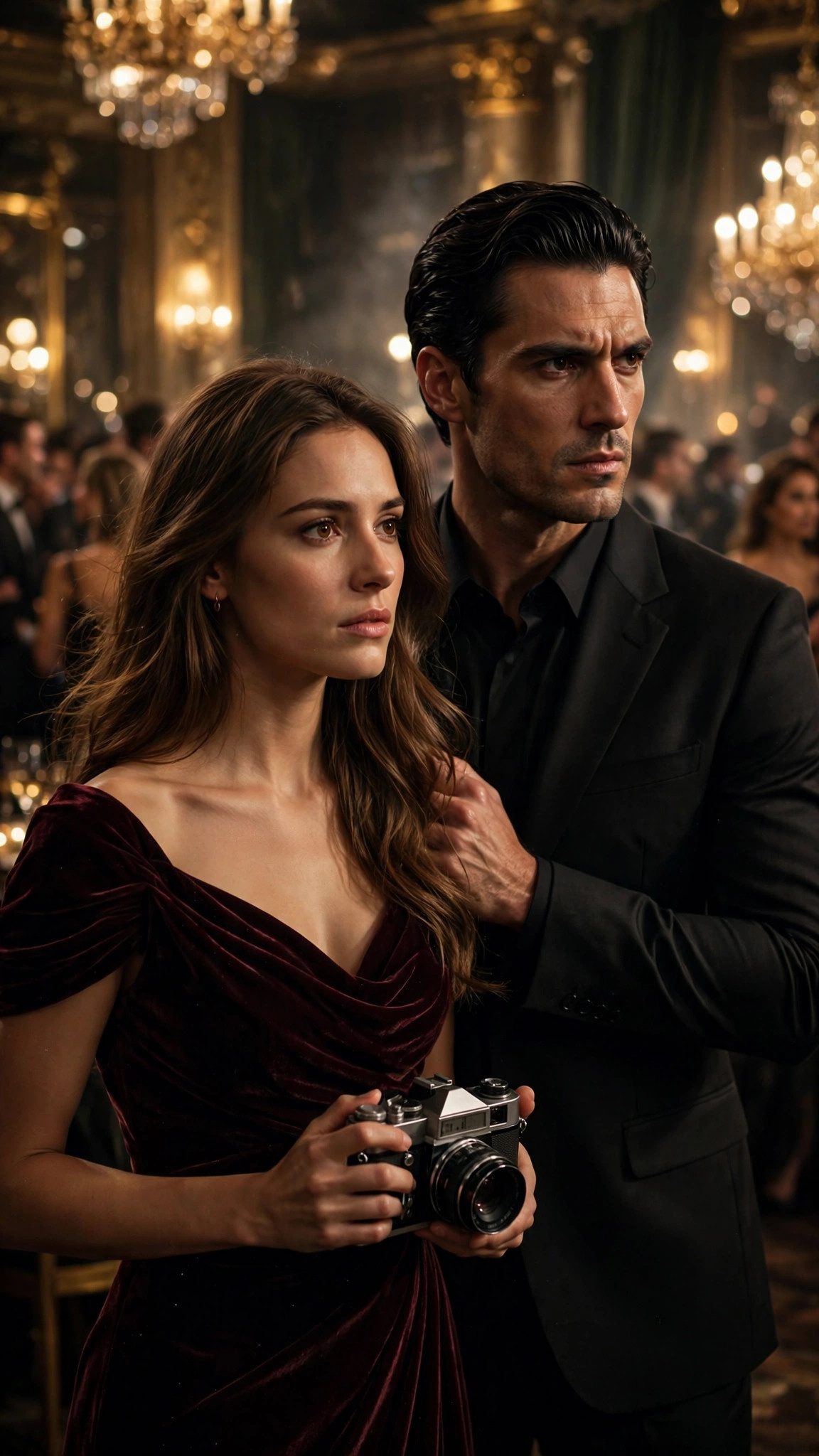
Christmas came to Chicago with snow and light, and the brownstone was full of people, and Rosa had been cooking for three days, and the whole house smelled like garlic and rosemary and fresh bread, and I stood in the kitchen in a red dress I had bought for the occasion, holding a glass of wine I was too nervous to drink, and I watched King across the room, talking to Sal, and I thought about how much had changed in three months.
Three months earlier, I had walked into a nightclub alone, wearing the only good dress I owned, holding a camera I could not afford to lose. Now I was standing in a house full of family, wearing a red dress, holding a glass of wine, and the man across the room was about to ask me to marry him, and I already knew what I was going to say.
Vera came and stood beside me, and she was wearing a green dress, and she looked beautiful, and she said, "Are you nervous?"
"Terrified," I said.
"Good," Vera said. "That means it matters. I was terrified when I opened the shelter. I was terrified when I went looking for King. Being terrified doesn't mean you shouldn't do it. It means you should do it anyway."
"Is that what you told yourself?" I asked. "When you went to the warehouse?"
"Yes," Vera said. "And it worked. I'm still here. And so are you. And so is my brother. And that is the whole secret, Harper. You just keep doing the terrifying thing, one more time, until one day you realize you aren't terrified anymore. You are just living."
Rosa came over then, wiping her hands on her apron, and she kissed my cheek, and she said, "It is time. Go to him. He has been practicing that speech for a week, and he is terrible at speeches, so be kind to him."
I went to him. He took my hands, and the whole room went quiet, the way a room goes quiet when something important is about to happen, and King Moretti, the most feared mafia boss in Chicago, the man who had never raised his voice in his life, looked at me, and he said, "Harper Bennett. Three months ago, you walked into a nightclub, and a man told you that you didn't belong there, and I stood up, and I said, 'She's with me.' I didn't know then what I was saying. I thought I was protecting a stranger. I didn't know I was claiming the woman I was going to spend the rest of my life with. You taught me that standing up for someone is not a moment. It is a promise. And I am here to make you a promise, in front of everyone I love. I promise I will stand between you and the world, for the rest of my life. And I promise I will never ask you to be smaller than you are. Will you marry me?"
He opened the velvet box, and inside was the ring, the simple gold band with the tiny camera engraved on the inside, and I looked at it, and I looked at him, and I said yes.
The room erupted. Rosa cried. Vera cried. Sal pretended not to cry, and failed, again. Enzo's children cheered. Someone opened champagne. Someone else started music. And King put the ring on my finger, and it fit perfectly, because Rosa had measured my finger while I was asleep, the way only Rosa would think to do, and he kissed me, and the whole world went quiet and bright at the same time.
Later, when the noise had settled, I went up to the guest room, the room with the window that looked out over the small garden, and I stood at the window, and I looked at the snow coming down over Lincoln Park, and I thought about the woman I had been, and the woman I was now, and the road between them.
I thought about Detroit, and the birthday cake in the refrigerator, and the two suitcases, and the drive to Chicago, and the little apartment above the bakery, and the photographs of strangers on the street. I thought about the nightclub, and the man who had said I didn't belong, and the man who had stood up and said, "She's with me." I thought about the restaurant, and the drink, and the photograph of Marcus Blake, and the family dinner, and the envelope on the door, and the van, and the warehouse, and the motel, and the bottling plant, and the ledger, and the trial, and the shelter, and the exhibition, and all of it, all of it, had started with a camera and a woman who refused to be afraid.
King came up behind me, and he put his arms around me, and he said, "What are you thinking about?"
"I was thinking about the photograph," I said. "The first one. The one of Marcus Blake. I took it without thinking, the way a photographer does. And it changed everything."
"It didn't change everything," King said. "You changed everything. The photograph was just a tool. You were the one who stood up. You were the one who called Sal. You were the one who walked into that bottling plant. You were the one who said, 'The light is good here.' You did that, Harper. Not the camera. You."
I turned around in his arms, and I looked at him, at the scar above his eye, thin and white, like a signature, and I said, "Then we did it together. You stood between me and the world. I stood between you and the world. That is how this works. That is how it will always work."
He kissed me then, and outside the window, the snow kept falling, and the city kept shining, and the world kept turning, and I thought about the title of my exhibition, and I thought about the title of my life, and they were the same.
The man who stood between me and the world. The woman who stood between him and the world. Two people, standing back to back, facing the world together, refusing to move.
The weeks between Christmas and spring were the happiest of my life, and also the busiest, because Rosa had decided that our wedding would be the greatest event the family had ever held, and Rosa did not do anything halfway. She tried seven different cakes before she chose one. She argued with the florist for an hour about the color of the roses. She made Vera try on six dresses before she found the right one for a maid of honor. And every night, she sat in the kitchen with a notebook, crossing things off lists and writing new lists underneath them, and she was happier than I had ever seen her.
Vera and I spent those weeks together, too, in the shelter garden and in the brownstone kitchen, talking the way sisters talk, about everything and nothing. She told me about the women in the shelter, about Ana, who was learning to be a photographer, about Maria, who had found a job in a bakery, about the twelve women who had become a family of their own. And I told her about Detroit, about the cake, about Derek, about the two suitcases, and she listened without judging, the way only a sister can listen.
"You know what I love most about your story?" Vera said to me one afternoon, as we sat in the garden with cups of tea going cold beside us. "It is not the nightclub, or the photograph, or the bottling plant. It is the fact that you kept going. You kept going when Derek betrayed you. You kept going when Blake threatened you. You kept going when my brother was taken. Most people stop. They stop and they stay stopped. You didn't."
"I had help," I said.
"We all had help," Vera said. "That is the point. No one does it alone. Not you. Not King. Not me. We do it together, or we don't do it at all."
Sal, for his part, took his role as the man who would walk me down the aisle very seriously. He bought a new suit. He practiced walking slowly, because Rosa told him he walked too fast. He asked me, three separate times, if I was sure, if I was happy, if there was anything I needed, and each time I told him the same thing. "I am sure. I am happy. I need nothing." And each time, he nodded, and he looked relieved, as if he had been carrying a weight and I had just lifted it off him.
"You are like a daughter to me," he said to me one evening, standing in the garden as the snow began to melt and the first green shoots came up through the cold ground. "I have a daughter of my own, in California, and I don't see her enough. But you, Harper, you are here, and you are brave, and you are kind, and you are going to be a wonderful wife to a man who deserves a wonderful wife. I am proud to walk you down that aisle. I am prouder than I have been of anything in a long time."
I hugged him then, and he hugged me back, and neither of us said anything more, because there was nothing more to say.
For our honeymoon, King took me to a lake house in Michigan, a quiet place with a dock and a rowboat and a kitchen with a view of the water, and for one whole week, there were no telephones, no meetings, no family business, no danger, just the two of us, and the lake, and the light. I taught him to use a camera, and he was terrible at it, and we laughed until our sides hurt, and he taught me to row a boat, and I was terrible at it, and we laughed again, and on the last night, we sat on the dock with our feet in the water, and we watched the sun go down, and King said, "This is the first time in my life I have ever been completely at peace. Do you know why? Because for the first time in my life, I am not waiting for something bad to happen. I am just here. With you. And that is enough."
"It is enough," I said. "It is more than enough. It is everything."
In the spring, we were married in the garden of the brownstone, under the same trees where Rosa's herbs grew, and Vera was my maid of honor, and Sal walked me down the aisle, because my father was gone, and Sal was the closest thing to a father I had, and Rosa cooked for two hundred people, and Enzo's children threw flower petals, and Detective Alvarez came, in her sharp suit, and she danced with Enzo, and even Sal danced, which no one had ever seen before.
Derek sent a letter from prison. It was short, and it was honest, in a way Derek had never been honest before. It said, "Harper, I am sorry. For Detroit. For Chicago. For all of it. I am learning to be a better man. I don't expect you to forgive me. I just wanted you to know that I am glad you found someone who stood up for you, because I never did, and you deserved someone who would. Be happy. Derek."
I read the letter twice, and then I put it in a drawer, and I did not answer it, because some things do not need an answer. Some things just need to be true, and then you move on.
My exhibition traveled to three more cities after Chicago. New York, Los Angeles, and finally, Detroit. In Detroit, I hung the photographs in a small gallery not far from the apartment where I had found Derek and Tessa, and the opening night was full, and a young woman came up to me, a girl really, no more than twenty years old, with a camera around her neck, and she said, "Your photographs taught me that I don't have to be afraid. That I can look at the world and see what is actually there. Thank you."
I looked at her, at her camera, at her brave young face, and I said, "Then go and take photographs. Take photographs of everything. Take photographs of the truth. And when someone tells you that you don't belong, you stand up, and you say, 'I belong wherever I decide to belong.' And if you ever need someone to stand beside you, you call me. Because that is what we do. We stand beside each other. That is how we survive. That is how we win."
She smiled, and she walked away, and I watched her go, and I thought about the woman I had been, carrying a birthday cake through the rain, and the woman I was now, standing in a gallery in Detroit, with a ring on my finger and a camera in my hand and a husband waiting for me at home, and I knew, with a certainty I had never felt about anything in my life, that I had finally, truly, come home.
King was waiting for me outside the gallery, leaning against the car, in his black suit, with his hands in his pockets, and when he saw me, he smiled, the small, careful smile, and he said, "Ready to go home, photographer?"
"Yes," I said. "Take me home."
And as we drove through Detroit, past the apartment where it had all begun, past the photography studio where I had bought the cake, past the streets I had once walked with a broken heart, I took one last photograph through the car window, a photograph of the city at dusk, gold and low and beautiful, and I knew it was the last photograph of my old life, and the first photograph of my new one.
Because I was not the woman who had left Detroit anymore. I was Harper Moretti now. Wife. Photographer. Sister. Daughter. Friend. A woman who had learned to stand up, and who had found a man who would stand beside her, and a family who would stand behind her, for the rest of her life.
And whenever anyone asked me how it all began, I told them the truth.
It began with a man in a nightclub who said I didn't belong. And a man who stood up and said, "She's with me. Touch her and you're done."
It began with a photograph. And it ended with a family. And everything in between was the story of a woman who learned that the most powerful thing in the world is not fear, or money, or power.
It is a person who stands between you and the world, and refuses to move.
THE END