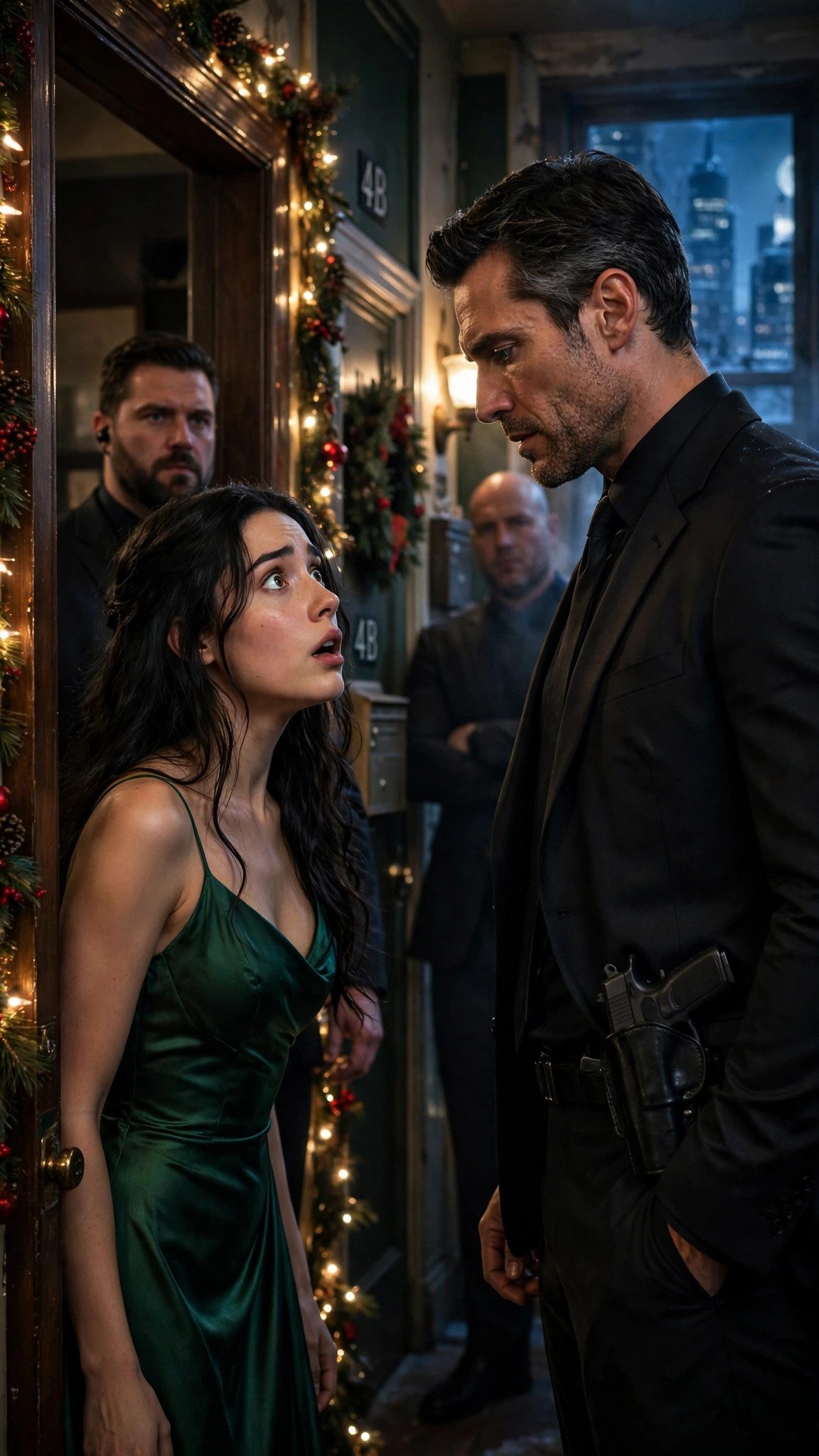
At exactly 9:00 P.M., the billionaire CEO I had worked for for three years appeared outside my apartment with two armed bodyguards and asked, "Are you alone?"
I had skipped our company Christmas party that night after overhearing my coworkers mock the emerald-green dress I had bought for the occasion. But Cassian Blackwood had not come to ask why I was absent. He had come to tell me that men had been watching my apartment for forty-eight hours, and that if I stayed there that night, I might die.
"You're coming home with me," he said.
I thought he was just a ruthless businessman. I had no idea he was a mafia boss. And I had no idea that someone had already decided I was his greatest weakness.
My name is Elara Whitmore. I am twenty-six years old, and for three years I have worked as the executive secretary to Cassian Blackwood, one of the wealthiest businessmen in New York. People in the office whispered about him the way people whisper about storms: with respect, with fear, and with the quiet certainty that you did not want to be standing in his path when he decided to move.
Cassian was famous for three things. His cold expression, which never seemed to change no matter what news you brought him. His impossible standards, which had reduced grown executives to stammering apologies in the middle of meetings. And his ability to silence an entire boardroom with a single look, the way a hand closing around a throat silences a voice.
I organized his meetings. I handled his confidential documents. I remembered every deadline, every flight, every name he pretended to forget. I kept his chaotic schedule running smoothly, and I did it so well that most days he barely seemed to notice I existed at all.
But I never imagined he noticed anything about me beyond my work.
That December, our company was preparing for its annual Christmas party. It was the one night of the year when the office stopped pretending to be a machine and pretended to be a family instead. There would be a string quartet in the lobby, a tree so tall it had to be brought in through the loading dock, and champagne that cost more per bottle than I spent on groceries in a month.
I had bought a beautiful emerald-green dress for the occasion. It was the most expensive thing I had ever bought for myself, and I had stood in the fitting room for a long time before I finally said yes to it, because the woman in the mirror looked like someone who belonged in a room full of beautiful people. The fabric fell like water. The color made my dark hair look darker and my skin look warmer. For the first time in a long while, I felt excited about going somewhere.
Then, on the afternoon of the party, I overheard several executives talking near the conference room. I had gone to collect a folder Cassian needed before the evening, and their voices carried clearly through the half-open door.
"Did you see what Elara bought for tonight?" one woman laughed. Her name was Vanessa Cole, and she had the kind of laugh that was designed to be heard by everyone except the person it was about.
Another voice snickered. "She really thinks a dress will hide that she's nothing but the boss's assistant."
"Three years fetching coffee and she thinks she's one of us," a man said. "Someone should tell her the dress doesn't change the job description."
They laughed again, and I stood in the hallway with the folder pressed against my chest, feeling my excitement die the way a candle dies when someone closes a door on it. Not all at once. Just a slow, quiet going-out.
I did not go into the conference room. I did not say anything. I put the folder on Cassian's desk, I went back to my own desk, and I sat there for a long time looking at my computer screen without seeing any of the words on it.
By six o'clock, the office had emptied. The lobby below was already filling with music and laughter and the sound of glasses. I could hear it all the way up on the forty-second floor, faint and bright, like a party happening in another country. I took the elevator down, I walked out into the cold December air, and I went home.
At home, I changed out of my work clothes and into comfortable ones. I put the emerald dress back in its bag and hung it in the closet, where it would stay unworn. I roasted a chicken for dinner because cooking something with my hands felt better than sitting still and thinking. I poured myself a glass of red wine. I sat on my small couch in my small apartment, and I told myself that I did not care about a party, or a dress, or a group of people whose opinions had never once paid my rent.
I had nearly finished the wine when I heard a knock on my door.
It was not a polite knock. It was three sharp raps, the kind of knock that does not ask for permission. It was the kind of knock that says: open this door now.
"Elara. Open up."
I froze with the glass halfway to my lips.
I knew that voice. I had heard it every working day for three years, across boardroom tables and through office doors and on the phone at two in the morning when a deal in another time zone needed a signature. But I had never heard it outside an office. I had never heard it in my own hallway, in the dark, at nine o'clock at night.
I put the glass down. My hands were shaking. I went to the door and opened it just enough to look outside, the chain still on, my heart beating so hard I could feel it in my throat.
Cassian Blackwood stood in the hallway.
But the man I had known for three years was gone.
The one standing before me wore a dark suit that cost more than my car, and beneath his jacket, when he shifted his weight, I saw the shape of a gun holstered against his ribs. Behind him stood two men I had never seen before, both in dark suits, both with their hands near their jackets, both looking up and down the hallway the way men look when they are expecting trouble to come through a door.
"Are you alone?" Cassian asked.
"Mr. Blackwood," I said. My voice sounded like it belonged to someone else. "What are you doing here?"
"Are you alone?" he asked again, and this time it was not a question. It was a check, the way a soldier checks a room before he steps into it.
"Yes," I said. "I just got home. What's wrong?"
"Come with me. Now."
"I just got home," I said again, because my brain had not caught up with my mouth. "What's wrong?"
He looked at me for a long second, and in that second I saw something I had never seen on his face in three years of working for him. It was not coldness. It was not anger. It was urgency, raw and undisguised, and it frightened me more than the gun had.
"If we stay here tonight, you might die," he said. "Men have been watching your apartment for forty-eight hours."
The words did not make sense. I heard them the way you hear words in a dream, clearly and yet somehow in the wrong order.
"Men have been watching my apartment," I repeated. "Why would anyone watch my apartment?"
"Because someone inside my organization believes you know everything about me," Cassian said. "And they have decided that the best way to weaken me is to take you."
I tried to turn back inside to grab my phone. It was a stupid instinct, the instinct of a person whose whole life has been organized around a small glowing rectangle. But Cassian blocked my way with one arm, and his hand closed around the doorframe, and he looked down at me with an expression that made it very clear that my phone was the least important thing in the world right now.
"You don't understand," he said. "It's not safe to pack. It's not safe to stay. It's not safe to go anywhere but where I take you."
"Then why me?" I asked. "Why would anyone target me? I'm a secretary. I answer phones. I schedule meetings. I am nobody."
"You're involved with organized crime," I said, and then I stopped, because I had meant it as a question and it had come out as a statement, and the look on his face told me it was true before he opened his mouth.
"Yes," Cassian said.
I could not bring myself to believe it. Three years. Three years of meetings and memos and coffee orders and flight confirmations, and the man I had worked beside every single day had been something else entirely. The man whose calendar I managed, whose suits I had sent to the cleaner, whose birthday I had remembered when no one else in the company had bothered to — that man controlled a criminal empire.
His real name was Cassian Blackwood. But his empire had been built on something far darker than business.
"You're a mafia boss," I whispered.
"Yes," he said again. He did not flinch. He did not look away. "And someone inside my organization has decided that you are the way to get to me."
"But I don't know anything," I said. "I don't know about your business. I don't know about any of this. I've spent three years scheduling your meetings and I never once—"
"They don't know that," Cassian said. His voice dropped lower. "They believe you know everything about me. Every deal. Every name. Every place I go. And they have decided that the best way to weaken me is to take you."
I had no idea what to do. I was trapped between a man who might be cold-blooded and a threat I did not fully understand, and both of them were standing in my hallway at nine o'clock at night while my dinner sat going cold on the table behind me.
The next moment, something hit the building.
It was not a loud sound at first. It was a deep thud, somewhere below us, the kind of sound you feel in your feet before you hear it in your ears. The lights in the hallway shook. My wine glass, still sitting on the coffee table inside, rattled against the wood.
Cassian did not hesitate. He grabbed my hand — his fingers closing around mine, warm and hard and certain — and he pulled me out of the doorway and toward the side exit at the end of the hall. One of the bodyguards moved ahead of us. The other fell in behind. They moved like men who had done this a hundred times before, and I moved like a woman who had never done it once in her life, stumbling in my socks on the thin hallway carpet, my free hand clutching at the wall for balance.
But before we escaped, I saw what was waiting for us outside: a fleet of black SUVs lined up along the curb, their headlights off, their engines running. My bodyguard's car was there too, and Cassian's own security vehicles, a whole silent convoy waiting in the dark December street like something out of a movie I had never agreed to be in.
And as Cassian pulled me toward the nearest car, as the cold air hit my face and the city noise rushed back in around me, I realized something that frightened me even more than the men who had been watching my apartment.
The danger might not be coming only from the men chasing us.
Someone close to him could have told them exactly where we would be.
Someone close to him had known about this apartment. Someone close to him had known that I would be home alone tonight, that I had skipped the party, that I would be sitting on my couch with a glass of wine and no one to call.
And if someone close to him knew that much, then the man holding my hand — the man who had just told me he was a mafia boss — might be the only person in the world I could trust tonight.
Or he might be the reason I needed saving in the first place.
The SUV door opened before I could decide which one it was. One of the bodyguards — a broad-shouldered man with a shaved head and a scar through his left eyebrow — held it open and gestured me inside with a nod, the way a doorman gestures a guest into a hotel. I climbed in because there was nowhere else to go. Cassian slid in beside me, and the door closed with a heavy, expensive sound, and suddenly the noise of the street was gone, replaced by the low hum of the engine and the smell of leather and the faint, clean scent of his cologne.
"Go," Cassian said to the driver, and the SUV pulled away from the curb so smoothly that I barely felt it move.
I turned in my seat and looked back through the rear window. My building was already shrinking behind us, its windows lit up warm and yellow against the dark. Somewhere up there, on the third floor, my dinner was still sitting on the table. My wine glass was still sitting on the coffee table. My phone was still sitting on the kitchen counter where I had left it when I went to answer the door.
Everything I owned was up there. Everything I was, or thought I was, was up there. And I was driving away from it in my socks, holding the hand of a man I had worked for for three years and apparently never known at all.
"Where are we going?" I asked.
"Somewhere safe," Cassian said. He had his phone out now, and he was typing with one hand, his thumb moving fast across the screen. "Somewhere they can't follow."
"Who are they?" I asked. "Who is watching me?"
He looked up from his phone, and for a moment the cold mask was gone again, and I saw the man underneath it — tired, and angry, and afraid in a way he clearly hated being.
"That," he said, "is what I intend to find out tonight."
The SUV turned onto the avenue, and the city opened up around us, all lights and traffic and people walking home with shopping bags, completely unaware that anything in the world was wrong. I pressed my hand against the cold window and watched them pass, and I thought about the emerald dress hanging in my closet, and the party I had skipped, and the women who had laughed at me that afternoon.
They had laughed because they thought I was nothing but the boss's assistant.
They had no idea how right they were — or how wrong.