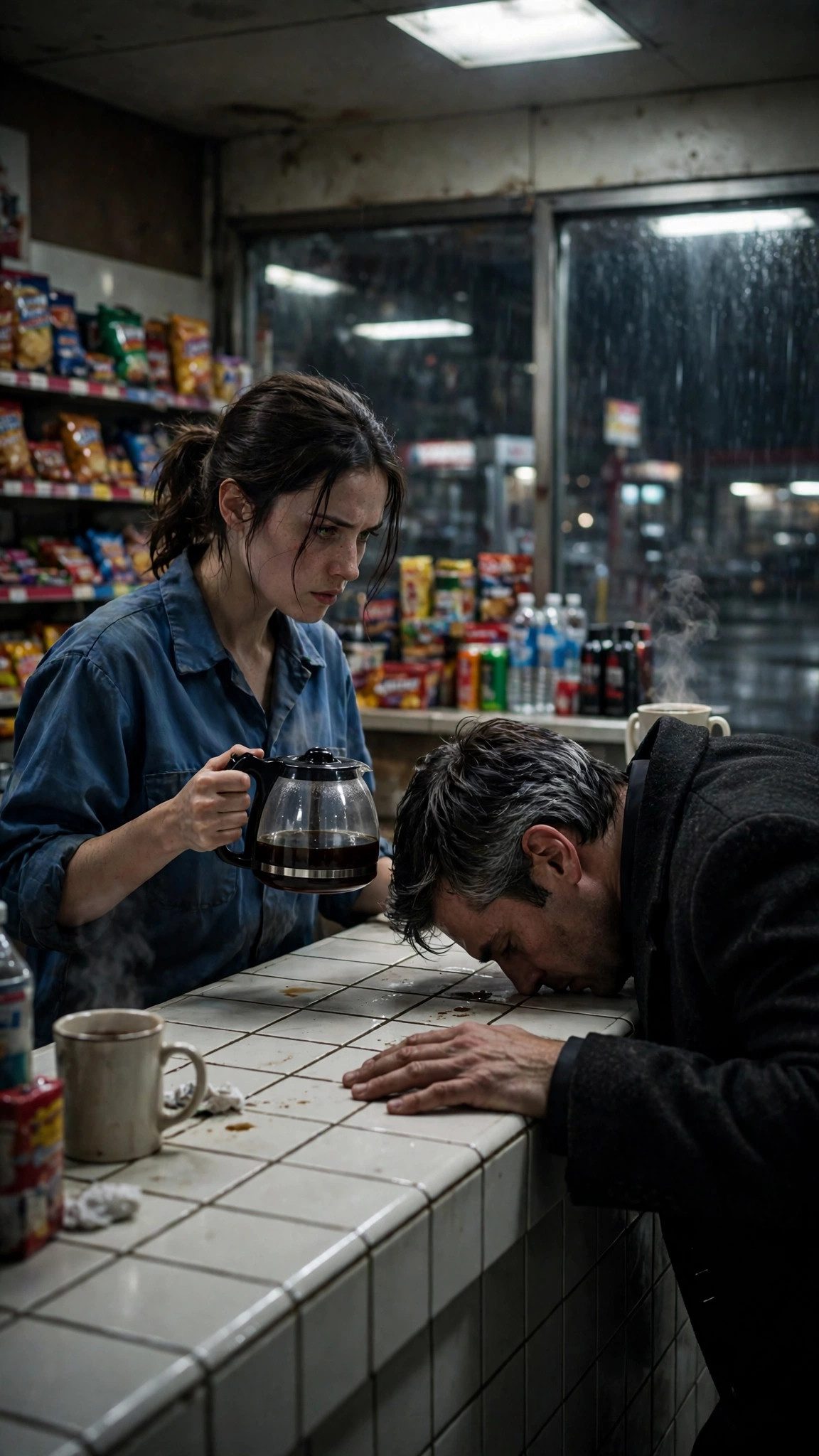
The morning after Falco's arrest, Agent Cole came to my father's house.
She sat at our kitchen table, drinking the tea I made her, and she told me what Rook had said in the interrogation room at three in the morning, when the detectives had laid out the phone records and the text messages and the photographs from the station's security cameras, and Rook had finally understood that nobody was coming to save him.
"His name is Marco," Agent Cole said. "Marco Falco. Vincent's nephew. Twenty-four years old. He worked at your gas station for one summer when he was seventeen — pumping gas, stocking shelves, mopping floors. That's how he knew the layout. That's how he knew where the lock was and where the brewer was and where you stood behind the counter."
I remembered him then, faintly, a skinny kid with dark hair who had worked the day shift for a few months and then stopped coming. I had barely noticed him. I barely noticed anyone.
"He walked Rook and the others through the station on a Tuesday afternoon," Agent Cole said. "He bought a soda. He used the bathroom. He stood at the counter and asked you for change for the vending machine. Do you remember?"
I closed my eyes, and I saw it — a Tuesday, a young man in a baseball cap, asking for change, smiling at me, and me handing him four quarters without looking at his face.
"I remember the cap," I said. "I don't remember his face."
"That's how it works," Agent Cole said. "The people who do this kind of thing count on not being remembered. They count on being invisible. They didn't count on you remembering the coffee brewer."
"The brewer?" I said.
"Rook told us that Marco pointed at the brewer and said, 'That's where the girl stands. She'll be behind the counter. She pours the coffee.' He told them about you, Miss Boon. He told them you were the witness. He told them you'd be useful."
"Useful," I said again, and the word tasted like ash.
"Marco is in custody," Agent Cole said. "He confessed this morning. His lawyer is already talking about a deal, but the deal doesn't matter. What matters is that we have Falco, we have Marco, we have Rook and his three men, and we have your manager."
"Dale," I said.
"Dale Kessler," Agent Cole said. "He's been charged with aiding and abetting attempted murder. He told us everything, too. Falco approached him six weeks ago, offered him five hundred dollars a week to send a text message every Thursday night. Dale said he needed the money. He said his wife left him. He said a lot of things. None of them matter."
"What happens to the station?" I asked.
"The owner is selling it," Agent Cole said. "The company that owns the lot has already had three offers. It'll probably be a coffee shop by Christmas. Or a car wash. The world moves on, Miss Boon. It always does."
She finished her tea and stood up. "I need you to testify at the trial. Not tomorrow, not next week — in a few months, when the case is ready. You'll tell the jury what you told me. About the coffee pot. About the gun. About the messages. Can you do that?"
Agent Cole prepared me for the testimony the way my father had prepared me for the range — slowly, carefully, with patience. She came to the house three times, and she sat at our kitchen table, and she asked me the questions the defense lawyer would ask, in the voice the defense lawyer would use, sharp and fast and designed to make me doubt myself.
"Miss Boon, isn't it true that you were frightened?" she said, playing the lawyer. "Isn't it true that you were shaking? Isn't it true that you can't be sure what you saw?"
"I was frightened," I said. "I was shaking. And I am sure. Those three things are all true at the same time."
"Good," Agent Cole said, and she smiled, a real smile, the first one I had seen from her. "Say it exactly like that on the stand. Don't let them make you choose between being afraid and being sure. You were both. That's what makes you credible."
My father listened from his chair, and when Agent Cole left, he said, "She's a good investigator. She reminds me of a deputy I used to work with. A woman named Ruth. She never missed anything, either."
I visited the station lot one last time, on a Sunday afternoon, after the sign had come down and the pumps had been drained and the windows had been boarded up. I stood in the empty lot, and I looked at the place where the black sedan had parked, and the place where Tony had stood behind the hood, and the place where the door had been locked, and I thought about how small it all looked in daylight. At night, with the lights on and the guns out, it had felt like the whole world. In the afternoon sun, it was just a gas station. Just a building. Just a place where something had happened, once, and then the world had moved on.
Carmine's office, when I saw it that afternoon, was nothing like I expected. No gold. No marble. Just a desk, and a window, and a photograph on the desk of a woman with dark hair and a kind face, and a coffee machine in the corner, small and old, the kind you buy at a department store. And on the wall, behind the desk, a framed photograph of a bakery — a small storefront with an awning, and a woman standing in the doorway, wiping her hands on her apron.
"My mother's bakery," Carmine said, when he saw me looking at it. "She ran it for thirty years. She made the best bread in the neighborhood, and she gave it away to anyone who couldn't pay. She used to say that a business isn't a business if it doesn't feed people. I didn't understand her then. I understand her now."
He told me about his mother while the coffee machine gurgled in the corner — how she had woken up at four every morning to knead the dough, how she had taught him to count change when he was seven, how she had died in the winter when he was nineteen, and how he had carried the guilt of it for twenty-two years, because he had joined the family to pay her bills, and by the time he had the money, she was already gone.
"She would have liked you," he said. "She liked people with steady hands."
And I thought about my own mother, gone so long I could barely remember her face, and I thought about the two of us, standing in an office in the city, both of us raised by people who had taught us that a life is measured by what you do when nobody is watching.
And I thought that maybe, just maybe, that was why the coffee had tasted so good that night. Because it had been poured by someone who understood what it meant to lose a mother, for a man who understood it too.
"Yes," I said. "I can do that."
"There's something else you should know," Agent Cole said, before she left. "We offered your manager a deal, and he took it. He told us about the money, about the texts, about the Tuesday afternoons when Marco walked through the station. He told us his wife left him last year, and he was behind on his rent, and Falco's five hundred dollars a week felt like a lifeline. It wasn't. It was a rope. And he knows that now."
"Will he go to prison?" I asked.
"Yes," she said. "For a long time. He'll have a lot of time to think about the difference between a lifeline and a rope."
After she left, I sat with my father, and I told him about the deal, and he was quiet for a long time, and then he said, "A man who sells his soul for five hundred dollars a week doesn't understand what a soul is worth. I feel sorry for him, Gemma. I really do."
"Do you?" I said. "After what he did to me?"
"He did it to himself first," my father said. "That's the saddest part. He did it to himself, and he didn't even know it."
"Good," she said. "And Miss Boon — one more thing. Mr. Zito asked me to tell you that he won't be coming to the station anymore. His routine has changed. He doesn't stop for coffee on the highway now. He says the highway has enough ghosts."
I nodded. I understood. I didn't know if I was relieved or disappointed, and I didn't want to examine the feeling too closely.
After Agent Cole left, I sat with my father in the living room, and he was having a good day — his breathing was easier, and his eyes were clear, and he asked me to read him the sports page, and I did, and for a little while the world felt almost normal.
Then the mail came, and in the mail was a letter from the hospital, and the letter said that my father's account had been paid in full. Every bill. Every charge. The whole balance, wiped clean, down to zero.
There was no name on the letter. No note. Just a stamped line at the bottom: "Paid in full. Thank you."
I knew who had done it. I knew it the way you know a thing without being told, the way you know rain is coming by the smell of the air. I drove to the city that afternoon, to the address on the white card — a building with no sign, a door with no name, a man in the lobby who looked at me and said, "Mr. Zito is expecting you," like he had known I would come.
Carmine's office was on the top floor, and it was nothing like I expected. No gold. No marble. Just a desk, and a window, and a photograph on the desk of a woman with dark hair and a kind face, and a coffee machine in the corner, small and old, the kind you buy at a department store.
"Miss Boon," Carmine said, standing up when I walked in. "How is your father?"
"You paid his bills," I said. "All of them."
"I did."
"Why?"
He was quiet for a moment, and he looked out the window at the city, and when he spoke, his voice was different — not the low, even voice of the counter, but something quieter, something that sounded like a man talking about something he didn't talk about often.
"My mother died when I was nineteen," he said. "She was sick for a long time, and the bills were more than my family could pay, and I watched my father sell everything we had — the house, the car, his father's watch — and it still wasn't enough. I joined the family because I didn't know any other way to get the money. I told myself I was doing it for her. By the time I had the money, she was gone."
He turned back to me. "Your father is still alive, Miss Boon. He's still sitting in his chair by the window, and he can still hear you read him the newspaper. That's worth more than any amount of money. And if I can make sure you don't have to sell everything you have to keep him there, then I will. That's not a payoff. That's not a debt. That's just a man who knows what it feels like to lose someone, making sure someone else doesn't have to."
I stood there, in his office, with the photograph of his mother on the desk, and I felt my throat close up, and I couldn't speak for a moment.
"Thank you," I said, finally. "Thank you, Carmine."
"Don't thank me," he said. "Thank your father. He's the one who raised a daughter who would throw a coffee pot at a hitman."
I laughed then, a real laugh, and he laughed too, and it was the first time I had heard him laugh, and it sounded like a man who hadn't laughed in a very long time.
"There's something else," he said, and he opened a drawer and took out a folder, and he set it on the desk between us. "The gas station is being sold. The company that owns it has accepted an offer. But I bought the lot next to it. The empty one, on the corner, with the old diner that's been closed for two years. I bought it yesterday."
"Why?" I asked.
"Because," he said, "a woman who makes the best coffee in New York shouldn't be pouring it in a gas station at three in the morning for men who don't say thank you. She should have her own place. Her own counter. Her own name on the sign."
He slid the folder across the desk. Inside were papers — a deed, a business license application, a floor plan for a coffee shop with a counter and a window and a little table by the door.
"Boon's," he said. "That's what the sign will say. If you want it."
I stared at the folder. I stared at the floor plan. I stared at the deed, with a blank line where my name was supposed to go.
"Carmine," I said, "I can't accept this. It's too much. The bills were enough. This is—"
"It's a loan," he said. "A business loan. At a fair rate. With a fair repayment plan. You'll pay it back, every cent, out of the profits of your own shop. I'm not giving you anything, Miss Boon. I'm investing in you. There's a difference."
I looked at the folder again, and I thought about my father, and the hospital bills, and the six years behind the counter, and the manager who had told me to stop acting like I was worth more than the job.
"All right," I said. "All right. I'll take the loan."
"Good," Carmine said, and he smiled — not the sharp smile from the gas station, but a real one, warm and unguarded. "Then there's one more thing. A condition of the loan."
"What's that?"
"The first cup," he said. "When you open, the first cup you pour is mine. Black. Just the way I like it."
I smiled back at him. "It's a deal."