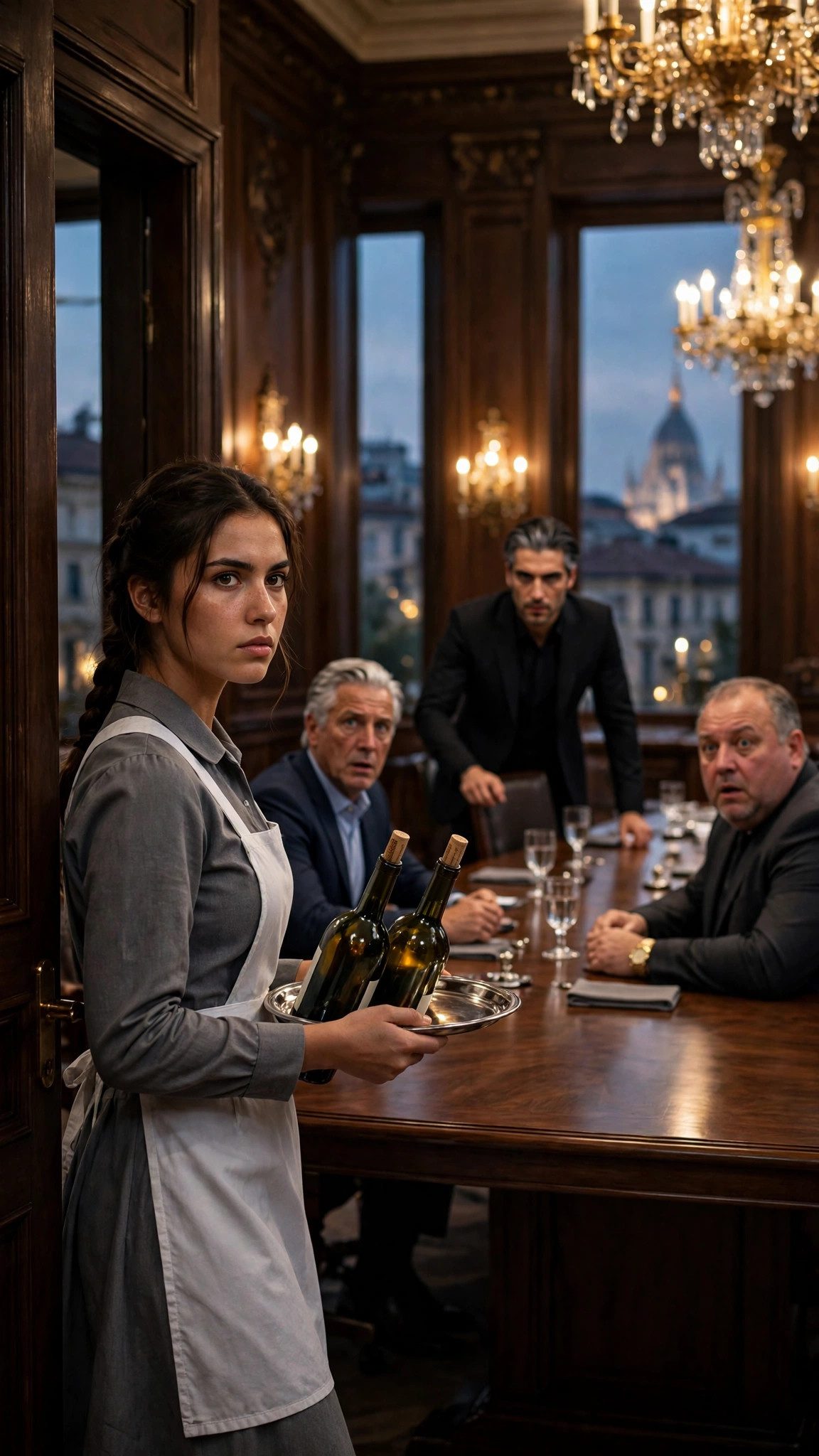
The deal was dying in front of me, and no one in the room knew how to save it except the woman carrying the wine.
I had been standing in the doorway of the DeLuca boardroom for eleven minutes, holding a silver tray with two bottles of Barolo, watching the most feared men in Milan fail at the one thing that was supposed to make them rich. The room smelled of cigar smoke and expensive cologne and fear, though none of the men in it would have admitted to the last one. The long walnut table gleamed under the chandeliers. On one side sat Giovanni Ferrante, fifty-five years old, silver-haired, the shipping magnate who owned half the docks at Genoa, his hands folded so tightly his knuckles had gone white. On the other side sat Dmitri Volkov, the Russian oligarch, fifty-eight, broad as a door, his heavy gold watch catching the light every time he gestured, which was often, and always in anger.
Between them sat the Don.
Alessandro DeLuca was thirty-eight years old and had run the DeLuca family for eight years, since the night his father Vittorio had died of a heart attack in this very house. He was tall, dark-haired with silver beginning at his temples, and his eyes were the color of winter rain. He wore a black suit that had been cut for him in Rome, and he had not moved in four minutes. He was watching the two men the way a man watches a fire he cannot put out.
The interpreter was the problem. Paolo Ricci sat at the Don's right hand, sweating through his shirt, translating badly and slowly, and every time he opened his mouth the deal slipped a little further away. Volkov would say something in Russian, long and blunt and full of numbers. Paolo would turn it into Italian that was shorter, softer, and wrong. Ferrante would answer in Italian, sharp and offended. Paolo would turn that into Russian that was shorter, colder, and wrong in the other direction. I had been listening from the doorway, and I knew exactly what was happening. I had known for nine minutes. I had been counting the money as it burned.
The deal was a joint venture on the Genoa port. Ferrante would bring the docks and the ships. Volkov would bring two billion euros and the Eastern routes. The DeLuca family would bring the permits, the protection, and the peace that made the whole thing possible. Everyone in the room would get richer than they already were, which was saying something. But Volkov believed Ferrante had just insulted his dead father. Ferrante believed Volkov had just threatened to walk away and take his money to Marseille. Neither of those things had actually been said. Paolo had invented both of them, one word at a time, with the careful, sweating precision of a man who was being paid to destroy something.
I knew, because I had heard Paolo on the telephone two nights before, in the service corridor behind the kitchen, telling someone that the job was done and the money should be in the account by Friday. I knew, because I had spent three years in this house listening through doors and I knew the sound of a lie in seven languages.
My name is Lucia Marchetti. I am twenty-six years old. I have worked as a maid in the DeLuca house for three years, and before that I cleaned rooms in a hotel near the central station, and before that I was a girl with two dead parents and a suitcase full of books in six languages. Nobody in this house knew that I spoke seven languages fluently. Nobody knew that my father had been an interpreter for the United Nations and my mother a professor of Russian literature, or that I had grown up at a dinner table where four languages were spoken before dessert. Rosa, the housekeeper, knew. Rosa had been my mother's friend at university, and Rosa had brought me here after the crash, and Rosa had told me on my first day, holding my face in her hands, "In this house, Lucia, being clever is more dangerous than being stupid. Keep your mouth shut and your head down, and you will live."
I had kept my mouth shut for three years. I had kept my head down. I had carried trays and made beds and polished silver, and I had listened. I knew which capo was skimming from the docks. I knew which driver was reporting to the Castellanos. I knew the Don took his coffee black at six in the morning and read the financial pages with a pencil, and that he had not laughed, really laughed, in the two years since his brother Enzo had been killed in Naples. I knew everything, and I had said nothing, because Rosa was right. In this house, being noticed was the most dangerous thing of all.
But the deal was dying. And the deal was the Don's whole future. And if the deal died, Volkov would go to Marseille, Ferrante would go to the Castellanos, and the war that had been simmering between the families for two years would boil over, and men would die, and one of them might be the man who had given me a home when I had nothing.
So I stepped into the room.
The door creaked. Every head turned. I felt the weight of twelve pairs of eyes, and the silence that followed was the kind of silence that comes before a gunshot.
"I can help," I said quietly. My voice was barely above a whisper. My hands were shaking so hard the bottles rattled on the tray.
The room went dead silent. The Don's dark eyes fell on me, and a chill swept through the room. I had no right to speak. No right to be there. I was a maid, and maids in the DeLuca house did not speak unless spoken to, and they certainly did not interrupt a meeting of the most feared men in Italy.
But something in my eyes must have been different. Something in the way I stood there, shaking and unafraid at the same time.
"What do you know about this?" the Don asked. His voice was low and dangerous, the voice of a man deciding whether to have someone thrown out or shot.
I set the tray down on the sideboard with hands that would not stop trembling. I stepped forward. My heart was racing so hard I could hear it in my ears. But my voice, when it came, was steady.
"Signor Volkov did not insult Signor Ferrante's father," I said in Russian, looking straight at Volkov. "He said his own father built his first ship with his hands, and that a man who builds with his hands does not break his word. Your interpreter told Signor Ferrante that Volkov called his father a thief."
Volkov's eyes widened. He leaned forward, his big hands flat on the table.
"And Signor Ferrante did not threaten to take his ships to Marseille," I continued, turning to Ferrante and switching to Italian. "He said the Genoa docks need new cranes before winter, and that the cranes must come from Volkov's factories, because only his factories can deliver them in time. Your interpreter told Signor Volkov that Ferrante called him a beggar."
Ferrante's mouth opened. No sound came out.
I turned back to Volkov and spoke in Russian again. "Signor Ferrante's deadline is not a threat. The harbor authority fines the docks for every week the old cranes stay up past November. He loses money every day the deal waits. He needs you. He is not trying to frighten you. He is trying not to go bankrupt."
Then I turned to Ferrante, in Italian. "Signor Volkov's money is not a gift. His London accounts were frozen for eleven months last year, and he cannot afford another failed venture. He needs this deal to close before the end of the quarter, or his own partners will remove him. He is not trying to dominate you. He is trying to survive."
The tension in the room shifted. It was like watching ice crack on a river in spring. Volkov sat back slowly, his eyes never leaving my face. Ferrante unfolded his hands. Paolo Ricci had gone the color of old paper.
"How do you know these things?" Volkov asked in Russian. His voice was rough, but the anger was draining out of it.
"Because I have been listening," I said in Russian. "And because I speak your language, and his, and five more. And because the man translating for you has been lying to both of you since the meeting began."
The Don stood up. He was very tall, and when he stood the whole room seemed to tilt toward him. He looked at Paolo, and Paolo shrank in his chair like a man who had just realized the floor was gone.
"Lucia," the Don said, and my name in his mouth sounded like something I had never heard before. "Come here."
I walked to the table. My legs felt like water. He gestured to the empty chair at his right hand, the chair where his most trusted adviser usually sat. I sat down. The leather was warm.
"Translate," he said. "Everything. Exactly. From now on, no one in this room speaks except through you."
So I did. For the next forty minutes, I translated between a Russian oligarch and an Italian shipping magnate, and I did not just translate. I negotiated. When Volkov dug in on the percentage, I reminded him in Russian that Ferrante's cranes would save his quarter. When Ferrante balked at the timeline, I reminded him in Italian that Volkov's factories were the only ones that could deliver. When they both started shouting about the harbor authority, I switched to English, the neutral ground, and laid out the numbers in a way that made them both look like winners. I kept my voice steady. I kept my hands folded in my lap where no one could see them shaking. I thought about my father, who had once told me that an interpreter is not a mirror but a bridge, and that a bridge has to be strong enough to carry the weight of two armies walking toward each other.
Within minutes — no, within the hour — the deal was saved. Volkov laughed, a great barking laugh that shook his shoulders, and slapped the table so hard the glasses jumped. Ferrante laughed too, and then they were shaking hands, and then Volkov was pouring vodka for everyone, and Ferrante was calling for the Barolo, and the Don was watching me with an expression I had never seen on his face before.
But my secret had been revealed. The Don, who had built his empire on control and loyalty, now held a power in his hands he had not expected. A maid who spoke seven languages. A maid who had been listening for three years. A maid who knew things.
When the room finally emptied, when Volkov and Ferrante had gone downstairs to celebrate with the Don's best wine, Alessandro DeLuca stayed behind. He stood by the window, looking out over the rooftops of Milan, his hands behind his back. The evening light turned the city gold.
"You're not just a maid," he said, his voice softer now, almost dangerous. "Who are you really?"
I looked up. My eyes met his. I had been afraid of this man for three years, and now, standing in the ruins of the deal I had just saved, I was not afraid at all.
"I'm someone who has been watching, learning, and waiting for the right moment," I said. "I'm not just a maid. I'm a woman who can change everything."
The Don stared at me, stunned. For the first time, he saw me not as a servant, but as a force to be reckoned with.
"You pick things up," he said slowly, and it was not a question.
"Yes," I said. "I pick things up."
He was quiet for a long moment. Outside, the bells of a church began to ring, and the sound drifted up through the open window, thin and golden.
"Then tomorrow," he said, "you will pick up something else. My interpreter is finished. You will take his place. And Lucia —" He paused, and his eyes held mine. "From now on, when you hear something in this house, you tell me. Everything you hear. Everything you have heard for three years. Do you understand?"
I understood. I understood that my life as an invisible maid was over. I understood that I had just stepped out of the shadows and into the center of the most dangerous room in Milan. I understood that Vincent Castellano, the man who had paid Paolo to kill this deal, would now know my name.
I understood all of that. And I said yes anyway.
That night, I went back to my small room above the kitchen, and I sat on the edge of my narrow bed, and I took out the box I kept under the floorboard. Inside it were my father's notebooks, full of vocabulary in seven languages, and my mother's photograph, and the letter Rosa had given me the day she brought me here, the letter my mother had written to her old friend years before she died. I read it again, the way I did whenever I needed to be brave. It said, in my mother's neat handwriting, that if anything ever happened to her, Rosa should look after her daughter, and that her daughter was smarter than anyone would ever guess, and that one day the world would need her.
I put the letter back. I put the notebooks back. I lay down in the dark and listened to the house settling around me, the way I had listened for three years, except now I was not listening as a maid. I was listening as the woman who had just changed everything.
Three years earlier, I had arrived at this house with a suitcase and a secret. I had been seventeen years old, and my parents had been dead for six weeks, and the world had felt like a door closing. Rosa had met me at the station in her black coat, and she had taken my suitcase, and she had said, "Your mother was my dearest friend. You will live with me now. You will work, and you will be safe, and no one will ever know what you are."
What I was, it turned out, was the one person in Milan who could save Alessandro DeLuca's empire. I just had not known it yet.
But I know it now. And so does he.