The first time I spoke seven languages in one day, I was nine years old, and I did not know it was unusual.
My father, Marco Marchetti, was an interpreter for the United Nations, and our apartment in Milan was the kind of place where languages collided the way weather collides over the mountains. In the morning my father spoke Italian to the baker and French to the postman. At lunch my mother, Katya Morozova Marchetti, spoke Russian to her sister on the telephone, long rolling conversations full of laughter that made the whole kitchen smell like tea. In the afternoon my father would come home from the Palazzo delle Nazioni in Geneva or the offices in New York, and he would sit at the kitchen table with his notebooks, and he would test me.
"How do you say 'the river is wide' in Russian?" he would ask.
"Reka shirokaya," I would say.
"And in French?"
"La rivière est large."
"And in German?"
"Der Fluss ist breit."
He would smile, and my mother would put a hand on my head, and the apartment would feel like the safest place in the world. I learned Spanish from our neighbor, Señora Alvarez, who taught me while we shelled peas on her balcony. I learned Arabic from my father's colleague, a kind man from Cairo named Omar, who came to dinner on Sundays and taught me to write my name in letters that flowed like water. By the time I was twelve, I spoke Italian, Russian, English, French, Spanish, German, and Arabic, and I thought everyone did. I thought it was like having brown eyes. I did not know it was a gift. I did not know it would one day save a man's empire, or that it would make me dangerous.
I also did not know that the DeLuca family existed. My parents kept that world far away from me. My father interpreted for diplomats and bankers, not for men with guns. My mother taught Russian literature at the university and believed, with all her heart, that books were stronger than bullets. They were wrong about that, the way good people often are. But they were right about almost everything else, and they loved me, and for seventeen years that was enough.
The crash happened on a rainy night in October, on the autostrada between Milan and Turin. My parents were driving home from a conference. A truck crossed the median. The police said it was quick, that they did not suffer, and I have spent nine years trying to believe that. I was seventeen. I had a suitcase, a bank account with almost nothing in it, and a box of my father's notebooks. I had no other family. My mother's sister lived in Moscow and had not spoken to us in years, not since the argument about the marriage. My father's brother had died when I was small.
Rosa Benedetti came for me. Rosa had been my mother's closest friend at university, before Rosa had left teaching to become a housekeeper, before my mother had married my father and moved to Milan. Rosa was sixty-one years old, with silver hair pulled back in a severe bun and hands that had scrubbed a thousand floors, and she met me at the central station in her black coat, and she took my suitcase out of my hands, and she said, "Your mother was my dearest friend. You will live with me now. You will work, and you will be safe, and no one will ever know what you are."
Rosa worked in the DeLuca house. She had been the housekeeper there for twenty years. She had a small room off the kitchen, and the Don's mother had been kind to her once, long ago, and that kindness had bought her a lifetime of employment. She took me to the house the next morning, and she introduced me to the staff, and she told the head of the household that I was her niece from the south, a girl who needed work, a girl who spoke only Italian and not much of that.
"Say nothing about your languages," she told me that night, holding my face in her hands. Her eyes were fierce. "In this house, Lucia, being clever is more dangerous than being stupid. The men in this house use clever people, and then they throw them away, or worse. If they know what you are, they will use you. If they think you are nothing, they will leave you alone. Keep your mouth shut and your head down, and you will live."
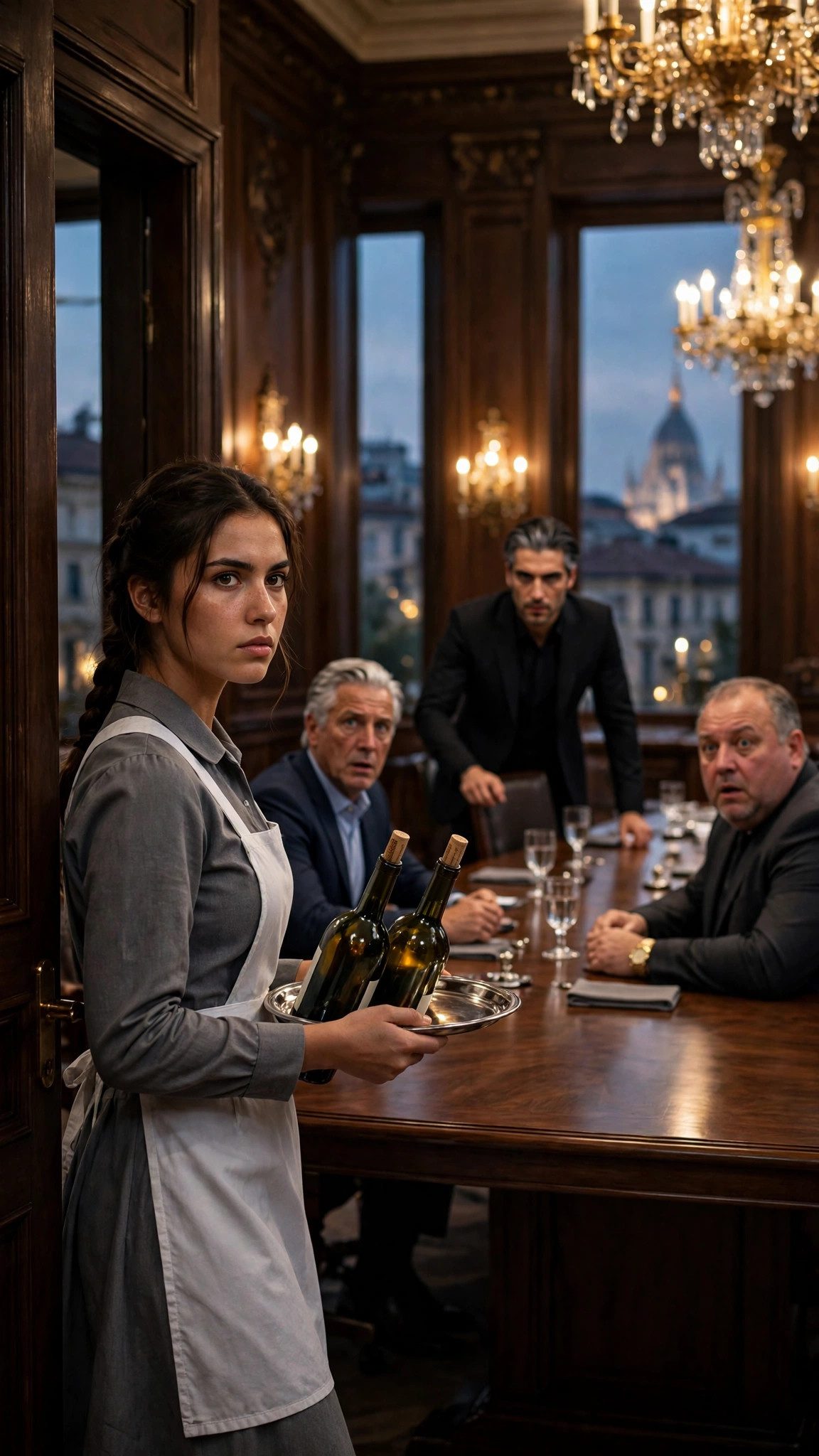
So I did. For three years, I kept my mouth shut and my head down. I learned to be invisible. I learned to move through the house like a shadow, carrying trays, making beds, polishing the silver in the dining room while the men talked about things that would have terrified me if I had not already known the world could end in a single rainy night. I learned to listen without seeming to listen. I learned that the capo named Salvatore was skimming money from the docks, because I heard him arguing with his wife on the telephone in the garden. I learned that the driver named Enzo was reporting to the Castellanos, because I heard him whispering in the garage in a dialect he thought no one in the house understood. I learned that the Don took his coffee black at six in the morning, that he read the financial pages with a pencil, that he had a scar on his left hand from a knife fight when he was nineteen, and that he had not laughed, really laughed, in the two years since his brother Enzo had been killed in Naples.
I learned everything. And I said nothing.
It was not a bad life, as lives go. I had a room above the kitchen, small and clean, with a window that looked out over the garden. I had Rosa, who brought me soup when I was sick and taught me to make her mother's ragù. I had the books in my father's box, which I read at night when the house was quiet, keeping all seven languages alive in my head like seven small fires. I had the garden, where I sometimes sat in the early morning before the house woke, listening to the birds and pretending I was a girl in an ordinary life.
But there were nights when the silence of the house pressed down on me like a weight, and I would lie awake and think about my mother, who had believed that books were stronger than bullets, and my father, who had believed that a bridge between two languages could stop a war. I would think about the girl I had been, the girl who had spoken seven languages before breakfast and thought it was normal, and I would wonder if that girl was gone forever, buried under a gray uniform and a white apron.
The morning after the boardroom, I woke before dawn, as I always did. I dressed in my uniform. I braided my hair the way Rosa had taught me, low and tight. I went down to the kitchen, and Rosa was already there, making coffee, and she looked at me with eyes that had seen everything.
"So," she said. "It happened."
"Rosa—"
"Don't." She held up a hand. "I heard. The whole house heard. The maid who speaks seven languages saved the Don's deal. Lucia, what have you done?"
"I saved his deal," I said. "The interpreter was lying. He was paid to kill it. If I had said nothing, the deal would have died, and Volkov would have gone to Marseille, and Ferrante would have gone to the Castellanos, and there would have been a war."
Rosa closed her eyes. "I know. I know, child. I am not angry. I am afraid. You were safe when you were invisible. Now you are visible, and visible people in this house are targets. The man who paid Paolo will know your name by tonight. Do you understand that?"
"I understand," I said.
She came around the counter and took my face in her hands, the way she had done on my first day. Her hands were warm and rough, and they smelled of coffee and soap.
"Then listen to me now, the way you listened to me then," she said. "The Don is not a bad man. I have worked in this house for twenty years, and I have seen him do cruel things and kind things, and I believe he is a man who wants to be good and does not always know how. But he is still a Don. He will protect you as long as you are useful to him. The day you stop being useful, you must have somewhere else to go. So keep your father's notebooks. Keep your mother's photograph. Keep something that is yours, and no one else's. Do you understand?"
"I understand," I said again, and I meant it.
She let me go. "Then go," she said. "He sent word an hour ago. You are to report to his study at eight o'clock. Not the kitchen. Not the dining room. His study. Bring nothing. And Lucia —" She paused, and her voice softened. "Your mother would be proud of you. She always said you were smarter than anyone would ever guess. She was right."
I walked through the house that morning the way I had walked through it for three years, but everything was different. The maids I passed stared at me. The guards nodded at me, which they had never done before. The cook pressed a warm roll into my hand and whispered, "Brava, Lucia," and then looked frightened of her own words. The house itself seemed to be holding its breath.
At eight o'clock, I knocked on the door of the Don's study. It was a room I had cleaned a hundred times, but I had never entered it when he was inside. The door was heavy oak, and the handle was brass, and my hand shook when I turned it.
"Come in," he said.
I went in. The study was long and dark, lined with bookshelves, with a great desk by the window and a fire burning low in the grate even though it was spring. Alessandro DeLuca stood by the window, looking out at the garden, his hands behind his back. He did not turn around.
"Sit down, Lucia," he said.
I sat in the chair across from his desk. I folded my hands in my lap. I waited.
He turned. His eyes were the color of winter rain, and they were fixed on me with an intensity that made my breath catch.
"Tell me about yourself," he said. "All of it. Your parents. Your languages. How you came to this house. Everything."
So I told him. I told him about my father, the interpreter, and my mother, the professor. I told him about the crash, and Rosa, and the three years of silence. I told him about the seven languages, and how I had learned them, and how I had kept them hidden. I told him about Paolo's telephone call, which I had overheard two nights before in the service corridor, and the words I had heard: that the job was done, that the money should be in the account by Friday. I told him everything, because Rosa had told me to keep something that was mine, but I had already given the most important thing away in the boardroom, and there was no taking it back.
When I finished, he was quiet for a long time. The fire crackled. A clock ticked somewhere. Outside, a bird sang in the garden.
"Paolo Ricci has worked for this family for nine years," he said at last. "I trusted him. I trusted him with my words, which is the same as trusting a man with your life. And he sold them."
"He sold them to the Castellanos," I said. "I heard him say a name on the telephone. Vincent Castellano."
The Don's jaw tightened. "Of course. Vincent has wanted the Genoa deal dead since the day it was proposed. If Volkov goes to Marseille, the port stays divided, and divided ports are easy to rob."
He walked to his desk and sat down. He leaned forward, his hands flat on the polished wood, and he looked at me the way a general looks at a map.
"Here is what will happen," he said. "Paolo is finished. He will be gone by noon, and he will never work in this city again. You will take his place. You will be my interpreter, and my adviser, and you will sit at my right hand in every meeting that matters. You will be paid ten times what you earned as a maid. You will have rooms on the second floor, not above the kitchen. And you will tell me everything you hear in this house, everything you have heard for three years, starting with the names of the men who are stealing from me and the men who are reporting to my enemies."
I nodded. My throat was dry.
"And one more thing," he said, and his voice dropped, and for a moment he did not sound like a Don at all. He sounded like a man. "Thank you. No one has ever saved something of mine before. Not like that. Not with words."
I stood up. My legs were unsteady, but I stood.
"Thank you, Don Alessandro," I said.
"Alessandro," he said. "When we are alone, you will call me Alessandro. Interpreters do not call their Don 'Don.' They call him by his name. That is the rule in every language."
I walked out of the study, and the house was different again. The maids stared. The guards nodded. And I understood, with a clarity that frightened me, that my life as an invisible girl was over, and that whatever came next would be decided in rooms like that one, with men like him, and that I would need every one of my seven languages to survive it.