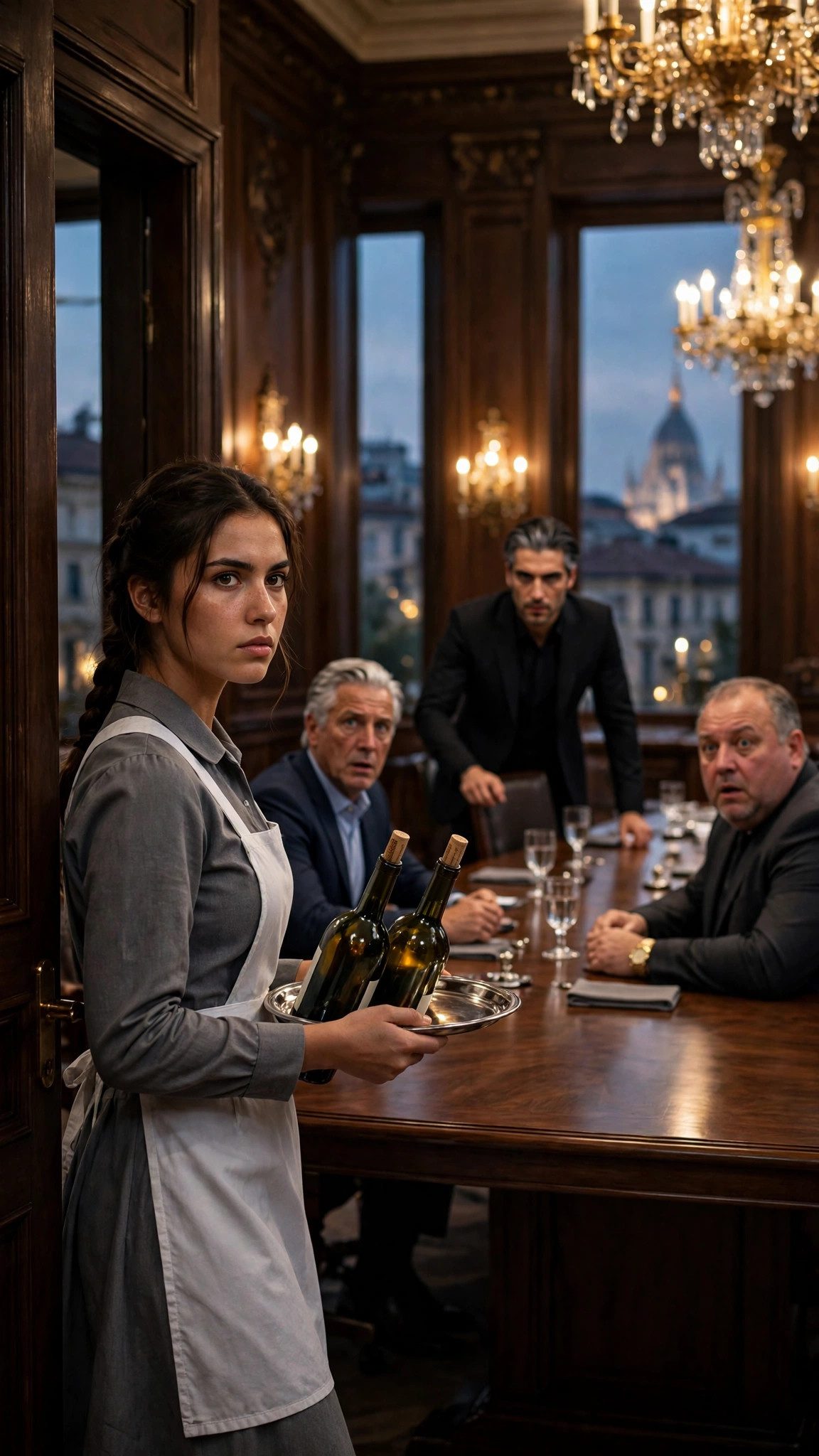
Paolo Ricci was gone by noon, exactly as Alessandro had promised. I did not see him leave. I heard about it from Rosa, who heard about it from the cook, who heard it from one of the guards: two men had come to Paolo's room, packed his suitcase while he watched, and driven him to the station with enough money for a ticket to Naples and a warning never to come back to Milan. It was, by the standards of the DeLuca family, an act of mercy. In another house, in another year, a man who sold his Don's words would not have left in a car. He would have left in a box.
I tried not to think about that. I tried to think about the work.
The work began the next morning. I was given rooms on the second floor — two rooms, actually, a sitting room and a bedroom, with windows that looked out over the garden and a wardrobe full of clothes that Rosa had chosen for me: dark skirts, silk blouses, a gray suit that made me look like a woman who belonged in a boardroom instead of a kitchen. I stood in front of the mirror for a long time, looking at a stranger. The girl in the gray uniform was gone. The woman in the mirror had my face, but she stood straighter, and her eyes were harder, and I was not sure whether I liked her or feared her.
Alessandro sent for me at nine. There was a meeting with Volkov's people, a smaller meeting this time, in the library, to work out the details of the port venture. I sat at his right hand, and I translated, and I discovered something I had not expected: I was good at this. Not just the languages — the languages were easy, they had always been easy — but the rest of it. The watching. The listening. The reading of a room. When Volkov's lawyer, a thin man named Petrov, tried to slip a clause into the agreement that would have let Volkov take control of the docks after five years, I caught it, and I translated it exactly, and I watched Alessandro's face go still, and I watched him say, in Italian, "Tell him no. Tell him the docks stay shared, or there is no deal." And I told him, in Russian, and I watched Petrov's face go pale, because he had not expected a maid to understand contract law.
After the meeting, Alessandro walked with me in the garden. It was the first time we had ever been alone together outside a room full of men, and the garden was quiet, and the air smelled of jasmine.
"You were listening for three years," he said. "Tell me what you heard. All of it. Start with the thieves."
So I told him. I told him about Salvatore, the capo who was skimming from the docks, and how I knew — the telephone arguments with his wife, the new car, the way he always volunteered to count the cargo on the nights when the manifests were thin. I told him about Enzo, the driver, and the whispers in the garage, and the dialect he thought no one understood. I told him about the cook's assistant who was selling information about the family's movements to a journalist, and the guard who drank on duty, and the accountant who kept two sets of books.
He listened without interrupting. When I finished, he was quiet for a long time, watching a bird move through the branches of an olive tree.
"Three years," he said at last. "You knew all of this for three years, and you said nothing."
"I was a maid," I said. "Maids who talk do not live long in houses like this."
"And now?"
"Now I am your interpreter," I said. "And interpreters talk. That is the job."
He almost smiled. It was the first time I had ever seen anything close to a smile on his face, and it changed him completely, the way sunlight changes a room.
"Then talk," he said. "And Lucia — thank you. For the thieves. For the liars. For all of it."
That afternoon, Alessandro called a meeting of his capos. I sat beside him, in the chair that had once belonged to his most trusted adviser, and I watched him do what Dons do when they discover they have been robbed by their own men. He did not shout. He did not threaten. He laid out the facts, one by one, in a voice so calm it was frightening, and he watched their faces as he did it. Salvatore went white. Enzo began to sweat. The accountant started to cry.
"You have all been stealing from me," Alessandro said. "Some of you have been stealing money. Some of you have been stealing information. One of you has been stealing my words." He paused. "I know everything. I know how much, and I know how long, and I know who you sold it to. I am going to give you one chance, because my father taught me that a man who has been loyal for twenty years and steals once is a different man from a man who has been stealing for twenty years. Those of you who confess, and repay what you took, and name the men you sold to, will live, and will work, and will earn back my trust. Those of you who lie to me now, in this room, will not leave it."
One by one, they confessed. Salvatore wept and promised to repay every euro. The accountant produced a second set of books from his briefcase, his hands shaking. Enzo, the driver, fell to his knees and begged, and named the Castellano lieutenant who had recruited him, a man named Dominic Voss.
It was a victory. It should have felt like a victory. But as I sat there, translating nothing, just listening, I felt a cold weight settle in my stomach. Because I knew something Alessandro did not know yet, and I had not told him, because I was not sure, and because I had learned in three years of silence that being sure matters more than being first.
I was not sure about Paolo.
Paolo had been the interpreter for nine years. He had been trusted. And yes, I had heard him on the telephone, and yes, he had been paid to kill the deal. But the telephone call had troubled me. The man on the other end had not sounded like a Castellano. He had sounded like someone else, someone I could not place, and the words Paolo had used — "the job is done" — had sounded rehearsed, the way a man sounds when he is saying what he has been told to say.
And there was something else. The mistranslations in the boardroom had been too perfect. Too precise. Paolo had not just mistranslated; he had mistranslated in exactly the way that would make both men angriest, in exactly the words that would wound each of them most. That was not the work of a careless interpreter, or even a bribed one. That was the work of someone who understood both men very well. Someone who knew Volkov's father, and Ferrante's pride, and exactly which buttons to press.
Someone who had been in the room.
That evening, before I went to my rooms, Alessandro asked me to join him for dinner. Not to serve. To sit. To eat at the long table in the dining room, in the chair across from his, while the cook — who had known me for three years as the girl who carried the trays — set plates down in front of us with hands that shook a little, and would not meet my eyes.
"I have eaten alone at this table for eight years," Alessandro said, pouring the wine himself, which he never did. "My father ate here with his capos. My brother ate here with his friends. I eat here with my accounts. Tonight I would like to eat with someone who tells me the truth."
He told me about Enzo then. Not the guard. His brother. Enzo had been twenty-nine when he died, two years younger than Alessandro, the funny one, the one who could make their father laugh, the one who had wanted to leave the family and open a restaurant in Naples. "He said the family was a cage," Alessandro told me, staring into his glass. "He said he wanted to cook for people who came to him because they were hungry, not because they were afraid. I told him he was a fool. Two weeks later, he was dead, and I have spent two years wondering if the bomb was meant for him, or for me."
I did not know what to say. I thought about my own parents, and the rainy night, and the way a single moment can divide a life into before and after. "My father used to say," I told him, "that grief is love with nowhere to go. He said the only cure is to give it somewhere to go."
"And where does yours go?" he asked.
"Into languages," I said. "Into listening. Into keeping seven small fires alive."
He nodded, as if that made perfect sense, and he poured more wine, and for the first time since I had met him, he looked almost at peace.
Later that night, before I went upstairs, the telephone rang in the study. It was a French investor, a Monsieur Dubois from Lyon, calling about a shipment of wine, and Alessandro handed me the receiver, and I spoke to him in French, smooth and easy, and I negotiated the price of three hundred cases while Rosa stood in the doorway, listening, her arms folded, a small smile on her face. When I hung up, she said, "Your mother would have been proud. She always said French was the language of diplomats, and you just proved her right."
That night, I could not sleep. I lay in my new bed in my new rooms, and I listened to the house, and I thought about Paolo, and about the telephone call, and about the fact that Alessandro had sent Paolo away to Naples with a ticket and a warning, and that if Paolo was not the real traitor, then the real traitor was still in the house, and now he knew that I was listening.
At two in the morning, I got up. I put on my dressing gown. I went down to the kitchen, where Rosa sometimes sat late with a cup of tea, and she was there, as I had hoped, and she looked at me, and she said, "You can't sleep either."
"I need to ask you something," I said. "About Paolo. Did you ever hear anything about him? Anything strange?"
Rosa was quiet for a moment, stirring her tea. "Paolo was a nervous man," she said at last. "He gambled. Everyone knew. He lost money at the card tables in the Navigli, and he borrowed, and he could never pay it back. A man like that is easy to buy."
"Who did he owe money to?" I asked.
She looked at me. "The same men everyone owes money to, child. The Castellanos. But Lucia —" She leaned forward. "There was something else. Two weeks ago, I heard Paolo arguing with someone in the garden. Not on the telephone. In person. A man with a voice I did not recognize. And Paolo was not the one begging. The other man was. The other man was saying, 'You have to do it. They will kill me if you don't.' And Paolo said, 'Then they will kill us both.'"
I felt the cold weight in my stomach grow heavier.
"Rosa," I said, "who was the other man?"
"I don't know," she said. "I never saw his face. But I know his voice. He spoke Italian with an accent from the south. From Naples."
Naples. The city where Alessandro's brother Enzo had been killed two years ago. The city where the Castellanos had their oldest friends. The city Paolo had just been sent to, alone, with a ticket and a warning.
"Thank you, Rosa," I said. "Go to bed. And lock your door tonight."
I went back upstairs. I stood at my window, looking out at the dark garden, and I thought about what I knew and what I did not know. I knew Paolo had been paid. I knew someone else had been afraid. I knew the mistranslations had been too perfect to be Paolo's work alone. And I knew that if the real traitor was still in this house, then the next move would not be against Alessandro. It would be against me.
I was the woman who had heard too much. And in the DeLuca house, women who heard too much had a way of disappearing.
Before I went to my rooms, I stopped in the small study off the kitchen, where I kept my father's notebooks in the drawer Rosa had given me, and I opened the one where he had written, in his careful hand, the words for the Neapolitan dialect. "A man always curses in his mother tongue," he had written in the margin, "and a man who is afraid speaks it even when he is trying not to." I read those words three times, and I thought about Paolo, and the voice on the telephone, and the man in the garden, and I knew, with a certainty that settled over me like cold water, that the fear I had heard in that voice was real, and that whoever was pulling the strings was pulling them from Naples, and that Naples was where Alessandro's brother had died. I closed the notebook. I put it back in the drawer. And I went upstairs to wait for the morning.
I did not sleep that night. I sat by the window until dawn, my father's notebooks open on my lap, and I waited for the morning, and for whatever would come with it.