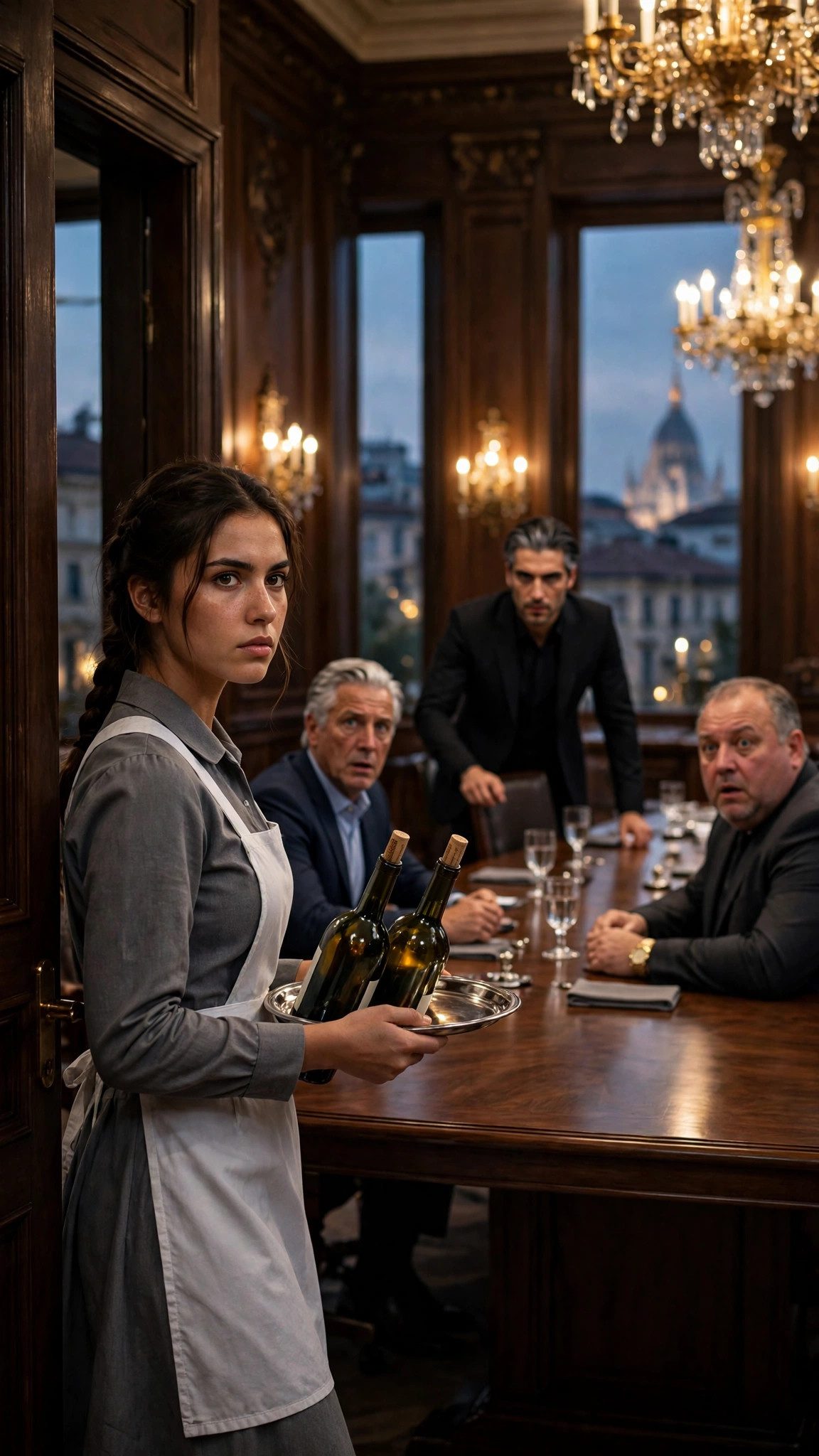
They came for me three nights later, on a Thursday, when the house was quiet and the rain was falling over Milan like a curtain.
I had spent the day translating for Volkov's lawyers, and the evening in the library with Alessandro, going over the final terms of the port venture. The deal was nearly closed. Volkov and Ferrante had agreed on the percentages, the timeline, the cranes. All that remained was the signing, which was scheduled for Monday morning, in the boardroom where it had all begun. Alessandro had told me, as I was leaving the library, that after the signing, he wanted to talk to me about something else. Something important. He had not said what, and I had not asked, but his eyes had been soft in a way I had never seen, and I had gone to bed thinking about it, and about him, and about the strange new life I was living.
I woke at two in the morning to the sound of my door opening.
I had locked it. I was sure I had locked it. But the door opened anyway, slowly, without a sound, and a man stepped into my room, and then another, and I knew, with the cold clarity that comes in moments of terror, that someone had given them a key.
The first man was tall and thin, with a scar across his cheek. The second was shorter, broader, with hands like hammers. Neither of them spoke. The thin one came toward the bed, and I did what Rosa had taught me to do when I was a girl and a man frightened me in the street near the station: I screamed.
I screamed as loudly as I could, and the thin man lunged, and his hand came down over my mouth, and I bit it, hard, and he cursed in a language I recognized instantly. Neapolitan dialect, thick and fast, the dialect of the docks in Naples, the dialect my father had once taught me to recognize because, he said, a man always curses in his mother tongue.
"She bit me," the thin man said, in Neapolitan, shaking his hand. "The little bitch bit me."
"Then gag her," the broad one said, also in Neapolitan. "And hurry. The guard changes at half past two."
They had a cloth. They had rope. They had planned this. But they had made one mistake, the same mistake every man in this story had made: they thought I was only a maid.
I did not fight them with my hands. I fought them with my voice.
I spoke in Russian, loudly, clearly, the words ringing out in the small room: "Pomogite! Menya pokhishchayut! V dome!" Help! I am being kidnapped! In the house!
The thin man froze. He did not speak Russian. He stared at me, and for a moment he did not know what to do, because I was not screaming, I was speaking, and speaking was the last thing he had expected.
Then I switched to Arabic, just as loudly: "Sa'iduni! Ana fi khatar!" Help me! I am in danger!
The broad man grabbed for the cloth, but I twisted away, and I shouted in French: "Au secours! On m'enlève!" And then in German: "Hilfe! Ich werde entführt!" And then in Spanish: "¡Ayuda! ¡Me están secuestrando!"
I was shouting in seven languages, one after another, as loudly as I could, and the men were staring at me as if I had gone mad, and then the door burst open, and Enzo was there, and he was not alone.
Enzo filled the doorway like a wall. Behind him were two more guards, and behind them was Alessandro, in his dressing gown, his hair wild, his eyes blazing, holding a pistol in his hand.
"Get away from her," Alessandro said, in a voice so quiet it was more frightening than a shout.
The thin man moved. He reached inside his jacket, and Enzo moved faster, and there was a sound like a door slamming, and the thin man fell to his knees, clutching his shoulder, and the broad man put his hands in the air, and it was over in less than a minute.
Alessandro crossed the room in three strides. He knelt beside my bed. His hands were on my face, and his eyes were searching mine, and for a moment he was not a Don at all. He was a man who had been terrified.
"Are you hurt?" he asked. "Lucia, are you hurt?"
"No," I said. My voice was shaking. "No, I'm not hurt. They didn't — they were going to take me. They had rope. They had a key. Someone gave them a key."
He stood up. He turned to the two men, who were now on their knees with Enzo's gun at their heads.
"Who sent you?" Alessandro asked.
The thin man said nothing. The broad man said nothing. Alessandro looked at me.
"Lucia," he said. "Ask them. In their language. Ask them who sent them."
I looked at the thin man, and I spoke in the Neapolitan dialect my father had taught me, the dialect of the docks, the dialect of men who curse in their mother tongue.
"Who sent you?" I asked. "Who gave you the key? Tell me, or the Don will ask you himself, and he will not be as gentle as I am."
The thin man stared at me. His face went gray.
"Voss," he whispered. "Dominic Voss. He gave us the key. He said to take the girl to the warehouse. He said the Castellanos would pay us. He said —" He stopped, and he looked at Alessandro, and he began to tremble. "He said she hears too much."
Dominic Voss. The Castellano lieutenant. The same man Enzo the driver had named, three days ago, in the meeting of the capos. The same man who had recruited the driver, and the same man, I now understood, who had recruited Marco Bellini, and who had ordered Paolo's death at the station in Naples.
Alessandro was very quiet. He looked at the two men on their knees, and then he looked at Enzo, and he said, "Take them to the cellar. Do not hurt them. I want them alive. I want them to talk to the police in the morning."
Then he turned to me, and he held out his hand, and I took it, and he helped me to my feet, and he wrapped his dressing gown around my shoulders, because I was shaking, and my nightdress was thin, and the night was cold.
"Come with me," he said. "You will not sleep alone tonight. You will sleep in the room next to mine, with Enzo outside the door, and in the morning, we will finish this."
I went with him. I did not argue. I was too tired, and too frightened, and too grateful to argue.
The next morning, Alessandro called a meeting of the family council. It was the first time I had ever been in the council room, a long dark room with a table that had been in the DeLuca family for a hundred years, and around it sat the capos, the advisers, the men who ran the empire. And Marco Bellini sat among them, pale and silent, his hands folded on the table, and I knew, the moment I saw him, that he had not slept either.
Alessandro stood at the head of the table. He told the council what had happened in the night. He told them about the two men, and the key, and the name Dominic Voss. And then he turned to Marco, and he said, very quietly, "Marco. Stand up."
Marco stood. His legs were shaking.
"Three nights ago," Alessandro said, "you went to the old warehouse by the docks. You met a man from Naples. He told you that Paolo was dead, and that your wife and your son would be next if you talked. And then he told you to take care of the girl, or they would. Is that true?"
Marco closed his eyes. "Yes," he whispered.
"And did you give them the key to her room?"
"No!" Marco said, and his voice broke. "No, Don Alessandro, I swear it. I did not give them the key. I refused. I told them I would not do it. I told them to kill me instead. And then —" He stopped, and tears were running down his face. "And then they told me they would take my son from his school. My son is seven years old. I did not give them the key. But I did not stop them either. I did not warn you. I was afraid. I am sorry. I am so sorry."
The room was silent. The capos watched Alessandro, waiting to see what he would do. In the old days, in his father's day, a man who had betrayed the family like that would not have left the room alive.
Alessandro looked at Marco for a long time. Then he looked at me.
"Lucia," he said. "You are the one they tried to take. What should happen to this man?"
Every eye in the room turned to me. I felt the weight of it, the terrible weight of being asked to decide a man's fate. I thought about Marco's wife, and his seven-year-old son, and the house by the sea in Naples. I thought about my own parents, and the rainy night, and the way the world takes everything. I thought about Rosa, who had told me that the Don was a man who wanted to be good and did not always know how.
"He did not give them the key," I said. "He was afraid, and he did not warn us, and that is a crime. But he did not betray us. He is a man who was given no choice, and he chose the smallest evil he could find. I think —" I paused, and I looked at Marco, and I saw a man, not a traitor. "I think he should live. I think his family should be brought here, where they will be safe. And I think he should work for the rest of his life to earn back what he almost lost."
Alessandro was quiet for a moment. Then he nodded, slowly.
"Then that is what will happen," he said. "Marco Bellini will live. His wife and his son will be brought to Milan tonight, under guard. And Marco will tell the police everything he knows about Dominic Voss, and Vincent Castellano, and the men who killed my brother. And if he lies, even once, he will answer to me."
Marco fell to his knees. He wept. He kissed Alessandro's hand, and then he turned to me, and he kissed my hand, and he said, in Italian, "Thank you. Thank you. You saved my life, and my son's life, and I will never forget it."
I did not know what to say. I had never saved a man's life before. I had saved a deal, and I had saved a Don's empire, but this was different. This was a man, kneeling in front of me, weeping, because I had chosen mercy.
Alessandro helped him to his feet. He dismissed the council. And when the room was empty except for the two of us, he came to me, and he took my hands, and he said, "You did something in there that I have never seen anyone do. You chose mercy, when you had every right to choose revenge. My father would not have done that. My brother would not have done that. I would not have done that, until today."
"Then maybe," I said, "the empire is already changing."
He looked at me for a long moment, and his eyes were soft, and his hands were warm around mine, and I understood, suddenly and completely, what he had wanted to talk to me about the night before, in the library, when he had said there was something important.
But he did not say it then. He let go of my hands, gently, and he said, "Go and rest, Lucia. Tomorrow, we sign the deal. And after that — after that, we will talk."
The morning after the council meeting, I went to find Rosa. She was in the kitchen, kneading dough, flour on her hands and on her apron, and she looked up when I came in, and she said, "You look like a woman who did not sleep."
"I slept," I said. "For the first time in days, I slept."
"Good," she said. "And the man? Marco?"
"He will live," I said. "His wife and his son are coming to Milan tonight. Alessandro has given him a second chance."
Rosa nodded, slowly, and she went back to her dough. "Your mother used to say that mercy is the only revenge that doesn't rot the hand that holds it. She was right. She was right about most things, your mother."
I stayed with her for a while, watching her work, breathing in the smell of bread and yeast, and for a little while the house felt like an ordinary house, and I felt like an ordinary woman, and the men who had come to my room in the night felt very far away.
Later, Enzo found me in the garden. He was carrying a cup of coffee, and he held it out to me, and he said, "The Don told me to tell you that the guards have been doubled, and that no one enters this house without his permission, and that you are to go nowhere without me."
"Thank you, Enzo," I said.
He hesitated, and then he said, "My brother — the Don's brother, the Enzo I was named for — he used to say that the bravest thing a person can do is speak when silence would be safer. I think he would have liked you, signorina. I think he would have said you were the bravest person in this house."
I did not know what to say to that. I thanked him, and I drank the coffee, and I watched the morning light move across the garden, and I thought about a young man I had never met, who had wanted to open a restaurant in Naples, and who had died because of it, and I thought about how strange it was that his name was now guarding me.
I went to my rooms. I locked the door. I lay down on my bed, and I slept, deeply and dreamlessly, for the first time in days, while Enzo stood guard outside my door, and the house settled around me, quiet and safe, and the rain washed the streets of Milan clean.