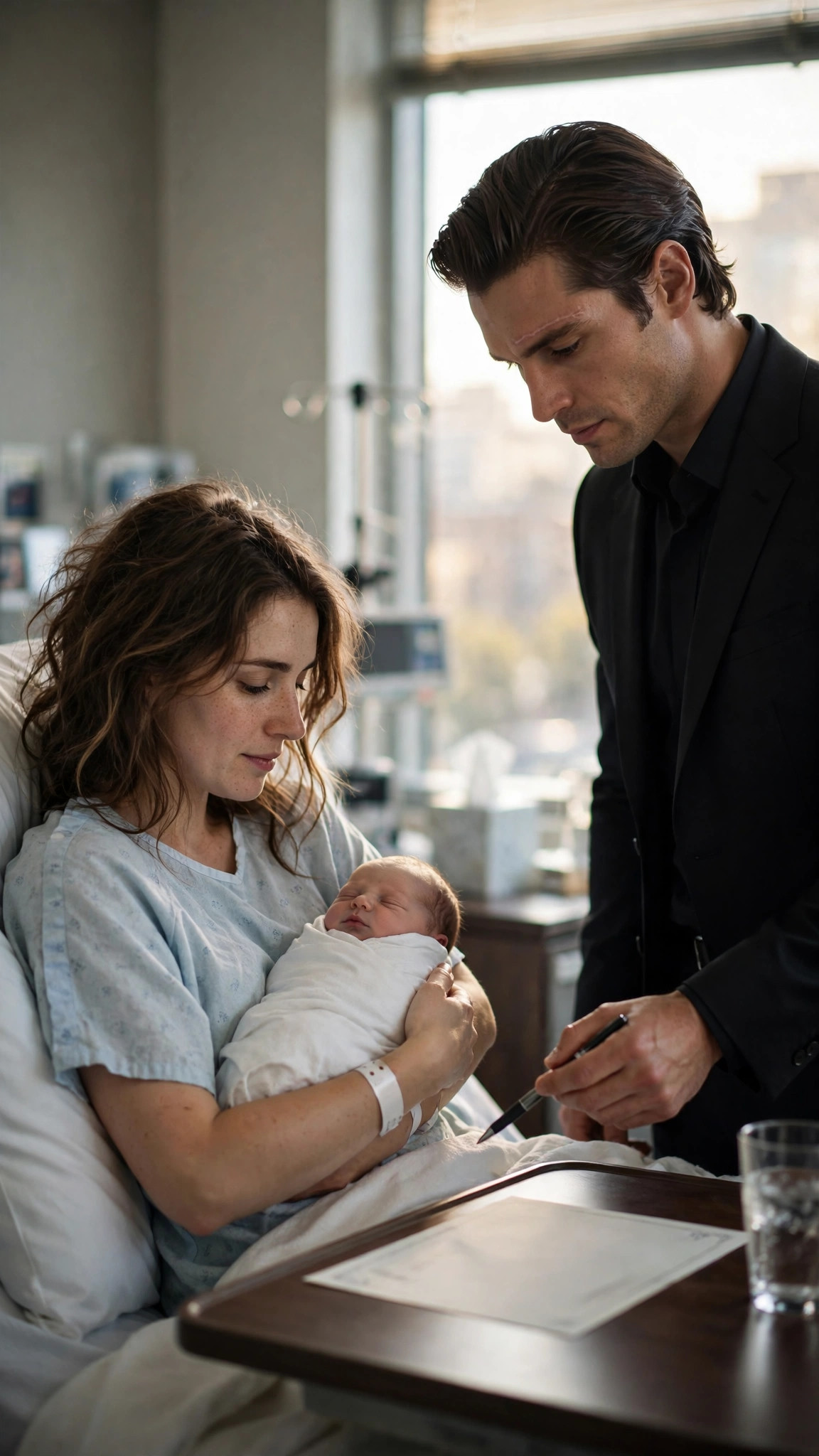
Three days after giving birth, I watched my daughter's father refuse to sign her birth certificate while his girlfriend sat beside him, smiling like none of this was real.
That is the sentence I have replayed in my head a thousand times since, and every time I replay it, I still cannot believe how calm I sounded when I said it out loud for the first time. I was twenty-six years old, three days out from the hardest thing my body had ever done, holding a baby girl who weighed six pounds and four ounces and who had my mother's eyes, and the man I had loved for two years was sitting in the chair beside my hospital bed telling a nurse that my name did not belong on our daughter's birth certificate.
"Cross her name off," Derek said. "Sign it in my name alone."
The nurse looked at me. Her name tag said Doyle, and she had the kind of face that had seen every version of this scene and had learned not to flinch at any of them. But she flinched then. Just a little. Just enough for me to see it.
"Are you sure you want this?" she asked me, and her eyes were full of worry.
"The mother should be the one to sign," Derek said, before I could answer. He said it the way he said everything that month, like a man reading from a script someone else had written for him. "Not him. You should give up that idea quickly."
I didn't know what idea he meant. I didn't know what any of it meant. My daughter was asleep in the clear plastic bassinet beside my bed, her tiny fists curled up near her chin, and I kept thinking that if I could just keep looking at her, none of the rest of it would be able to touch me.
Then a voice from the hallway carried into my room, light and bright and completely wrong for a maternity ward, and Brittany Hale walked in.
Brittany was twenty-four years old, blonde in the expensive way that costs four hundred dollars every six weeks, wearing a cream-colored coat that probably cost more than my rent. She had been Derek's girlfriend for five months. I had found that out the way you always find these things out, by accident, in the worst possible way, and I had spent the last three months of my pregnancy trying to be dignified about it, which mostly meant crying in the shower where no one could hear me.
At first she seemed happy. She smiled at Derek, and then her expression changed to embarrassment when she saw me looking at her, and then she rearranged her face into something sympathetic, which was worse.
"Why are you telling me to leave?" she asked Derek.
"I'm not telling you to leave," Derek said. "I can keep you here, no problem."
"I don't care what you ask me to do," she said, and she looked at me, and her voice went sweet and reasonable, the way people sound when they are about to say something cruel and want it to look kind. "I want you to sign the paper. If your nurse asked you to sign, why wouldn't you sign it? Why are you miserable? It is no reflection on your character."
"I just want to go home," I said. My voice sounded far away, like it belonged to someone in another room.
"Can I sign it?" Derek asked, looking at me, and for one second I almost laughed, because he was asking my permission to erase me.
"Derek, don't argue," I said. "I am recording this conversation."
That was a lie, or mostly a lie. My phone was on the bedside table, face down, and I had not pressed record. But I had thought about it, and in that moment I wished I had, and something in my voice must have made him believe me, because he went quiet for a moment, and his face went red.
"You don't have to work at the student office," he said, and that sentence didn't make any sense at all, and I realized he wasn't even listening to me anymore. He was talking to the nurse now, and to Brittany, and to the room. "I was never paid for this job. You won't regret joining us."
"That makes no sense," he said to the nurse. "She can put his name on the birth certificate. What is the point of this?"
"I know you're here," the nurse said carefully. "But where are you from, Derek Morrison?"
"I know you're here," Derek said. "But your birth certificate isn't a record of anything."
"I will take care of this myself," he said. "I trust the system. It's time we locked in the tunnel."
He frowned. "Are you sure? What should I do?" he asked. It didn't feel like an ordinary question. "All right," I said. "I will take responsibility."
I opened my mouth to give instructions, but my words changed. I heard a deep voice behind me.
"Enough."
Every conversation in the room stopped.
The stranger wore a black suit tailored like armor, with dark hair swept back and a pale scar cutting through one eyebrow. Behind him stood a broad-shouldered man whose jacket did not quite hide the weapon beneath it. Even the nurses avoided meeting his eyes.
He looked at her, nodded calmly at the nurse, and then gestured to the birth certificate on the table. He didn't ask any questions. He didn't even look at Derek. He turned toward me.
"Miss Emma," he said, "do you know the father of your baby?"
The nurse looked alarmed. "You don't mean Derek Morrison," she said.
"No." He picked up the pen and put it on the table. His dark eyes had a low, quiet voice. "No one should have to fight him." He looked at Derek with one eyebrow raised, a single crack in his otherwise calm exterior. He stirred long enough to take in the room around him. He turned back to me.
"Miss Emma, do you know who I am?"
"No, I don't," I said.
And the most feared man in the hospital said, "My name is Luca Moretti. Write it beside hers."
Then he uncapped a pen.
"My name is Luca Moretti," he said quietly. "Write it beside hers."
That was the moment my life split in two. There was the life before, and there was the life after, and the line between them was a pen on a hospital table and a stranger in a black suit who had just claimed my daughter as his own.
But to understand how I got to that hospital room, you have to go back to the beginning. You have to go back to the girl I was before any of this happened, the girl who thought she knew what love looked like, and what a family was supposed to be.
I was born Emma Reed, and I lost my mother when I was twelve years old. Her name was Grace, and she was the kindest person I have ever known, and the cancer took her in eleven months, which felt both impossibly fast and unbearably slow. My father raised me after that, on his own, driving a car for a private company in the city, coming home late with tired eyes and clean hands, telling me stories about the streets of Manhattan like they were fairy tales. He never talked about his work. He just drove, and he came home, and he made me pancakes on Sunday mornings in the shape of whatever animal I asked for, and he told me that as long as we had each other, we had everything.
He died when I was twenty. A car accident, they told me. A wrong place, wrong time. I was a sophomore in college, and I got the phone call in the middle of a lecture on color theory, and after that there was no one left. No aunts, no uncles, no grandparents. Just me, and a small apartment in Queens, and a scholarship I didn't understand and had never applied for that paid my tuition anyway, and my best friend Lily, who had been my roommate since freshman year and who refused to let me grieve alone.
Lily Chen is the reason I am alive, in every way that matters. She held my hair back when I threw up from grief. She sat with me in the hospital when my father died. She became a pediatric nurse because she wanted to be the person in the room who knew what to do when everything was falling apart. She is the person who told me, three days after I gave birth, to go to the hospital office and get my daughter's birth certificate moving right now, before Derek could do whatever it was he was planning to do.
"Emma, go to the hospital and get the child's birth certificate now," she said. "You must get this case moving now. Don't wait. Don't let him get ahead of you."
I didn't understand what she meant, not really. I thought she was just being Lily, practical and fierce and three steps ahead of everyone. I didn't know that Derek had already been to the records office twice. I didn't know that Brittany's father had already made phone calls. I didn't know that the man who would walk into my hospital room had been watching over me for six years without my knowing it.
I met Derek Morrison two years before that hospital room, at a gallery opening in Chelsea where I was showing three of my illustrations. I was twenty-four, fresh out of college, working freelance as a children's book illustrator, which is a beautiful way to say I was broke and happy and drawing rabbits in waistcoats for a living. Derek was twenty-seven, handsome in a clean, expensive way, a junior partner at a finance firm called Meridian Capital, and he bought one of my prints. He told me it reminded him of his childhood. He asked me to dinner. He was charming and funny and he listened when I talked, which was more than most men did, and for a while I thought I had finally found the thing my parents had always told me to look for: a person who made the world feel less lonely.
For the first year, it was good. He took me to restaurants I couldn't afford. He bought me a winter coat when mine fell apart. He met Lily and made her laugh, which is not easy, and Lily told me he was a keeper, which is the highest praise Lily has ever given any man. We moved in together after fourteen months, into a one-bedroom in Astoria with a view of a brick wall and a radiator that sang at night. I painted a mural on the kitchen wall, a garden full of impossible flowers, and Derek said it was the best thing in the apartment.
Then, slowly, the way these things always happen, he started to change. He stayed late at the office more often. He took calls in the other room. He stopped asking about my work. He forgot my birthday, and then he forgot our anniversary, and then one night I found a receipt in his coat pocket for a dinner for two at a restaurant I had never been to, on a night he had told me he was working late, and I knew.
I didn't confront him right away. I did what women do when they are afraid of what they already know: I watched, and I waited, and I gathered small, terrible pieces of evidence like a magpie. A text message that lit up his phone at midnight. A blonde hair on his jacket that was not mine. A hotel key card in his wallet, from a hotel in Midtown, dated the weekend he had told me he was visiting his mother in Connecticut.
Her name was Brittany Hale. I found her the way you find anyone now, by accident and then by obsession, scrolling through photographs until my hands shook. She was twenty-four. She was beautiful in the way that money makes people beautiful. Her father owned a property development company called Hale Development, and Derek had started doing business with him, and somewhere between the boardrooms and the dinners, he had decided that she was the future and I was the past.
I found out I was pregnant two weeks after I found out about Brittany.
I remember standing in the bathroom of our apartment, holding the test, staring at the two pink lines, and thinking two things at the same time: I am going to be a mother, and I am completely alone. Derek was in the other room, on the phone with someone, laughing, and I stood there with the test in my hand and I thought about my mother, and about the name Grace, and about the fact that I had no one to call except Lily, who was on shift at the hospital and couldn't answer anyway.
I told Derek that night. I sat him down at the kitchen table, under the mural I had painted, and I told him I was pregnant, and I watched his face change. Not with joy. Not with anger. With calculation. Like a man doing arithmetic in his head and not liking the sum.
"We need to talk about this," he said. "We need to finally talk about this. I'm getting a paternity test done."
"A paternity test," I said. "You want a paternity test."
"I just want to be sure," he said. "It's not personal, Emma. It's practical."
It was the most personal thing anyone had ever said to me.
That was the beginning of the end, though I didn't know it yet. Over the next seven months, Derek drifted further and further away, until he was barely living in our apartment at all. He moved his things out a suitcase at a time, so slowly that I could pretend it wasn't happening. He stopped coming to my appointments. He didn't come to the ultrasound where we found out it was a girl. He didn't ask what I was going to name her.
I named her Grace, after my mother. I decided that in the delivery room, in the middle of the worst pain of my life, when the nurse asked me if I had a name, and I said Grace, and it felt like my mother was in the room with me, holding my hand, telling me I could do this.
And then, three days later, Derek walked into my hospital room with Brittany Hale beside him, and he tried to take my name off my daughter's birth certificate, and a stranger in a black suit walked in behind them and said, "Enough."
That is where this story really begins.