The first thing you need to understand about me is that I was raised by a man who believed that a promise was a kind of furniture. You built your life around it. You didn't move it when it got inconvenient. You didn't throw it out when it got old. My father, Thomas Reed, made exactly one great promise in his life that I knew about, and it was to my mother, on the day I was born, that he would keep us safe no matter what it cost him.
He kept that promise for twenty years, and then he died keeping it, and I didn't find out until six years after his funeral that it had cost him everything.
But before that, before any of this, there was just the two of us in a small apartment in Queens, and Sunday pancakes shaped like elephants, and a father who drove a car for a living and never once complained about the hours.
My mother died when I was twelve. Grace Reed had been a librarian at the public library on 82nd Street, and she had a laugh that made strangers turn around on the subway, and she read to me every night until the cancer made it hard for her to sit up. In the last month, she couldn't read anymore, so I read to her. I read her the same book she had read to me when I was small, about a rabbit who lived in a garden and was brave when it mattered, and she would squeeze my hand at the brave parts.
After she died, my father and I learned how to be a family of two. He taught me how to make his terrible coffee. I taught him how to braid my hair, badly. We went to the library on Saturdays and he let me check out as many books as I could carry, and on the walk home he would ask me what I had learned, and I would tell him, and he would listen like it was the most important thing anyone had ever said.
He worked for a private car company. That was what he told me, and that was what I believed for my entire childhood. He drove important people around the city, he said. Businessmen. He wore a dark suit and polished his shoes every night and kept a small notebook in his breast pocket where he wrote down addresses and times in a neat, careful hand. He came home late sometimes, and when he did, he would sit at the kitchen table with a glass of water and stare out the window for a while before he came to kiss me goodnight.
I never asked him who he drove. It never occurred to me to ask. He was my father. He drove a car. That was the whole story, as far as I knew.
When I was sixteen, he gave me a sketchbook for my birthday, a real one, with thick paper that didn't bleed when you used ink, and he said, "Your mother would have wanted you to have this. She always said you saw the world differently than other people." I carried that sketchbook everywhere. I drew the people on the subway. I drew the pigeons on the fire escape. I drew my father asleep in his chair with his shoes still on, and when he woke up and saw it, he laughed until his eyes watered, and then he put the drawing on the refrigerator with a magnet shaped like a ladybug.
I went to college on a scholarship I had never applied for. That should have been strange to me, and on some level it was, but I was eighteen and grieving and grateful, and when the letter came saying my tuition was covered in full for four years by something called the Reed Family Educational Trust, I didn't ask questions. I just cried, and then I went. My father walked me to the subway on my first day with my suitcase, and he hugged me so hard I thought my ribs would crack, and he said, "Your mother would be so proud of you, Emma. So proud."
That was the last normal thing that ever happened to me.
Lily Chen was my roommate in freshman year, assigned by lottery, and she is the single best thing that ever happened to me by accident. Lily is five foot two, loud, funny, terrifyingly organized, and the most loyal person I have ever met. She grew up in Flushing with three younger brothers and a mother who ran a dumpling restaurant, and she had decided by the age of ten that she was going to be a nurse, and nothing in the world was going to stop her.
We survived college together. We survived my father's death together, though survived is the wrong word. When my father died, I was twenty years old, sitting in a lecture hall learning about color theory, and my phone buzzed, and it was a police officer, and after that the world went very quiet for a very long time.
They told me it was a car accident. A wrong place, wrong time. A man in the wrong lane on the West Side Highway. My father had been driving home late from work, and another car had crossed the median, and he had died instantly, they said, which was supposed to be a comfort and wasn't.
Lily held me through all of it. She came to the funeral. She helped me clean out the apartment. She sat with me on the floor of my empty childhood bedroom while I packed my father's things into boxes, his polished shoes, his dark suits, his small notebook full of addresses in his neat handwriting, and she didn't say anything stupid like "he's in a better place." She just sat there, and when I cried, she handed me tissues, and when I stopped crying, she made tea.
After college, I became a freelance illustrator. I drew children's books, mostly, rabbits and foxes and brave little girls who lived in gardens. It didn't pay much, but it paid enough, and I loved it, and Lily became a pediatric nurse at St. Catherine's Hospital, which is where she still works, and where my daughter was born, and where everything in this story happened.
For four years after my father died, my life was small and quiet and mine. I had my apartment, my drawing table, my best friend, and a grief that had settled into something I could carry. I dated a few men, nothing serious. I told myself I was fine. I believed it, mostly.
Then I met Derek Morrison at a gallery opening in Chelsea, and for a while I thought the loneliness was over.
Derek was twenty-seven, tall, clean-shaven, with the kind of smile that made you feel like you were the only person in the room. He worked in finance, at a firm called Meridian Capital, and he talked about markets the way other men talked about sports, with an easy confidence that I mistook for strength. He bought one of my prints that night, a watercolor of a fox in a waistcoat, and he told me it reminded him of a story his grandmother used to tell him, and I thought, this is a man who understands stories.
He asked me to dinner the following week. He took me to a small Italian place in the West Village, and he asked me about my work, and he actually listened. He asked about my parents, and I told him they were both gone, and he reached across the table and took my hand, and he said, "Then I'll just have to take extra good care of you." I believed him. God help me, I believed him.
For the first year, it was good. Really good. He was attentive and generous and funny. He remembered the names of my clients. He framed the first illustration I ever sold and hung it in his apartment. He met Lily and made her laugh within five minutes, and Lily, who trusts no one, told me later that he was "all right, for a finance guy," which from Lily is practically a marriage proposal.
We moved in together after fourteen months. A one-bedroom in Astoria, with a view of a brick wall and a radiator that sang at night. I painted a mural on the kitchen wall, a garden full of impossible flowers, blue roses and golden sunflowers and a rabbit in a waistcoat sitting under a tree, and Derek stood back and looked at it for a long time and said, "That's the best thing in this apartment."
I believed him. I believed all of it.
The change came slowly, the way a tide goes out. You don't notice it happening until you're standing on dry sand wondering where the water went. Derek started staying late at the office. He started taking calls in the other room, with the door closed. He stopped asking about my work. He forgot my birthday in March, and when I reminded him, he laughed and said he'd make it up to me, and he never did. He forgot our anniversary in June. He started going to the gym at odd hours. He started dressing differently, better suits, sharper shoes, a watch I had never seen before that cost more than my monthly rent.
I found the first piece of evidence in his coat pocket, the way women always do. A receipt from a restaurant in Midtown, dinner for two, two glasses of wine, a dessert to share, dated a Tuesday night when Derek had told me he was working late on a merger. I stood in our hallway holding that receipt for a long time, and I thought about confronting him, and then I put it back in his pocket and I said nothing, because I was afraid of what I already knew.
After that, I saw everything. The text messages that lit up his phone at midnight, the name on the screen always just a first name, always deleted before morning. The blonde hair on the shoulder of his dark suit, long and fine, nothing like my brown hair. The hotel key card in his wallet from a hotel on 57th Street, dated the weekend he had told me he was visiting his mother in Connecticut. His mother lives in Ohio. She has never lived in Connecticut.
Her name was Brittany Hale. I found her photograph online, the way you do, scrolling until your hands shake and your stomach turns inside out. She was twenty-four years old, blonde, beautiful in the way that money makes people beautiful, with a smile that had never once had to apologize for anything. Her father was Richard Hale, and he owned a property development company called Hale Development, and Derek had started doing business with him six months earlier, and somewhere between the boardrooms and the dinners and the hotel rooms, Derek had decided that Brittany was his future and I was his past.
I found out I was pregnant two weeks after I found out about Brittany.
I remember standing in the bathroom, holding the test, staring at two pink lines, and thinking two things at exactly the same time: I am going to be a mother, and I am completely alone. Derek was in the other room, on the phone with someone, laughing at something she had said, and I stood there with the test in my hand and I thought about my mother, and about the name Grace, and about the fact that the only person in the world I could call was Lily, who was on shift at the hospital and couldn't pick up.
I told Derek that night. I sat him down at the kitchen table, under the mural I had painted, with the test on the table between us, and I told him I was pregnant, and I watched his face change. Not with joy. Not with anger. With calculation. Like a man doing arithmetic in his head and not liking the sum.
"We need to talk about this," he said. "We need to finally talk about this. I'm getting a paternity test done."
"A paternity test," I said. My voice sounded very calm. "You want a paternity test."
"I just want to be sure," he said. "It's not personal, Emma. It's practical."
It was the most personal thing anyone had ever said to me.
That night, I called Lily. She came over after her shift, still in her scrubs, and she sat on my couch and listened to all of it, the receipt and the hotel key and Brittany and the pregnancy and the paternity test, and then she said, "Emma, listen to me. You are not alone. You have me. And whatever that man does, you and this baby are going to be fine, because I am not going anywhere."
She was right. She stayed. Through the whole pregnancy, she stayed. She came to every appointment Derek didn't come to, which was all of them. She held my hand at the ultrasound where we found out it was a girl. She helped me set up the nursery in the corner of my bedroom, a secondhand crib and a mobile of paper stars I had made myself. She told me, over and over, that I was going to be a good mother, and that Grace was lucky to have me, and that Derek Morrison was a fool who didn't deserve either of us.
I named her Grace, after my mother. I decided that on the night I found out she was a girl, sitting on my fire escape with Lily, watching the city lights. "Grace," I said. "After my mom." And Lily put her arm around me and said, "She would have loved that."
Derek moved out slowly, a suitcase at a time, so slowly I could pretend it wasn't happening. He stopped sleeping at the apartment. He stopped answering my calls. By my eighth month, he was living with Brittany in her father's building on the Upper East Side, and I was alone in Astoria with a nursery in the corner of my bedroom and a baby who kicked every time I played music.
I went into labor on a Tuesday morning, three weeks early, and Lily drove me to St. Catherine's, and fourteen hours later, Grace was born, six pounds and four ounces, with my mother's eyes and a cry that sounded like a small, furious bell. Lily cut the cord. She put Grace on my chest, and I looked down at her, and I thought: I did it. I made a person. She is mine. Nobody can take her from me.
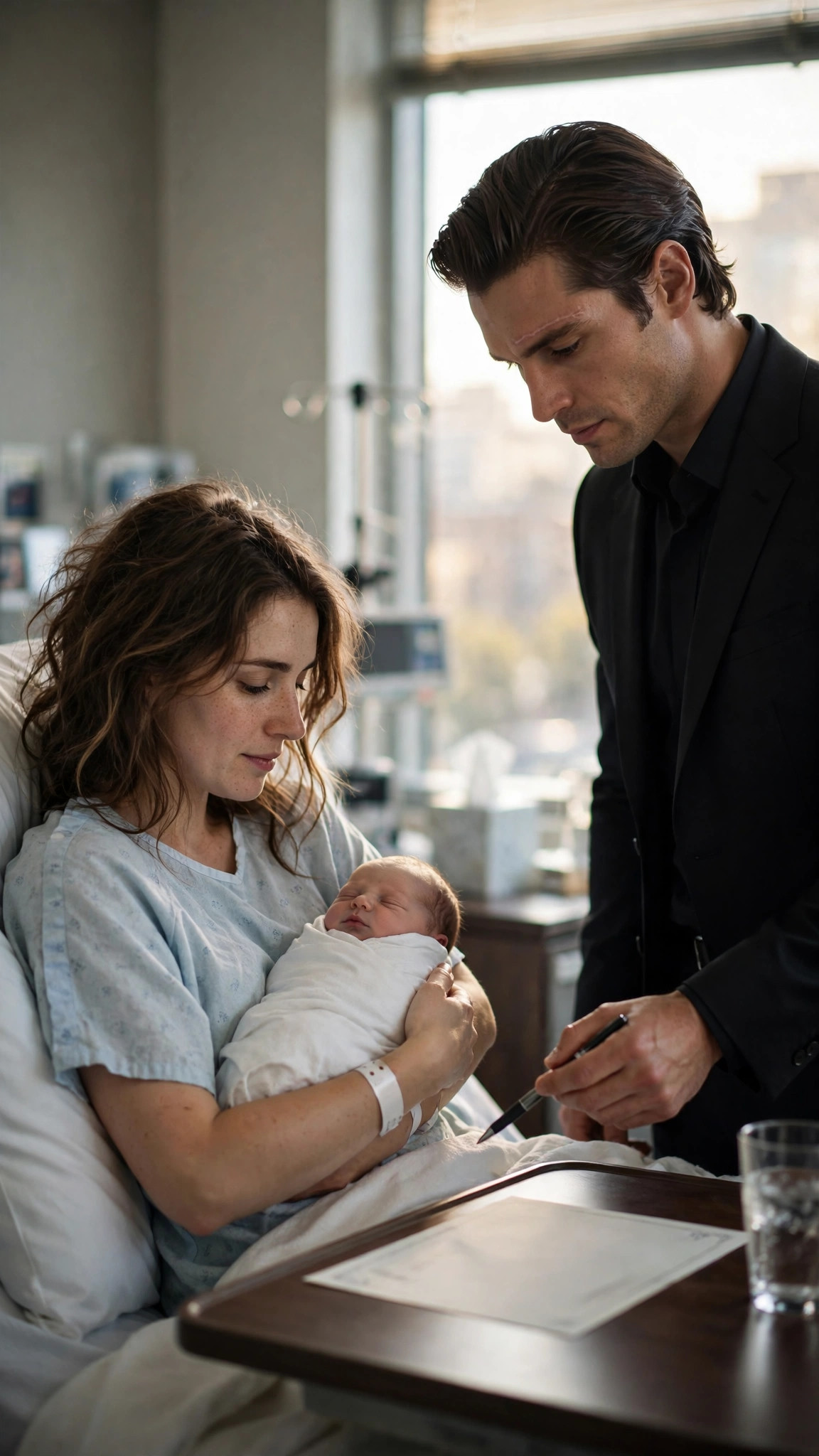
Three days later, Derek walked into my hospital room and tried to prove me wrong.