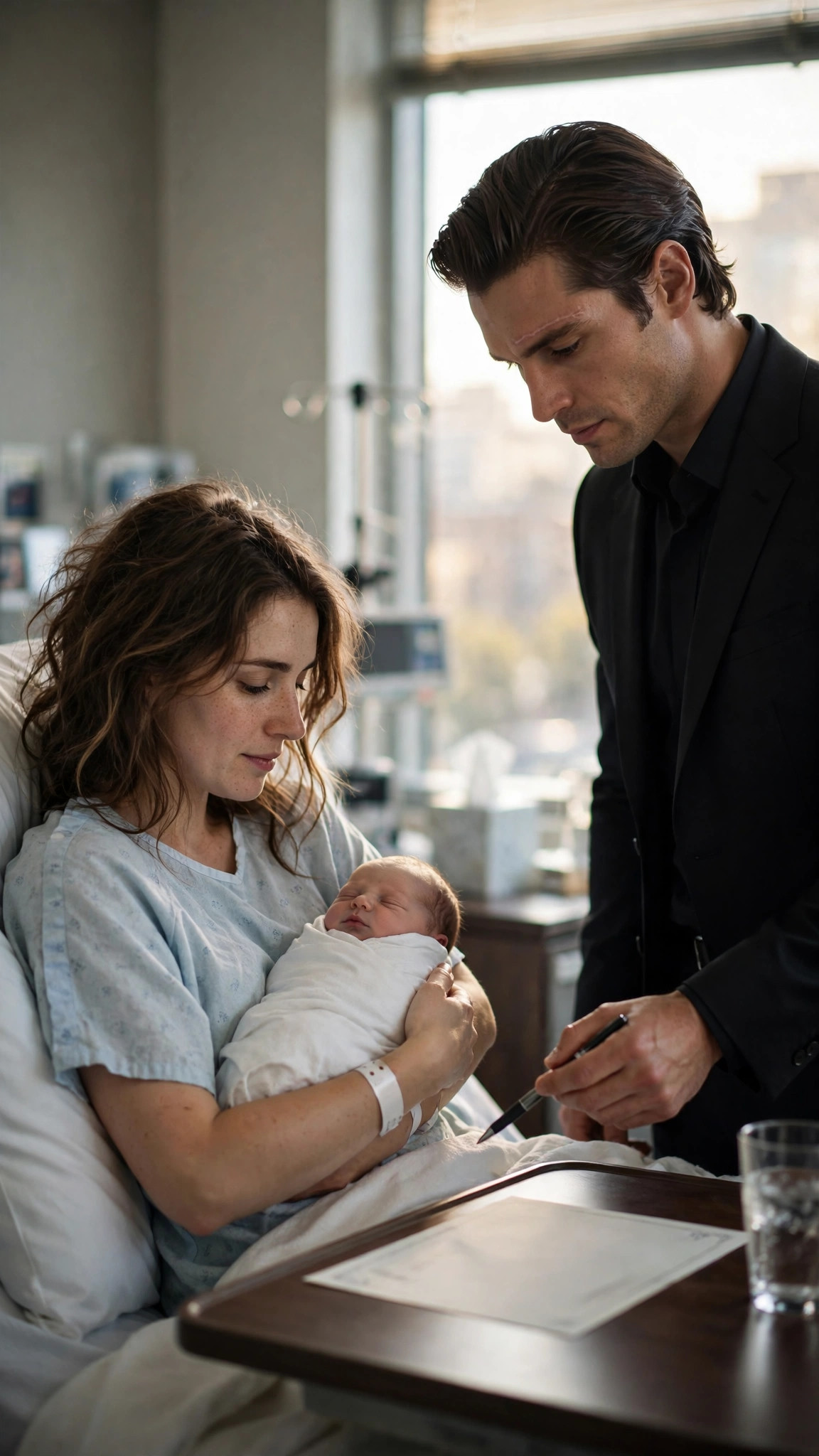
I went home from the hospital five days after Grace was born, and home was not home anymore.
The apartment in Astoria was the same as I had left it. The mural was still on the kitchen wall, the garden full of impossible flowers. The crib was still in the corner of my bedroom. My sketchbooks were still on the table. But Derek's things were gone, all of them, down to the last sock, and the silence in the apartment was different now. It wasn't the silence of a home. It was the silence of a place someone had left.
Lily came with me. She had taken a week off work, which she couldn't afford, and she slept on my couch, and she made soup, and she changed diapers with the grim efficiency of a woman who had changed a thousand diapers in her life and was not impressed by any of them. Grace cried at night, and Lily got up with her, and I got up with her, and between the two of us we kept her fed and warm and clean, and I thought, this is what a family is. Not the man who left. The friend who stayed.
On the third night home, someone knocked on my door at nine o'clock. It wasn't a knock, really. It was three soft taps, polite and patient, the kind of knock that doesn't need to be loud because the person on the other side knows you will answer.
It was Luca Moretti. He was alone this time, without the broad-shouldered man, and he was holding a paper bag from a bakery on the corner, and he looked, for the first time since I had met him, almost nervous.
"Miss Emma," he said. "May I come in? I brought bread. I didn't know what else to bring. People bring bread when they visit a new mother, I think. My mother used to say that."
I let him in. I don't know why. Maybe because he had stood between me and Derek in that hospital room. Maybe because he had known my father. Maybe because I was twenty-six years old and alone with a newborn baby and the most feared man in the city had brought me bread.
He sat at my kitchen table, under the mural I had painted, and he put the bread down, and he looked at Grace asleep in her crib, and then he looked at me, and he said, "I owe you the truth about your father. All of it. You deserve to hear it from me, not from a lawyer or a policeman or a newspaper."
And then he told me.
My father, Thomas Reed, had not driven a car for a private company. He had driven for the Moretti family for eleven years. He had been Luca Moretti's driver, his most trusted man, the one who knew every address, every route, every safe house in the city, and who had never once spoken a word about any of it to anyone, including his own daughter.
Six years ago, on a rainy night in March, Luca had been leaving a restaurant on Mulberry Street after a meeting with the Castellano family, a meeting that had not gone well. As Luca walked to the car, a man stepped out of the shadows with a gun. My father saw him first. He didn't hesitate. He stepped between Luca and the gun, and he took the bullet that was meant for Luca Moretti, in the chest, and he died on the sidewalk while Luca held him and called for an ambulance that came too late.
"His last words," Luca said, and his voice, which had been so steady, broke for the first time, "were about you. He said, 'Take care of my Emma.' He said it twice. And then he was gone."
I sat at my kitchen table and I cried. I cried for my father, who had lived a secret life I had never known. I cried for my mother, who had died never knowing what her husband really did. I cried for the six years I had spent believing a lie about a car accident, and for the scholarship that had paid my tuition, and for the man sitting across from me who had carried my father's dying words for six years and had never once tried to find me until the day I needed him.
"The scholarship," I said, when I could speak. "The Reed Family Educational Trust. That was you."
"It was your father's money," Luca said. "He saved every dollar he ever earned working for me, and he left it in a trust for your education, with instructions that you were never to know where it came from. I only administered it. It was his gift to you, not mine."
"And the car accident," I said. "The police. The wrong lane on the West Side Highway."
"We made it look like an accident," Luca said, and he didn't flinch from it. "To protect you. If the Castellanos had known that Thomas Reed died saving me, they would have come for his family to finish what they started. So we buried him as a victim of a traffic accident, and I paid for the funeral, and I went to his grave every year on the anniversary, on March fourteenth, and I told him I was keeping my promise."
"March fourteenth," I whispered. That was the day my father had died. I had always gone to the cemetery alone on that day, with flowers, and I had always wondered why there were fresh flowers on his grave before I got there.
"Those were mine," Luca said.
I looked at him, this man in a black suit sitting at my kitchen table eating bread with my newborn baby asleep in the next room, and I didn't know what to feel. Grief. Gratitude. Anger. All of it at once, tangled together like yarn.
"Why didn't you come sooner?" I asked. "Why did you wait six years?"
"Because your father asked me not to," he said. "He told me, years before he died, that if anything ever happened to him, I was to watch over you from a distance, and never let you know about his life, unless you were ever in danger. He wanted you to have a normal life, Emma. A life without my world in it. I honored that. I paid your tuition. I made sure your building was safe. I made sure no one ever bothered you. And I stayed away."
"And now?" I asked.
"Now you are in danger," he said. "Derek Morrison is not acting alone. Brittany Hale's father, Richard Hale, owes the Castellano family more money than he can ever repay. Vincent Castellano is using that debt. He told Hale that if his daughter can get Derek to erase you and take control of that baby, Castellano will forgive the debt and give Derek a partnership in Hale Development. Derek is a pawn, Emma. He doesn't even know who is moving him."
"And Grace?" I asked. "What does Castellano want with a baby?"
"Leverage," Luca said. "My name is on her birth certificate now. That makes her mine, in the eyes of the world. Castellano knows that. If he can take her, or threaten her, he can make me do anything. He tried to kill me six years ago and your father stopped him. He has been waiting six years to finish the job, and now he has found a way to reach me through you."
I looked at Grace, asleep in her crib, her tiny fists curled near her chin, and I felt something cold settle in my stomach.
"What do I do?" I asked.
"You come with me," Luca said. "Not forever. Just until this is over. I have a house on the Upper East Side, with a garden, and a nursery I had prepared the day after I met you, because I knew this moment would come. There are gates, and guards, and no one gets in without my permission. Lily can come too. Your friend is welcome in my house. And when Castellano is finished, when Derek is finished, when all of it is finished, you can go wherever you want, and I will never bother you again. That is my promise. The same promise I made your father."
I should have said no. A sensible woman would have said no. A sensible woman would have called the police, or a lawyer, or anyone, and told the mafia king to leave her alone.
But I wasn't a sensible woman. I was a twenty-six-year-old orphan with a five-day-old baby and a man who wanted to erase her, and a man in a black suit was offering me a house with a garden and a nursery and a gate that no one could get through.
"On one condition," I said. "I don't owe you anything. Not now, not ever. I won't be grateful in the way you want me to be grateful. I won't marry you. I won't be yours. I am Emma Reed, and Grace is my daughter, and you are her protector, not her owner. Do you understand?"
Luca Moretti looked at me for a long moment, and then he did something I had never seen him do. He smiled. Not the cold smile from the hospital. A real smile, small and surprised, like a man who had just been told something he hadn't expected to hear.
"I understand," he said. "Your father would have liked that answer."
We moved the next morning. Lily helped me pack, and she didn't ask me if I was sure, because Lily knows me, and she knows that when I make up my mind, it stays made. She packed Grace's crib and the mobile of paper stars and the sketchbooks, and she said, "If this man hurts you, Emma, I will kill him myself, and I don't care who he is."
The house on the Upper East Side was not a house. It was a townhouse, five stories, with a garden in the back that had a lemon tree in it, which I didn't know could grow in New York, and a nursery on the third floor painted pale yellow, with a white crib and a rocking chair and a window that looked out over the garden. Someone had filled the shelves with children's books. Someone had put a stuffed rabbit on the pillow.
"Who did this?" I asked.
"I did," Luca said, and he looked embarrassed. "I went to a store. I asked a woman there what a baby needs. She gave me a list. I bought everything on it."
I laughed. I hadn't laughed in weeks, and it came out of me all at once, loud and surprised, and Grace woke up and started crying, and Lily took her, and Luca stood there holding a paper bag of bread, looking at me like I had just done something extraordinary.
On our second evening in the house, Luca knocked on the nursery door and asked if he could come in. Grace was asleep in her crib, and I was sitting in the rocking chair with a sketchbook on my lap, drawing her the way she slept, her fists curled near her chin. He stood in the doorway for a moment, watching us, and then he came in and sat on the floor, which surprised me, because men in suits tailored like armor do not usually sit on nursery floors.
"I brought you something," he said, and he took a small wooden box out of his jacket pocket and set it on the rug between us. "It belonged to your father. I have kept it for six years, and I should have given it to you the day I met you. I didn't know how."
I opened the box. Inside, on a bed of dark velvet, was my father's watch, a simple steel watch with a scratched face and a leather strap worn soft from years of wear. I knew it at once. I had seen it on his wrist every day of my childhood. He had checked it at the kitchen table every morning before he left for work, the way other men check the weather.
And underneath the watch was his notebook. The small notebook he had always carried in his breast pocket, full of addresses and times in his neat, careful handwriting. I had packed it away after the funeral, in a box in my closet, and I had never been able to bring myself to open it. This was a different notebook. A second one. One I had never seen.
"Open it," Luca said quietly.
I opened it, and the first page was not an address. It was a letter, in my father's handwriting, dated two weeks before he died.
"My dearest Emma," it began, and I had to stop reading, because my hands were shaking too hard to hold the page still.
Luca waited. He didn't say anything. He just sat on the floor of the nursery and waited while I cried, and when I could read again, I read the whole letter, and it said what I had always needed to hear. That he loved me. That he was proud of me. That he had made choices in his life he was not proud of, but that loving me and my mother was not one of them. That if anything ever happened to him, a man named Luca Moretti would come, and I was to trust him, because he was the only man my father had ever trusted with his life.
"He wrote that two weeks before he died," I said. "He knew. He knew something was going to happen."
"He knew the Castellanos were coming," Luca said. "He had heard things. He wrote that letter and gave it to me, and he told me to give it to you if the day ever came. I have carried it in my desk for six years, waiting."
I closed the notebook and held it against my chest, and I looked at this man sitting on my nursery floor, and I thought about my father writing that letter at his kitchen table, late at night, knowing he might not come home, and writing to me anyway, because that was what fathers do.
"Thank you," I said. "For keeping it. For keeping him."
"I didn't keep him," Luca said. "He kept me. Every day since that night on Mulberry Street, I have lived a life your father bought for me. Everything I have, everything I am, I owe to him. The least I can do is keep his daughter safe."
He stood up then, and he straightened his jacket, and he looked down at Grace asleep in her crib, and he said, very quietly, "Goodnight, Emma. Goodnight, Grace." And then he left, and I sat in the rocking chair with my father's watch in one hand and his letter in the other, and I cried until Lily came in and sat on the floor beside me and held my hand, and neither of us said anything at all, because there was nothing left to say.
That night, after Grace was asleep and Lily was asleep on the couch in the room next to mine, I sat in the nursery in the rocking chair, and I looked out at the garden, and I thought about my father. I thought about him driving through the city at night, keeping his secrets, saving his money, loving me from a distance even in death. I thought about the notebook full of addresses in his neat handwriting. I thought about the flowers on his grave every March fourteenth.
And I thought about Luca Moretti, who had carried my father's dying words for six years, and who had put his name on my daughter's birth certificate, and who had bought a stuffed rabbit for a baby he had just met.
I didn't trust him. Not yet. But for the first time since my father died, I didn't feel alone. And that, I was beginning to understand, was the most dangerous feeling in the world.