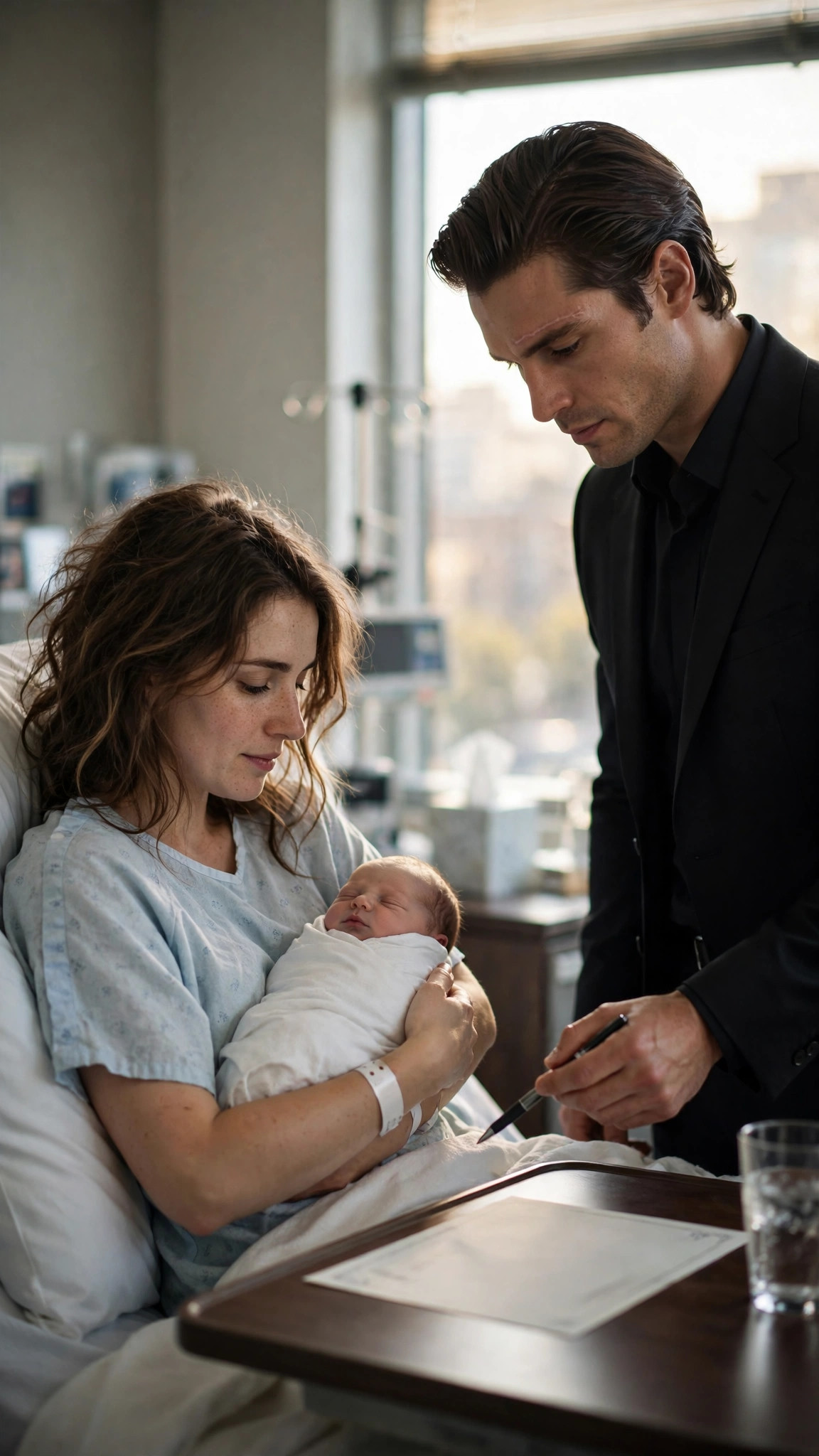
The letter came on a Tuesday, delivered by a courier in a gray uniform, in an envelope so thick it felt like a book. It was addressed to me, at Luca's house, which meant Derek knew where I was, and that frightened me more than the letter itself.
Inside was a petition, filed in family court, in which Derek Morrison claimed to be the biological father of Grace Reed Morrison, and asked the court to order a paternity test, to remove Luca Moretti's name from her birth certificate, and to grant Derek sole custody on the grounds that I was, in his words, "an unfit mother living under the influence of a known organized crime figure."
I read it twice, sitting at the kitchen table, while Grace slept in her bassinet beside me and Lily stood behind my chair reading over my shoulder, and when I finished, I put it down very carefully, the way you put down something that might explode.
"He called her Grace Reed Morrison," I said. "He gave her his last name. Like she was already his."
"He's trying to scare you," Lily said. "That's all this is. Paper and lawyers and big words. He doesn't want Grace. He wants to win."
But it didn't feel like paper. It felt like a hand reaching into my house and trying to pull my daughter out of her crib.
Luca came home that evening and found me sitting at the table with the petition in front of me, and he read it standing up, his face very still, and when he finished, he put it down and said, "We will fight this. And we will win. But I need you to understand something first, Emma. The paternity test will come back positive. Derek is her biological father. No test in the world will change that. So we cannot win by denying biology. We have to win by telling the truth."
"The truth," I said. "The truth is that he tried to erase me from my own daughter's birth certificate. The truth is that he didn't come to a single appointment. The truth is that he moved in with Brittany Hale while I was pregnant and he never once asked how I was."
"Then that is what we will show the court," Luca said. "All of it. The recording. The nurses. The records office. Lily's testimony. Everything."
"The recording," I said. "I lied about the recording. My phone was face down. I never pressed record."
"I know," Luca said. "But the hospital did."
I stared at him. "What?"
"St. Catherine's records everything in the maternity ward," he said. "Audio, in the hallways and the rooms, for safety. It is hospital policy. The recording of that morning exists, Emma. Derek's voice, Brittany's voice, all of it, on tape. My lawyer already has a copy. He got it through a court order yesterday morning, before Derek's petition was even filed."
I didn't know whether to laugh or cry. The lie I had told in that hospital room had turned out to be true after all, in a way I had never expected.
My lawyer was a woman named Priya Nair, from a legal aid clinic in Queens, and she was twenty-nine years old and fierce in a way that reminded me of Lily. She came to the house the next day, and she sat with me for three hours, and she asked me everything: about Derek, about Brittany, about the pregnancy, about the hospital, about Luca, about my father. She took notes in a small notebook, in handwriting almost as neat as my father's, and when she finished, she said, "Emma, I want to be honest with you. Biology matters in family court. A lot. Derek being the biological father gives him a claim. But a claim is not custody. Custody is about what is best for the child. And what is best for a three-week-old baby is her mother, in a safe home, with people who love her. Not a man who tried to erase her mother from her birth certificate."
"Will the judge see it that way?" I asked.
"The judge will see the recording," Priya said. "And the recording is devastating."
The paternity test was done the following week, at a laboratory downtown, with a court-appointed technician and lawyers from both sides watching. Derek came with Brittany, and he looked at Grace the way you look at a piece of evidence, and I held her against my chest and I didn't let go of her for a second.
The result came back seven days later. Positive. Derek Morrison was the biological father of Grace Reed Moretti, with a probability of 99.99 percent.
Derek called me the night the result came back. I almost didn't answer, but Lily said, "Answer it. Let him hear your voice. Let him know you're not afraid." So I answered.
"Did you see the result?" he asked, and he sounded almost happy. "She's mine, Emma. The test proves it. The court is going to give her to me. You should start preparing yourself for that."
"She's not yours, Derek," I said. "She's mine. She was mine when you were in a hotel room with Brittany, and she was mine when you didn't come to a single appointment, and she's mine now. A test doesn't make you a father. Showing up makes you a father. And you never showed up."
"I showed up at the hospital," he said.
"You showed up to erase me," I said, and I hung up.
The hearing was set for a Thursday morning, in a courtroom on the tenth floor of the family court building, with fluorescent lights and wooden benches and a judge named the Honorable Maria Santos, who had been on the bench for twenty-two years and had heard every version of every story.
Derek sat on one side of the courtroom with his lawyer, a slick man in a gray suit who kept smiling at the judge like they were old friends. Brittany sat behind him, in a cream coat, her hands folded in her lap. Her father, Richard Hale, sat beside her, a heavy man with a red face who kept looking at his phone.
I sat on the other side with Priya, and Luca sat behind me, in the second row, in his black suit, with Rocco beside him, and Lily sat on my other side, holding my hand so hard it hurt.
The judge called the case. Derek's lawyer stood up and talked about biology, and rights, and a father's love, and he made it sound so reasonable that for a moment I almost believed him. He said Derek had made mistakes, but that he had come to his senses, and that he wanted to be a father to his daughter, and that no court in America would deny a biological father his child.
Then Priya stood up, and she said, "Your Honor, the court has received an audio recording from St. Catherine's Hospital, dated the morning of the child's third day of life. I would like to play a portion of it now."
The judge nodded. Priya pressed a button on a small speaker, and Derek's voice filled the courtroom.
"Cross her name off. Sign it in my name alone."
"The mother should be the one to sign, not him. You should give up that idea quickly."
"She can put his name on the birth certificate. What is the point of this?"
And then Brittany's voice, sweet and reasonable: "I want you to sign the paper. If your nurse asked you to sign, why wouldn't you sign it? Why are you miserable? It is no reflection on your character."
And then my voice, far away and shaking: "I just want to go home."
And then the deep voice, the one that had said "Enough," and the courtroom went very quiet, because everyone in that room could hear what I had heard in the hospital that day: a man trying to erase a mother, and a stranger walking in to stop him.
When the recording ended, the judge was silent for a long time. Then she looked at Derek, and she said, "Mr. Morrison, is that your voice on that recording?"
Derek's lawyer stood up. "Your Honor, context—"
"Is that your voice, Mr. Morrison?" the judge asked again.
"Yes," Derek said, very quietly.
"And did you ask hospital staff to remove the mother's name from her child's birth certificate?"
"I was upset," Derek said. "I wasn't thinking clearly. Brittany and I had been—"
"Answer the question, Mr. Morrison."
"Yes," Derek said.
The judge looked at her notes. "And did you attend any prenatal appointments with Miss Reed during her pregnancy?"
"No," Derek said.
"Did you contribute financially to the pregnancy or the birth?"
"No," Derek said.
"Did you visit your daughter at any point between her birth and the filing of this petition, other than the morning in question?"
"No," Derek said.
The judge set her pen down. "Mr. Morrison, this court finds that you are the biological father of the child. Biology is a fact, and the court respects it. But biology is not parenthood. Parenthood is showing up. Parenthood is signing your name beside the mother's, not instead of it. Parenthood is being there at three in the morning when the baby cries, and you were not there, Mr. Morrison. You were in a hotel room with another woman. This court denies your petition for sole custody. The child's birth certificate will remain as it is. You will be granted supervised visitation, one afternoon a month, at a court-appointed facility, contingent on your completion of a parenting course. That is my ruling."
Derek stood up. His face was white. "This is insane," he said. "This is—"
"Mr. Morrison," the judge said, "you are excused."
Outside the courtroom, on the wide stone steps of the building, the afternoon sun was so bright it hurt my eyes after the fluorescent lights inside. Lily carried Grace in the soft carrier against her chest, and Priya walked beside me with her briefcase, and Luca waited at the bottom of the steps with Rocco, his hands in his pockets, looking up at us like a man waiting for a verdict he already knew.
"How do you feel?" Priya asked me, as we came down the steps.
"Like I just survived something," I said. "Like I held my breath for five weeks and I can finally breathe."
"You did survive something," Priya said. "And you did it the right way. You told the truth, and you let the evidence speak, and you never once raised your voice. Judges remember that, Emma. They remember mothers who stay calm when everything is on fire."
Lily shifted Grace in the carrier and kissed the top of her head. "She's ours," she said. "She's staying ours. That's all that matters."
Luca met us at the bottom of the steps. He didn't say anything at first. He just looked at Grace, asleep against Lily's chest, and then he looked at me, and he nodded once, the way he had nodded at the nurse in the hospital that first day, calm and certain, like a man who had just watched a promise being kept.
"Thank you," I said to him, and I meant it, and this time he didn't tell me not to thank him. He just said, "Let's go home."
We walked out of that courtroom into the hallway, and Lily hugged me so hard I thought my ribs would crack, and Priya was smiling, and Luca was standing by the elevators with Rocco, and for a moment, just a moment, I thought it was over.
It wasn't over.
That night, at two in the morning, the alarm went off.
I woke to shouting in the hallway and Grace crying in her crib, and Lily was already in my room, scooping Grace up, and Rocco was in the doorway with his weapon drawn, and Luca was coming up the stairs two at a time, buttoning his shirt, his face like stone.
"Stay in the nursery," he said to me. "Lock the door. Don't open it for anyone but me or Rocco."
"What's happening?" I asked, and my voice was shaking.
"Men at the gate," he said. "Three of them. Castellano's men. They came for Grace."
I locked the door. I sat on the nursery floor with Lily and Grace, and I held my daughter against my chest, and I listened to the sounds from downstairs, shouting and breaking glass and a car alarm, and I thought about the night my father died on a sidewalk on Mulberry Street, and I thought about how history repeats itself, and I prayed, to my mother and to my father and to anyone who might be listening, that it would not repeat itself tonight.
It was over in nine minutes. When Luca came back upstairs, his shirt was torn at the shoulder and there was blood on his knuckles, not his own, and his face was calm in the way that frightened me more than anger ever could.
"It's done," he said. "Rocco has one of them. The other two ran. The police are on their way. No one got inside the house. Grace is safe."
"Who sent them?" I asked, though I already knew.
"Vincent Castellano," Luca said. "He used Hale's debt to get Derek, and he used Derek to get to you, and now he has tried to take Grace himself. He won't try again. Not after tonight."
"How do you know?" I asked.
"Because I am going to end it," Luca said. "Tomorrow morning, I am going to walk into Vincent Castellano's office, and I am going to give him a choice. He can let go of the Hale debt, and let go of Derek, and let go of my family, and walk away with his life and his business. Or he can keep coming, and I will finish what your father started six years ago. He will choose to walk away. Men like Castellano always do, when the price gets high enough."
He was right. I don't know what happened in that office the next morning. Luca never told me, and I never asked. But that afternoon, Richard Hale called Derek and told him the partnership was off, the debt was forgiven, and he was never to contact Emma Reed again. Brittany left Derek the same day, in a taxi, with two suitcases, without saying goodbye. And Vincent Castellano's men never came back to my gate.
Derek called me one last time, two days later. He sounded small, and tired, and nothing like the man who had sat in my hospital room and tried to erase me.
"Emma," he said. "I'm sorry. I know that doesn't fix anything. But I'm sorry. I was weak, and I was stupid, and I let people use me, and I lost the only good thing I ever had."
"You lost me," I said. "You never had Grace. She was never yours to lose."
"I know," he said. "Will you ever let me see her?"
"The court said supervised visitation," I said. "One afternoon a month. If you finish the parenting course. If you show up. That's the deal, Derek. You show up, or you don't see her. That's how fatherhood works."
He was quiet for a long time. "I'll show up," he said. "I promise."
"Don't promise," I said. "Just do it."
I hung up, and I sat in the nursery with Grace asleep in her crib, and I thought about everything that had happened in five weeks, and I realized something that surprised me: I wasn't angry anymore. I was just tired. And underneath the tiredness, there was something else, something I hadn't felt since before Derek, something that felt almost like hope.