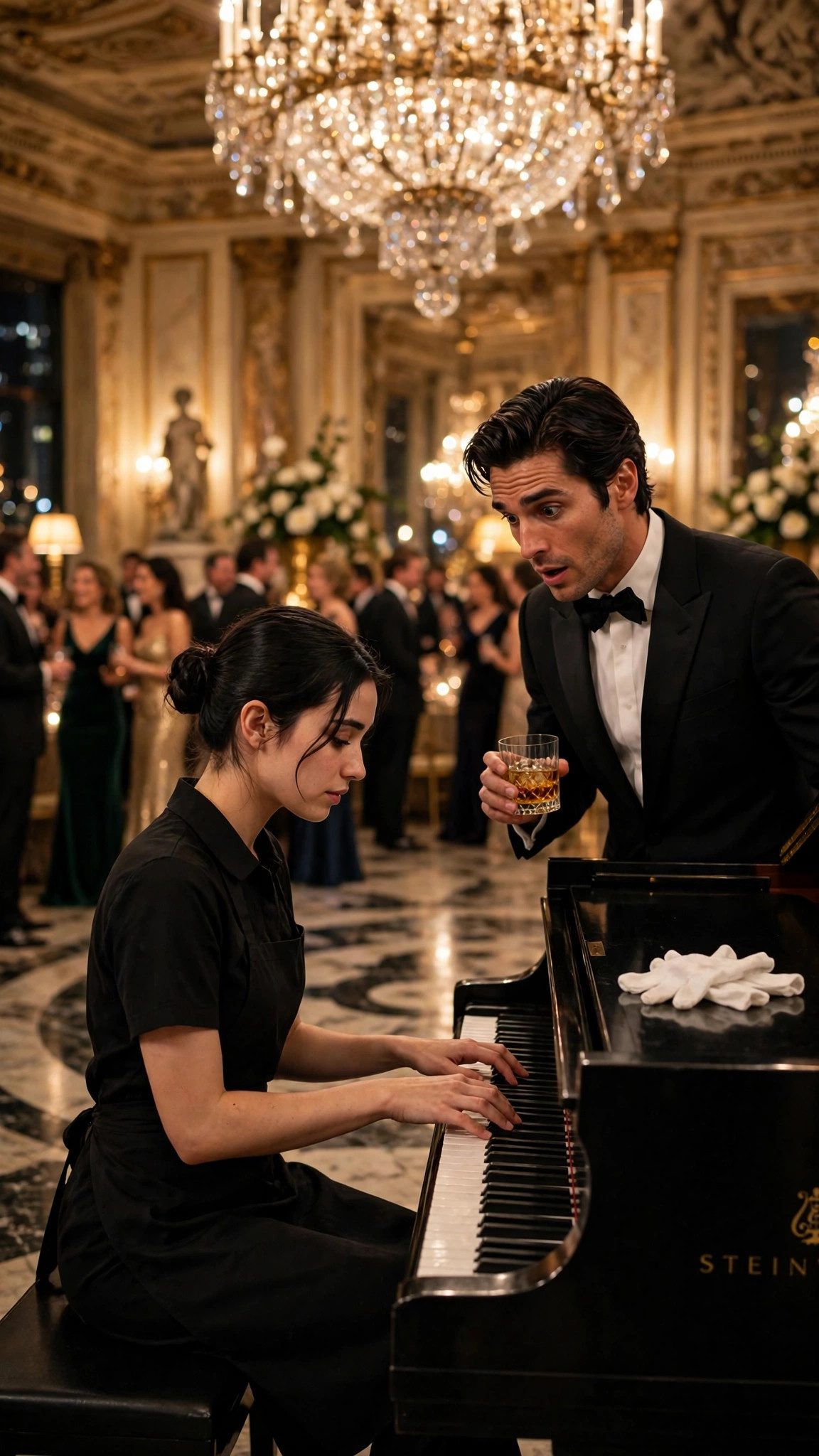
The laughter inside Hawthorne Estate died before my fingers reached the tenth note.
It did not fade the way laughter usually fades, trailing off into coughs and murmurs. It stopped, all at once, as if someone had cut a wire. Four hundred of the richest people in Chicago went silent in the middle of a marble ballroom, and the only sound left in the world was the piano.
I was sitting at a nine-foot black Steinway grand piano beneath an enormous crystal chandelier, wearing a plain black housekeeping uniform with my white gloves folded neatly beside my tray, and I was playing Rachmaninoff's Second Piano Concerto from memory. I had not touched a piano in almost two years. My hands remembered anyway.
Five minutes earlier, Dominic Vale — the most feared man in Chicago — had stood near the center of the ballroom with a whiskey glass in one hand and amusement glinting in his dark eyes, and he had laughed and declared, "Any woman who can play that concerto perfectly, I'll marry," never imagining that the quiet maid carrying champagne behind him would be the one to sit down at the piano.
But I am getting ahead of myself. The night did not begin at the piano. It began at six in the morning, the way every gala night at Hawthorne Estate begins: with me already tired.
I had been working since six that morning, and by the time the black cars started rolling through the iron gates at seven in the evening, my feet ached inside my sensible shoes and my hair had begun to escape from its neat low bun in small dark wisps that no amount of pins would hold.
"Table twelve needs new glasses," my supervisor called across the service corridor, not looking up from her clipboard.
"I'm going," I said.
"The flowers by the east staircase need water."
"I'll handle it."
My friend Nora Briggs appeared beside me carrying a stack of folded napkins, her round face flushed from the heat of the kitchen. "You know what I admire about rich people?" she asked.
"What?"
"They suffer bravely." She nodded solemnly toward the ballroom, where a woman in a diamond necklace was already complaining that her champagne was not cold enough. "Look at her. All that money, and still she suffers."
I nearly laughed. "Please don't get fired tonight."
"Me?" Nora pressed a hand to her chest in mock innocence. "I am the soul of discretion. I only think these things. I never say them out loud. Mostly."
For three years, Hawthorne Estate had been my workplace. The salary was decent, the medical benefits had helped during the final year of my father's life, and the staff housing had saved me when hospital bills nearly emptied everything I had. I was never ashamed of honest work. Other people, however, sometimes seemed determined to make me feel that I should be.
The evening had begun like every charity gala at Hawthorne Estate — black cars rolling through iron gates, couture gowns brushing marble floors, diamonds flashing beneath chandeliers, and wealthy guests discussing acquisitions and elections while pretending the fundraiser was the reason they had come. The ballroom smelled of white lilies and expensive perfume and polished wood. Waiters in black moved between the tables like shadows. Somewhere in the kitchen, a chef was shouting in French.
I carried my tray through the crowd, refilling glasses, clearing empty plates, smiling politely at people who looked straight through me. It was a skill I had learned in my first month at Hawthorne: how to be invisible while standing in the middle of a room. Rich people are very good at not seeing the people who serve them. I had come to find it restful. Nobody expected anything from a woman they did not see.
Then Caroline Whitmore approached while I arranged champagne glasses on a side table.
Beautiful, polished, and born into one of Chicago's oldest real-estate families, she had spent the previous year appearing beside Dominic Vale often enough for society magazines to predict an engagement. Her blonde hair was swept into a perfect chignon. Her gown was the color of champagne, and it probably cost more than I earned in a year. She stopped beside my table, and her gaze traveled slowly over my uniform, from my plain black collar to my sensible shoes, the way a person might look at a stain on a tablecloth.
"Is that really what they make you wear?" she asked, in a voice just loud enough for her two friends to hear.
"Yes, ma'am," I said.
She gave her friends a knowing smile. "They could at least choose something more elegant."
I met her eyes calmly. "It's comfortable."
Her smile tightened, because humiliation only works when the other person agrees to be embarrassed. She turned away, her friends trailing after her in a rustle of silk, and I went back to the champagne glasses.
After she walked away, Nora whispered, "I would've spilled champagne on her."
"That's why they don't give you the expensive bottles," I said, and we laughed, but my attention drifted toward the piano.
The Steinway had arrived that afternoon, polished until the chandelier shimmered across its black surface like stars. It stood at the far end of the ballroom, its lid raised, waiting. My chest tightened. I had not touched a piano in almost two years. Music carried too many memories, and I had packed those memories away the way you pack away a dead person's clothes — carefully, and with the lid shut tight.
But my eyes kept going back to it. The keys gleamed, white and black, patient as always. Pianos never judge you for staying away. They only wait.
I tried to keep serving drinks. I carried a tray of champagne toward table twelve, and that was when Dominic Vale stood up from his chair near the center of the ballroom and raised his whiskey glass, and the room quieted the way rooms always quieted for him.
At thirty-six, his name alone could silence businessmen, politicians, and men whose careers depended on never disappointing the Vale family. He was tall, with a sharp, handsome face and dark hair swept back from his forehead, and he wore a black tuxedo with a bow tie that sat perfectly straight, as if it were afraid to be crooked around him. He smiled — the slow, amused smile of a man who owned the room and knew it.
"Friends," he said, and his deep voice carried easily across the marble floor. "Before we get to the boring part of the evening — the part where I ask you for money — I have a proposition."
A ripple of laughter moved through the guests.
"That piano," Dominic said, nodding toward the Steinway, "cost more than most of your cars. And it is sitting there, silent, which offends me. So here is my offer." He looked around the room, his eyes bright with mischief. "If any woman here can play that concerto from beginning to end without a single mistake, I'll marry her."
The ballroom exploded with laughter. Women in diamonds giggled behind their hands. Men slapped each other's shoulders. Someone shouted, "Careful, Dominic, they'll all line up!" Someone else shouted, "Does it have to be the whole thing?"
"No shortcuts," Dominic said, grinning. "Beginning to end. Not one mistake. That is the price of my hand in marriage, ladies. A bargain, I assure you."
No one expected anyone to accept. The evening's entertainment had begun, and the wealthy guests began daring one another toward the piano, laughing, pointing, nudging their wives and daughters forward while everyone pretended they were joking and nobody was actually going to do it.
I tried to keep serving drinks. I turned back toward the bar with my tray, focusing on the glasses, on the ice, on anything except the piano.
Then Caroline noticed me staring. She had been watching me the way a cat watches a bird that has not yet realized the door is closed, and she smiled — the slow, deliberate smile of a woman who has found a new way to be cruel in public.
"Why don't you try, Elena?" she said, her voice carrying sweetly across the sudden hush.
The laughter started before I even moved.
It rolled through the ballroom in waves. A woman near the front laughed so hard she had to hold her necklace. A man in a gray suit pointed at me and said something to his wife that made her cover her mouth. Four hundred people were laughing at the idea of the maid sitting at the piano, and I stood there with my tray in my hands, feeling every eye in the room turn toward me like a spotlight swinging across a stage.
I should have shaken my head. I should have smiled politely and said, "No, thank you, ma'am," and gone back to my champagne glasses, and the night would have gone on exactly as it was supposed to go on, with me invisible and safe.
But something in me — something I had buried two years ago beside my father's grave — stirred and sat up and refused to lie back down.
Slowly, I removed my white gloves. I placed them beside my tray on the side table, one on top of the other, neat as always. Then I walked toward the Steinway.
The laughter followed me, thinning as I crossed the marble floor. My shoes made almost no sound. The guests parted for me the way water parts for a stone, and I could feel their eyes on my back, on my plain black uniform, on my hair pulled into its neat low bun. I heard a woman whisper, "Is she actually going to—" and a man answer, "Let her. It will be funny."
Dominic's amused expression followed me all the way to the bench. He stood a few feet from the piano, whiskey glass in one hand, watching me with the indulgent smile of a man watching a child attempt something far beyond her. He did not stop me. He was curious, I think. Or perhaps he simply could not imagine that the maid carrying his champagne knew what a piano was.
Then I sat down.
The bench was cool beneath me. The keys were smooth and familiar under my fingertips, and for one dizzying second I was seven years old again, sitting on my father's lap in a church basement while he tuned an old upright, my small legs dangling, my hands reaching for the keys he had just made sing.
My fingers touched the keys. And before I played the tenth note, Dominic Vale's smile disappeared.
The opening of Rachmaninoff's Second Piano Concerto is not loud. It begins with eight quiet chords, like waves gathering far out at sea, each one a little stronger than the last, until the orchestra — or in this case, the memory of the orchestra in my head — rises to meet it. I played those chords the way my father taught me: slowly, honestly, with the weight of the whole arm behind each one, not just the fingers. The notes filled the ballroom and climbed toward the chandelier, and the room went still.
I did not look up. I did not need to. I could feel the silence gathering around me like a held breath. Somewhere behind me, a glass stopped clinking. Somewhere to my left, a woman whispered, "Oh, my God," and someone shushed her.
The melody came then — the great, aching theme that every pianist knows and very few can truly play — and my hands moved across the keys the way they had moved a thousand times in practice rooms and church balconies and backstage corridors, the way they had moved when I was twelve and my father stood behind me with his hands on my shoulders and said, "There. That is the sound, Elena. That is what it is supposed to sound like."
I played on. The tenth note passed, and the eleventh, and the twelfth, and the ballroom did not breathe.
My hands were not thinking anymore. They were remembering — the way they had remembered in the church balcony when I was twelve, listening to the orchestra below and storing every note in a place behind my ribs. I could feel my father's hands on my shoulders, the way he used to stand behind me while I practiced, his fingers tapping lightly against my collarbone whenever I rushed a passage. "Slow down, Elena," he would say. "The music is not running away from you. It will wait. It always waits for the person who respects it."
I respected it now. I let each chord breathe before I reached for the next one. I let the melody unfold the way a flower unfolds in the morning, slowly, without being forced. The piano responded the way a good piano always responds to a player who listens — it sang. The Steinway had been silent all evening, polished and waiting, and now it was awake, and its voice filled every corner of the ballroom, climbing the marble walls and ringing in the crystal chandelier above my head.
Somewhere behind me, I heard a chair scrape softly against the floor, and then nothing. Somewhere to my right, a man cleared his throat and then stopped, as if he had caught himself in the middle of a thought and decided it was not worth finishing. The air in the ballroom had changed. It was no longer the air of a party. It was the air of a concert hall, thick with attention, and I could feel four hundred strangers leaning toward me without moving, the way people lean toward a fire on a cold night. Dominic Vale stood inches from the piano with his whiskey glass forgotten in his hand, and his smile was gone, and in its place was something I had never seen on his face before.
Shock.
And beneath the shock, something else. Something that looked almost like fear.
I played on, and the music rose, and somewhere in the back of my mind, past the notes and the memory of my father's hands, a small, clear voice said: He made a promise. In front of four hundred people, he made a promise. And he has no idea what he has just done.