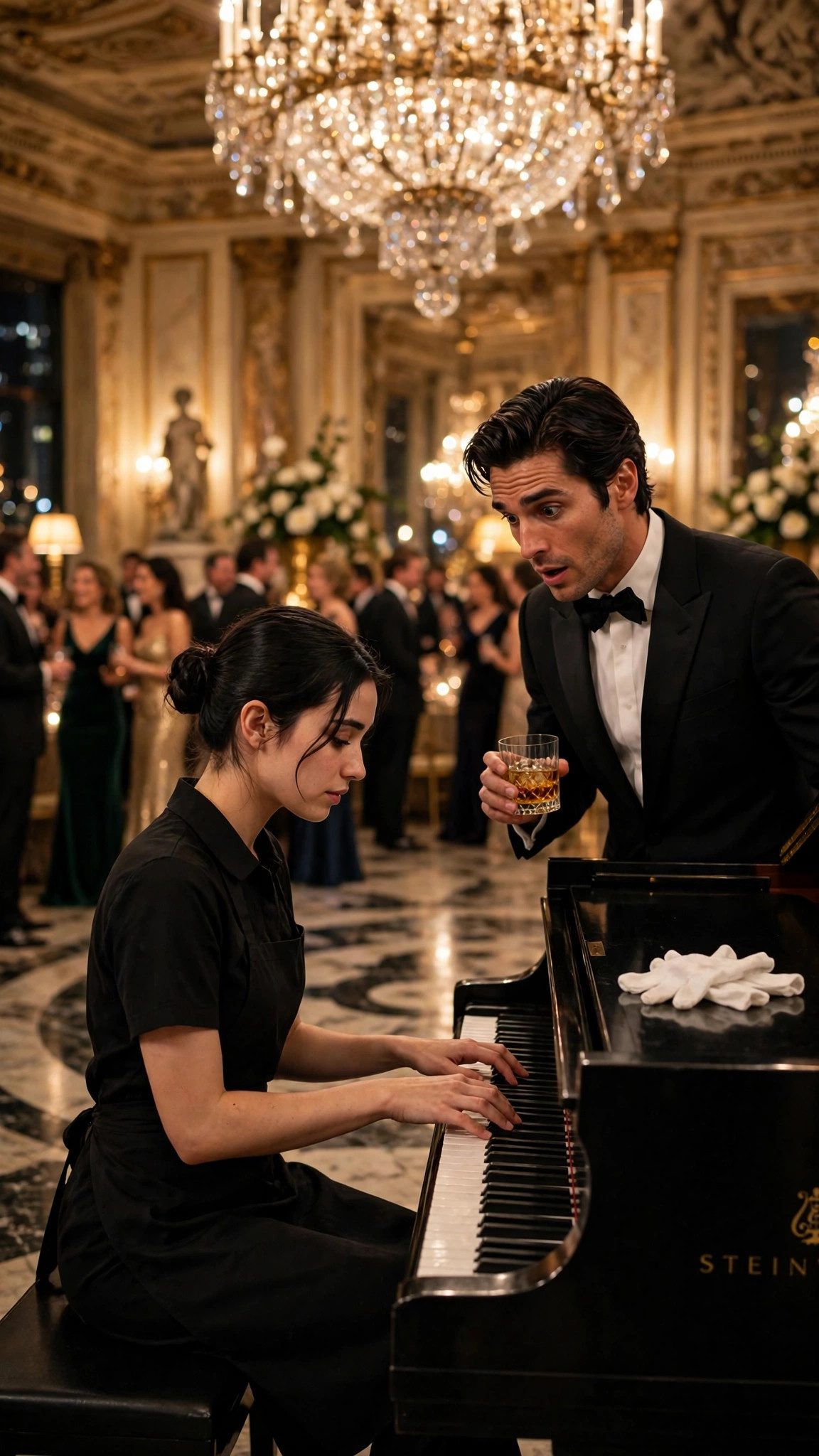
I do not remember deciding to finish the concerto. I remember only the music, and the way it carried me forward the way a river carries a swimmer who has stopped fighting the current.
The first movement of the Rachmaninoff Second is a long road. It begins with those eight quiet chords, rises into the great theme, falls back into shadow, and then climbs again, higher and harder, until the piano and the orchestra are running together toward a summit neither of them can see. There is a passage near the end of the first movement — a cascade of octaves that sounds like a waterfall made of glass — and when I reached it, my hands did not hesitate. They had never hesitated. They knew the road the way a horse knows the road home.
The ballroom had gone so quiet that I could hear the chandelier. Not the crystals — the air moving through them, a faint high ringing, like a wine glass touched by a fingernail. I could hear a woman breathing hard somewhere behind me. I could hear my own heart, steady and loud, keeping time with the music the way it had kept time since I was seven years old.
And then the first movement ended, and the silence that followed was so complete that for a moment I thought I had gone deaf.
Then the second movement began — the Adagio, slow and aching, the melody that sounds like someone remembering a love they thought they had lost — and I played it the way my father had taught me to play slow music: as if each note were a word in a letter you are afraid to finish writing.
Somewhere in the middle of the second movement, I finally looked up.
Dominic Vale was standing three feet from the piano, and he had not moved since I sat down. His whiskey glass hung forgotten at his side, his knuckles white around it. His dark eyes were fixed on my hands, and his face — the face that had laughed at his own joke not ten minutes earlier — was utterly still, as if someone had pressed a pause button on him.
Behind him, the ballroom was a painting of astonishment. A woman in a red gown had her hand pressed to her mouth. An old man in the front row, a judge whose name I knew from the newspapers, was leaning forward in his chair with tears running openly down his face. Nora stood at the edge of the service corridor with her hands clasped together so tightly that her knuckles were white, and she was crying too, and smiling, both at once, the way people do when they are witnessing something they know they will tell their grandchildren about.
Caroline Whitmore stood near the bar, and she was not crying. Her face was white — not pale, white, the way marble goes white when you strip the polish off it — and her champagne glass was trembling in her hand. Her friends had stepped slightly away from her, the way people step away from someone who has just been publicly struck.
I looked back down at the keys and played on.
The third movement came — fast, furious, triumphant, the music my father used to call "the part where the sun comes out" — and my hands flew. The octaves crashed. The melody soared. The ballroom seemed to lean toward me, four hundred people holding a single breath together, and then the final chords came down like a door closing on a cathedral, one after another, enormous and certain, and then —
Silence.
It lasted perhaps three seconds. It felt like three years.
Then the ballroom erupted.
It was not applause. Applause is polite. Applause is something you do at the end of a performance because it is expected. This was something else — a roar, a wave breaking over a seawall, people leaping to their feet, shouting, stamping, crying, a standing ovation that began before I had even lifted my hands from the keys. A woman threw a white rose onto the piano. A man near the front was shouting "Brava!" over and over again, his voice cracking. The chandelier seemed to shake with the noise.
I sat on the bench, my hands still hovering above the keys, stunned. I had forgotten what applause felt like. I had forgotten what it felt like to be heard.
A man in the front row — the old judge whose name I knew from the newspapers, a man who had sentenced murderers and freed innocent men and who had not cried in public in forty years, or so the papers said — was standing now, and he was applauding with his hands above his head, and tears were running openly down his face, and he did not seem to care who saw them. Beside him, a woman in a green gown had both hands pressed to her chest, as if she were trying to hold her heart inside her body. A waiter I knew from the kitchen — Tomas, who had worked at Hawthorne for twenty years and who had never once spoken to me except to ask for a clean tray — was standing in the service doorway with a tray still balanced on one hand, forgotten, and he was staring at me with his mouth open.
And Dominic — Dominic was standing three feet from the piano, and his face was a battlefield, and I could see, even from the bench, the exact moment when the amusement drained out of him and was replaced by something else entirely. It was the look of a man who has just discovered that the world is larger than he thought it was, and that he has been living in a smaller version of it than he needed to.
Someone in the crowd shouted my name. Not "the maid." Not "that girl." My name. "Elena!" And then another voice, and another, and the whole ballroom was chanting it, softly at first and then louder, and I sat there on the bench in my plain black uniform, with my white gloves folded beside my tray, and I thought: they know my name. Four hundred people who looked through me an hour ago know my name now. And I did not know whether to laugh or to cry, so I did neither. I simply sat there, breathing, while the sound of my own name washed over me like rain.
And then, through the noise, I heard Dominic Vale's voice.
"Stop," he said.
It was not loud. It was not a shout. But it cut through the applause the way a knife cuts through silk, and the room fell silent again, all at once, the way it had fallen silent before my tenth note.
Dominic stepped forward, slowly, and set his whiskey glass down on the piano with a soft click. He looked at me — really looked at me, for the first time, as if he were seeing a person and not a uniform — and his face was a battlefield of emotions: shock, anger, admiration, and beneath them all, something that looked very much like a man realizing he has just lost a game he did not know he was playing.
"You played it," he said. "From beginning to end. Without a single mistake."
The ballroom held its breath.
"I heard every note," he said, and his voice was quieter now, almost rough. "I don't know music the way you do. But I know when something is perfect. That was perfect."
A murmur ran through the crowd, like wind through wheat.
Dominic looked around the room — at the four hundred guests, at the judges and the politicians and the businessmen and the society reporters with their notebooks already open — and then he looked back at me, and he said the words that changed everything.
"I made a promise," he said. "In front of all of you. And a Vale keeps his promises."
The ballroom exploded again, but this time the noise was different. It was not applause. It was chaos. People were shouting questions. Reporters were pushing forward. A woman near the front fainted, or pretended to, and two men caught her. Caroline Whitmore's champagne glass slipped from her fingers and shattered on the marble floor, and nobody even turned to look, because everyone was looking at me.
At me. Elena Carter. The maid.
Dominic held out his hand to me. It was a large hand, scarred across the knuckles, the hand of a man who had done things in his life that he did not talk about at dinner parties. It trembled, very slightly. I do not think he knew it was trembling.
"Stand up, Elena," he said.
I stood. My legs felt like they belonged to someone else. The ballroom spun gently around me, chandelier and marble and diamonds, and Dominic's hand was warm and steady under mine.
"Say something," he said quietly, for my ears only. "Please. I have just promised to marry a woman I know nothing about, in front of four hundred people, and I need you to say something."
I looked at him — at the sharp handsome face, at the dark eyes that had gone from amused to shocked to something I could not name — and I heard my father's voice in my head, as clear as if he were standing beside the piano.
"A gift isn't a crown. It's a responsibility."
"I played the concerto," I said, and my voice came out soft and steady, the way it always did when I was telling the truth. "You made a promise."
It was, perhaps, the bravest sentence I had ever spoken. It was also, perhaps, the most foolish. But I had just played Rachmaninoff in front of four hundred people after two years of silence, and I was no longer the woman who had walked into that ballroom with a tray of champagne. I did not know who I was yet. But I knew I was not going back to being invisible.
Dominic stared at me for a long moment. Then, slowly, the corner of his mouth lifted — not the amused smile from before, but something smaller and more honest, the smile of a man who has just been beaten at his own game and is surprised to find that he does not mind losing.
"So I did," he said.
The rest of the evening passed in a blur of noise and light. Dominic's security men formed a wall around me. Nora pushed through the crowd and grabbed my arm and whispered, "Elena, what did you just DO?" in a voice that was half terror and half delight. A society reporter shoved a microphone toward my face and asked me how long I had been planning this, and I said, "I wasn't planning anything," which was true and also sounded like a lie.
Caroline Whitmore left the ballroom without speaking to anyone. I saw her go — champagne-colored gown, straight back, chin high — and I saw her father, Charles Whitmore, a silver-haired man in a gray suit, hurry after her with a face like thunder. I did not know then what I know now: that Caroline's family owed money to men who did not forgive debts, and that her engagement to Dominic Vale had been the only thing standing between her father and ruin. I did not know that my ten minutes at the piano had just destroyed a plan that had taken a year to build.
I did not know any of that. I only knew that my hands were shaking, and that my father's voice was still in my head, and that Dominic Vale was standing beside me, looking at me as if I were a puzzle he had just discovered in his own house.
Later — much later, after the guests had gone and the ballroom was empty except for the cleaning staff and the smell of spilled champagne — Dominic found me in the service corridor, out of my uniform at last, sitting on a stack of folded tablecloths with my shoes off and my feet aching.
"Elena Carter," he said, leaning against the doorframe, his bow tie finally loosened, his jacket over his arm. "Twenty-eight years old. Employed here for three years. No criminal record. No family in Chicago." He paused. "Your father tuned pianos. He died two years ago. You stopped playing the day he died."
I stared at him. "How do you know all that?"
"I had my people look into you," he said, without apology. "In the last two hours. It is what I do. I find out who people are before I let them change my life."
"And have I changed your life?" I asked.
He was quiet for a moment, looking at me with those dark, unreadable eyes. "I made a promise in front of four hundred people," he said finally. "My uncle Anthony — my father's brother, my consigliere — has already called me three times. He says a Vale's word is his bond, and if I break it publicly, I lose the respect of every family in this city. He also says that if I marry a maid, I lose the respect of every family in this city. He is not sure which is worse."
"What do you say?" I asked.
Dominic smiled then — a real smile, tired and honest. "I say that I have spent ten years being the most feared man in Chicago, and tonight a maid sat down at my piano and made four hundred people forget I existed. I say that I don't know what happens next. And I say that I would like to find out."
He pushed off the doorframe and held out his hand again. "Come to dinner tomorrow. Not as my employee. As my guest. We will talk. No promises beyond that one — the one I already made, which I intend to keep, in whatever form it takes."
I looked at his hand. I thought about my father, and about the Rachmaninoff, and about the lid of a piano coming open after two years in the dark.
I took his hand.
"Tomorrow," I said. "Dinner. As your guest."
"Good," Dominic said. "And Elena — one more thing."
"Yes?"
"Whatever happens next," he said, his voice dropping low, "be careful. There are people in this city who do not like surprises. And tonight, you were the biggest surprise Chicago has had in years."