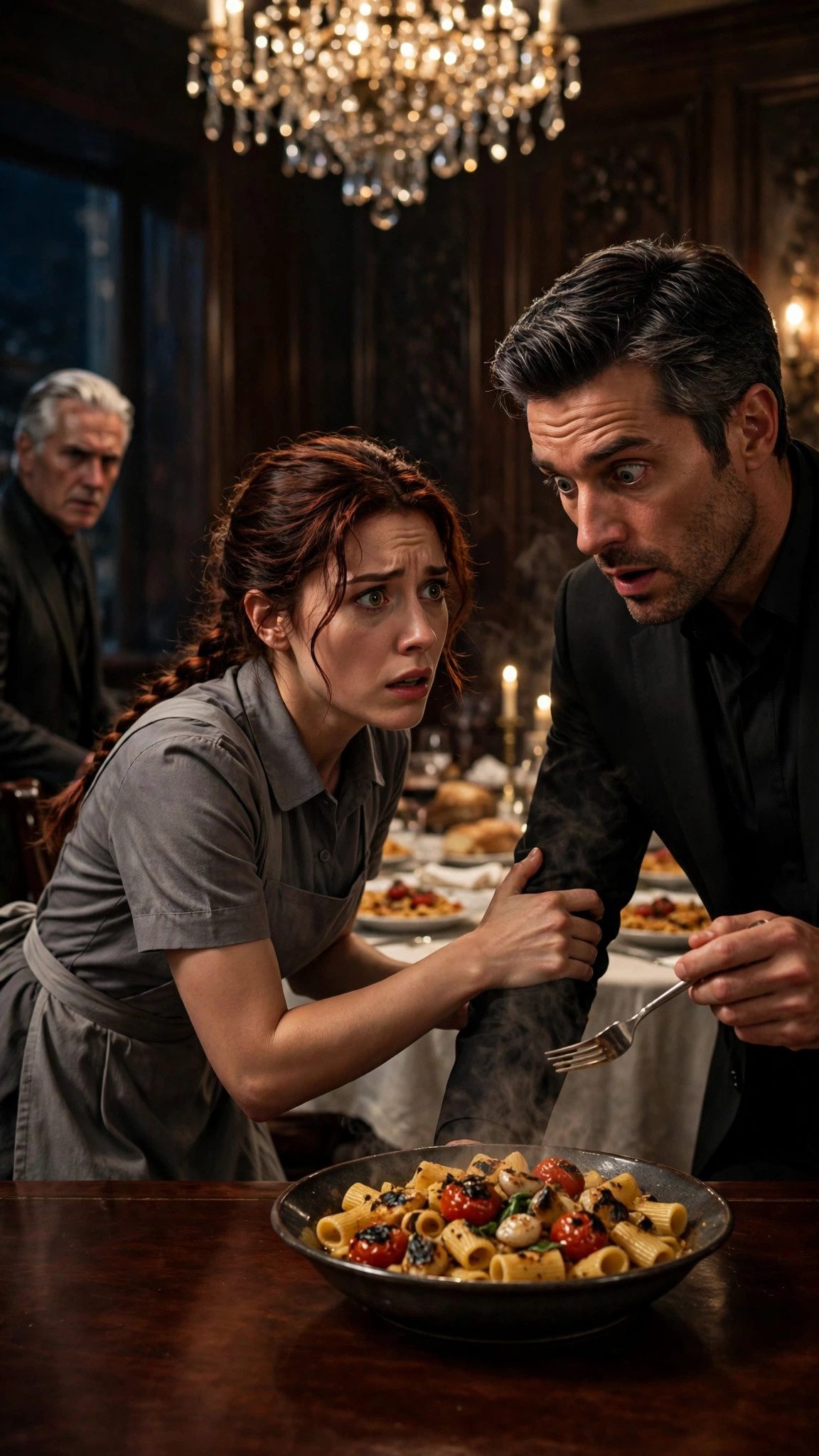
I did not tell anyone what I had smelled in the pantry. Not on the first day, and not on the second. A new maid does not walk into a house of grief and fear and announce that someone is trying to murder the family. She watches. She listens. She learns the shape of the house, and the habits of the people in it, and she waits for the smell to come to her again — because poison, like any secret, always comes back to the place where it was made.
On my second morning, I was sent to lay the breakfast table. The dining room was a great, cold room with a mahogany table long enough to seat twenty, and a chandelier that threw small hard lights onto the polished wood. Arthur Moretti sat at the head of it, alone, with a plate of eggs and toast in front of him, and a cup of tea beside it. He did not touch any of it. He sat with his hands flat on the table and stared at the plate the way a man stares at a letter he is afraid to open.
His sister Aria sat halfway down the table, picking at her own food, watching him. She was thirty years old, dark-haired, sharp-featured, with her father's eyes and her mother's temper — or so Mrs. Delgado told me later. She had come home for the birthday party and stayed, and in three weeks she had gone from being the sister who visited at holidays to being the woman who ran the house, because someone had to, and Arthur would not.
"Eat, Arthur," she said. "For God's sake. One bite. The doctor says if you keep this up you'll be in hospital by Christmas."
"I am not hungry," Arthur said. His voice was flat, the voice of a man who has said the same sentence so many times it has worn smooth.
"You are not hungry because you will not let yourself be hungry," Aria said. "You are punishing yourself for Father's death. He would hate this. He would hate to see you like this."
Arthur did not answer. He stood up, slowly, and walked out of the dining room without touching his food. Aria watched him go, and then she put her fork down, and she looked at me — really looked at me, for the first time — and her eyes narrowed.
"You're the new girl," she said. "Nora."
"Yes, miss."
"My brother is not mad," she said, as if I had accused him of it. "He is grieving. The doctor says so. So do not stand there with that look on your face."
"What look, miss?"
"The look," she said, "of someone who thinks she knows something the rest of us don't."
I lowered my eyes and said nothing, because a maid who has worked in a house for two days does not argue with the Don's sister. But as I cleared Arthur's untouched plate, I leaned over it, the way a maid leans over a plate, and I smelled it. Eggs. Butter. Toast. Tea. And underneath the tea, so faint I almost missed it, the sweet, oily smell, like rhubarb left too long in the sun.
My hands did not shake. I was proud of that, afterward. My hands did not shake as I carried the plate to the kitchen and set it down, and I said to Chef Pascal, very quietly, "The tea. Who made the tea?"
Pascal looked up from his stove. His face was gray. "I made it," he said. "I make the tea every morning. The same leaves, the same pot, for thirty years. Why?"
"Nothing," I said. "It just smelled different today."
"It smells the same as it always smells," Pascal said, but his voice was not certain, and his eyes went to the pantry door, and then away again. "Go and do your work, girl. And mind what you say in this house. Walls have ears here."
That afternoon, Dominic Ferrante came to the kitchen. He was forty-two, silver at the temples, dressed like a man who had never done a day of manual work in his life, and he moved through the house like he owned it — which, in a way, he almost did. He was Arthur's underboss, his second-in-command, the man who had run the family's business while Arthur sat at an empty table and refused to eat. Everyone deferred to him. The staff called him "Mr. Dominic" and stood straighter when he walked in.
He watched me work for a while — I was scrubbing the great iron pans, the ones Pascal used for the pasta — and then he said, "You're the new maid. Nora, isn't it?"
"Yes, sir."
"My men tell me you were asking questions about the tea."
I kept scrubbing. "I asked Chef Pascal who made it. That is all."
"And why would you ask that?"
"Because it smelled different," I said. I looked up at him then, because I wanted to see his face when I said it. "It smelled sweet. Like rhubarb."
Something moved behind his eyes. It was very quick, and very small, but I saw it — the way you see a fish move under dark water. Then he smiled, and the smile did not reach his eyes.
"Rhubarb," he said. "In tea. You have an imagination, girl. Perhaps you should keep it to yourself. This house has had enough trouble without a new maid inventing poison in the teapot."
"I am not inventing anything, sir."
"No," Dominic said. "You are a maid who has been here two days, and you are telling the underboss of this family that someone is poisoning the Don. Do you understand what happens to people who make accusations like that in this house? Do you understand what happened to the last maid who asked too many questions?"
"Gabby left," I said. "She went upstairs, and then she was gone."
Dominic's smile widened, just a little. "Gabby left because she was a silly girl who could not handle this house," he said. "Do not be a silly girl, Nora."
He walked out. I stood at the sink with my hands in the hot water, and I thought about what he had said, and about the way his eyes had moved when I said the word "rhubarb," and about the cardboard box on the bottom shelf of the pantry, and I understood something I had not understood before.
Dominic Ferrante knew about the smell. He knew exactly what it was. And he wanted me to stop asking about it.
That night, I cooked. I had been told to prepare the pasta for the family dinner the next day — the great trays of blistered-tomato and burned-garlic pasta that were the Moretti family's favorite dish, the dish Chef Pascal had made for thirty years. I cooked my own batch first, in my small kitchen at home, the way my grandmother taught me: the tomatoes pressed with a wooden spoon until their skins blistered and split, releasing their acidic juice; the garlic burned slightly on the iron pan until it turned golden brown at the edges; the olive oil, the salt, the patience. I wanted to make the dish warm. I wanted to make it perfect. Because I had a plan, and the plan needed a perfect bowl of pasta.
The plan was this: I would bring my own bowl to the family dinner, and I would put it in front of Arthur Moretti, and I would watch his face when he smelled it. If the house pasta smelled of rhubarb and mine did not, then the poison was in the kitchen's food, not in the recipe. And if Arthur's body had been refusing the house food for three weeks, then his body already knew what his mind could not prove — and my clean bowl would be the proof that let him believe it.
But I needed one more thing first. I needed to know where the poison was coming from. Because a smell does not appear in a kitchen by itself. Someone has to bring it in. Someone has to hide it. Someone has to put it in the food.
So after midnight, when the house was dark and silent, I went back to the pantry with a candle, and I stood on a chair, and I lifted the ceiling tile above the top shelf — the loose one, the one Mrs. Delgado had told me rattled when the wind blew — and I reached up into the dark space above it.
My fingers found paper. A paper bag, folded over at the top, tucked between the joists where no one would ever look unless they knew it was there. I pulled it down, carefully, and set it on the shelf, and opened it.
Inside was a white powder, fine as flour, with a faint sweet smell that rose up and wrapped itself around my face like a hand over my mouth. Rhubarb root, dried and ground. Enough to poison a hundred meals. Enough to kill a family.
And tucked into the fold of the bag, like a bookmark, was a handkerchief. White linen. Monogrammed, in dark blue thread, with the initials D.F.
Dominic Ferrante.
I stood in the pantry with the bag in my hands and the candle guttering beside me, and I thought about my father, and about the cardboard box, and about the words my grandmother had said to me when I was twelve years old: "If you ever smell it in a kitchen where it does not belong, you run, and you tell someone."
I did not run. I put the bag back exactly where I had found it, and I put the ceiling tile back, and I went to my room, and I lay awake until morning, planning what I would do next. Because telling someone was not enough. I had to prove it. I had to prove it in a way that Dominic Ferrante could not talk his way out of, in front of the whole family, at the table where his poison had already killed one man.
And I knew exactly how I was going to do it.
But first, I had to be sure. A nose is not proof. A memory is not proof. Even a smell as certain as the one in the pantry is not proof — not in a house like this, not against a man like Dominic Ferrante, who had the family's trust and twenty years of loyalty behind him. I needed to be sure, and the only way to be sure was to test it, the way my grandmother had taught me to test anything in a kitchen: side by side, clean against dirty, with your eyes closed and your nose open.
So the next morning, I cooked two bowls of pasta. One was mine — the batch I had made at home the night before, clean, safe, the tomatoes blistered and the garlic golden, the way my grandmother taught me. The other was from the house kitchen — a ladle of the great trays Pascal's staff had prepared for the family dinner, the same pasta, the same recipe, the same ingredients, or so everyone believed.
I set them side by side on the kitchen table, and I closed my eyes, and I leaned over the first bowl, and I smelled it. Tomatoes. Garlic. Olive oil. Salt. Safety. Then I leaned over the second bowl, and I smelled it. Tomatoes. Garlic. Olive oil. Salt. And underneath it all, faint as a rumor, sweet and oily and wrong — the smell of rhubarb root, ground fine and stirred into the sauce where no one would see it.
The difference was so small that most people would never have noticed it. But I noticed it, the way my father would have noticed it, the way my grandmother had trained me to notice it. And once I had noticed it, I could not unnotice it. It was there, in every spoonful, in every plate, in every tray the kitchen had prepared for the family table.
I opened my eyes, and Chef Pascal was standing across the table from me, watching. His face was gray, and his hands were shaking, and I realized he had been standing there for a while, watching me smell his food.
"You smell it too," I said. It was not a question.
"I smell something," Pascal said, very quietly. "I have smelled something for three weeks, girl, and I have told myself I was imagining it, because I am an old man, and old men imagine things. The tea, that night — it tasted bitter. I told myself the leaves were old. The pasta, yesterday — it smelled sweet, underneath the garlic. I told myself the tomatoes were too ripe." He looked down at the two bowls, and his voice dropped to a whisper. "I cooked the birthday dinner, girl. With my own hands. I stood at that stove and I tasted every dish before it left my kitchen, the way I have done for thirty years. And I did not taste the poison. Do you understand what that means? It means someone put it in after I tasted it. Someone in my kitchen. Someone I trusted."
"Who serves the food after you taste it?" I asked.
Pascal's face went whiter. "The servers," he said. "The maids. The —" He stopped. "Dominic. Dominic comes into my kitchen every night before dinner, and he tastes the food, and he tells me it is good, and he carries the first tray out himself. He has done it for twenty years. He says it is his honor, as the underboss, to serve the Don first."
We looked at each other across the two bowls of pasta, and neither of us said anything, because there was nothing left to say. The poison was going into the food after Pascal tasted it, and the only person who touched the food between Pascal's stove and the Don's table was Dominic Ferrante.
That afternoon, Aria found me in the hallway outside the pantry, and she blocked my path, the way she had blocked it that morning, and she said, "You were in the pantry last night. Mrs. Delgado saw the candle. What were you doing in the pantry at midnight, Nora?"
"Looking for something, miss," I said.
"Looking for what?"
"For the truth," I said. "The same thing your brother has been looking for for three weeks."
Aria's eyes narrowed. "My brother is grieving," she said. "He is not looking for anything. He is sitting at an empty table, starving himself, because he cannot bear to live in a house where his father is dead. That is grief, Nora. Not a mystery. Not a murder. Grief."
"Then why does the tea taste bitter, miss?" I asked. "Why does the pasta smell sweet? Why did Gabby leave in the middle of the night without her wages? Why does Mr. Dominic come into the kitchen every night and taste the food before it leaves the stove?"
Aria opened her mouth, and then closed it, and for a moment, the sharp, certain woman I had met on my first day was gone, and in her place was a girl who had held her father's hand while he died, and who had been telling herself a story about it for three weeks because the true story was too terrible to bear.
"I don't know," she whispered. "I don't know, and I don't want to know. But if you know — if you really know — then prove it. Prove it tonight, at the dinner table, in front of everyone. Because if you are wrong, Nora, my brother will never forgive you. And neither will I."
"I will prove it," I said. "Tonight."
She walked away, and I went back to the kitchen, and I picked up my bowl — my clean bowl, my safe bowl — and I held it in my hands, and I thought about my father, and about my grandmother, and about the nine-year-old girl who had promised herself that she would smell it first.
Tonight, I would keep that promise. In front of the whole family. At the table where a man had already died.