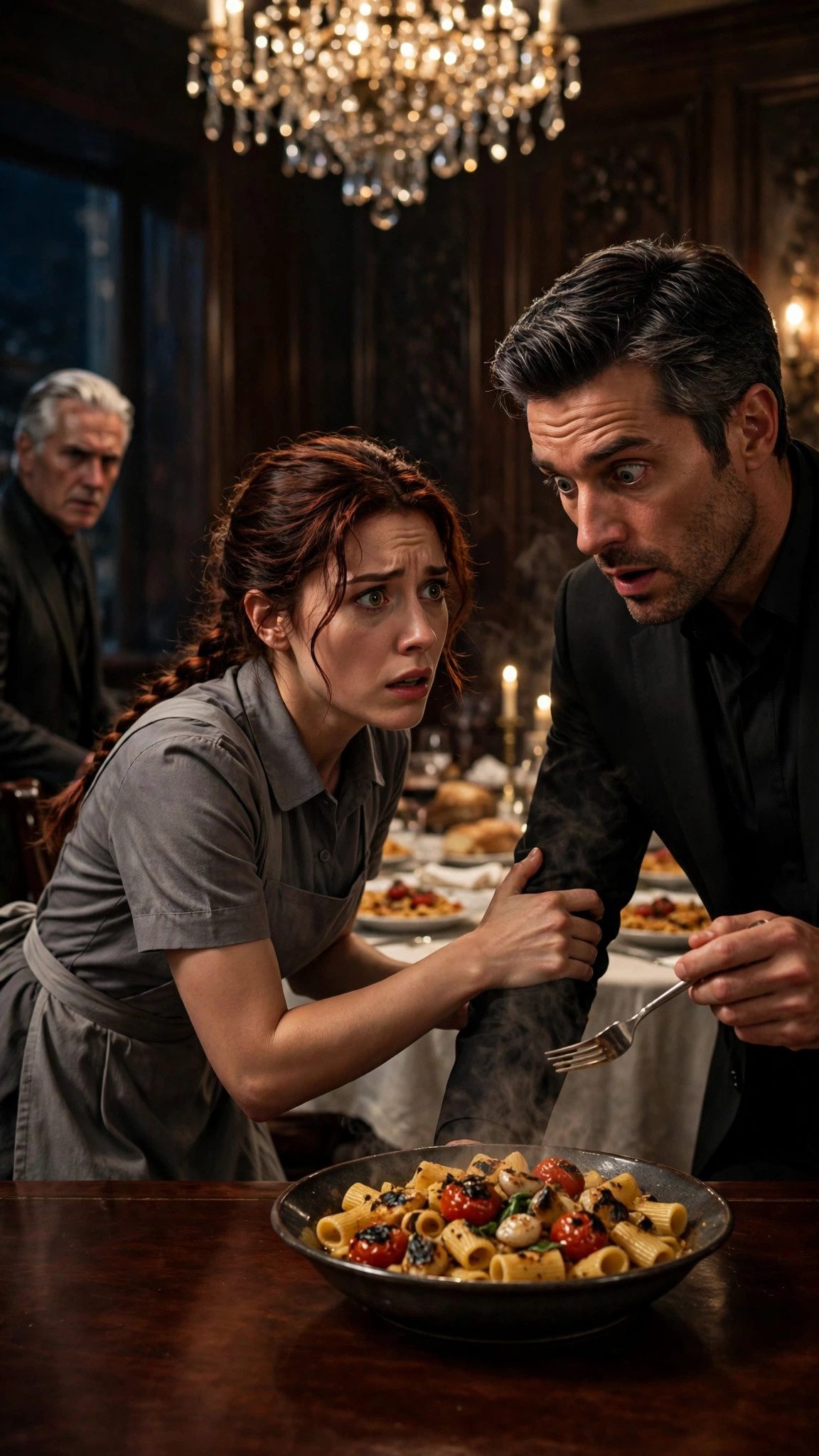
The next morning, I did three things before breakfast.
First, I went to the pantry and took a pinch of the white powder from the paper bag — just a pinch, on the tip of my finger — and I folded it into a twist of paper and hid it in my apron pocket. I did not take more. I did not want Dominic to know the bag had been touched. A man who hides poison in a ceiling checks his hiding place, and if the bag is lighter than he remembers, he will know someone has found it.
Second, I went to see Dr. Ellison. He was the family doctor, a man of sixty with kind eyes and tired hands, who had been the one to say Vittorio Moretti died of a heart attack. I found him in his small office above the garage, where he kept his books and his instruments, and I closed the door, and I put the twist of paper on his desk, and I said, "I need you to tell me what this is."
He opened the paper. He looked at the powder. He touched it with the tip of his finger and held it to his nose, and his face went white.
"Where did you get this?" he whispered.
"From the pantry," I said. "From a paper bag hidden above the ceiling tiles. I need you to tell me what it is, Doctor. And I need you to tell me the truth."
He sat down slowly. "It is rhubarb root," he said. "Dried and ground. In this quantity —" He looked at the pinch on the paper, and then at me, and his hands were shaking. "A pinch of it in a pot will make the food taste bitter. A spoonful of it will stop a man's heart. It looks like a heart attack. It feels like a heart attack. The symptoms are the same. The only difference is the smell — sweet, oily, wrong. Most people never notice it. Most people eat it and never know."
"Did my — did Vittorio Moretti eat it?" I asked. "On his birthday. In his tea."
Dr. Ellison was silent for a long time. Then he said, very quietly, "I have been the Moretti family doctor for thirty years, Nora. I held Vittorio's hand while he died. I told his children it was his heart. I believed it, at the time. But since then — since Arthur stopped eating — I have gone back over it in my mind, a hundred times. Vittorio was a strong man. His heart was strong. And his tea —" He stopped. "His tea tasted bitter that night. I remember it now. Aria refilled his cup, and he made a face, and he laughed, and he said the new blend was too bitter. I thought nothing of it. But a heart attack does not make a man's tea taste bitter, Nora. Poison does."
"Will you help me?" I asked.
He looked at me for a long moment. "What do you want me to do?"
"I want you to test the pasta," I said. "The family dinner tonight. The whole pasta order. I want you to be there when it is served, and I want you to test it, in front of everyone, so that no one can say afterward that it was a mistake, or a misunderstanding, or a silly maid with an imagination."
He nodded, slowly. "I will be there," he said. "And Nora — be careful. If someone in this house is poisoning the family, and you are the one who found it, then you are the most dangerous person in this house tonight."
Third, I went to find Gabby.
It took me most of the morning. Mrs. Delgado would not tell me where she lived — "She doesn't want to be found, girl, and I won't be the one to send trouble to her door" — but the girl who delivered the milk knew, and the boy who swept the steps knew, and by noon I was standing outside a small flat above a laundry on the other side of the city, knocking on a door that took a long time to open.
Gabby was twenty-three years old, thin, with dark circles under her eyes and a baby asleep in a basket beside her bed. She looked at me through the crack of the door and said, "If he sent you, tell him I didn't say anything."
"Nobody sent me," I said. "My name is Nora. I took your place in the Moretti house. I need to know why you left."
She stared at me for a moment. Then she opened the door, just wide enough to let me in, and closed it behind me, and locked it, and stood with her back against it as if she were holding the whole world out.
"I went upstairs," she said. "After the birthday party. Mr. Vittorio was dead, and the house was full of people crying, and Mr. Dominic told me to go upstairs and fetch his coat from his room, because he was going out. I went upstairs. And on the landing, outside his door, I heard —" She stopped. Her hands were shaking. "I heard him talking on the telephone. He was talking about the tea. He said, 'It worked. The old man is dead. The boy won't eat — he's too frightened to eat, and that is even better, because a Don who won't eat is a Don who can't lead.' And then he laughed, and he said, 'The next one will be the pasta. All of it. The whole order. Let them eat it together, like a family.'"
She started to cry then, quietly, the way people cry when they have been holding it in for a long time. "I came downstairs and I told Mrs. Delgado I was leaving, and I left that night, and I never went back. I didn't take my wages. I didn't take anything. I just left. Because I knew that if I stayed, and I told anyone what I had heard, then I would be next. And now I have a baby, and I can't be next. Do you understand? I can't be next."
"I understand," I said. "And I am not going to tell anyone that you told me. But I need to know one more thing. The paper bag. In the pantry. Above the ceiling. Did you see him hide it?"
Gabby nodded, slowly. "The night before the birthday party," she whispered. "I was putting away the flour, and he came in with a paper bag, and he stood on a chair, and he lifted the ceiling tile, and he put it up there. I pretended I didn't see. I pretended I was counting the tins. And he looked at me, and he smiled, and he said, 'You didn't see anything, Gabby.' And I said, 'No, sir. I didn't see anything.' And I meant it. I didn't see anything. I still don't see anything."
I took her hand. It was cold. "You saw enough," I said. "And I will make sure it is enough."
I went back to the mansion that afternoon with the taste of fear in my mouth and the plan in my head, clear as a recipe. Tonight, at the family dinner, the whole pasta order would be served — every plate poisoned, every plate beautiful, every plate a trap. And I would be there with my own clean bowl, and Dr. Ellison would be there with his test, and Arthur Moretti would finally have the proof his body had been waiting three weeks to hear.
And Dominic Ferrante would be sitting at that table, smiling, waiting for his poison to do its work — and he would not know that the new maid, the girl who had been in the house for three days, had already smelled it first.
But before the dinner, there was one more thing I had to do, and it was the hardest thing of all. I had to go back to Dr. Ellison, and I had to ask him the question I had been afraid to ask all morning: exactly how had Vittorio Moretti died? Not the story the family had been told. Not the words on the death certificate. The truth — what the doctor had seen with his own eyes, in that dining room, on the night of the birthday party.
I found him in his office above the garage, sitting at his desk with his head in his hands, the way Arthur had sat at the kitchen table. He looked up when I came in, and his eyes were red, and I knew he had been sitting there for a long time, going over it in his mind, the way I had gone over my father's death for seventeen years.
"Tell me about that night, Doctor," I said. "Tell me everything. From the beginning."
He told me. He told me how Vittorio had sat at the head of the table in his best suit, laughing, raising his glass, telling his children he was proud of them. How he had taken a sip of his tea and made a face, just for a second, and laughed, and said the new blend was too bitter. How Aria had refilled his cup. How he had taken another sip, and then another, and how, an hour later, he had put his hand to his chest, and his face had gone gray, and he had fallen forward onto the table, and the teacup had shattered on the floor.
"I held his hand while he died," Dr. Ellison said, and his voice shook. "I felt his pulse slow down, and stop. I told his children it was his heart. I believed it. A man of seventy-one, after a long dinner, after wine — a heart attack is not unusual. But since then, I have gone back over it, a hundred times, and there are things that do not fit. His heart was strong, Nora. I had examined him a month before, and his heart was strong. And the tea — the tea tasted bitter. I remember it now, clearly. I tasted it myself, afterward, from the pot, and it was bitter in a way tea should never be bitter. Sweet, underneath the bitterness. Oily. Wrong."
"Rhubarb root," I said.
"Rhubarb root," he agreed. "A pinch in a pot will make the food taste bitter. A spoonful will stop a man's heart. And the symptoms — the gray face, the hand to the chest, the sudden collapse — they look exactly like a heart attack. That is why it is the perfect murder, Nora. No one suspects poison when the dead man is seventy-one years old and has just eaten a rich dinner. No one asks for a test. No one looks for a paper bag in a ceiling."
He stood up then, and he went to a cabinet, and he took out a small bottle, and he showed me the reagent inside it — a clear liquid that turns deep purple when it touches rhubarb-root poison. "I have carried this in my bag for thirty years," he said. "I have never used it. I never thought I would need to use it in this house." He put the bottle back, and he looked at me, and he said, "Tonight, I will use it. In front of everyone. And whatever happens after that, Nora — whatever happens — you must know that you did the right thing. You smelled it first. And because you smelled it first, no one else is going to die of it."
That night, before the dinner, I went back to the pantry one last time, and I stood on the chair, and I lifted the ceiling tile, and I looked at the paper bag, sitting there in the dark between the joists, innocent as a bag of flour. And as I stood there, I heard footsteps in the hall outside — slow, careful footsteps, stopping outside the pantry door. I held my breath. I did not move. The footsteps waited, and then went on, down the hall, toward the stairs. I put the tile back, and I climbed down, and I blew out my candle, and I stood in the dark pantry with my heart hammering, and I understood something I had not understood before.
Dominic Ferrante checked his hiding place every night. He had been down that hall, outside that door, checking. And tonight, after the dinner, he would check it again. And if the bag was gone, or lighter, or moved, he would know someone had found it.
So I left it exactly where it was. I did not take it. I did not move it. I left it there, in the dark, above the ceiling tiles, waiting for its moment — the moment when Mrs. Delgado would stand on a chair in front of the whole family and lift it down, and the whole house would see what had been hiding above their heads for three weeks.
Gabby had told me one more thing before I left her flat, something I had not written down, something I had carried with me all the way back to the mansion. She had told me about her two years in the house — about the birthday parties, and the Sunday dinners, and the way Vittorio Moretti had always been kind to her, always asked about her mother, always slipped her an extra week's wages at Christmas. "He was a good man," she had said, crying quietly, her baby asleep in the basket beside her. "For a Don, he was a good man. And when he died, I cried, and I cried, and I cried. And then I heard Mr. Dominic on the telephone, laughing about it, and I understood that the good man had been murdered, and that the man who murdered him was still in the house, eating at the table, smiling at the family. And I ran. I ran because I was afraid. And I have been afraid every day since."
"You don't have to be afraid anymore," I had told her. "Not after tonight."
I hoped it was true. I hoped it with everything I had. But as I stood in the dark pantry, listening to Dominic's footsteps fade down the hall, I knew that hope was not enough. Tonight, at the dinner table, I would have to be more than hopeful. I would have to be right — and I would have to prove it, in front of twenty people, while the man who had poisoned them all sat at the table smiling.