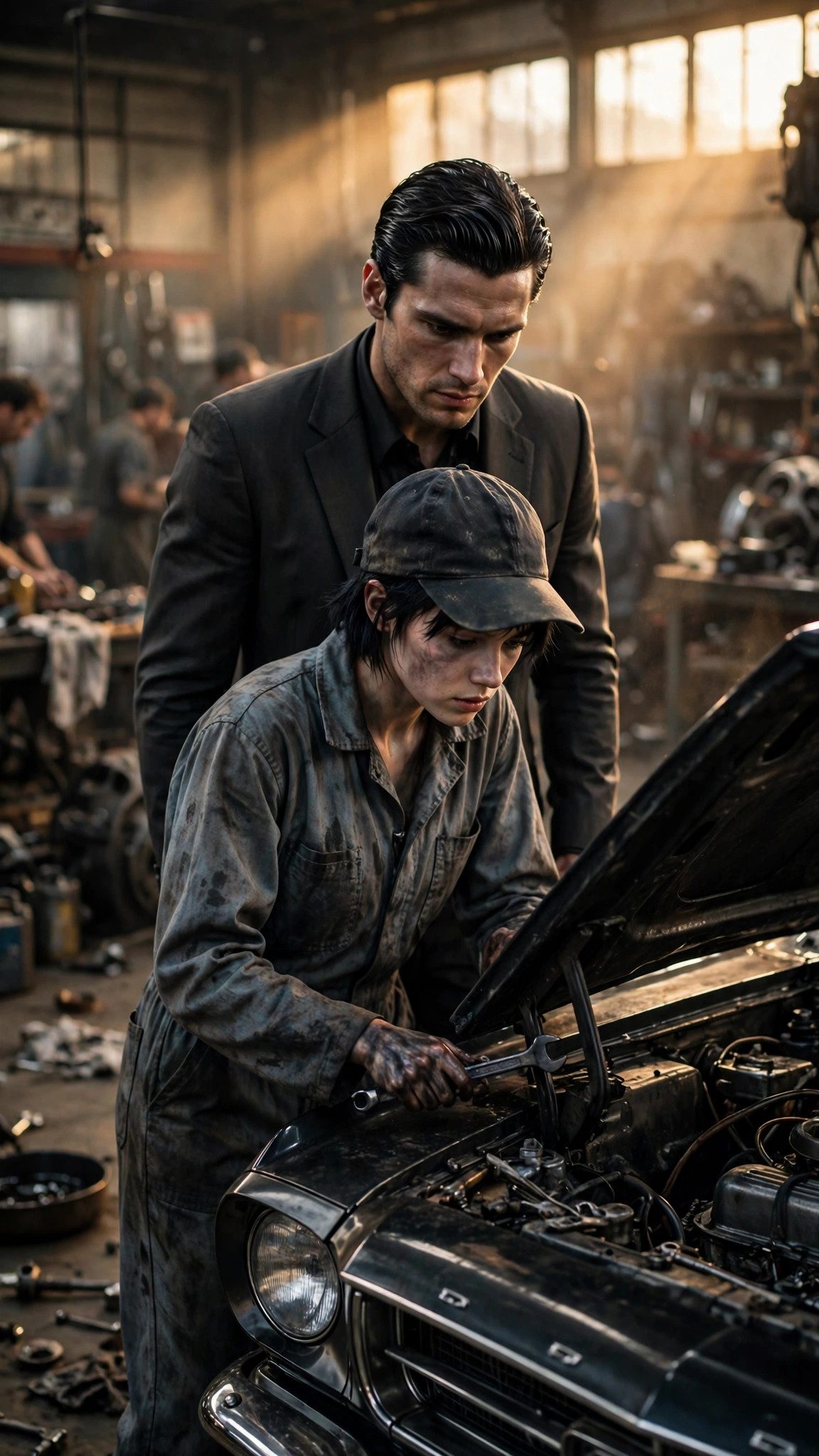
The first week at Moretti Motorworks, I learned that a lie is not one thing you say. It is a thousand small things you do, every day, without stopping, and the moment you get tired and let one of them slip, the whole thing falls apart.
I woke at 4:45 every morning in the room above the laundromat, in the dark, and I bound my chest before I did anything else. The strips of sheet were rough against my skin, and by the end of the day they itched so badly I wanted to tear them off, but I never did. Not in the shop. Not ever. I pulled on Michael's old work pants and a flannel shirt two sizes too big, darkened my eyebrows with the pencil I kept in my tool roll, and tucked what was left of my hair under a baseball cap. I practiced my voice in the cracked mirror over the sink — low, flat, bored — until it stopped sounding like a woman pretending and started sounding like a young man who did not care about anything.
"My name is Eli Ross." I said it to the mirror every morning, the way other people said a prayer.
Then I walked the twelve blocks to the shop in the dark, and I was Eli Ross by the time I pushed through the steel door.
Tony Mercer ran the floor. He was fifty-two, built like a refrigerator, with hands that had been fixing engines since before I was born, and he had exactly three rules for his mechanics: show up on time, do the work right, and don't ask questions about the cars that came in after dark.
"Some of these cars belong to men who don't want their business discussed," he told me on my first day, jerking his thumb at a black armored SUV with bulletproof glass that had come in on a flatbed at midnight. "You fix what's broken. You don't look in the trunk. You don't read the paperwork. You don't remember the license plates. Understand?"
"Yes, sir."
"Good. And one more thing. Mr. Moretti owns this place. He comes in most days, but he doesn't talk to the mechanics. He watches. If he ever looks at you twice, you're done. Understand?"
I understood. I had spent my whole life being looked at — at parties, at dinners, at the country club, at my father's table — and being looked at had never once kept me safe. Being invisible was the only thing that ever had.
So I became invisible. I kept my head down. I worked fast and clean and I never complained. I never stayed after work. I never drank with the other mechanics when they went to the bar on Fridays. I never used the locker-room showers — I told Tony my skin broke out from the soap, which was a lie, but it was a small lie, and small lies were the ones I could afford. I ate lunch alone on the loading dock, a sandwich I made in my room the night before, and I watched the pigeons on the power lines and tried not to think about the life I had left behind.
The other mechanics were decent men, mostly. There was Ray, who was sixty and had a bad knee and a daughter in college. There was Marcus — no, not Marcus, I could not hear that name without my stomach turning — there was a mechanic named Eddie, who was twenty-four and talked too much and asked me once if I wanted to come to a Cubs game with him and his brother. I said no. I said no to everything. Eli Ross said no to everything, because yes was a door, and doors led to questions, and questions led to the truth.
"You're a strange kid, Eli," Eddie said one afternoon, wiping his hands on a rag. "You never talk. You never laugh. You work like a machine. What's your story?"
"I don't have a story," I said.
"Everybody has a story."
"Not me," I said, and I went back to the engine I was working on, and Eddie got the message, and after that he left me alone. Mostly.
The work itself was the only part that felt honest. Engines did not care who I was. A misfiring cylinder did not care about my name. A cracked gasket did not care about my past. There was a problem, and there was a reason, and the reason could always be found if you listened carefully enough. Michael had taught me that when I was twelve, sitting on a stool in our father's garage while he took apart a carburetor and explained what every sound meant.
"Listen," he used to say, tapping the side of his head. "The engine tells you what's wrong. You just have to learn how to hear it."
Michael had been the only person in my family who ever really saw me. He was four years older, and he was supposed to take over my father's business one day, and instead he spent his weekends in the garage with grease on his hands and me on the stool beside him, teaching me everything he knew. When he died on the Kennedy Expressway — a drunk driver, a rainy night, a phone call at 2 a.m. that split my life in half — I lost the only person who had ever asked me what I wanted.
After Michael died, my father stopped looking at me altogether. I think I reminded him too much of what he had lost. And then Marcus Bellamy came into our lives, and my father saw a way to turn his remaining daughter into something useful, and the wedding was arranged, and nobody asked me anything at all.
I thought about Michael every day in that garage. I wore his clothes. I carried his tool roll. I used the wrench he had given me on my sixteenth birthday, the one with my initials scratched into the handle — E.R., Elena Russo, which was convenient, because Eli Ross had the same initials, and nobody ever noticed. Sometimes, when I was alone under a hood with an engine humming in front of me, I could almost hear him: "Listen. The engine tells you what's wrong."
Dante Moretti came into the shop most mornings at nine. I learned his routine the way I learned everything in that place — by watching without being seen. He arrived in a black car with a driver, walked through the steel door without looking at anyone, and went straight up the metal stairs to his office. Sometimes he came down to the floor in the afternoon and walked slowly between the bays, his hands behind his back, looking at the cars. He never spoke to the mechanics. He never raised his voice. He did not need to. The whole garage changed when he was on the floor — men stood straighter, worked faster, stopped talking. It was not fear, exactly. It was something quieter than fear. It was the knowledge that this man had built an empire on noticing things, and nobody wanted him to notice them.
For seven months, he never noticed me. I made sure of it. When he walked the floor, I kept my head under a hood. When he passed my bay, I turned my back. I was a shadow in coveralls, and shadows do not get looked at twice.
But there were close calls. There were always close calls.
The first one came in my second week. I was working under a lift, and my cap slipped off, and my hair — what was left of it, short and ragged from the scissors — fell across my forehead. Ray was standing three feet away. He glanced at me, and I saw his eyes narrow, just for a second, and then he looked away, and I shoved the cap back on with hands that were shaking.
"Your hair's getting long, kid," he said, not unkindly. "You should get it cut."
"I will," I said, and that night I took the scissors to it again, in the bathroom above the laundromat, cutting it shorter and shorter until it looked like a boy's haircut done by a boy who did not care.
The second close call was worse. It was a hot day in July, and the garage was like an oven, and I was sweating through my flannel shirt, and Eddie came up behind me and clapped me on the shoulder, hard, the way men do with each other.
"Jesus, Eli, you're built like a —" He stopped. His hand was still on my shoulder. I froze. I could feel his fingers pressing against the binding under my shirt, and I knew, I knew, that he could feel something wrong, something that did not belong on a young man's chest.
He pulled his hand back slowly.
"Like a what?" I asked, and my voice came out steady, somehow, steady and low and bored.
"Like a stick," he said, and he laughed, a little too loudly. "You need to eat more, kid. You're all bones."
"Yeah," I said. "My mother used to say the same thing."
It was the first true thing I had said to anyone in weeks, and it almost broke me. My mother had said that. She had said it while she put extra food on my plate, while she laughed, while she was still alive and the world still made sense. I turned back to the engine and I did not say another word for the rest of the day, and Eddie did not touch me again.
My first payday came at the end of my second week, and Tony handed me an envelope with cash in it — four hundred and sixty dollars, counted out in twenties — and I stood there holding it like it was something holy. It was the first money I had ever earned that was entirely mine. Not my father's money. Not Marcus Bellamy's money. Mine. I had fixed engines, and someone had paid me for it, and nobody had asked me to smile for photographs or sit beside a man I feared.
That night I walked to the grocery store and bought real food for the first time since I had left Lake Forest — bread, and eggs, and a small bag of apples, and a bar of chocolate I ate standing in the doorway of the laundromat, because I could not wait until I got upstairs. I sat on my mattress with the chocolate and the apples and the envelope with the rest of the money in it, and I counted it three times, and I thought about Michael, who had always told me that the best feeling in the world was finishing a job with your own two hands and getting paid for it honestly.
"You'll see," he used to say, wiping grease off his forehead with the back of his wrist. "One day you'll fix something nobody else can fix, and you'll know. You'll know you're good at this, Elena. And nobody will ever be able to take that away from you."
He was right. Nobody could take it away from me. Marcus could take my name, and my father could take my home, but they could not take the fact that I could hear what was wrong with an engine and fix it. That belonged to me, and only to me.
The other thing I learned in those early weeks was the history of the shop itself, and I learned it from Ray, who had worked there longer than anyone except Tony. Ray told me, over lunch on the loading dock one afternoon, that the shop had belonged to Dante's father before Dante, and that the old man had built it with his own hands, brick by brick, after coming to America with nothing.
"Salvatore Moretti," Ray said, squinting into the sun. "That was his name. He fixed cars for thirty years in this very building. And when he died, Dante took over. He was twenty-two years old. Twenty-two, and already running the family business, and this shop, and everything else. He never had a chance to be young, that one. He went straight from being a son to being a boss."
"Does he ever talk about his father?" I asked, before I could stop myself.
Ray shook his head. "Never. Not a word. But he kept the Mustang. His father's car. He keeps it running, and he brings it in here himself, and he watches every bolt that goes into it like it's made of gold. That car is the only thing in this whole building he cares about the way his father did."
I thought about that for a long time afterward. I thought about a twenty-two-year-old boy who had lost his father and inherited an empire, and who had kept one old car running for sixteen years because it was the only piece of his father he had left. And I thought about my own father, who was still alive, and who had sold me to a man I feared, and I wondered which of us had really lost a father, and which of us had only lost the idea of one.
The third close call was the worst of all, and it had nothing to do with the shop.
It was a Saturday morning, my day off, and I was buying groceries at the corner store in a baseball cap and sunglasses, and I heard a voice behind me say, "Elena?"
I did not turn around. I did not move. I stood in front of the canned beans with my hand frozen in midair, and I waited, and the voice said it again, closer this time: "Elena Russo? Is that you?"
It was a woman from my father's world — a charity gala woman, diamonds on her fingers, a voice I had heard a hundred times at parties I had not wanted to attend. I kept my back to her. I kept my head down. I picked up a can of beans and I put it in my basket, and I walked to the next aisle, and I did not look back.
"I'm sorry," I said, in Eli's voice, low and flat. "You have the wrong person."
"Oh," she said, and I could hear the doubt in her voice. "I'm sorry. You just — from behind, you looked like someone I used to know."
I paid for my groceries and walked out of the store, and I did not run, because running would have given me away, and I walked all twelve blocks back to my room above the laundromat, and I locked the door, and I sat on the floor with my back against it, and I shook for an hour.
That was the night I almost left Chicago. I sat on my mattress with my duffel bag half packed, and I thought about getting on a bus to somewhere nobody had ever heard of Elena Russo — St. Louis, or Kansas City, or Denver — and starting over again as someone else entirely. But Eli Ross had a job, and Eli Ross had a room, and Eli Ross was surviving, and starting over meant giving up the one thing that was working. And besides, I thought, where would I go? Marcus had investigators. My father had connections. The only place Elena Russo could hide was inside Eli Ross, and Eli Ross lived in Chicago, in a garage on the West Side, under the roof of a man who had never once looked at him.
So I stayed. I went back to the shop on Monday morning, and I kept my head down, and I fixed engines, and I told myself that if I was careful enough, and quiet enough, and invisible enough, I could do this forever.
I was wrong. I just didn't know it yet.
The thing about being invisible is that it works until the day it doesn't. And the day it stops working is never the day you expect. It is an ordinary Tuesday, with an ordinary car, and an ordinary problem that nobody else can solve, and you open your mouth before you think, and you say, "Start it again," and the whole garage goes quiet, and the most dangerous man in Chicago turns around and looks straight at you.
And for the first time in seven months, someone finally sees you.
And you realize, too late, that being seen was the one thing you were afraid of — and the one thing you had been waiting for all along.