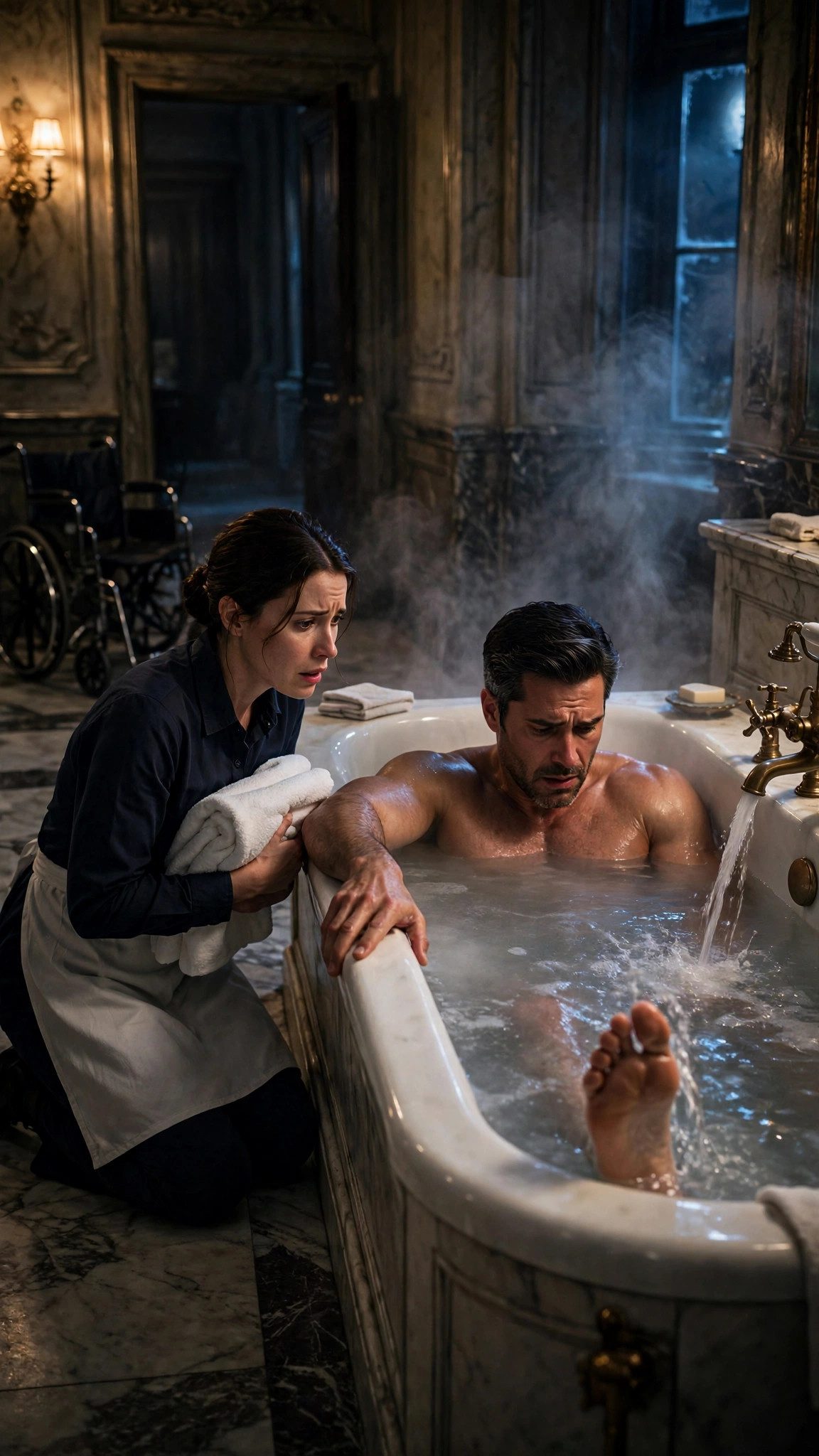
The bathwater was hot enough to burn him, and Maxwell Rourke did not react.
Then Martha Kovak turned on the cold tap, and his right foot pulled away.
A man paralyzed from the chest down was not supposed to do that.
Steam filled the third-floor bathroom of Rourke House until the mirrors disappeared. Martha stood just inside the doorway with six folded towels pressed against her chest and tried to remember exactly which mistake had brought her there.
Six days earlier, she had been hired to clean downstairs rooms. Not bedrooms. Not offices. Definitely not the private third floor occupied by Maxwell Rourke, the thirty-nine-year-old shipping magnate newspapers called a waterfront entrepreneur and prosecutors called something less flattering when the microphones were off.
Everyone in Providence knew the Rourke name. The legal side owned trucking companies, warehouses, marine terminals, and enough waterfront property to make city council members return calls quickly. The illegal side was never described quite as clearly. People said containers moved through the Rourke docks without inspection. They said bookmakers paid for protection. They said men who borrowed money from the wrong people occasionally left Rhode Island without notifying their landlords.
Martha did not know which rumors were true. She knew only that grown men lowered their voices in his house. And that Maxwell Rourke had been in a wheelchair for fourteen months.
"Out."
His voice came from somewhere beyond the steam. Martha tightened her grip on the towels.
"Sir, Miss Delaney told me these were needed."
"Then leave them."
She should have. She needed this job too badly to test the temperament of a man whose reputation could empty a hallway. But something in the bathroom felt wrong. Not dangerous in the way Maxwell was dangerous. Clinical. Familiar. Martha had spent six years working in nursing homes and rehabilitation centers before a medication error ended her career. Training stayed in the hands after paperwork took away the title.
The room was too hot. Not just humid. Hot.
She stepped closer. Maxwell sat in a wide therapeutic tub near the window, shoulders above the water, one arm resting along the edge. His chest and upper arms carried the hard strength of a man who had once used his body without thinking about it. Below the ribs, nothing moved.
His face turned slightly. "Did you misunderstand me?"
"No, sir."
"Then why are you still here?"
Martha put the towels down. The steam rolled over her face. She knelt beside the tub and lowered the inside of her wrist into the water. Heat bit immediately. She pulled back.
"Because this water is too hot."
His expression did not change. "It's fine."
"It isn't."
"I can't feel it."
"That is exactly why it isn't fine."
That got his attention. Not much. His eyes moved to her face. Dark gray. Cold. Too observant.
"Who told you to check my bath?"
"No one."
"Then stop improvising."
Martha leaned across the tub and opened the cold tap. Water rushed in beside Maxwell's right leg. His foot jerked away. Not violently. Six inches, maybe less. Enough.
Martha stopped breathing. She stared. The toes had pulled back. The ankle had shifted.
Maxwell's face changed. For the first time since she had entered Rourke House, he looked afraid. Not surprised. Afraid.
Which told her something worse. He had noticed things before.
—
Six days earlier, Martha had stood on the front steps of Rourke House with a borrowed coat and a resume that ended in a lie of omission. The house rose three stories above the East Side of Providence, gray stone and black iron, with a view of the water that made the whole city look smaller than it was. A woman of fifty-eight with iron-gray hair pulled into a knot opened the door before Martha could knock twice.
"Miss Delaney," the woman said, as if the name were a job description. "Housekeeper. You are the new girl."
"Martha Kovak."
"Downstairs rooms only. The kitchen, the dining room, the library, the hall. You do not go upstairs without being sent. You do not speak to Mr. Rourke unless he speaks to you. You do not ask questions about the family. Do you understand?"
"Yes, ma'am."
Miss Delaney looked at her the way people look at a stray dog they have decided, against their better judgment, to feed. "You worked at Harborview."
"Six years. Rehabilitation."
"And you left."
Martha had rehearsed this answer in the mirror of her small apartment in Pawtucket for three nights. "I made a medication error. A patient died. I lost my license."
She did not add the rest. She never added the rest, because the rest sounded like an excuse, and excuses were what guilty people made. The rest was that the chart had been wrong before she ever touched it. The dose on the page was ten times what the doctor had ordered, written in a hand that was not hers, and by the time anyone looked closely, the original order had been corrected in the system and her signature was the only one left on the page. The night nurse, Denise Fallon, had cried at the hearing and said she could not remember who had written what. The board had revoked Martha's license anyway. A dead man named Walter Abernathy, seventy-one years old, a retired schoolteacher who had liked crossword puzzles and called her "dear," was gone, and Martha had carried that weight for two years without ever being allowed to set it down.
Miss Delaney studied her for a long moment. "We pay on Fridays. Cash. You start in the kitchen."
That was how Martha Kovak, thirty-four years old, a former rehabilitation nurse with a revoked license and a dead patient she could not stop seeing in her sleep, came to clean the downstairs rooms of the most feared man in Providence.
The first day, she learned the geography of the house the way nurses learn a ward: by walking it until her feet knew it. The kitchen was enormous and cold in the mornings, with a stove the size of a small car and a pantry full of things no one seemed to eat. The dining room had a table that could seat twenty and chairs that looked as if no one had sat in them for months. The library smelled of leather and pipe smoke, and the books were the kind people buy by the yard. The hall had a staircase that rose to the second floor and then, narrower and darker, to the third.
She did not go up. She was not sent. She cleaned what she was told to clean, and she listened, because listening was the other thing training had left in her hands.
The house talked the way houses do when the people in them think the help cannot hear. The driver, Tony Ferraro, a broad man of fifty with a voice like gravel, told the cook that Mr. Rourke had not left the house in three weeks except for a doctor's appointment. The cook, a round woman named Rosa who had been there twenty years, said the night nurse, Cole Bennett, had been coming late three nights running and smelled of whiskey when he arrived. Miss Delaney said Mr. Rourke's uncle, Victor Rourke, visited every Tuesday and always left the study door closed behind him.
On the third day, Martha saw Maxwell Rourke for the first time. She was polishing the banister in the hall when the elevator at the back of the house opened — the house had an elevator, installed after the shooting — and Tony wheeled him through toward the library. Maxwell was bigger than Martha had expected. Broad shoulders, dark hair going gray at the temples, a face that had been handsome before something in it had gone hard. He wore a charcoal sweater and dark trousers, and his hands rested on the wheels of his chair with the easy strength of a man who had spent fourteen months learning to move himself.
He did not look at her. She did not speak to him. Miss Delaney's rules were clear.
On the fourth day, she found a thermometer in the kitchen drawer while she was looking for a corkscrew. It was a digital meat thermometer, the kind with a thin steel probe. She held it for a moment, turning it over in her hand, and then she put it back. She did not know why she had noticed it. She only knew that her hands had always remembered the tools of her old work, the way a musician's hands remember an instrument.
On the fifth day, Rosa told her that Mr. Rourke took his bath at seven-thirty every evening, and that Cole Bennett drew it for him, and that the water had to be hot because Mr. Rourke liked it hot, and that no one was to disturb him during it.
On the second day, Miss Delaney inspected Martha's work in the library with the slow thoroughness of a woman who had spent thirty years finding fault in other people's cleaning. She ran a gloved finger along the top of the bookshelves, checked the corners of the window frames, and looked at the polished table in the light from the window.
"You clean well," she said at last, and it sounded like a reluctant admission. "Harborview taught you that."
"Harborview taught me to be thorough," Martha said. "A dirty room in a rehabilitation center is not an inconvenience. It is an infection waiting to happen."
Miss Delaney's expression softened, just a fraction. "My sister was in Harborview," she said. "After her hip. The nurses there were kind to her." She paused. "I read your file, you know. The medication error. The hearing. I read all of it before I hired you."
Martha's hands went still on the polishing cloth. "And you hired me anyway."
"I hired you because the file also said you had six years without a single complaint before that night, and because the file said the dose on the chart did not match the dose the doctor ordered, and because no one at the hearing could explain why." Miss Delaney folded her arms. "I have run this house for thirty years, Miss Kovak. I know the difference between a woman who makes a mistake and a woman who is blamed for one. Now finish the shelves. The dining room is next."
That afternoon, Martha was polishing the dining room table when she saw Maxwell Rourke through the tall windows, out in the garden. Tony had wheeled him to the end of the path, where the garden overlooked the water, and left him there alone. He sat very still, his hands on the wheels of his chair, looking out at the harbor the way a man looks at a place he used to belong to. He stayed there for an hour, unmoving, while the light changed on the water. Martha watched him from behind the glass, and she thought about the patients she had known at Harborview — the ones who sat by the windows and stared at the parking lot, not because they wanted to go anywhere, but because they wanted to remember what going somewhere felt like.
She thought about Walter Abernathy then, too, the way she always did when she saw a man sitting alone. He had liked to sit by the window in the day room with a crossword puzzle, and he had called her "dear," and on his last good day he had finished the whole puzzle without asking for help and held it up for her to see, proud as a schoolboy. The hearing had lasted three days. Denise Fallon had cried on the second day and said she could not remember who had written the dose on the chart. The board had looked at Martha's signature and made its decision. No one had asked why the original order had been corrected at two in the morning, four hours after Mr. Abernathy died. No one had asked who had been on the night shift. Martha had walked out of the hearing room with nothing — no license, no job, no way to do the only work she had ever been good at — and she had spent two years cleaning other people's rooms, telling herself that it did not matter, that hands were hands, that work was work.
It mattered. It had mattered every single day.
On the sixth day, at twenty minutes past seven in the evening, Miss Delaney found Martha in the kitchen and put six folded towels into her arms.
"Take these to the third floor," she said. "Mr. Bennett is late again. Mr. Rourke is already in the bath. Leave the towels and come straight back down."
Martha carried the towels up the narrow stairs, past the second floor with its closed doors, to the third floor where the air smelled of steam and eucalyptus and something medicinal. The bathroom door stood open. The mirrors had disappeared behind the fog. And the water, when she finally knelt beside the tub and tested it with her wrist, was hot enough to burn a man who could not feel it.
She opened the cold tap. The water rushed in beside his right leg. And his foot pulled away.
Six inches. Maybe less. Enough.
Maxwell Rourke looked at her with fear in his dark gray eyes, and Martha Kovak understood, in the space of a single breath, that the most dangerous man in Providence had been keeping a secret for a very long time — and that someone in his own house had just tried to kill him with a bathtub full of scalding water.
"Say nothing," he said quietly.
Martha looked at the foot that had moved. She looked at the water. She looked at his face.
"How long?" she asked.
He did not answer. He did not have to. The fear in his eyes was answer enough. He had noticed things before. He had noticed them for months. And he had told no one, because the person who had shot him fourteen months ago was still close enough to finish the job.
"Say nothing," he said again.
Martha nodded slowly. She picked up the towels. She set them on the rack by the door, exactly where Miss Delaney would have wanted them. And as she turned to leave, she said, in the calm voice she had once used with patients who were afraid to tell her the truth about their pain, "The water was one hundred and eighteen degrees. I know, because I tested it. Whoever drew this bath wanted you hurt. And you already knew that before I walked in."
She left the bathroom. She walked down the narrow stairs, past the second floor, into the kitchen, where Rosa was wiping down the counters and the evening went on as if nothing had happened.
But something had happened. A foot had moved. A man who was supposed to feel nothing had felt the cold. And Martha Kovak, who had lost everything because of one mistake she did not make, had just walked into the one house in Providence where a mistake like that could get her killed.