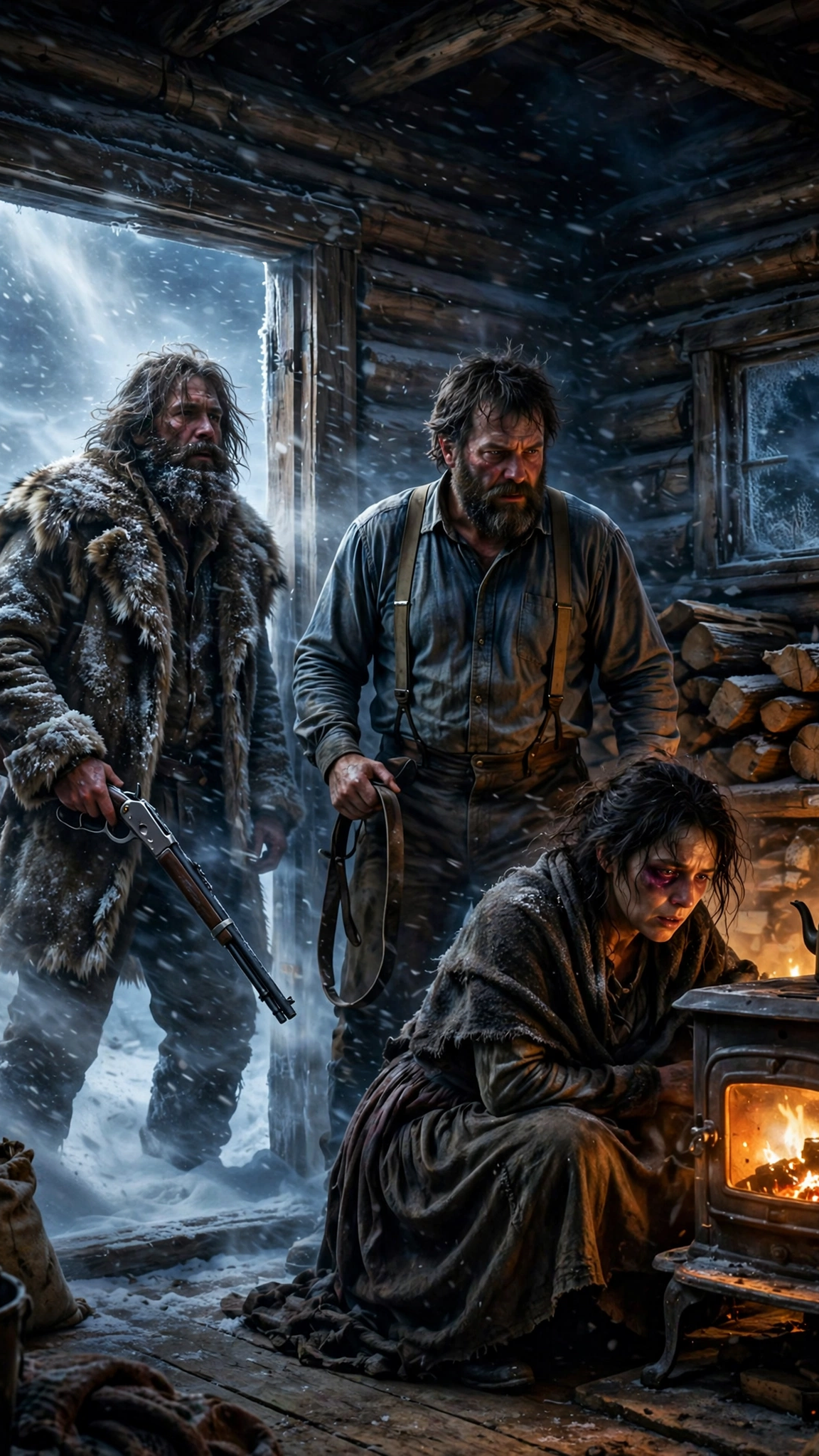
The belt cracked against the chair beside her head, and Hazel did not scream.
She had learned, over three years in this cabin, that screaming made it worse. Screaming gave him a reason. Silence gave him nothing but the sound of his own anger, and so she crouched beside the chair with both hands protecting her head and waited for the leather to find her or not find her, the way a rabbit waits in the grass when the hawk's shadow passes over.
The iron stove burned behind them. The whole cabin shook beneath the blizzard. Wind drove itself through the gaps in the warped timber walls and made the lanterns sway on their nails, and the frost on the windows glowed cold and blue while the firelight painted everything else orange.
Baron stood over her, the belt still in his fist, his face flushed with whiskey and rage, his breath coming hard enough that she could smell it from where she crouched.
"I told you to keep that woodbox full!"
Hazel said nothing. Her hands stayed over her head. Her left eye was swollen nearly shut from the morning — he had caught her with the back of his hand before breakfast, for burning the porridge — and through the slit that remained she could see his boots, caked with mud and snow, planted wide on the plank floor as if he owned the ground itself.
The woodbox was not full. She knew it was not full. She had filled it at noon, and he had burned through it all afternoon sitting by the stove with the bottle, feeding the fire log after log as if the wood were free and the winter were short and the nearest stand of timber were not three miles away through snow that came up to a man's knees. She had meant to fill it again before dark. She had been mending his shirt when the light went. That was the truth of it, and the truth did not matter. The truth had never mattered in this cabin. What mattered was that he had a belt in his hand and a reason in his mouth, and the storm outside was strong enough that no one for twenty miles would hear anything at all.
He raised the belt again. The leather sang as it came up.
And then the knocking came.
Three heavy knocks. Slow. Deliberate. A fist against the heavy wooden door, louder than the wind.
Baron froze with his arm in the air. Hazel's eyes lifted toward the door, and for one moment her heart did something it had not done in three years. It hoped.
A deep male voice came through the storm, calm as still water.
"A man needing a fire."
Baron stared at the door. His mouth worked. He looked down at Hazel, and she saw the calculation move across his face — a stranger, in a blizzard, at his door, and a shotgun leaning by the woodbox, and the belt still in his hand. He let the belt fall to his side, not dropped, not forgotten, only set aside for the moment, and he crossed the cabin in three strides and pulled the heavy wooden door open.
A blast of snow exploded inside. The wind shoved past him and tore at the lantern flames and threw a white sheet across the floor, and there in the whiteout stood the biggest man Hazel had ever seen.
He was motionless. Snow crusted his buffalo hide and wolf fur until he looked carved out of the storm itself. His beard was thick and iced at the edges. His hair hung long and weather-beaten beneath a fur hood. A Winchester hung naturally in one hand, the way another man might carry a walking stick. Behind him the blizzard howled white and blind, and the cold poured into the cabin like water through a broken dam.
Baron pointed his shotgun toward him. His hands shook — from drink, from cold, from something else he would never have named.
The stranger did not react. He did not raise his rifle. He did not step back. He stood in the doorway with snow swirling around his boots, and then, slowly, he held out his other hand, and in his palm lay several silver coins.
"Fire," he said again. "A man needing a fire."
Baron stared at the money. Hazel stared at the stranger. She had not seen another human face besides Baron's in five months, and the sight of this one — weathered, quiet, unafraid — felt like something she had forgotten how to want.
Baron took the coins. His fingers closed over them hard, the way a man closes his hand over something he is afraid will be taken back. He jerked his head toward the stove.
"Get in, then. And shut that door."
The stranger stepped inside and shut the door against the storm, and the cabin went quiet again except for the wind in the walls and the crackling of the stove. He stamped the snow from his boots, set his Winchester down within reach of his hand, and lowered himself onto the stool beside the hearth, holding his big hands out to the heat. He did not look at Hazel. He did not look at Baron. He looked at the fire, and the fire looked back at him, and Hazel understood, without knowing how she understood it, that this man was not afraid of anything in this cabin.
She rose slowly from beside the chair. Her legs shook. She kept her eyes down, the way she had been taught — the way three years had taught her — and she went to the stove to put the coffee on, because that was what a wife did when a guest came in from the cold, even in a house like this one. Especially in a house like this one.
The battered percolator sat on the shelf. She took it down with both hands and filled it at the bucket, and she carried it carefully across the plank floor toward the stove, past Baron where he stood by the table, past the stranger warming his hands.
Baron extended his boot.
It was deliberate. She saw it happen. She saw his leg come out, slow and casual, and there was nothing she could do about it because her hands were full and her feet were already moving and the floor was wet where the snow had melted.
She tripped. The percolator crashed onto the wooden floor. Water splashed across Baron's trousers. Hazel hit the edge of the table and dropped beside the chair, her hands going up to protect her head before she had even finished falling, and the cabin went silent except for the wind.
Baron's face hardened. The red drained out of it and left something pale and cold behind, and when he spoke his voice was low and flat, which was worse than shouting.
"You clumsy, stupid woman!"
He struck her once with the back of his hand. It was not a hard blow by his measure — a cuff, a correction, the sort of thing he would later call nothing — but it was enough to knock her against the chair, and she curled inward the way she had learned to curl, small and tight, waiting for the rest of it.
He reached for his belt. The leather scraped through the brass buckle as he pulled it free, and the sound of it filled the cabin the way the wind filled the walls.
In the background, the stranger slowly looked up from the hearth.
His expression changed almost imperceptibly. Nothing in his face moved very much. But something behind his eyes went still and cold, the way a lake goes still before it freezes, and he rose from his stool without a sound, the Winchester coming up into his hands as if it had been waiting there all along.
Baron stood over Hazel with the belt raised. Hazel curled inward, expecting another blow, her hands over her head, her swollen eye squeezed shut.
Then — CLACK.
The unmistakable sound of a Winchester being cocked.
Baron stopped instantly. He did not move. He did not breathe. The belt hung in his hand, forgotten, and the cabin held its breath along with him.
Hazel opened her eye. The stranger was standing now, the Winchester firmly against his shoulder, the barrel aimed directly at Baron's chest. His breathing remained calm. His hands did not shake. The blizzard howled through the gaps in the walls, and the stove crackled, and the water from the percolator spread slowly across the plank floor, darkening the wood.
"Put the belt down."
Baron's arm came down slowly, as if the air had grown thick around it. The leather belt slipped from his fingers. It landed on the wet wooden floor with a flat slap, and it lay there, coiled and harmless, while Baron stared at the stranger with humiliation turning into suppressed hatred in his eyes.
The stranger's rifle never moved.
"Hit her again, and I'll put a hole through you." Harlon's voice was quiet.
Hazel slowly looked toward him, stunned that someone had finally intervened — that someone had finally, after three years, said the words out loud and meant them. Baron stared back at the stranger, and his face made it clear that he was not finished. Not by a long way.
The wind screamed. The fire burned. The rifle did not move.
And that was how it began.
—
Three years earlier, Hazel had arrived at this cabin in a wagon, in the spring, with a trunk full of her mother's things and a husband who had not yet raised his hand to her.
She had been twenty-three, and she had been a fool in the particular way that young women are fools when they have just buried a father and a man offers them a home. Baron had come to the settlement at Fort Laramie with a wagon of his own and a claim on the Dakota plains and a smile that had not yet learned to curl into something else. He had told her about the cabin he had built with his own hands, about the land, about the winters being hard but the summers being fine. He had told her she would never want for anything. She had believed him, because she had wanted to believe him, and because her father's house was gone and her father's debts had eaten everything except the trunk and the clothes on her back.
The wedding had been small. The fort's chaplain had married them in the morning, and they had set out by noon, and Baron had talked the whole way about the land and the timber and the creek, and Hazel had listened and thought that this was what a future sounded like.
The cabin had been smaller than he described it. The roof leaked in one corner. The floor was rough plank. But the stove was good, and the woodbox was full, and there was a garden patch already turned, and Hazel had stood in the doorway with the spring sun on her face and thought: I can make this a home. I can make anything a home, if I work at it hard enough.
She worked at it. She planted the garden. She mended the roof. She learned to bake bread in the iron stove and to salt pork and to make soap from ash and fat. She kept the cabin clean and the woodbox full and the coffee hot, and for the first two months Baron was kind to her in his rough, distracted way. He kissed her forehead in the morning. He brought her wildflowers from the creek bank. He told her she was a good wife.
The first blow came in the third month, over nothing. She had burned the beans. That was all. The beans had stuck to the pot and blackened, and Baron had come in from the field tired and hungry, and he had looked at the blackened pot and his face had gone still, and he had struck her across the mouth with the back of his hand, and she had fallen against the table, and the pot had clattered to the floor.
Afterward he had wept. He had held her and wept and said he was sorry, said it would never happen again, said the drink had done it, said the heat had done it, said he was not that kind of man. She had believed him. She had wanted to believe him. She had cleaned the blood from her lip and told herself that a marriage was hard work, and that hard work sometimes hurt.
The second blow came a month later, over a shirt. The third came over a fence post. By the first snow, she had stopped counting. She had learned the rules instead: keep the woodbox full, keep the coffee hot, keep her eyes down, keep her mouth shut, do not cry, do not answer back, do not leave the cabin without his permission, because the nearest neighbor was six miles away and the winter was coming and a woman alone on the plains had nowhere to go.
She had learned that the swollen eye healed in a week. She had learned that the bruises on her ribs healed in two. She had learned that fear could become a kind of furniture in a house — something you moved around without looking at, something that was simply there, in every room, all the time.
And she had learned, most of all, that no one was coming. The trader came twice a year. The fort was forty miles away. The blizzard shut the world out for months at a time. She was alone in a cabin with a man who owned her the way he owned the land, and the only sound that ever answered her was the wind.
Until the night of the knock.
Until the night a towering mountain man in snow-crusted fur stepped through her doorway with a Winchester in his hand and a voice as calm as still water, and said, "A man needing a fire," and everything in the cabin changed.
Hazel lay awake that night — the night the video ends, the night the rifle never moved — listening to the storm and to Baron's breathing in the dark, and to the stranger's slow, even breaths by the stove, and she thought about the wagon that had brought her here three years ago, and the girl she had been, and the woman she had become, and the one question that had kept her alive through all of it.
What would happen, she wondered, when a violent husband realized that the stranger in his cabin was no longer willing to sit and watch?