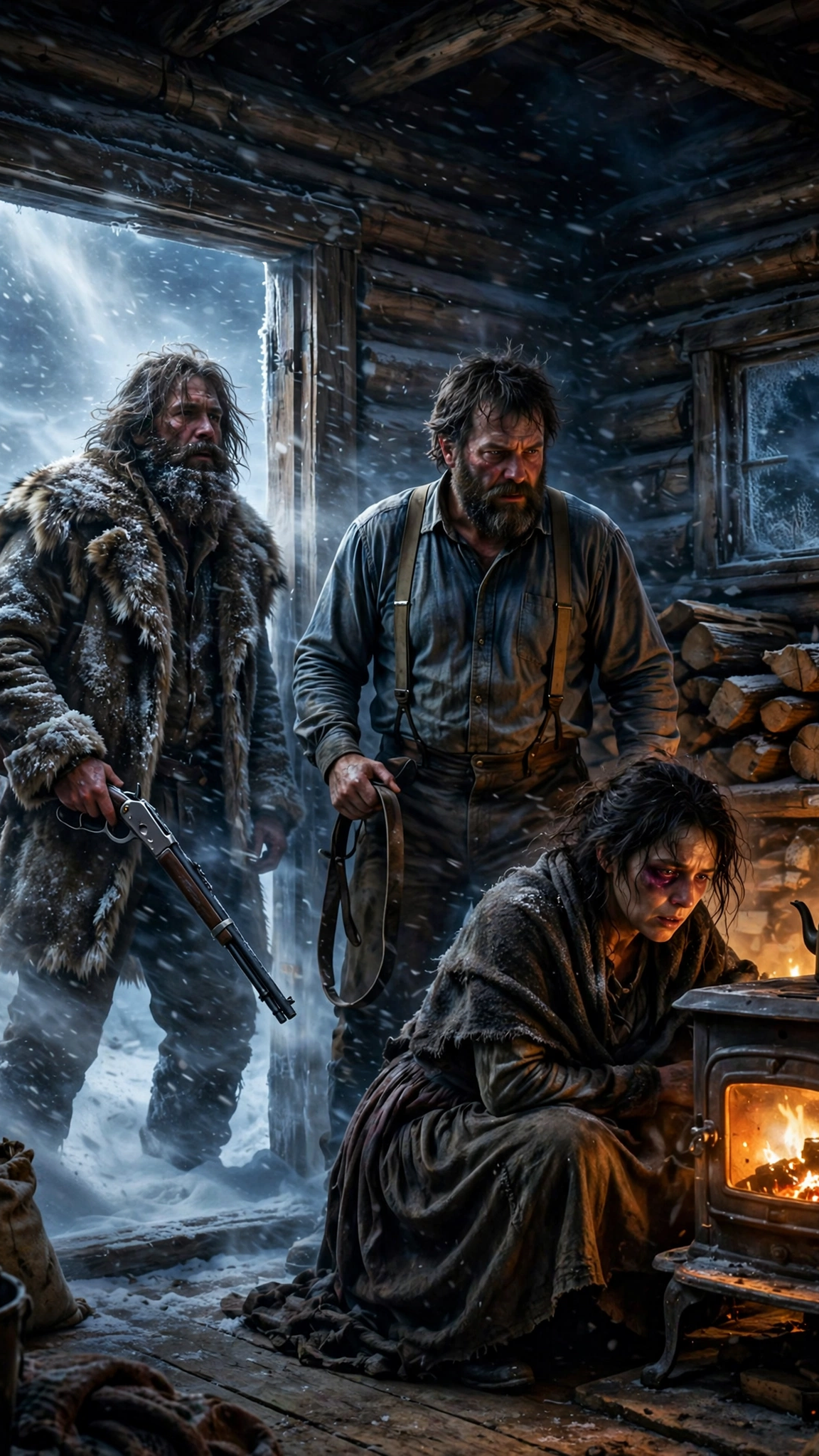
The first winter taught Hazel that cold could be a kind of prison.
It came early that year, in the middle of October, and it did not leave until April. The snow piled against the cabin walls until the windows were white slabs and the door would only open halfway, and the wind found every gap in the warped timber and sang through them day and night. Baron spent the days cutting wood and the evenings drinking, and Hazel spent the days keeping the fire alive and the evenings keeping out of his way.
She learned the rhythm of it the way a person learns the rhythm of a song they hate. In the morning he was sullen but quiet, and she could work in peace if she kept the coffee hot and the porridge unburned. By noon he was restless, pacing the cabin, finding fault with the floor, the roof, the garden tools, the weather. By evening, after the bottle had been opened, his hands were looking for something to hit.
It was never the same thing twice. A burned supper. A shirt with a loose button. A floor that was not swept to his satisfaction. A look — he was very particular about looks. A look that lasted too long, or a look that went away too fast, or a look that he imagined had been there when it had not. Hazel learned to keep her eyes on her work. She learned to move quietly. She learned to make herself small in a cabin that was already small, and to take up as little room as a person could take up while still being alive.
She was not the only woman on the plains who lived this way. She knew that, because once, in the second year, the trader's wife had come with the wagon, a thin woman with tired eyes who had looked at Hazel's swollen lip and said nothing at all, which was its own kind of message. The trader's wife had pressed a small tin of salve into Hazel's hand when Baron was not looking, and Hazel had hidden it under the floorboard beside her mother's trunk, and she had used it sparingly, a little at a time, because she did not know when she would get more.
The nearest neighbor was six miles away, a family named Odegard with a sod house and four children and a husband who was gone half the year freighting to the fort. Hazel had walked there once, in the second summer, on a day when Baron was away cutting timber. She had told herself she was going to borrow a cup of sugar. She had walked six miles through the heat with her shawl pulled tight around her shoulders, and Mrs. Odegard had given her the sugar and a glass of cold water and had looked at her — really looked at her, the way the trader's wife had looked at her — and had said, very quietly, "If you ever need to come here, you come. Day or night. You understand me?"
Hazel had understood her. She had thanked her and walked the six miles home, and she had never gone back, because Baron had come home early that day and found her gone, and what followed had taught her that the price of asking for help was higher than the price of silence.
That was the second year. The second year was when the harvest failed.
Baron's claim was poor land. She had not known that when she married him — she had not known enough about land to know the difference — but she learned it in the second summer, when the corn came up thin and yellow and the creek ran low and the garden withered in the heat. Baron blamed the weather. Then he blamed the seed. Then he blamed her. The garden was her work, after all. If the garden failed, the failure was hers, and the failure had to be paid for, and the payment was taken out of her skin.
He drank more that year. The bottle that had once lasted a week began to last three days, and then two, and then he was drinking in the morning, and the mornings became as dangerous as the evenings. He began to talk about the claim next door, about the Odegards, about how their land was better, about how the survey had been wrong, about how a man could not be expected to make a living on ground like his. He talked about it the way other men talked about the weather — constantly, and as if talking about it might change it.
The claim dispute came in the third spring. Baron rode to the fort and came back with papers and a face like a thundercloud, and he told Hazel that the land agent had laughed at him. Laughed at him. He had stood in that office and been laughed at, and the humiliation of it sat in him like a stone, and that night he broke two chairs and the wash basin and Hazel's left wrist — not badly, just enough that it swelled and ached for a week, and she learned to do everything with one hand.
After that, he stopped going to the fort. He stopped going anywhere. He stayed in the cabin, drinking, and the cabin grew smaller around them both, and Hazel began to understand something that frightened her more than the blows.
She was beginning to disappear.
It happened slowly, the way the snow piled against the walls. She stopped thinking about the future. She stopped remembering the girl she had been — the girl who had read books, who had laughed easily, who had believed that a home was something you built with love and work. She stopped looking in the small cracked mirror that hung by the door, because the face that looked back at her was not a face she recognized. It was a tired face. A careful face. A face that had learned to flinch before the blow landed.
She kept the woodbox full. She kept the coffee hot. She kept the stove burning. She did all of it the way a person does a task they no longer believe in — mechanically, perfectly, and without hope.
The third winter was the worst of them. It came in November with a storm that lasted four days, and it never really left. The snow was deep by Christmas, and the woodpile was shrinking, and Baron had stopped cutting timber because the cold hurt his lungs and the drink hurt his head, and Hazel had taken to cutting wood herself, in secret, in the mornings before he woke, hauling the axe out to the pile and working until her arms shook, because a cold cabin was more dangerous than a tired body, and because the woodbox had to be full. The woodbox always had to be full.
She remembered the day the storm began — the storm that would bring the stranger to her door. It had started as a gray morning, the sky low and heavy, and by noon the wind had risen and the snow had begun to fall sideways, and by dark the world outside the cabin had vanished entirely. Baron had come in from the woodpile with snow on his shoulders and whiskey on his breath, and he had looked at the woodbox and seen that it was half empty, and his face had gone still in the way she had learned to fear most.
She had filled it at noon. She had filled it again at three. But he had burned through it all afternoon, sitting by the stove with the bottle, and the wood was gone, and the fault was hers, because the fault was always hers, and she had known, the moment she saw his face, what the evening would bring.
She had been mending his shirt when the light went. That was the truth of it. A small, ordinary truth, the kind of truth that did not matter in this cabin.
She set the shirt aside. She went to the stove. She put the coffee on. She kept her eyes down and her hands busy, and she waited for the evening to unfold the way evenings always unfolded, and she thought about nothing at all, because thinking about nothing was the only safe thing left to think about.
Outside, the blizzard screamed. Inside, the stove crackled, and the lanterns swayed on their nails, and Baron sat by the fire with the bottle, and Hazel stood by the stove with her hands wrapped around a tin cup, and the cabin waited — the way it had waited for three years — for the next thing to happen.
She did not know that the next thing to happen would be a knock on the door.
She did not know that a towering mountain man in snow-crusted fur was fighting his way through the whiteout toward her cabin, following the smell of woodsmoke, carrying a Winchester and a handful of silver coins, and that he was about to walk through her doorway and change everything.
She knew only that the woodbox was half empty, and the storm was getting worse, and Baron was reaching for his belt, and the night was very young, and the winter was very long, and she was very tired of being afraid.
Then the belt cracked against the chair beside her head, and she did not scream, and the knocking came, three heavy knocks, slow and deliberate, and a deep male voice came through the storm and said, "A man needing a fire."
And Hazel, who had not hoped for anything in three years, hoped.
—
The thing Hazel missed most was not kindness. It was conversation.
She had been a talkative girl. Her father used to say she could talk the ears off a mule, and he had said it with pride, the way a father says it when his daughter's voice fills a house. In the settlement she had talked to everyone — to the women at the well, to the children in the yard, to the old men on the porch who told stories about the war and the crossing. She had been full of words, once.
Baron did not talk to her. He talked at her. He gave orders. He gave complaints. He gave his opinions about the weather and the land and the government, and he expected her to listen, and listening was all she was good for, as far as he was concerned. When she tried to talk back — when she tried to tell him about her day, or about something she had read in the one book she owned, a worn copy of poems her mother had given her — he would look at her as if she had spoken in a foreign language, and then he would find something wrong with the supper.
So she stopped talking. She kept her words inside herself, the way she kept everything else inside herself, and they piled up there, year after year, until she sometimes wondered if she would ever speak a full sentence again.
She spoke to the stove instead. She spoke to the garden. She spoke to her mother's trunk, which sat at the foot of the bed with its brass corners and its smell of lavender that had faded years ago. The trunk held her mother's dresses, folded in tissue, and her mother's Bible, and a small daguerreotype of her parents on their wedding day, and a pair of silver hair combs that Hazel had not worn since the wedding. She opened the trunk on Sundays, when Baron was out, and she would take out the Bible and read a psalm aloud, just to hear a human voice in the cabin — even if the voice was her own.
She also kept a small thing in the trunk that Baron did not know about. A knife. Not a weapon — a kitchen knife with a bone handle, the one her father had used to cut apples. She had hidden it there in the first year, after the second blow, and she had never used it, and she did not know if she ever would. But knowing it was there had kept her alive on the worst nights, the way a candle keeps a room alive when the fire has gone out.
She thought about the knife sometimes, when Baron was reaching for his belt. She thought about what it would feel like to hold it in her hand. She thought about whether she would have the courage. And then she thought about what would happen afterward — the fort forty miles away, the snow, the law, a woman alone on the plains with blood on her hands — and she put the thought away, the way she put everything away, into the trunk, under the floorboard, into the quiet part of herself where no one could reach it.
She did not know, that gray morning when the storm began, that she would never need the knife. She did not know that the answer to her silence was already walking toward her through the whiteout, a towering man in buffalo hide with a Winchester in his hand, a man who had lost his own wife to a fever and had spent ten years alone in the mountains learning how to be still.
She knew only that the woodbox was half empty. And the storm was getting worse. And the belt was in Baron's hand.
And then the knocking came.