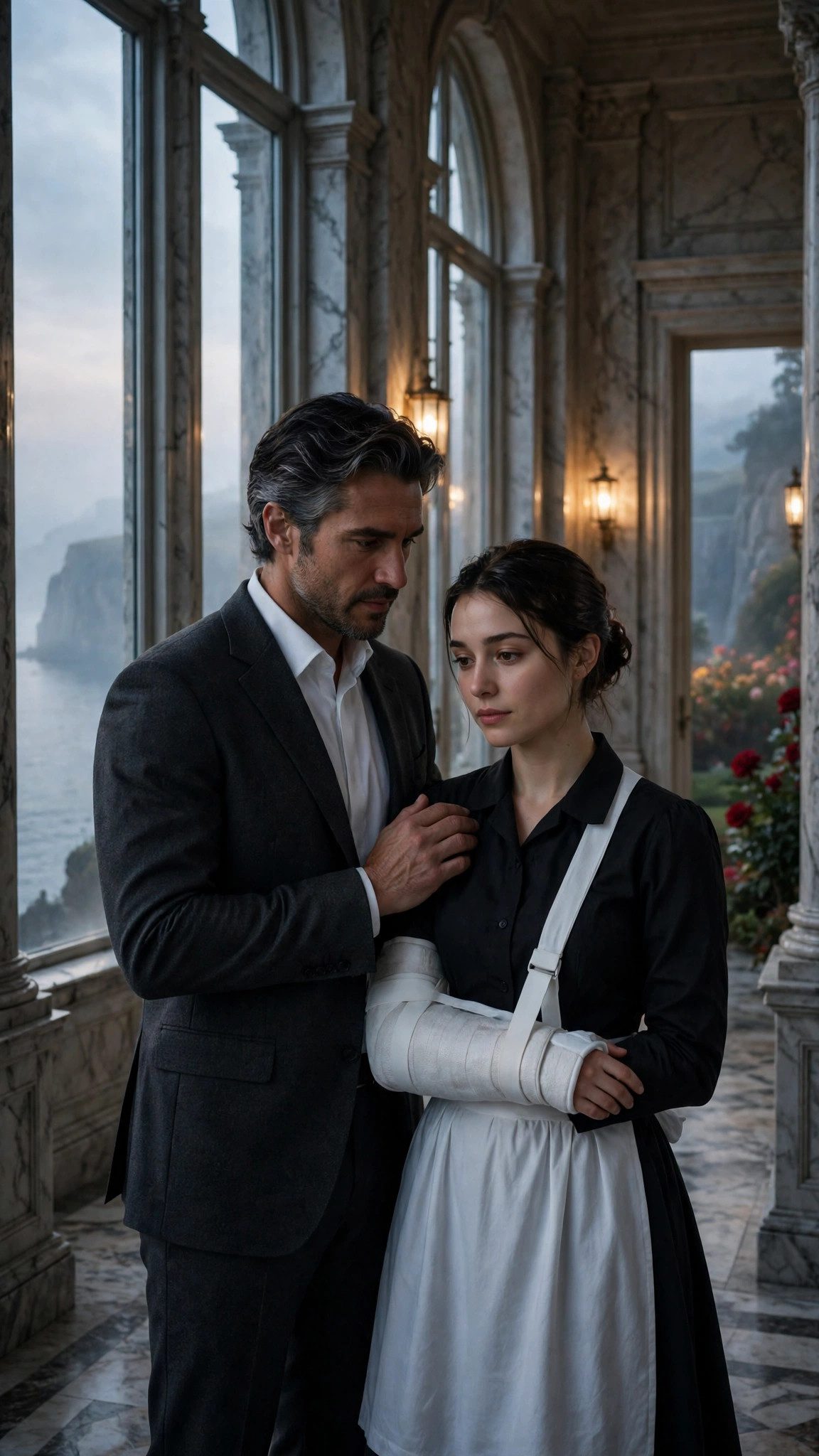
It was a spring morning, a year after the morning Damon Blackwell noticed my broken arm, when the house finally learned my name in full.
I woke up in the bedroom on the second floor, the one with the tall windows that looked out over the bay, and the sun was shining, and the roses in the garden were in bloom, and Mrs. Calloway knocked on my door and said, "Miss Kate, it is time."
I had not slept in that bedroom when I first came to the estate. I had slept in a small room in the staff wing, with a narrow bed and a single window. But over the months, things had changed, one small change at a time, and one day Damon had asked me to move into the second-floor bedroom, the one that had once been Marla's, and I had said yes, and Mrs. Calloway had helped me move my things, and she had hung my dresses in the wardrobe, and she had put my mother's photograph on the dresser, next to a photograph of Tommy, and she had said, "This room has been waiting for someone, Kate. I think it was waiting for you."
That morning, I put on a white dress, simple and plain, the way my mother would have liked it, and I pinned my dark hair up, and I put on the small gold locket that Tommy had given me on our wedding day, because I wanted him to be with me, in a way, on this day, and because I knew he would have wanted me to be happy.
Downstairs, the garden was full of people. My uncle Ray was there, in a suit he had bought for the occasion, standing stiffly beside the rose beds, looking as if he could not quite believe where he was. Mrs. Calloway was there, in her best dress, crying happy tears and pretending she was not. The staff were there, all of them, the cook and the drivers and the gardeners and the maids, and the children from the sailing school were there, and Agent Elena Vasquez was there, in a pale blue dress, smiling, and Tony was there, and even Daniel was there, on a day's leave from prison, standing quietly at the back, in a suit that did not quite fit him, and when he saw me, he nodded, and I nodded back, because we had both survived Victor Blackwell, and that was something.
And Damon was there, waiting for me at the end of the garden path, in a charcoal suit, with his dark hair greying at the temples, and a black eagle tattoo just visible at his wrist, and when he saw me, he smiled, and it was the same smile I had seen in Marla's photograph, the smile of a man who believes he will be happy forever.
We were married in the garden, among the roses Marla had planted, and the minister said the words, and Damon put a ring on my finger, and I put a ring on his, and when he kissed me, the children from the sailing school cheered, and Mrs. Calloway cried, and my uncle Ray took out his handkerchief and blew his nose very loudly, and everyone laughed.
That morning, before the ceremony, Mrs. Calloway had come to my room with a cup of tea, and she had sat on the edge of my bed, the way she had done on the morning after the arrests, and she had looked at me, and she had said, "Kate, I want you to know something. I have worked in this house for thirty years, and I have seen brides come and go, and I have seen wives who were loved and wives who were not, and I have never once seen a man look at a woman the way Mr. Damon looks at you. Not even with Marla, God rest her. He looks at you as if you are the first true thing he has seen in five years."
I had cried a little then, and Mrs. Calloway had handed me her handkerchief, and she had said, "None of that now. You will ruin your face. Marla would have wanted you to be happy, Kate. She was a kind woman, and kind women do not begrudge other women their happiness."
My uncle Ray walked me down the garden path, because my father was gone, and my mother was gone, and Tommy was gone, and Uncle Ray was the only family I had left, and he held my arm very tightly, and he whispered, "Your mother would be so proud of you, Kate. She would be so proud."
And when I reached Damon, and he took my hand, I thought about the morning he had noticed my broken arm, and about the fifteen men who had vanished, and about the house that had learned my name, and I thought about how strange life was, that the worst day of my life had also been the first day of my real life.
Afterward, we had a reception on the terrace, and there was music, and there was dancing, and Damon danced with me, and he held me close, and he whispered in my ear, "Do you hear that, Kate?"
"Hear what?" I asked.
"The house," he said. "Listen."
I listened. The house was full of music and laughter and the sound of people talking, and the staff were calling me "Mrs. Blackwell," and the children were calling me "Miss Kate," and my uncle was telling stories about my mother, and Agent Vasquez was telling stories about the trial, and the garden was full of roses, and the bay was shining in the sun, and the house, which had once been cold and silent and full of men who made people disappear, was warm, and loud, and alive.
"It learned your name," Damon said. "All of it. Kate Bennett Blackwell. The house knows who you are now."
That night, after the guests had gone, Damon and I walked through the house together, room by room, and he showed me things I had never seen: the portrait of his father in the study, the letters Marla had written to him, kept in a drawer in the library, the small brass plaque by the front door that his father had put there when the house was built, with the words "Blackwell House" engraved on it.
"We are going to change that plaque," Damon said. "Not the name. The name stays. But underneath it, we are going to add something. Do you know what?"
"What?" I asked.
"'This house belongs to everyone who lives in it,'" he said. "Because that is what Marla believed, and that is what you taught me, Kate. A house is not a building. It is the people in it. And the people in it have names, and the house should know them all."
We had the plaque made the next week, and it hangs by the front door to this day, and every morning, when I walk past it, I touch it, the way my mother used to touch the doorframe of our apartment for luck, and I think about how far I have come.
On Grace's first birthday, we had a party in the garden, and all the children from the sailing school came, and Mrs. Calloway baked a cake with pink frosting, and my uncle Ray brought Grace a small wooden boat he had carved himself, and Damon held her up so she could see the bay, and she laughed, and she reached out her little hands toward the water, as if she wanted to touch it.
Agent Vasquez came too, with a present wrapped in blue paper, and she sat with me under the rose arbor, and she said, "Kate, do you remember the first time I interviewed you? You were so frightened you could barely speak. And now look at you. You run a foundation. You run a sailing school. You run this house. Victor Blackwell is in prison because of you."
"I did not do it alone," I said.
"No," she said. "But you did it first. You were the first person in that house who told the truth, and the truth is contagious, Kate. Once one person tells it, other people find the courage to tell it too. That is how houses change. That is how families change. One person, telling the truth, at the right moment."
I thought about that for a long time afterward, because it was true, and because it was the most important thing anyone had ever said to me. I had not set out to change a house, or a family, or a city. I had only wanted to survive, and to keep my job, and to protect my uncle, and to hold onto my twenty-one dollars. But survival, it turned out, was not a small thing. Survival was the first step, and telling the truth was the second, and everything else — the trial, the foundation, the sailing school, the wedding, the baby — had followed from those two steps, one after the other, like roses blooming along a wall.
I think about my mother, Grace Bennett, who cleaned houses for twenty years and was never once asked her name, and I think about how proud she would be to know that her daughter's name is on the door of the finest house on the bay. I think about Tommy, who loved me and died too young, and I think about how he would have wanted me to be happy, and I am happy. I think about my uncle Ray, and his twenty-one folded dollar bills, and I think about the fact that I still have them, in the bottom drawer of my desk, and that I will never need them, but I will never throw them away, either, because they are a reminder of where I came from.
And I think about Damon, who saw a maid hiding a broken arm, and who decided, in that moment, that his house would be different, and who kept that promise, and who taught a house to learn a name, and who taught me that I was worth more than I had ever believed.
A year after our wedding, we had a daughter. We named her Grace, after my mother, and she has dark brown hair and grey eyes, and she runs through the corridors of the house, and the staff call her by her name, and the house knows her name, too, because a house that has learned one name can learn another.
Grace was born in the spring, on a morning when the roses were just beginning to bloom, and Damon held her in his arms in the hospital, and he cried, and he said, "She has your eyes, Kate. She has your mother's eyes." And Mrs. Calloway came to see her, and she held her, and she said, "She is a Blackwell, and she is a Bennett, and she will never have to be invisible, not in this house, not ever."
We brought her home to the estate, and we put her crib in the bedroom with the tall windows, and at night, when the house was quiet, I would stand by her crib and watch her sleep, and I would think about my mother, who had never lived to see a grandchild, and about Tommy, who had never lived to be a father, and about Marla, whose roses bloomed outside the window, and I would feel grateful, and sad, and happy, all at the same time, the way a person feels when life has given them more than they ever dared to ask for, and taken away more than they ever thought they could bear.
When Grace was six months old, Daniel came to visit, on a weekend leave from prison, and he sat in the garden with us, and he held her, very carefully, with his big hands, and he looked at her, and he said, "She is beautiful, Kate. I am glad she will grow up in a house where no one will ever hurt her." And I believed him, because I had seen him change, in the courtroom, and in the letters he wrote me from prison, and in the way he looked at Grace, as if she were a second chance, and in a way, she was, for all of us.
And sometimes, in the evenings, when the sun is setting over the bay, and the roses are in bloom, and the house is full of the sounds of people living their lives, Damon and I sit in the garden, and he holds my hand, and he says, "Do you remember the morning I noticed your arm?"
"I remember," I say.
"Fifteen men vanished that morning," he says. "And I thought I was doing it for justice. But I was wrong. I was doing it for you. I just did not know it yet."
And I lean my head against his shoulder, and I look at the house, our house, the house that learned my name, and I think about the girl I was, the girl nobody knew, the girl who carried a wooden box with twenty-one dollars in it, and I think about how she would feel if she could see me now, sitting in the garden of the finest house on the bay, with a husband who loves her, and a daughter who runs through the halls, and a name that everyone in the house knows.
She would feel, I think, the way I feel now: safe, and loved, and home. She would feel the sun on the bay, and the roses in the garden, and the sound of her own name spoken kindly by people who love her, and she would know, at last, that she had never really been invisible at all — she had only been waiting for the right house, and the right people, to see her.
The house learned my name. And in learning it, it taught me my own.
The End.
THE END