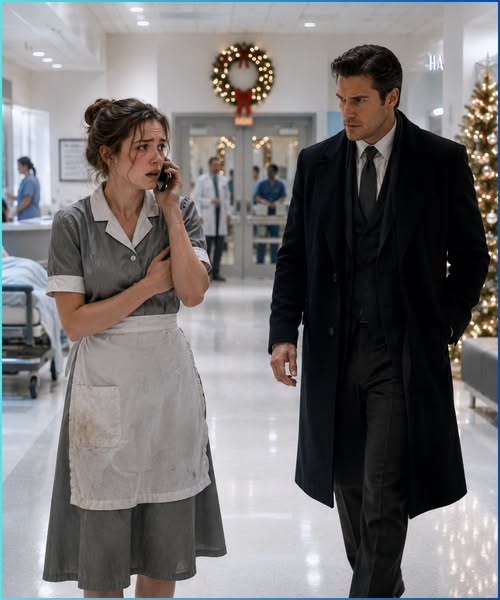
The morning after Marcus Wynn was taken in for questioning, Maeve woke before the light did. The harbour-side apartment was quiet in a way the mansion never was. No footsteps in the corridor, no kettle already on, no list of rooms waiting to be put right before anyone else was awake. Only the low sound of water against the quay outside, and the faint tick of a clock she had not set herself.
Her left wrist ached inside its splint, a dull, steady reminder rather than a sharp pain. She lay still for a moment and took stock of herself the way the nurse at St. Brendan's Hospital had taught her to do: head clear, no dizziness when she turned it slowly on the pillow, fingers moving, breath even. The mild concussion had left her tired more than anything else, tired in her bones, as if she had walked a long way in bad weather. But her thoughts were her own again, and that mattered more than rest. For days now, other people had been deciding what was safe to tell her, what she could be spared, what she ought not to be asked. Today, she decided, that would change.
Callum was already up. She found him in the small kitchen, standing by the window with a cup of coffee gone cold in his hand, looking out at the grey harbour water. He had not slept much; she could tell by the set of his shoulders and the careful way he moved, as if noise itself might break something.
"They will want your statement today," he said, without turning around. Then he caught himself. "That is, Detective Brennan said they would like to speak with you, when you are ready. Not before."
Maeve poured herself a glass of water with her good hand, slowly, because the splint made everything clumsy. "I am ready," she said. "I have been ready since the night I called you from St. Brendan's. Nobody has actually let me finish a sentence about it yet."
He turned then, and something in his face eased, though it did not soften into anything easy. "Then you will speak first, and I will not speak for you. That is a promise, Maeve. I have made enough decisions on other people's behalf."
It was the first time he had said her name quite like that, not as a summons from another room, but as an equal speaking to an equal. She nodded, and did not make a ceremony of it. There would be time enough for ceremonies later, if any were needed at all.
Detective Nora Brennan arrived just after nine, with a younger officer who introduced himself, took out a notebook, and then mostly listened. She was a plain-spoken woman in her forties, with no patience for theatre, and Maeve liked her at once for it. They sat at the apartment's table, and Brennan explained, clearly and without rushing, what would happen: a recorded statement, in Maeve's own words; a medical note from St. Brendan's to be attached to the file; and, separately, the evidence that had already been gathered, which Maeve would be shown and asked to confirm where she could.
"I want to be clear about one thing before we start," Brennan said. "You are a witness here, Miss Donnelly, not a suspect, and not a piece of evidence to be carried from room to room. If you need a break, say so. If something is not right in how I have written it down, correct me. The statement has to be yours, or it is no use to anyone."
Maeve glanced at Callum, who had taken a chair by the window, deliberately out of the way, his hands folded. He did not prompt her. He did not even look at her in a way that told her what to say. She took a breath, and began.
She told it in order, because order was the only thing that had kept her steady through the whole strange week. Christmas Eve, and the men who had come looking for something in Gabriel's room. The questions they had asked about the red book, asked as if she must know where it was, as if a housemaid would be told such things and then simply be expected to hand them over. The fear, yes, she did not hide the fear, but also what she had noticed even while she was afraid: that they had known the layout of the west hallway, that they had gone straight for Gabriel's room rather than wandering, that they had spoken of the book as if it still existed somewhere and could still hurt someone. She told Brennan about calling Callum from St. Brendan's, about the splinted wrist and the concussion, about the way the hospital light had seemed too bright and the nurse's voice too far away, and about the sealed envelope with the initials C.V. behind the stuck bottom drawer of the writing desk in Gabriel's room, the envelope she had found and kept safe because something in her had understood, even then, that it was not hers to open alone and not hers to throw away.
Then she told Brennan about the days after: the harbour-side apartment, the retrieval of the envelope with Callum beside her, Gabriel's letter, the torn page from the red book, the small brass key. She spoke carefully about the shorthand, because she did not want to claim more than she knew. She had deciphered it slowly, line by line, with the patience of someone used to reading other people's handwriting in household accounts and old letters. What she had found was a record of falsified shipments around the time of the Pier Nine fire, entries that did not match the cargo that had actually moved, and a sign-off that matched Marcus Wynn. And she had her own notebook, kept in her own hand, recording that Marcus had entered the west hallway on Thursday, a small fact that had seemed unimportant when she wrote it down and had become, in hindsight, the thread that pulled everything together.
Brennan listened without interrupting, and the young officer wrote steadily. When Maeve finished, Brennan read the statement back to her, section by section, and Maeve corrected two small things: the time she had arrived at the hospital, which she remembered more precisely now, and the exact wording of one question the attackers had asked. It was her statement, in the end, and she signed it with her right hand, slowly, her signature a little less neat than usual but unmistakably hers.
"Thank you," Brennan said. "Now, there is the medical side, and then I will tell you what we have, because you have a right to know where this stands."
At St. Brendan's that afternoon, a doctor Maeve had not seen before examined her wrist, checked the healing of the sprain, and reviewed the concussion notes from Christmas Eve. He wrote everything down plainly: splinted left wrist, sprain, no fracture; mild concussion, symptoms improving; follow-up in one week; no further treatment expected beyond rest and the splint. Maeve asked him to read the note aloud before he filed it, and he did, without making her feel difficult for asking. She had learned, in the last week, that asking to see the words written about you was not rudeness. It was the difference between being a patient and being a person.
On the way back to the apartment, Callum was quiet for a long time. Then, in the car, with the harbour coming back into view, he said, "Brennan told me this morning, before you woke, that Marcus is cooperating."
Maeve looked at him. "Cooperating how?"
"Off the record in detail, on the record in substance," Callum said. "He has admitted that he passed information about the house, and about Gabriel's room, to someone outside. He has named the person who paid him. Brennan will tell you the name herself when she comes back this evening, because she wants you to hear it from the police, not from me. But I wanted you to know the shape of it before then, so it is not a shock in a stranger's mouth."
Maeve nodded. She appreciated that, more than she could say at once. Shock had been the weather of the last week; a little warning was a kind of shelter.
Brennan came back at six, as promised, with a folder she did not open on the table, and a manner that was businesslike but not cold. She sat down, accepted the tea Maeve offered with her good hand, and said, "We have reopened the Pier Nine case. That is the formal position now. It is no longer closed as an accident, and it will not be closed again on anyone's say-so."
She laid it out plainly, as Maeve had asked her to do, and as Callum, to his credit, did not interrupt. Gabriel Vale's copy of the records, the torn page and the letter, together with the security logs and the CCTV from the house, had given the police a chain they could follow without relying on any one person's word. Marcus Wynn's cooperation had filled in the middle of that chain. And at the far end of it was a name: Victor Strand, an adult businessman who ran a shipping partnership that had worked with the Vale interests for years, a man Maeve had never met and whose name had meant nothing to her until that evening.
According to Marcus's account, corroborated by payment records the police had now obtained, Strand had paid Marcus to help destroy the red book. The book, Brennan explained, had contained the true record of certain shipments, the ones Gabriel had found falsified. If the true record survived, Strand's part in the falsification would survive with it. The fire at Pier Nine, five years ago, had been set to destroy records. That was the plain truth of it, stated without decoration, and Maeve felt it land in the room like something heavy put down on a table.
Gabriel had died in that fire while trying to retrieve the original book. He had gone back in, Brennan said, because he believed the book was the only proof that would hold, and because he would not let a lie stand in place of the men who had trusted the shipments to be honest. There was nothing graphic in how she said it, and nothing that asked Maeve or Callum to picture more than they needed to. The facts were enough. A young man had tried to save the truth, and the fire set to destroy it had taken him instead. The case that had been ruled accidental for five years had not been accidental at all.
Maeve sat very still. She thought of Gabriel's room, kept all these years at the end of the west hallway, dusted and aired by hands that had never known him, and of the sealed envelope behind a stuck drawer, waiting for someone patient enough to find it. She thought of the letter, and of how Gabriel had written as if he knew he might not be believed, and had hidden his proof anyway, in the one place a housemaid's careful housekeeping would eventually find it. It was not a comforting thought, exactly, but it was a true one: he had not been careless. He had been careful, and his care had outlasted the people who wanted him forgotten.
Callum had gone pale, and then very quiet, in the way Maeve had seen before when grief arrived not as a storm but as a weight settling. He did not stand up. He did not make a fist, or reach for his phone, or speak of Strand as a man to be dealt with. For a long moment he simply sat with his hands flat on the table, looking at nothing in particular, and Maeve understood that he was doing something harder than anger: he was letting the truth be what it was, without reshaping it into a story in which he could have saved his brother.
"I told myself for five years that I should have seen it," he said at last, his voice low and even. "That if I had been sharper, or harder, or closer to him, Gabriel would still be alive. I built a great deal on that guilt. I kept his room as it was because I could not bear to change it, and I kept people at a distance because I was afraid of losing anyone else in the same way. It was not protection. It was a way of not having to face that I could not undo it."
Brennan waited, with the patience of someone used to grief in interview rooms. Maeve reached across the table, not to comfort him in any grand way, but simply to put her good hand over his for a moment, and then draw it back, so that the gesture was hers to give and his to receive, and not a claim on either side.
"You did not set the fire, Callum," Maeve said. "And you did not pay Marcus. The men who did those things are the ones who answer for them now. Your guilt does not bring Gabriel back, and it does not make the case stronger. What makes it stronger is the truth, told plainly, by the people who know it. That is what we are doing."
He looked at her, and nodded, slowly. "No revenge," he said. "I have thought about it, Maeve, I will not pretend I have not. In the old way of doing things, Strand would never have reached a courtroom. But that way is what left Gabriel's death ruled an accident for five years, because everyone was too afraid, or too loyal, or too compromised to let the police do their work. I will not do that again. The case goes to prosecution. That is the only ending I will accept, and the only one Gabriel would have wanted, I think. He went back for a book of records, not for a weapon. He believed in proof."
Brennan closed her folder. "Then we are in agreement," she said. "Charges are being prepared against Victor Strand, and against Marcus Wynn for his part, on the evidence we have and on Marcus's own admissions. There will be formal interviews, and there will be a court process, and it will take time. Nobody will ask you to confront anyone, Miss Donnelly, and nobody will ask Mr. Vale to settle this privately. If anyone approaches you, either of you, about this case outside the police, you call me directly."
After Brennan left, the apartment felt different, not lighter exactly, but less crowded, as if a door that had been shut for five years had finally been opened and the air could move through the house again. Callum stood by the window for a while, looking out at the harbour lights coming on, one by one, across the water. Maeve joined him, keeping a careful distance with her splinted wrist tucked against her side, and they stood there without needing to fill the silence.
"I kept thinking," Callum said, "that if I found out what happened, the grief would stop. It has not stopped. But it has changed. It is not a question any more. It is a fact, and facts can be carried, even when they are heavy. Questions only circle."
Maeve thought about that, and about the statement she had signed that morning, and the medical note filed in her own name, and the notebook she had handed over, not surrendered, but offered, as evidence given by a person who understood its worth. She had not been a bystander in this story, swept along by other people's decisions. She had found the envelope. She had deciphered the shorthand. She had designed the test that caught Marcus, feeding him alone a false location for a supposed copy of the red book, and watching, with the logs and the cameras as witnesses, as he acted on it. She had spoken for herself today, and corrected the record where it was wrong. Whatever came next, she would not be written out of it as the invisible housemaid who happened to be in the wrong room.
"Gabriel's room," she said, after a while. "When this is over, it should not stay sealed in silence. He was a person, not a secret. We will find the right way to honour that, when the time comes."
Callum nodded. "We will. Together, and properly. Not in a hurry, and not in the dark."
Outside, the harbour water darkened, and the first stars came out over Boston, thin and clear in the cold air. Inside, the kettle boiled, and Maeve made tea with one good hand and one splinted wrist, and did not ask for help she did not need. The case was moving to prosecution. The truth, at last, was on the record. And for the first time since Christmas Eve, the future felt like something she might have a say in shaping, rather than something that happened to her while she was looking the other way.