Three weeks later, on a bright cold morning with the first edge of winter in it, they put a stone in the Caldwell family plot in Bergen County, in the row where the family buried its own.
It was not a large ceremony. Ethan did not believe in large ceremonies, and Maggie did not believe in ceremonies at all, but some things require witnesses, and so there were witnesses: Danny, and Mrs. Abernathy with her handkerchief, and six old men in dark coats who had read a letter at a dining table and come to pay a debt twenty-six years late, and Rosa, who had insisted on coming and who stood at Maggie's elbow the whole time like a small round bodyguard.
The stone was granite, the gray of winter water, and it said:
PATRICK DOYLE
1948–2000
HE STOOD BETWEEN US AND THE FIRE
Ethan had chosen the words. He had not consulted her, which she had minded, until she read them, at which point she had minded nothing about him at all for a full minute and a half.
"He chose them himself," Mrs. Abernathy whispered, as the old men filed past and each of them, in turn, put a hand flat on the stone in the old way. "Wouldn't have the stonecutter's suggestions. Stood over the man like a foreman."
Afterward, in the car, Ethan said, "The ninth of every month. The grave with no flowers." She looked at him. "Mine is two rows down from his — your father's. I never knew. I stood there eleven minutes a month for fifteen years, and he was two rows down, in the unmarked—" He stopped. Started again, with an effort she could hear. "There's a stone now. There will be flowers. I am not a man who— When you know better. That's what your father would say, I expect."
"He would say you're late," Maggie said. "And then he'd make you tea and forgive you before it cooled. It was his worst quality. I have it too."
"I know," Ethan said. "I'm counting on it."
She resigned on a Monday.
She wrote the letter properly, on paper, and left it on his desk in the study — the study with its new coffee table and its painting hung straight and its floor polished to a mirror by hands other than hers — and she stood at the window of the narrow room under the eaves packing her carpetbag for the second time in her life, with the rosary, and the photograph, and the black notebook, which she no longer needed to hide, which was the strangest part of all of it.
He knocked. Ethan Caldwell, knocking, at a door in his own house — she noted it the way her father had taught her to note everything, and filed it under signs that the room had changed.
"You're not leaving," he said, in the doorway, not as a command. That was new too. He was learning to make it a question, and it cost him visibly, and she honored the cost by answering it seriously.
"I am leaving the staff, Mr. Caldwell."
"Ethan."
"Ethan." She folded the last of her uniforms — she was keeping exactly one thing from the house, and it wasn't the uniform. "I came here to clear a name. It's cleared. I scrubbed your floors for fourteen months to get close enough to the truth to touch it, and I touched it, and a woman can't go back to being furniture in a house where she knows where all the bodies are buried. Literally, now. Including my father's, God rest him. So. I'm resigning."
"As my maid," Ethan said. "Yes. I accept." He stepped into the room, which no one had ever done, and held out his hand — not for a handshake. In it was a key, and a badge of the kind his security captains carried, and under them a contract, folded once. "Danny is a soldier, and he's loyal, and he cannot read a room the way you read my dining room. Nobody alive reads a room the way you do, because nobody else's father—" He stopped, and did the thing she had come to recognize as his truest tell: he set his jaw, and said the difficult part plainly. "Head of house security. Your terms, your staff, your budget. The house that nearly killed me twice in a week gets the woman who stopped it twice. Stay, Maggie. Not as staff. As the person I trust to watch the hands."
"That's the job my father died doing."
"Yes," Ethan said. "And nobody will ever tell your daughter he froze. Because there won't be lies left in this house for her to come back and dig up. I'll see to it personally. It's the only inheritance I intend to leave."
She looked at the key for a long moment. Then she took it, because her father — who had loved the Caldwells with his eyes open, who had known exactly what they were and stood between them and the fire anyway — her father would have laughed at her for refusing the post out of pride, and she had not crossed a state and fourteen months of laundry to become prouder than Patrick Doyle.
"My terms," she said. "The staff get real wages and real days off. Rosa gets a sous-chef; she's sixty-one and she's been doing the work of three people since the war — some war, I never asked which. The cameras on the garden wall get fixed before anything else, all of them, and I hold the work orders personally. And nobody — nobody — works in this house under a story somebody else wrote for them. If I hire them, I know their names. All their names. First and last."
"Done," Ethan said.
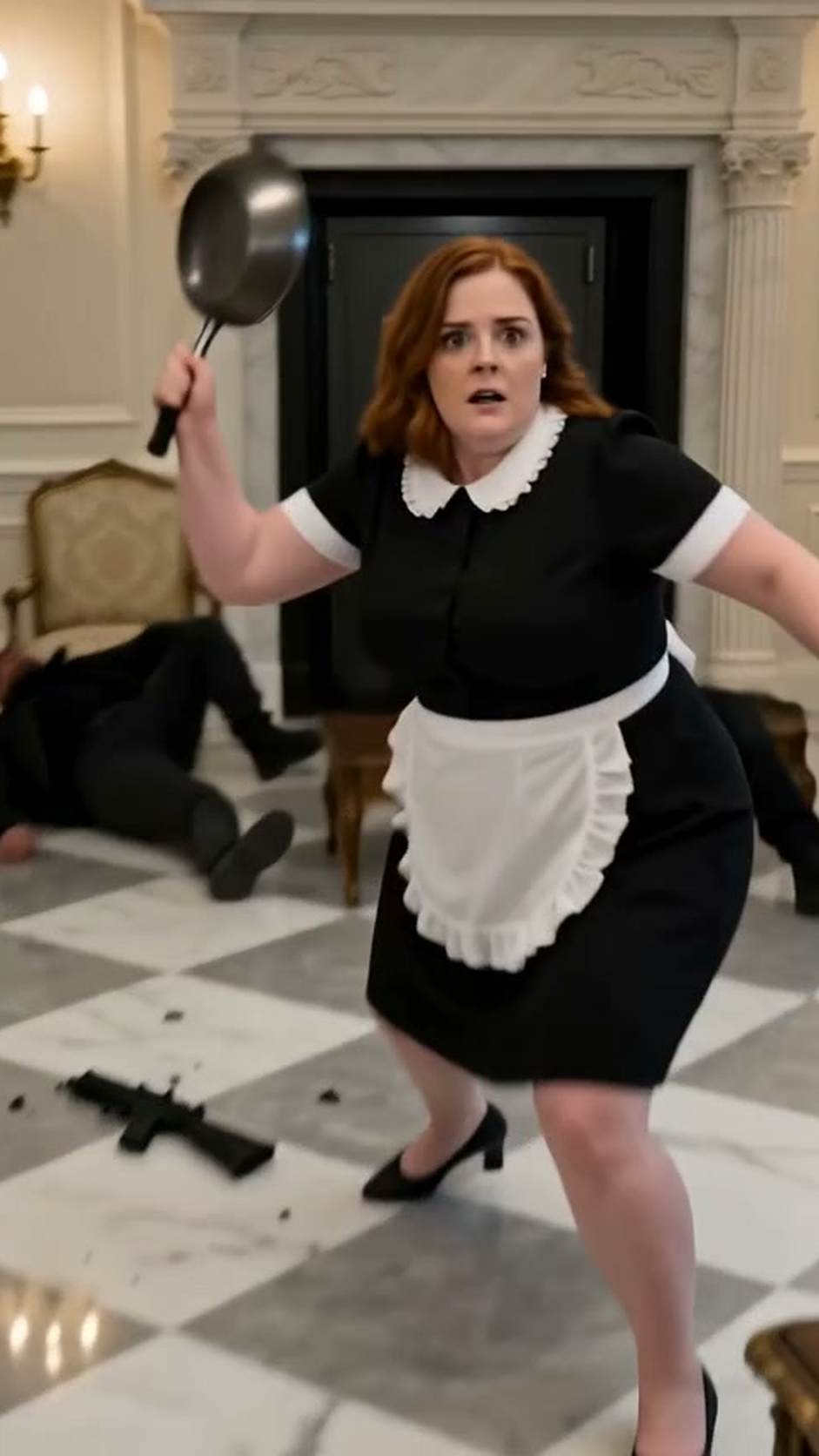
"And the skillet," Maggie said, "hangs in the kitchen. On the third hook. Where Rosa can see it. As a reminder to the house."
"Of what?"
"That the help," Maggie said, "is helping."
Her first morning in the new job, Maggie walked the garden wall with a clipboard, Danny at her shoulder, and signed off on six cameras one by one as the technicians brought them live — the boathouse corner last, its black rectangle blooming into gray dawn and rooftops on the monitor grid, and she stood in the security alcove where she had once dusted around a dead screen and watched all sixteen windows of the house's sight come open like eyes. "Now we see," Danny said. "Now we see," she agreed. "Hold the work orders personally. That was the deal. Nothing in this house goes dark again on a signature nobody can find."
And that night Ethan called her to the study — not summoned, called, there was a difference now and they both kept track of it — and the tin box stood open on the desk, and on top of the photograph and the folded letter lay the gloves.
Her father's driving gloves. Cracked brown leather, worn thin at the palms, with the stitching her mother had reinforced one winter in thread that didn't quite match, because the Doyle family had never in its life thrown away a thing that still worked.
"Henry kept them," Ethan said. "Then I kept them, without knowing why I was keeping them, the way you keep a word in a language you've forgotten you speak. They're not mine to keep anymore." He held them out with both hands, the way you hand someone a flag. "They never were."
Maggie took them, and held them against her chest, and stood in the middle of the room where she had once come over a desk in the dark to save everything it contained, and cried for the second time in Ethan Caldwell's study — but differently now, the way rain is different after the drought breaks, not a collapse but a season arriving.
"I used to think I'd feel finished," she said at last. "When his name was clean. I thought there'd be a — a click. Like a lock. There isn't, is there?"
"No," Ethan said. "There's just the house, still standing, and the people in it knowing the truth at breakfast. My father would say that's what finished actually looks like. It looks like Tuesday." He paused. "Stay for Tuesday, Maggie."
"I'm staying for all of them," she said. "It's in the contract. I wrote it in myself."
By December the house had changed in ways that visitors could feel without naming. The staff ate in the dining room on Sundays when the family was away. The security office had a second chair in it, and a woman in it, and the wall of monitors had a new camera over the garden wall that someone checked with religious regularity. The Compass Ledger still lay in the safe behind the painting — Ethan had offered it to her once, to burn, as a gift, and she had refused it, because a book of debts is also a book of names, and some of the names in it were men who had put their hands on her father's stone. It stayed. But above the safe, inside the study, in a plain black frame where only Ethan ever looked, hung a photocopy of a photograph: a laughing man, an Irishman, and a boy standing very straight beside greatness.
And on the first Sunday of December, there was a dinner — a small one, four covers, no captains, no business — and Maggie Doyle sat at the table, at Ethan Caldwell's right hand, in a dress that was not black and white, and Danny carved, and Rosa ate her own cooking at a table for once and pronounced it adequate, and at some point in the evening Ethan reached across the space between their chairs and covered Maggie's hand with his own, tattoos and all, in full view of the chandeliers, like a man signing his name to something.
"You're staring," she said.
"I'm noticing," Ethan said. "It's a new discipline. I'm told it takes practice."
"Fourteen months of practice you skipped."
"Then I'll have to make up the time." He turned her hand over in his, gently, and looked at it — a working hand, a fighting hand, the hand that had come over his desk in the dark and rearranged his life. "Stay down, you told me. In the dining room. Do you remember?"
"I remember."
"I've been thinking about it. I believe that's the moment." He said it with the air of a man reporting a fact he had verified from several sources. "Not the study. The study I could explain — training, instinct, your father. But the dining room, Maggie. You crossed a room full of armed men, in a maid's uniform, with a bandage on your arm, and you put your hand on the master of the house and pulled him out of the path of a bullet, and the master of the house—" the ghost of something almost like a smile crossed the most feared face in New Jersey, "—let you. Do you know what that means, in my world?"
"That you have excellent reflexes?"
"It means I trust you with my life in front of witnesses," Ethan said. "In my world there is no other ceremony. Everything else is paperwork." He lifted her hand, and pressed his mouth to the knuckles, once, with great formality, like a man sealing a treaty. "The paperwork can be arranged whenever you like. There's no hurry. I've learned patience from a woman who waited fourteen months to be seen."
"Careful, Mr. Caldwell," Maggie said, and her eyes were bright, and her hand stayed exactly where it was. "A girl could get ideas."
"Ethan," he said. "And God help me, I hope she does."
The next morning he made her breakfast, because he had announced at dinner — recklessly, in wine — that the master of the house was capable of feeding himself and any woman in it, and Maggie, who had made ten thousand breakfasts in that kitchen, sat at the counter in her new authority and watched the ruthless crime boss of New Jersey burn the toast, set off the smoke alarm, and swear at a frying pan in terms that would have ended negotiations.
She reached past him, without standing up, and took the skillet down from the third hook, and put it in his hand.
"Use this," she said. "Apparently it solves everything."
"It was closer," Ethan said, and Maggie Doyle laughed — in her own kitchen, in her own house, in the full light of morning, seen, named, and home.
THE END